Does your pet sitting questionnaire tell a sitter what “normal” looks like, or does it only record a name, feeding time, and phone number? A useful form should help owners explain routines, help sitters judge compatibility, and give both sides a dependable record before care begins. It should also adapt to the difference between a healthy indoor cat, a reactive dog, a bird with enclosure requirements, and a pet whose medication or emergency plan needs careful demonstration.
The most practical approach is to use seven modular templates across the full sitting journey. Combine required questions, optional details, conditional fields, and short confirmation checklists instead of forcing every owner and sitter through one oversized form. The sequence fits Global Pet Sitter's simple flow, create a profile, find a match, connect and care, while preserving room for transparent conversations before a sit is confirmed.
1. Initial Pet Care Questionnaire
The first form should make a pet understandable before direct messaging begins. Start with one record for each animal, not one shared text box for the household. Ask for the pet's name, species, breed or type, age, identifying markings, photo, feeding routine, water arrangements, exercise needs, sleep habits, toilet or litter routine, and any regular medication.
Use plain language. “What does your pet usually eat, and when?” is easier to answer than “Describe dietary management.” If an owner selects “medication,” reveal fields for the medicine name, dose, timing, route, storage, and administration method. If they select “bird,” “reptile,” “fish,” or “livestock,” reveal habitat, temperature, lighting, enclosure, feeding, and security prompts instead of assuming the care resembles a dog visit.
The range of professional care supports this species-specific approach. Pet Sitters International reported that its members cared for cats, dogs, small animals, birds, freshwater fish, reptiles and amphibians, saltwater fish, livestock, horses, and exotic pets. Its data also distinguished a basic care visit, dog walking, and overnight sitting, which shows why the form should ask about both animal type and service type. The organization's industry statistics provide useful context for building those fields.
Practical rule: Keep the first screen quick, then use conditional logic to ask for detail only when the pet or service requires it.
Let owners add optional notes in their own words. A short description such as “hides behind the sofa when visitors arrive” can reveal more than a binary temperament field. Make profiles editable, display relevant answers in sitter search results, and point owners to this sitter information sheet when they need a more detailed handover record. An owner might also choose to include dietary supplements, such as Joyfull's gut boosters, among the supplies the sitter should know about.
2. Sitter Experience and Qualifications Questionnaire
A sitter profile should answer a practical question for the owner: Can this person handle my animal, my service, and my home responsibly? Ask about species experience, service types, availability, travel capacity, medication skills, overnight expectations, home sitting experience, backup arrangements, and the kinds of behavior the sitter is comfortable managing.
Keep experience claims specific. “I love animals” doesn't tell an owner whether the sitter has handled a shy cat, administered liquid medicine, managed a bird enclosure, or cared for several animals during an overnight stay. A stronger answer names the situation, the sitter's role, and the limits of their confidence. Ask sitters to identify tasks they can perform independently, tasks requiring owner instruction, and tasks they won't accept.
Credentials need context rather than decoration. Let sitters upload first-aid or other certification documents for review, list the issuing organization and expiry information, and distinguish verified credentials from self-reported experience. The platform can show clear badges, but it shouldn't imply that a badge replaces a conversation or a meet-and-greet. Owners should still compare the sitter's background with the pet's actual needs.
Make reputation portable without making it vague
Experienced sitters moving from another platform may have useful reviews that don't yet exist in a new community. A transparent import process can allow screenshots or other supporting evidence, while labeling imported feedback clearly rather than presenting it as a review created on Global Pet Sitter. The same principle applies to references, travel experience, and specialist skills. Background check requirements can help owners understand what verification may involve, but the questionnaire should state exactly what the platform has checked.
Ask sitters to confirm their profile periodically, especially after changes in location, services, availability, or credentials. A digital nomad may be a strong fit for a long house sit in one region and unavailable for a short visit elsewhere. Owners need that information before they invest time in an application.
3. Behavioral Characteristics and Special Needs Questionnaire
Behavioral information works best when it describes triggers, signals, and successful responses. Don't ask only whether a pet is “friendly.” Ask how the pet reacts to visitors, children, other animals, noise, handling, separation, transport, food changes, and unfamiliar environments. Include energy, confidence, sensitivity, and recovery prompts, followed by an open field where the owner can describe the animal in everyday language.
A dog that barks at the door may settle quickly after a sitter enters. Another may hide, guard resources, or attempt to escape. A cat may tolerate touch but panic when a carrier appears. Those differences affect matching, arrival procedures, walking plans, and the time a sitter should allow for trust to develop.
Use a combination of selectable descriptions and comments. A scale can help owners communicate energy or confidence, but it shouldn't pretend to measure behavior precisely. Ask for observable examples instead:
- Common triggers: Record sounds, people, animals, objects, or situations that cause fear, excitement, avoidance, or defensive behavior.
- Early warning signs: Note body language, vocalization, hiding, pacing, freezing, staring, or changes in appetite.
- What helps: Describe distance, treats, toys, quiet spaces, familiar cues, or handling methods that have worked.
- What to avoid: State whether chasing, forced contact, unfamiliar equipment, or particular forms of restraint make the situation worse.
Turn owner knowledge into sitter confidence
Include a short sitter response after the meet-and-greet: what did the sitter observe, what questions remain, and which handling tasks need practice? Owners can also rate their confidence in the sitter's ability to manage specific behaviors. That creates a useful conversation without turning the form into a pass or fail test.
A behavioral answer should tell the sitter what to notice and what to do next, not label the pet as “good” or “difficult.”
For first-time sits, attach a short video or arrange a live demonstration when appropriate. A scenario prompt such as “Your pet refuses to come inside after a walk” is more useful than a broad question about obedience. The completed record should preserve the pet's individuality while making boundaries clear.
4. Pet Emergency and Medical Protocol Questionnaire
Medical instructions need to close the communication loop. A field that says “give medication as directed” leaves too much room for misunderstanding. Ask for the medicine name, exact dose, route, schedule, start and end dates, storage requirements, acceptable administration methods, missed-dose instructions, refusal behavior, and the owner's escalation preference.
Written instructions alone don't ensure successful administration. A prospective study of 66 cat owners found medication noncompliance in 39% of cases, and 25% reported difficulties administering treatment, with resistance from the cat the most common challenge. Those figures come from the veterinary medication study, and they support a practical design change: ask not only what the pet is prescribed, but how the pet accepts care.
Include a medication log with timestamps, route, administrator, and exception notes. For complex treatment, ask the owner to demonstrate the process and have the sitter perform a supervised return demonstration. Add a required confirmation box, or ask the sitter to restate the plan in their own words. This gives the owner a chance to correct an error before the handover.
Separate preference from authority
The emergency section should record the regular veterinarian, emergency clinic, insurance or payment arrangement, backup contact, transport permission, and treatment authorization. Ask what the sitter may approve if the owner can't be reached, who can make decisions, and where the pet's records are stored. Include an identification photo for each animal and a downloadable one-page emergency card for quick reference.
The owner's signed authorization should match the sitter's actual authority. This emergency authorization form guidance can support the handover, but the questionnaire should still capture the specific instructions for that pet and sit. Include a short scenario tree for injury, sudden illness, missing pet, evacuation, and inability to contact the owner.
5. Home and Security Access Questionnaire
A sitter can follow an excellent care plan and still encounter preventable problems at the front door. The home access form should document keys, lockboxes, temporary codes, alarm procedures, entry and exit routines, parking, neighbors with access, Wi-Fi needs, cameras, restricted rooms, household hazards, waste disposal, and essential utilities.
Write access instructions as a sequence that someone unfamiliar with the property can follow. “Use the side door” may be insufficient if the side gate sticks, the alarm activates immediately, or the key must be turned in a particular direction. Owners can add photos or a short video for complicated locks and security systems, but sensitive information should be stored securely and shared only with the relevant sitter.
Confirm boundaries as carefully as entry
The form should ask where the sitter may go, which appliances or rooms are off limits, whether guests are permitted, and what household tasks are expected. Include mail, plants, bins, heating or cooling, and visible signs of a problem. These details aren't cosmetic. A sitter needs to know whether a closed door protects a nervous animal, a hazard, or private property.
Use temporary, time-limited credentials where possible. Ask the sitter to confirm that they received and understood the instructions, then require a second confirmation after the first entry if the system behaves differently than expected. For international sits, add translation support and local terminology for locks, alarms, utilities, and emergency access.
Security principle: Don't place an address beside an unprotected key code, and don't treat a house manual as permission to enter areas the owner hasn't approved.
A simple checklist can prevent omissions, while a separate emergency access section makes urgent entry rules visible. Keep this questionnaire distinct from the pet profile so owners can update a code or access person without rewriting the animal's care information.
6. Sit Details and Scheduling Logistics Questionnaire
The sit-specific form turns a promising match into a clear agreement. Begin with dates, location, service type, arrival and departure windows, required presence, visit frequency, overnight expectations, pet-related tasks, communication preferences, and any household responsibilities. Then separate essential requirements from preferences that can be discussed.
Parallel sections work well:
- Sitter will commit to: State arrival windows, care tasks, updates, medication logs, home routines, and escalation steps.
- Owner will provide: List food, medication, equipment, access, accurate records, emergency contacts, and a reachable communication channel.
- Both sides will confirm: Record handover timing, changes, cancellation arrangements, backup coverage, and what happens if travel plans shift.
Progressive disclosure keeps a straightforward cat sit from feeling like a contract dossier. A complex international stay can reveal additional questions about language, transport, currency, local veterinary care, climate risks, and time-zone communication. The system should also flag schedule conflicts before an owner accepts an application, rather than leaving the problem for the handover.
Make the final summary easy to inspect
Before confirmation, generate a concise summary that both parties can review and sign digitally. Show the exact service expectations and any agreed payment or non-payment arrangement clearly. Global Pet Sitter's community-driven model places emphasis on transparent communication and honest pricing, so the questionnaire should make assumptions visible rather than burying them in messages.
Add prompts that encourage clarification: “What does a normal update look like for you?” “What should happen if the sitter is delayed?” “Who takes over if the owner can't return?” A sit that looks simple in a listing can become complicated when a pet refuses food, a flight changes, or a lock fails. Clear answers protect the relationship before pressure arrives.
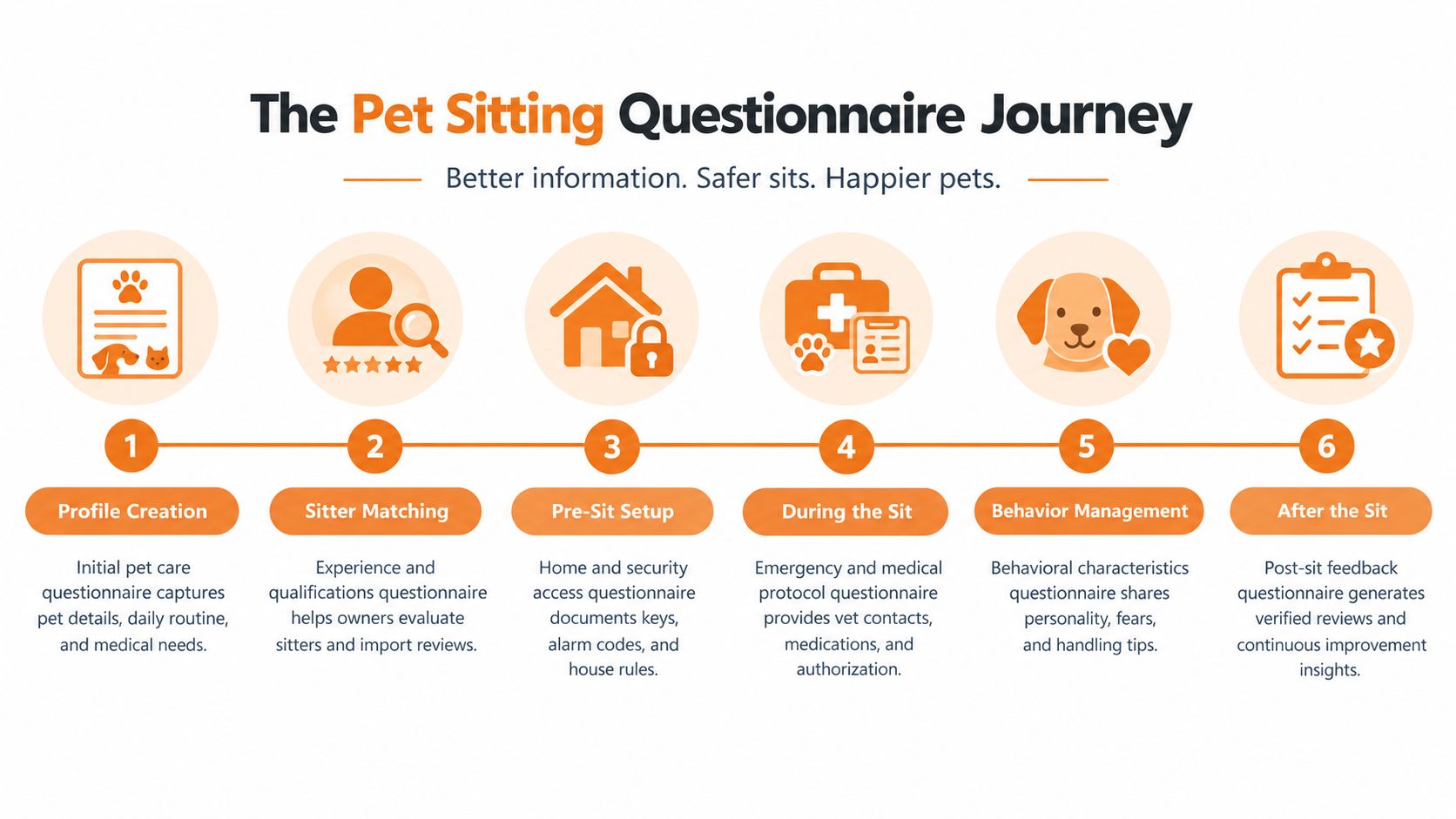
7. Post-Sit Feedback and Continuous Improvement Questionnaire
The final questionnaire should improve the next sit, not merely produce a star rating. Send separate forms to the owner and sitter after care ends, with a short set of shared questions and a few role-specific prompts. Ask whether the care plan was accurate, whether instructions were understandable, whether communication matched expectations, what went well, and what should change before another booking.
Owners can comment on pet wellbeing, home care, reliability, and response to unexpected events. Sitters can report whether the schedule was realistic, supplies were available, access instructions worked, and the pet's profile matched observed behavior. Both perspectives matter. An owner may feel reassured by frequent updates, while the sitter may have found the requested schedule difficult to sustain.
Keep reviews specific and evidence-based. Invite photos or videos where appropriate, but don't pressure either party to disclose private information. A moderation process should remove abusive or irrelevant content while preserving fair criticism. Public feedback builds trust only when members can understand what the reviewer experienced.
Turn feedback into profile improvements
Use recurring feedback to prompt updates to the original questionnaire. If a sitter repeatedly reports that food measurements were unclear, add a required quantity or measuring-tool field. If owners discover that emergency transport permissions were missing, make that section more visible before confirmation. The platform should also explain when member feedback leads to a change, so community participation has a visible result.
Imported reviews can help experienced sitters carry their reputation into a new marketplace, but imported material should remain clearly identified as imported. Verified on-platform reviews, completed sits, qualifications, and owner comments should each have their own meaning.
Ask a final practical question: “What should the next sitter know?” That answer often captures the small detail that prevents friction, such as a carrier location, a preferred update style, or a pet's new stress signal.
7-Part Pet Sitting Questionnaire Comparison
| Questionnaire | Implementation complexity | Resource requirements | Expected outcomes | Ideal use cases | Key advantages |
|---|---|---|---|---|---|
| Initial Pet Care Questionnaire | Medium, standard form with conditional fields | Moderate, profile fields, owner input, storage | Comprehensive pet basics for faster matching and fewer basic questions | Profile onboarding; new listings; repeat-care continuity | Reduces miscommunication; creates consistent records; speeds matching |
| Sitter Experience & Qualifications Questionnaire | Medium–High, verification and review-import flows | High, document upload, verification processes, badge system | Transparent sitter credibility and searchable qualifications | Highlighting experienced sitters; nomadic/travel sits; trust-building | Differentiates experienced sitters; supports review import; builds trust |
| Behavioral Characteristics & Special Needs Questionnaire | High, detailed scales, open responses, optional media | High, complex fields, training resources, storage | Reduced behavioral surprises; safer, more personalized care | First-time sits; special-needs or reactive pets; trainer handoffs | Enables tailored care; reduces sitter stress; improves safety |
| Pet Emergency & Medical Protocol Questionnaire | High, sensitive data handling and legal consent capture | High, secure storage, vet contacts, authorization workflows | Clear emergency actions, empowered sitters, reduced liability | Pets with chronic conditions; international sits; senior pets | Protects pet health; clarifies decision authority; increases sitter confidence |
| Home & Security Access Questionnaire | Medium, secure fields, multimedia instructions | Medium, encrypted storage, photos/videos, temporary credentials | Fewer access issues, preserved privacy, safer property management | House-sitting; complex security systems; international homes | Prevents security breaches; reduces sitter anxiety; documents access |
| Sit Details & Scheduling Logistics Questionnaire | Medium, calendar, payment, and agreement integration | Medium, scheduling tools, payment handling, e-signature | Aligned expectations, fewer disputes, transparent pricing | Booking confirmation; detailed sits; pricing transparency | Functions as an agreement; clarifies scope and deliverables |
| Post-Sit Feedback & Continuous Improvement Questionnaire | Low–Medium, rating system and moderation tools | Medium, moderation, review import, public profile display | Verified reviews, actionable feedback, stronger platform trust | After sit completion; quality assurance; sitter recognition | Builds credibility; drives improvement; supports community governance |
Turn the Best Questions Into a Reusable System
A strong pet sitting questionnaire isn't one long document. It's a living care record assembled at the right moments. Start with the initial pet profile so owners can explain species, routine, feeding, bathroom habits, behavior, medication, and emergency contacts before sitters apply. Add the behavioral and medical modules only when the answers indicate that more detail is needed, but don't hide critical safety questions behind an overly aggressive attempt to keep forms short.
Use the home access and scheduling templates before anyone commits. Confirm how the sitter enters, what areas are private, which tasks are included, how updates work, and what happens if plans change. A written summary gives both sides something concrete to review, while a meet-and-greet or video walkthrough tests whether the instructions make sense in practice.
Progressive disclosure keeps a simple sit usable. A healthy indoor cat with a familiar routine shouldn't require the same experience as a pet with multiple medications, specialized equipment, or a habitat that needs daily monitoring. At the same time, international sits deserve extra attention to clinic access, language, transport, local hazards, payment arrangements, and emergency authority. The form should become more detailed because the care requires it, not because every user receives the same administrative burden.
Keep answers current. Owners should update the record when a pet's diet, medication, behavior, access code, veterinarian, or emergency contact changes. Sitters should confirm that their services, availability, qualifications, and location remain accurate. Critical instructions deserve direct confirmation, especially medication administration, escape risks, transport permission, and treatment authority.
The completed questionnaire supports conversation, but it doesn't replace it. A sitter should be able to ask follow-up questions, demonstrate a task, and say when a request falls outside their skills. An owner should be able to correct assumptions before handing over keys. That combination of structured information and human judgment is more reliable than either one alone.
This modular approach fits Global Pet Sitter's focus on transparency, verified trust, honest pricing, and clear communication. It also gives the community useful feedback about which questions prevent confusion and which fields create unnecessary friction. The best system is one that helps the right people recognize each other, prepares them for ordinary care and unusual events, and leaves a clear record when the sit is complete.
Global Pet Sitter lets owners post sits with pet details, connect with potential sitters, and discuss care expectations before committing. Build a clearer profile, bring your experience and reviews into the conversation, and visit Global Pet Sitter to find a transparent way to plan your next sit.
Log in om een reactie achter te laten
