Paid overnight care often reaches triple digits in recent North American surveys, while a stay-exchange model can run on a flat annual membership such as Global Pet Sitter's €100 long-term target. Treat either option as a scope of care: hours present, duties covered, and the midday gap.
Before you pack, map your pet's day. An evening arrival and morning departure fits some cats and older dogs. A puppy, anxious rescue, or pet needing medication may need continuous presence. Ask what the quoted night really buys.
Typical Pet Sitting Rates per Night
The most useful starting benchmark comes from the 2026 survey of nearly 4,000 active Pet Sitters International members, reported by GlobalPETS: average overnight rates were $110.43 in the United States and CA$113 in Canada, and 62% of members offering overnight services said a midday visit wasn't included. The survey's service-level benchmarks appear below.
That last detail changes your travel budget. If your dog needs a lunchtime toilet break, an overnight booking alone may leave a gap. Ask about that gap before deciding whether a sitter is affordable.
Overnight pet sitting benchmarks for 2026
The survey rows distinguish short visits, overnight stays, and live-in care. The final row is a separate marketplace snapshot: Thumbtack's overnight dog-sitting price guide reported a U.S. national average of $75–$85 in 2025, based on listed example providers.
| Service | Place | Typical rate | What the figure usually means |
|---|---|---|---|
| Drop-in visit, 15 minutes to 1 hour | United States | $20.64–$46.26 | Feeding or a short walk, not an overnight stay |
| Overnight pet sitting | United States | $110.43 | Evening and morning care; a midday visit is often extra |
| Live-in or 24-hour care | United States | $167.62 | A live-in care tier above a standard night; confirm permitted absences |
| Drop-in visit, 15 minutes to 1 hour | Canada | CA$20.73–CA$47.66 | Short visit, not overnight care |
| Overnight pet sitting | Canada | CA$113 | Overnight presence in the home |
| Live-in or 24-hour care | Canada | CA$217.67 | The highest care tier in the survey; confirm supervision terms |
| Listed overnight dog sitting, 2025 | United States | $75–$85 | Thumbtack examples of advertised overnight dog sitting |
These are benchmarks, not interchangeable offers. A professional-member survey and a collection of advertised provider prices describe different groups. You can use them to orient your budget, but neither tells you what a particular sitter will charge for your household.
The currency matters, too. Canadian-dollar prices aren't U.S.-dollar quotes, and a national average doesn't account for your address, dates, or pet's routine.
Start with your pet's daytime needs
Write down the feeding, walking, and medication tasks that fall between the sitter's morning departure and evening return. Then ask whether the quoted booking covers them, requires another visit, or leaves you responsible for arranging someone else.
Don't assume a live-in label guarantees uninterrupted supervision either. Ask whether the sitter can leave for errands or other work, and agree on acceptable absences.
Practical rule: A complete care schedule is more useful than a cheap night with an unexplained daytime gap.
If you're coordinating childcare as well as pet care, Bornbir's guide to how much overnight nannies charge is a useful separate budgeting resource. Keep those quotes separate, but ask the same practical question about each: what work and what hours are you buying?
For pet care, send your routine before requesting a final total. That lets the sitter price the booking you need rather than an ordinary night that doesn't fit your trip.
What a Night of Care Actually Covers
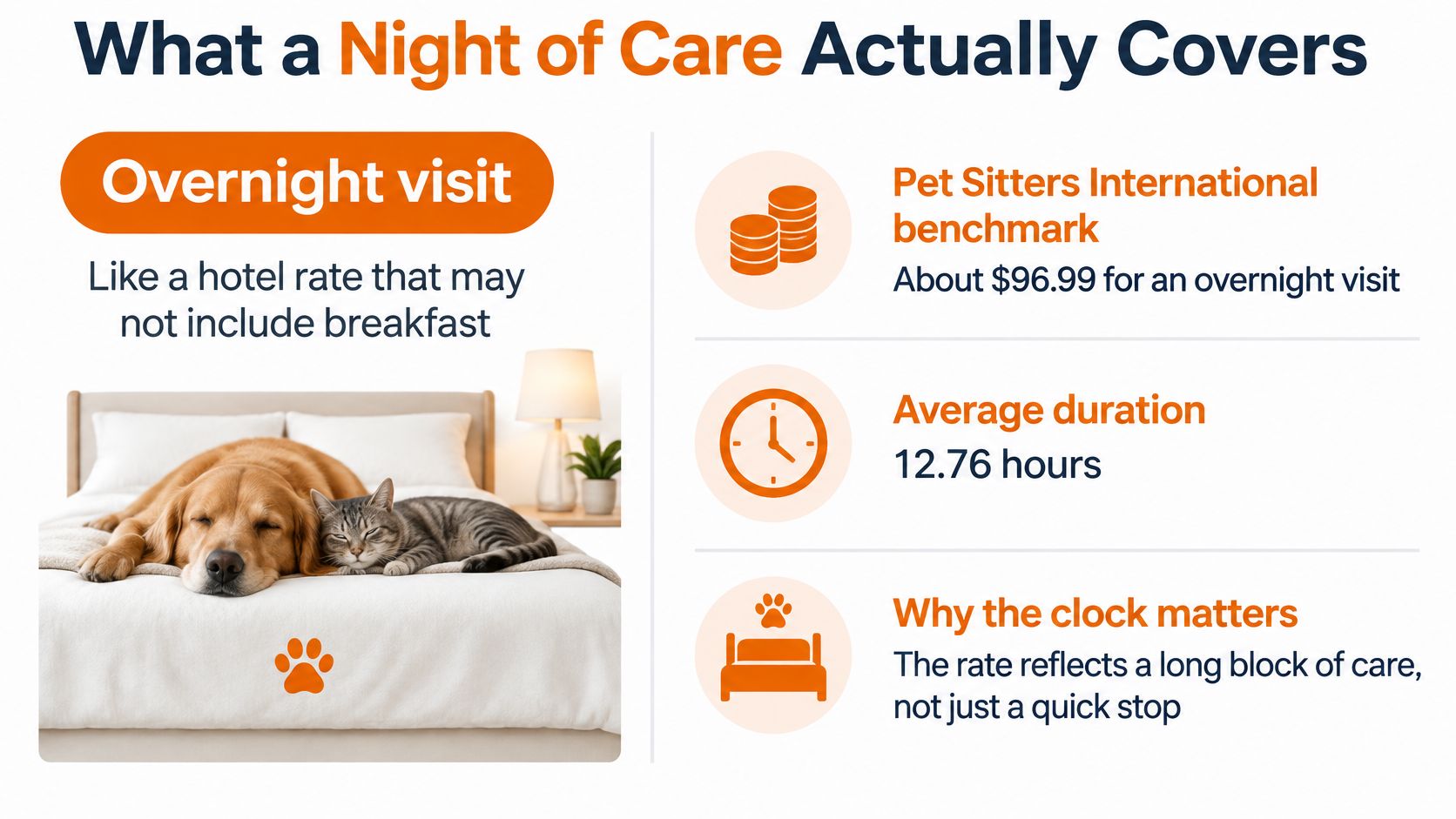
Think of an overnight rate like a hotel rate that may not include breakfast. The main service is clear, but the extras can change whether the booking works for you.
The clock gives you a better comparison than the word overnight. Pet Sitters International's 2024 State of the Industry Survey provides a U.S. benchmark of approximately $96.99 per overnight visit averaging 12.76 hours, with a separate benchmark of $104.96 for an overnight service averaging 14.3 hours.
This visual highlights the connection between the price and the coverage window.
Compare the service unit
A sitter sleeping at your home is offering something different from a visitor who comes for dinner and returns for breakfast. Both arrangements can provide useful care, but you shouldn't accept one while expecting the other.
| Service unit | Where care happens | Coverage to establish | Main distinction |
|---|---|---|---|
| Drop-in | Your home | A scheduled visit | The sitter leaves after completing the agreed tasks |
| Overnight stay | Your home | Evening arrival through morning departure | The sitter sleeps in the home |
| Boarding | The sitter's home | Drop-off through collection, with supervision terms | Your pet stays away from home |
| Live-in care | Your home | Daytime and overnight presence, including permitted absences | A broader commitment than a sleeping shift |
A consumer guide from Zarla illustrates the spread in service labels, with U.S. estimates of about $45–$75 for overnight care and $75–$150 for professional overnight sitting. Those labels still need a written description before you can judge value.
Define the actual duties
For a true overnight stay, establish who handles the evening meal, final toilet break, sleeping arrangements, morning food, and morning walk. Agree on updates and a way to reach you if the pet refuses food, becomes distressed, or seems unwell.
Then separate duties that need their own discussion:
- Medication: Name the medicine, method, timing, and required handling experience.
- Puppy supervision: Describe toilet training, overnight waking, chewing, and confinement routines.
- Household tasks: List plants, bins, mail, and cleaning rather than treating them as unlimited extras.
- Emergency arrangements: Leave veterinary contacts, transport instructions, and authorization for care.
This accompanying video provides another resource to consider alongside your written care plan.
Before judging a low quote, ask exactly when the sitter arrives, when they leave, and whether they sleep at the property. Those answers establish what you're being offered.
Factors That Change the Nightly Rate
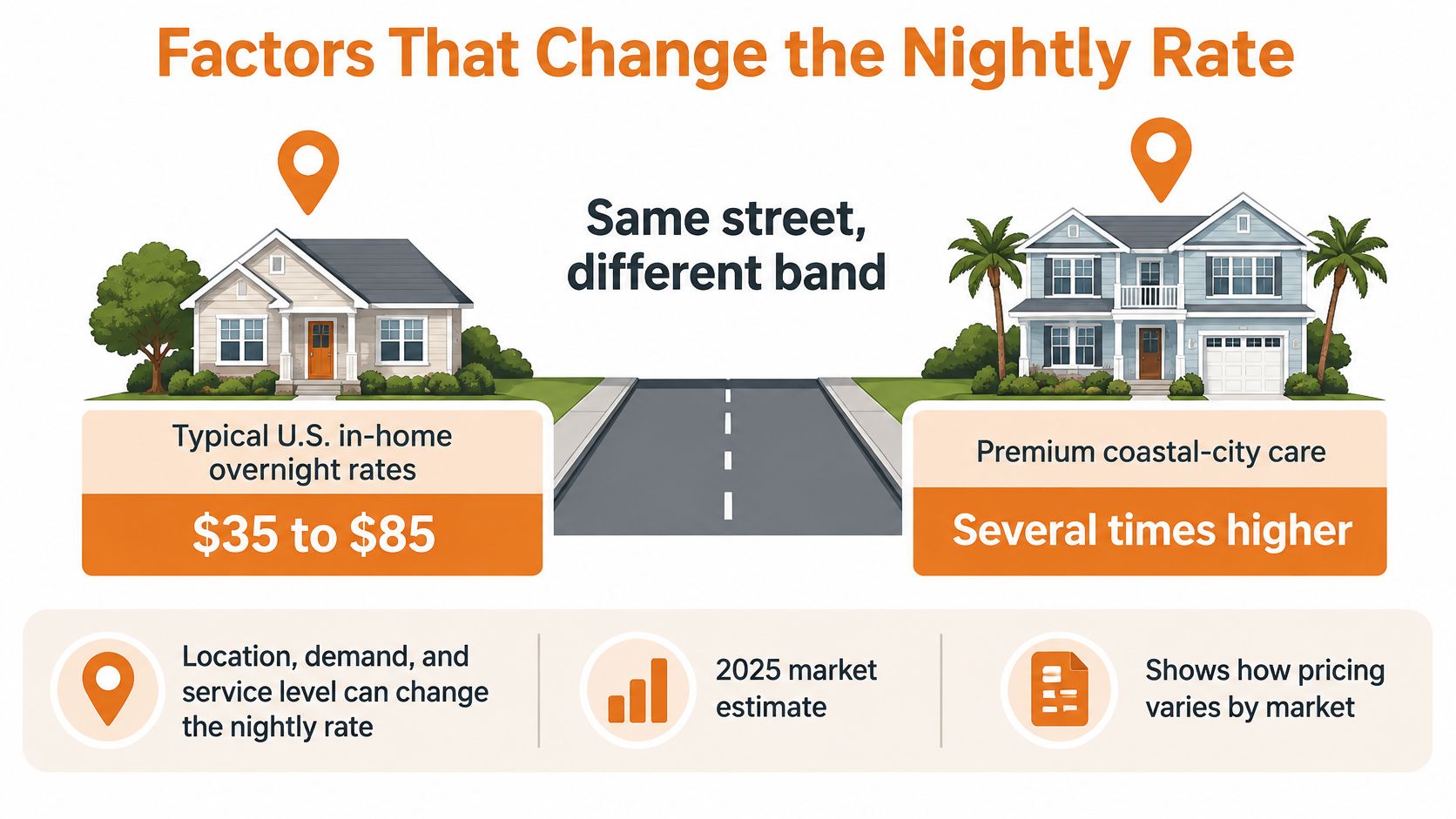
Two homes on the same street can require very different work. A settled adult dog with a familiar walking route isn't the same booking as a puppy, a reactive dog, or animals needing separate feeding and medication.
A 2025 market estimate from Dataintelo placed typical U.S. in-home overnight rates at $35–$85 per night, with premium coastal metropolitan providers charging as much as $120 for households with multiple pets or special-care requirements. That's a market estimate, not a promise that a suitable professional will be available within the lower band.
The visual below summarizes the main categories to consider when reading a quote.
What moves a nightly pet sitting price
| Factor | Usual effect | How to read it |
|---|---|---|
| Local cost of living | Shifts the whole price band | Compare sitters serving the same area |
| Sitter experience | Can move a quote upward | Look for experience relevant to your pet's needs |
| Number of pets | May add a fee beyond the included animals | Check the base rate's pet limit |
| Pet type and age | Changes handling and supervision time | Energy, mobility, and routine matter more than species alone |
| Medication or medical monitoring | May require a defined premium | Describe doses and monitoring tasks before accepting |
| Holiday demand | Can trigger peak-date pricing | Ask which dates attract the premium |
| Hours in the home | Changes the service being purchased | Sleeping overnight and remaining throughout the day aren't equivalent |
Pay for the work your household needs
Experience is useful when it matches the assignment. A sitter comfortable with a confident adult dog may not have the handling skills for a fearful dog who guards food. Ask how they would manage your pet's actual routine, not just how long they've worked with animals.
Cats don't automatically mean an easy booking. Separate meals, hidden medication, litter problems, or animals who must remain apart can require careful work. Give the sitter enough detail to price those tasks fairly.
Holiday pricing reflects availability as well as effort. A sitter reserving your dates can't also accept another household for the same commitment. Ask which nights carry the premium and whether it applies to associated visits.
Travel logistics belong in their own budget. If you're deciding whether to take your pet rather than leave them at home, Precious Pets Transport Services, LLC's guide to planning a budget-friendly door-to-door pet move can help you identify a separate set of transport costs.
The published price figures here concern North American markets. Elsewhere, collect local quotes instead of converting these amounts and treating them as local expectations. A listing needs hours, pet limits, holiday terms, and special-care charges before you can compare it fairly with another sitter.
How to Compare and Negotiate a Nightly Rate
Say you're booking care for an adult dog who needs no medication. The sitter will sleep at home, complete the evening and morning routines, and leave during your dog's usual comfortable alone time.
Now change the booking. Add another pet, a lunchtime visit, and holiday dates. The final total should explain how those changes are handled, even if the sitter chooses to include an extra rather than charge separately.
Use this checklist to keep the conversation focused on the booking rather than the headline price.
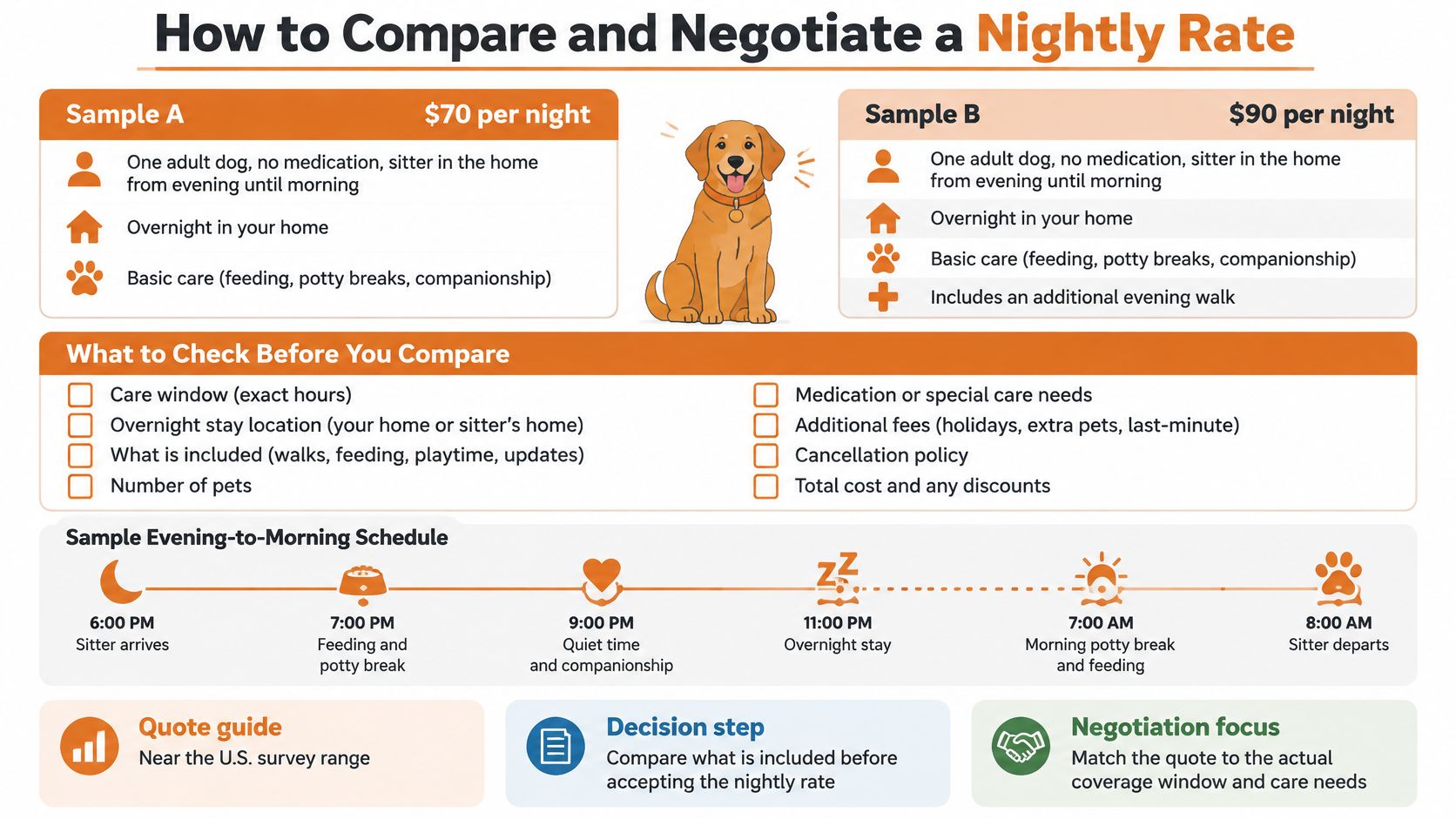
Sample booking quotes compared line by line
The figures below are illustrative quote structures, not additional market averages. The base-night examples use a working band within the broader consumer estimates, while the lunchtime benchmark represents short-visit pricing.
| Booking line | Charge type | Typical figure | What to check |
|---|---|---|---|
| Sample A base night, one adult dog, evening to morning | Base night | $50 to $100 illustrative band | Coherent only if no midday care is needed |
| Sample B base night, same window | Base night | $50 to $100 illustrative band | Compare the same hours and base duties |
| Sample B second pet | Extra-pet fee | Sitter's stated additional-pet charge | Must be a separate line or explicitly included |
| Sample B lunchtime visit | Drop-in | $20.64 to $46.26 survey benchmark | Confirm the required visit length |
| Sample B holiday weekend | Holiday premium | Sitter's stated peak-date surcharge | Flagged before booking |
If both bookings cost the same, don't immediately assume something's wrong. The sitter might include multiple pets or offer inclusive holiday pricing. What matters is that the additional work appears in the written agreement.
Send a clear request
You can send this wording without turning the discussion into a price argument:
- Arrival and departure: Please confirm when you'll arrive and leave.
- Daytime care: Will you provide the required daytime care, and is it included?
- Pets and medication: What charges apply to additional animals or medication tasks?
- Delayed return: How would you charge if my return is late?
- Complete total: Please itemize everything payable for these dates.
Put the accepted details into a pet sitting contract template, including cancellation and emergency arrangements. A message saying the price looks fine doesn't settle an unclear care schedule.
Negotiate the scope before negotiating the price. Don't accept less care than your pet needs just to reach a preferred total.
For sitters, a concession should be deliberate. You might reduce optional household work or agree to a simpler schedule, but don't absorb an undisclosed puppy or extra animal. For owners, compare coverage, daytime policy, pet count, special care, and holiday dates before choosing.
How Sitters Build a Fair Nightly Quote
Build the quote from the schedule outward. If you start with an attractive nightly price and only later ask about duties, you risk accepting work that doesn't fit your availability.
A useful listing tells owners what they can reserve, what they can add, and what happens when plans change. This visual shows that build order.
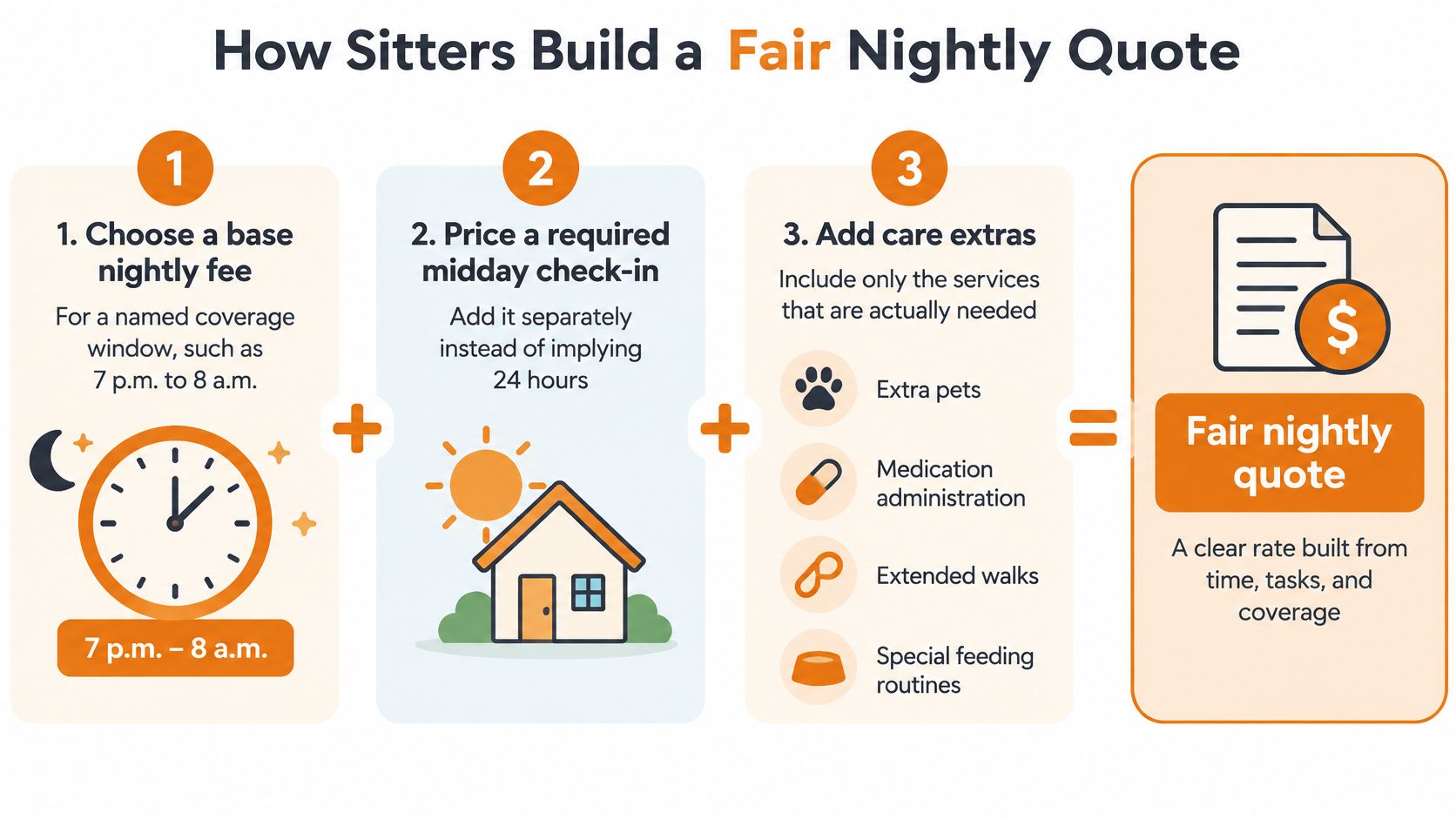
Build the quote in order
- Name your base window. Use an explicit evening arrival and morning departure. State which feeding, walking, and sleeping duties it covers.
- Add required daytime visits. Reserve those appointments in your schedule rather than hoping you can fit them between other jobs.
- Define extensions. Explain when additional time becomes payable and how you calculate it.
- Separate care adjustments. List additional pets, puppy care, holiday dates, and any extended-stay pricing.
- Agree on practical terms. Set cancellation rules, key handover, emergency contacts, and the process for approving changes.
For a concrete platform example, Rover's published house-sitting and boarding rules define coverage as up to 24 hours per night, with extended care adding 50% of the nightly rate for more than two and up to eight extra hours, or 100% for more than eight extra hours. Those are Rover's rules, not a universal definition of overnight care.
Add-ons that change a base nightly rate
| Adjustment | When it applies | Pricing rule |
|---|---|---|
| Included window | Every booking | State actual coverage hours and permitted absences |
| Midday visit | The pet needs care outside the base window | Charge separately if it isn't included |
| Late pickup within the shorter extension bracket | The booking exceeds the agreed end under the applicable policy | Rover's shorter extended-care premium applies |
| Late pickup beyond the longer extension threshold | The booking enters the longer extension bracket | Rover's full-night extended-care premium applies |
| Extra pet | More animals than the base rate includes | State a separate per-pet fee or inclusive allowance |
| Puppy or special care | Extra supervision or handling is required | Name the task and any surcharge |
| Holiday | Agreed peak dates | Show the premium before acceptance |
A delayed return can keep you from starting another booking or completing other work. Your own extension policy should reflect that commitment, but owners need to know the policy before they travel.
HomeProBadge's explanation of how to set clear terms for cleaning quotes offers a useful parallel for household work: define the agreed tasks rather than leaving the scope open-ended. Pet care deserves the same clarity, especially when owners also request cleaning or home maintenance.
Use the principles in our honest pricing guide to make the final offer understandable. Send the complete itemized quote before acceptance, not a low base price followed by unavoidable additions.
Adjusting the Rate When Budgets Are Tight
A tight budget doesn't make a medication schedule less demanding. Morgan Stanley's discussion of the U.S. pet economy reports that owners are more willing to reduce cosmetic or elective care than routine or necessary veterinary treatment. Apply that distinction to sitting: cut optional work before essential care.
Start with the ordinary coverage window, then identify which adjustments represent unavoidable labor. Medication, mobility assistance, separation anxiety, travel, and emergency backup need an honest discussion, not an unexplained discount.
Change the service safely
- Remove optional extras: Drop nonessential household tasks before reducing pet supervision.
- Adjust attendance: Shorten the window only if the pet can safely manage the resulting absence.
- Consider another setting: Boarding may be worth comparing if your pet is comfortable away from home.
- Protect necessary visits: Don't remove a toilet break or timed dose just because it appears as an add-on.
Budget boundary: A cheaper arrangement must still meet the pet's needs.
A community or accommodation exchange can work when both people willingly accept the responsibilities. Document expenses, keys, routines, veterinary contacts, and cancellation terms so neither person mistakes a mutual exchange for an open-ended work commitment.
Tell the sitter your budget and identify the nonnegotiable care tasks. Then ask what suitable arrangement they can offer, rather than asking them to perform the same work for less.
Choosing Paid Care or a Stay Exchange
Choose paid overnight care when you want a commercial booking with an itemized charge, fixed service commitments, and clearly priced extensions. It's also the more suitable path when your pet needs specialist support that you should commission explicitly.
Choose a stay exchange when your home and pets suit a willing sitter, and both sides value care in return for accommodation. Read our guide to house sitting free of nightly care payments to understand that distinction before arranging a stay.
Match expectations before committing
- For paid care: Request the complete trip total and written confirmation of the required duties.
- For an exchange: Compare relevant experience and reviews, discuss routines, and agree on responsibilities before confirming travel.
At Global Pet Sitter, sitters care for pets in the owner's home in exchange for a free stay, and no money changes hands. Owners must vacate the property during the sit, with sole occupancy for the sitter unless otherwise agreed in advance.
We don't provide pet sitting or pet care services directly. Owners and sitters make their own private arrangements, so a good match depends on candid conversations about the animal, the home, and what each person can commit to.
If a stay exchange suits your trip, visit Global Pet Sitter to create a profile, describe your pets' routines, and connect with potential sitters. We charge no booking fees, ever, and the exchange replaces a nightly care payment with a free stay in your home. Agree on the coverage and responsibilities before confirming your plans.
Bitte melde dich an, um einen Kommentar zu hinterlassen
