Your suitcase is open, your pet is watching, and you're scrolling through sitter profiles trying to decide who you'd trust with the spare key. Or you're on the other side, looking for somewhere to stay and wondering why an owner would choose you over someone with an established reputation. Searching for “house sitting free” is the easy part. Getting comfortable with the person behind the profile takes more work.
What Free House Sitting Actually Looks Like
Free house sitting is a non-cash exchange, not a complimentary holiday. The sitter receives temporary use of the home while taking on agreed responsibilities such as pet care, collecting mail, watering plants, and keeping the property secure. That's the basic house-sitting arrangement, and both sides should understand it before discussing dates.
Consider a hypothetical match: an owner needs someone who'll maintain their dog's routine while they travel. A remote worker wants accommodation somewhere they can settle for a while. Their interests line up, but only if the worker's meetings leave room for walks and the owner's expectations leave room for work.
The attractive kitchen and nearby beach aren't the deciding factors. The dog's needs are.
The care comes before the destination
Pets are involved in approximately 80% of house-sitting arrangements; the same overview reports that a 2024 BBC Travel article recorded annual increases in house- and pet-sits of 55% in the United Kingdom and 69% in the United States, within the post-pandemic expansion of the model (house- and pet-sitting overview). Those are historical figures, not current growth estimates.
For holidaying owners, budget travelers, digital nomads, and slow travelers, the exchange can make sense. But wanting affordable accommodation doesn't qualify someone to manage an anxious dog, administer medication, or recognize when an animal needs help.
Practical rule: Choose the care responsibilities first and the destination second.
Owners should apply the same discipline. Don't choose someone because they're available, friendly, or willing to do everything you ask. Choose someone whose actual abilities and daily schedule fit your pet.
Trust and clarity are the currency. A sitter needs an honest description of the home and workload. An owner needs dependable care, not an enthusiastic promise that becomes inconvenient after arrival.
Setting Up a Profile That Actually Gets Picked
Lead with what you can handle, not how much you love traveling. An owner needs to picture you managing an ordinary morning in their home, including the less photogenic parts.
Write a profile that answers practical questions:
- Relevant care experience: Describe the animals you've looked after and the tasks you performed. Don't describe yourself as experienced with medication if you've only watched someone administer it.
- Daily availability: Explain whether you work remotely, attend appointments away from home, or need uninterrupted working time.
- Clear limits: State what you won't accept, such as unfamiliar medical procedures or dogs whose handling needs exceed your ability.
- Genuine availability: Keep your dates current. Don't make an owner work through a conversation before revealing that you can't cover the departure.
Show evidence without overselling yourself
Use a clear, recent photograph in natural light. An additional picture with an animal is useful if it reflects genuine care experience, not a passing encounter staged for the profile.
Where review imports are supported, use screenshots of existing reviews to show work you've already done elsewhere. Preserve enough context to make them understandable, redact private information, and don't present an imported review as a review earned on your new platform.
Use this profile screenshot as a prompt to assess how clearly you present your experience:

Owners need credible profiles too. Show the sleeping space, describe the neighborhood, and explain practical limitations such as unreliable internet, difficult parking, or stairs. Include the pet's routine rather than relying on affectionate descriptions.
A useful listing tells a sitter what an ordinary day requires, not just why the home is lovely.
Define what a successful stay looks like to you. If you expect a quiet household, careful plant care, or a particular cleaning standard, disclose that before applications arrive. Hidden expectations aren't a test of whether someone is considerate.
Finding Legitimate Free House Sitting Opportunities
Start with opportunities you can assess properly. I'd choose a straightforward local arrangement with responsive owners over a spectacular overseas listing with missing details.
Use dedicated marketplaces, local Facebook groups, neighborhood apps, and personal introductions as discovery channels, not proof that an arrangement is safe. For choosing between dedicated services, consult this comparison of house-sitting platforms, then assess the individual listing yourself.
Where to Find Free House Sits
| Channel | Best For | Watch Out For |
|---|---|---|
| Dedicated house-sitting platforms | Comparing dates, responsibilities, profiles, and reviews | Assuming membership means every claim has been checked |
| Local Facebook groups | Finding nearby opportunities and arranging introductions | Sparse profiles and pressure to commit privately |
| Neighborhood apps | Exploring sits close enough for an advance visit | Vague duties presented as a casual favor |
| Personal introductions | Starting a conversation with shared context | Skipping checks because someone knows someone |
| Traveling and remote-work networks | Finding dates compatible with onward plans | Choosing the destination before assessing the care |
Apply for compatibility, not volume
Before applying, establish the exact dates, animals involved, expected time at home, and whether the owner will arrange a live conversation. Ask about anything that would change your decision before writing a long application.
Make your opening message specific. Mention the pet's stated needs, explain your relevant experience, and confirm that your schedule fits. Avoid sending a travel autobiography with a brief sentence about liking animals at the end.
- Pursue: Clear responsibilities, candid answers, current availability, and willingness to discuss difficult details.
- Clarify: Unexplained gaps, inconsistent dates, or photographs that don't show the living arrangements.
- Decline: Pressure to commit before questions are answered, refusal to meet live, or demands for sensitive information without a clear reason.
A dream location with little visible interest isn't automatically fraudulent. It does deserve questions. Ask whether the dates remain available and why the owner is still looking rather than inventing either a reassuring explanation or a frightening one.
Verifying Trust Before Anyone Hands Over a Key
Being nervous about leaving your pet isn't irrational. In a U.S. survey described by Steve Dale's Pet World, 61% of pet owners worried more about their pet's well-being than their own vacation enjoyment, 49% experienced separation anxiety, and 49% didn't trust anyone else to provide proper care.
Don't answer that anxiety with endless messaging. Answer it with checks that produce useful evidence.
Use this sequence before either person makes an irreversible commitment:
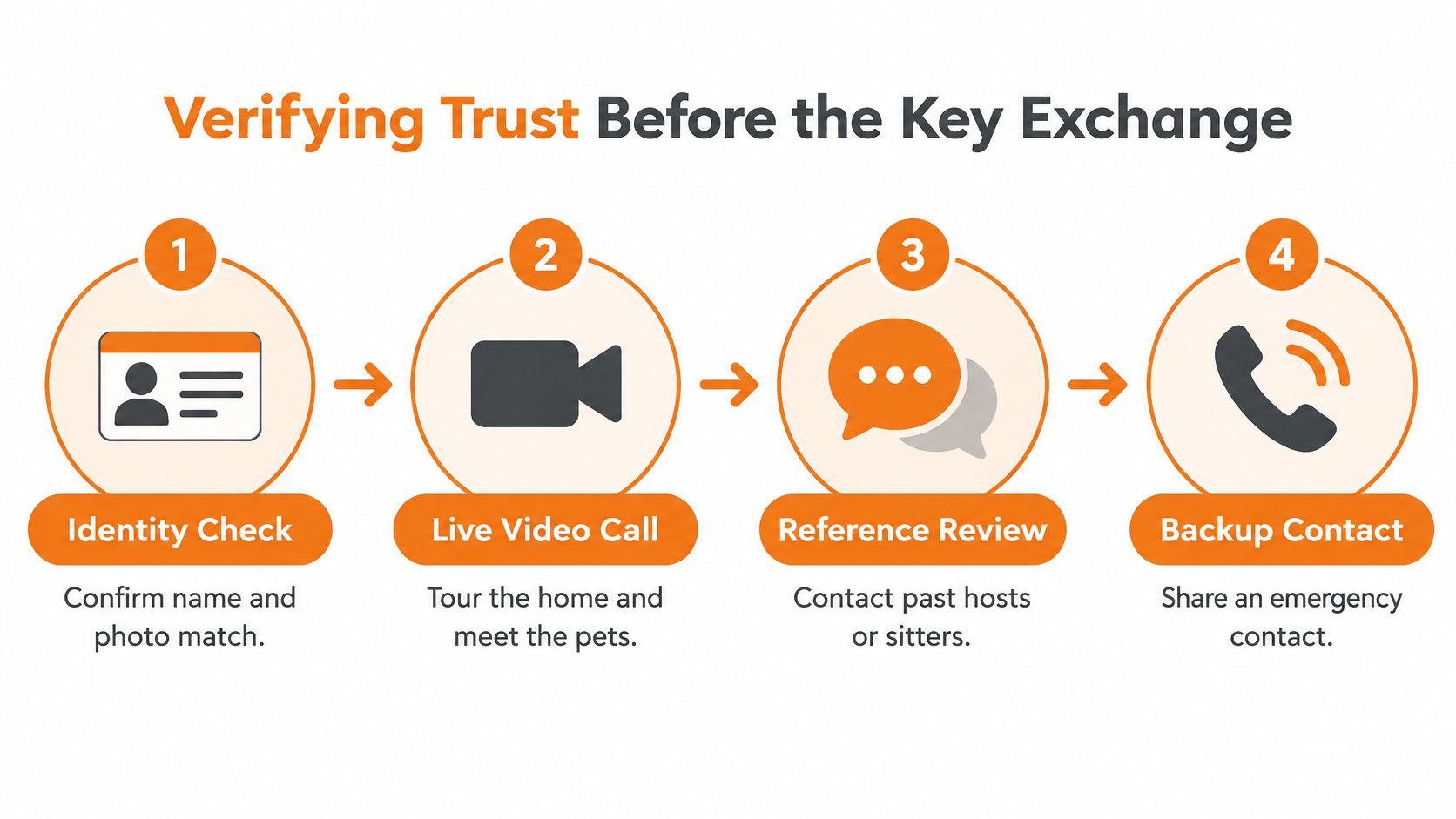
Check the person behind the profile
Confirm identity and working contact details through an appropriate, privacy-conscious process. Don't circulate identity documents in public groups or request more personal information than you need.
Arrange a live video call or in-person meeting. Owners should show the actual living space and introduce the pets; sitters should explain how they'll manage the routine around other commitments.
Obtain at least two independently checkable references, alongside identity checks and a live meeting, as part of a structured pre-sit verification workflow. Contact the references rather than accepting screenshots as the final word.
- Ask references about conduct: Did the person follow instructions, communicate problems, and leave when agreed?
- Discuss an awkward scenario: Ask what happens if a dog refuses medication or the sitter's onward travel changes.
- Check mutual boundaries: Owners should disclose anyone else with access; sitters should disclose everyone who would stay.
Star ratings support a conversation. They don't replace one, and neither does a shared acquaintance.
Look for calm, practical answers
A promising match can discuss limitations without becoming defensive. Be wary of anyone who dismisses reasonable questions as distrust or offers sweeping guarantees instead of explaining their approach.
Use the video below as an additional conversation prompt, not a substitute for checking your own match:
You don't need complete certainty. You need enough credible evidence to make a reasoned decision, plus permission to decline when the answers don't add up.
Negotiating Expectations and Documenting the Arrangement
The awkward conversation is better before departure than after someone has booked transport. Agreeing that you'll both “be reasonable” leaves too much room for disagreement.
Write down the operational details, even when you like each other. Use a shared document that both parties review, and make sure the sitter can access essential instructions without an internet connection.
This checklist shows the main categories to settle:
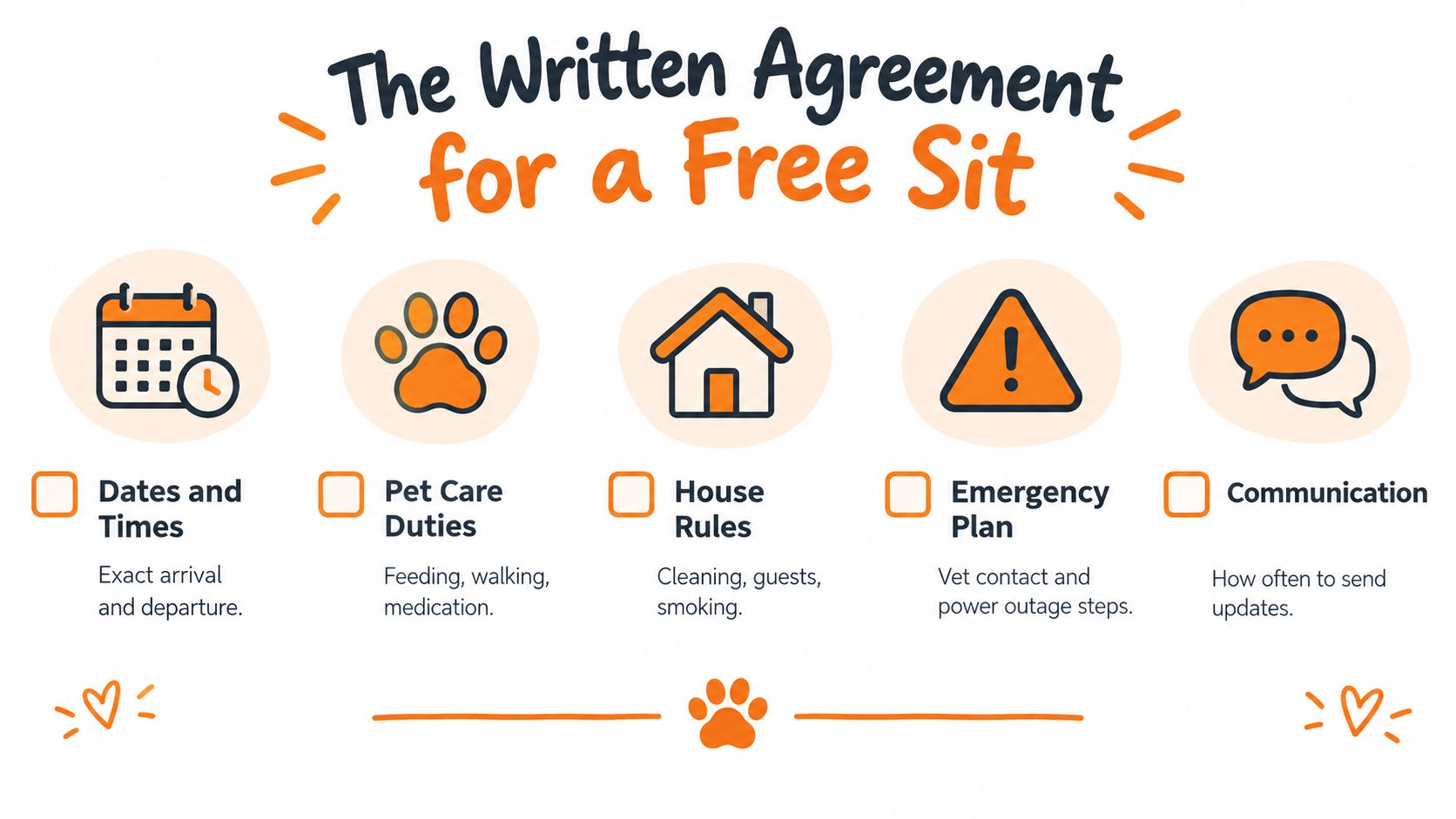
Build instructions someone can actually follow
Start with a house-sitting agreement template, then replace generic wording with the details of this particular home.
- Arrival and departure: Record the handover, key return, and what happens if the owner's return is delayed.
- Pet routine: Specify food quantities, feeding times, walking expectations, permitted time alone, and medication instructions.
- Home rules: Cover guests, smoking, cleaning, plants, mail, heating, and rooms or equipment that are off limits.
- Emergency authority: Record the veterinarian, emergency clinic, local backup contact, treatment authorization, and spending approval process.
- Cancellation: Identify who contacts whom, who arranges replacement care, and how any agreed costs will be handled.
- Updates: Agree on the channel, timing, and consent for timestamped photographs, including what shouldn't appear in them.
Don't bury important instructions in a lengthy chat history. Keep urgent information together and distinguish routine updates from matters requiring an immediate call.
Agree on reassurance without constant availability
An owner might want frequent proof that everything is fine. A sitter might feel uncomfortable being expected to document every walk. Resolve that difference before confirming, including how long a normal reply can take.
Agree on updates that reassure the owner without turning the sitter's day into a continuous reporting exercise.
During the handover, ask the sitter to demonstrate unfamiliar tasks rather than nodding through explanations. Test the keys, show the shutoffs, and locate the pet carrier.
If the workload changes materially afterward, reopen the agreement. Don't treat newly disclosed responsibilities as something the sitter has already accepted.
Safety, Insurance, and the Real Cost of Going Free
Unpaid doesn't mean unprotected, and it certainly doesn't mean automatically insured. Treat insurance as something to confirm with the relevant provider, not something to infer from a platform badge or a homeowner's confidence.
Ask the home insurer how the proposed arrangement affects the policy. Explain the duration, occupancy, pet-care duties, and whether anyone else will enter the property. Get clarity on the sitter's position, not just confirmation that the house itself has insurance.
Ask about the actual arrangement
Use this guide to verifying insurance coverage to organize questions, then rely on the insurer's policy wording and written answers.
- Occupancy and vacancy: Does this sitter's presence satisfy the policy's requirements, and do absence conditions still apply?
- People and animals: What coverage, exclusions, or separate arrangements apply to an injured sitter or pet-related incident?
- Damage and repairs: Who reports a problem, authorizes work, pays initially, and handles any excess or deductible?
- Existing condition: Take dated handover photographs and distinguish pre-existing faults from damage caused during the stay.
If you're placing belongings in storage while traveling, check that separately too. Standby Self Storage's guidance on how to protect your stored items with insurance is a useful starting point for that distinct coverage question.
Insurance and liability rules vary by jurisdiction. An agreement records expectations; it doesn't rewrite an insurance policy or settle every legal issue. Ask a qualified adviser when the stakes warrant it.
Don't confuse sitter travel with pet travel
If the pet stays home, focus on the care and emergency plan. If the pet will cross a border, check destination, transit, return-country, and carrier requirements with an accredited veterinarian.
The CDC's international pet-travel guidance identifies possible requirements including vaccinations, microchipping, testing, and accurate health documentation. Don't assume another traveler's checklist applies to your animal or route.
Keep a fallback accommodation and transport budget too. A confirmed sit shouldn't leave either party financially trapped if circumstances change.
Your First 90 Days of Free House Sitting
Treat this as a suggested 90-day learning plan, not a deadline for accepting a sit. Move forward when you're ready, not because a calendar says you should.
The roadmap below is a planning aid rather than a promise of bookings:
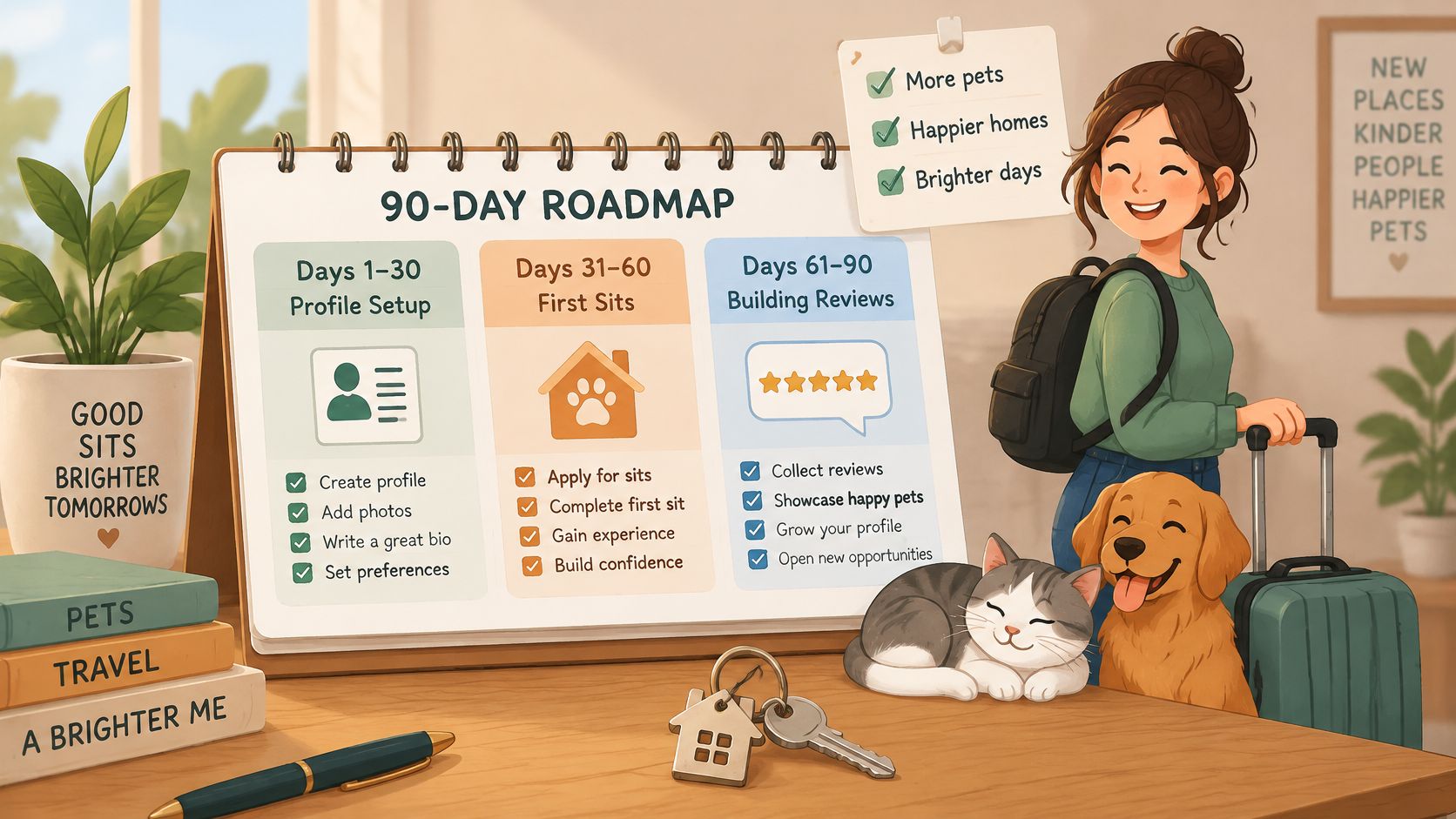
Start nearby and earn useful experience
Weeks 1–2: Finish your profile, ask permission to share references, and define your requirements. Owners should prepare an honest listing and care instructions instead of waiting until departure approaches.
Weeks 3–6: Aim for a short local arrangement with manageable responsibilities. Proximity makes an advance meeting easier and gives you a practical fallback if you discover a mismatch.
Weeks 7–10: Consider longer stays or different locations only after reviewing what you handled comfortably. Don't increase duration, travel complexity, and animal-care difficulty simultaneously.
Weeks 11–12 and the remaining days: Request specific feedback, update your profile, and revise anything that caused confusion. Review declined opportunities too, because recognizing a poor fit is part of becoming reliable.
When choosing a community, look beyond listing photographs. Examine how members raise concerns, whether support answers practical questions, and whether feedback leads to visible changes. An active group or feature-voting process is useful only if you find the participation constructive.
Questions first-timers ask
Does free mean the sitter spends nothing?
No. The exchange removes the lodging payment, not every travel expense. Budget for personal costs and confirm any proposed contributions before committing.
What should happen if someone cancels?
Follow the written cancellation plan and notify the other person promptly. Owners need replacement care; sitters need somewhere safe to stay.
Does pet-only care count as house sitting?
Ask whether the arrangement includes staying overnight. A drop-in pet-care visit isn't the live-in accommodation exchange described here.
Should I accept a difficult pet to build my reputation?
No. Start within your competence, disclose your limits, and expand your skills deliberately.
Global Pet Sitter connects owners and sitters for home-and-pet-care exchanges and lets experienced sitters carry over existing reviews through screenshots. Visit Global Pet Sitter to create a profile or post your dates, then use the checks above before confirming a match.
Please sign in to leave a comment
