The dog is already at the front door before the knock finishes. Tail up, bark on repeat, body bumping the hallway like the house is under attack, and you're left guessing whether this is bad manners, guard mode, or just a nervous habit that explodes every time the bell rings. Many call it "bad behavior" because that's the easiest label, but that label hides the underlying issue, which is that different dogs react to the door for different reasons.
If you're leaving town soon, that matters even more. A sitter doesn't need a vague warning that your dog “gets excited at the door,” they need a clear protocol for what to do before anyone enters, what body language to watch, and when to skip the greeting entirely.
The Moment the Doorbell Rings
The doorbell goes off, and the dog is off the floor in a blink. Some owners laugh it off as quirky, some call it protective, and some feel embarrassed because it happens every single time. The truth is simpler and less flattering. Door behavior is usually a reflex tied to a trigger, not a moral failure.
A 2021 peer-reviewed study of 386 dog owners found that barking was the most frequently reported response, with 193 owners, or 50.0%, reporting it and 29.0% of all recorded reactions tied to barking study on household-noise reactions. That does not mean every barking dog is the same. It means barking at household sounds is common, and a “dog at the door” is usually responding to a specific context, not just “being naughty.”
The mistake people make is treating every door reaction as one training problem. It isn't. A dog can bark because a stranger appeared, because the sound startled them, because they want access, because they're frustrated, because they're guarding space, or because they're panicking about what comes next. If you don't separate those causes, you'll pick the wrong fix.
Write down for the sitter: exactly what happens when the bell rings, who the dog reacts to most, and whether the dog settles once the visitor is inside or stays activated until the door is closed.
Five Different Dogs at the Same Door
The same bark does not mean the same motive
A loose, wiggly dog that barks once, trots forward, and relaxes when the visitor sits down is telling you something very different from a stiff dog that freezes in the doorway and ratchets up as the person gets closer. The first dog may be alert, excited, or under-stimulated. The second may be fearful or defensive. Those are not interchangeable.
The household-noise study helps here because it shows barking is common, but it also showed other reactions such as retreating and pacing, which tells you that door sound can pull very different behavior patterns out of the same dog household-noise study. In practice, I sort dogs into five profiles.
| Type | Typical Trigger | Body Language | Escalates When | First Move |
|---|---|---|---|---|
| Alert barking | Knock, bell, footsteps | Upright, focused, watchful | Trigger repeats, door stays active | Move away from the door and reset |
| Fear barking | Novel person, sudden approach | Stiff, frozen, tucked, avoidant | Visitor comes closer, pressure increases | Increase distance, no greeting |
| Frustration barking | Blocked access, barrier, leash | Pulling, whining, fixated | Dog can't reach the trigger | Remove access and redirect |
| Excitement barking | Anticipation of people or routine | Wiggly, bouncing, hard to settle | More stimulation, more attention | Calm routine, mat, low arousal |
| Possible aggression | Guarding, cornering, stiff stare | Hard body, closed mouth, tension | Direct approach, forced interaction | Separate immediately, do not test |
Read the dog before you touch the knob
The operational rule is blunt. If the dog is loose and recoverable, you can train and manage. If the dog is stiff, cornering people, or trying to get past you, don't pretend that's a manners issue. That's a safety issue.
I've watched too many people confuse intensity with confidence. A loud bark at the door is not automatically aggression, and a silent dog is not automatically safe. The question is always the same, what happens to the body when the trigger gets closer? If the answer is “the dog hardens,” you're already past casual training.
Practical rule: if the dog's posture gets tighter as the person approaches, stop the greeting and increase distance.
What Your Dog's Bark Is Telling You
Listen for the shape of the sound
Door-related barking has a different acoustic pattern from play or separation barking. In an observational study of 10 dogs, doorbell-triggered disturbance barking had significantly longer duration and lower mean frequency than contact or play barking, with p < 0.01 for both Yin's barking study. That matters because a bark is not just noise, it's information.
The practical ear-test is straightforward. A long, harsher, lower bark that comes in bursts usually means the dog is reacting to an arrival or disturbance. A higher, bouncier, more variable bark usually points more toward play or social excitement. That doesn't make the sound “good” or “bad,” it makes it readable.
Match the bark to the body
The sound by itself is not enough. A dog can bark hard and still be emotionally loose. Another dog can bark less but look far more distressed. The body tells you which is which.
The bark tells you the trigger category. The body tells you the risk.
That's why changing the bark alone is a weak goal. If you only teach silence without changing the emotional state behind the reaction, the dog often stays tense and the behavior comes back the next time someone rings the bell. I'd rather see a dog go to a mat than sit at the door in a stressed silence.
Training the Door Response from Scratch
Start below threshold or don't start at all
The most defensible way to change a door reaction is systematic desensitization plus counterconditioning plus response substitution. Merck Veterinary Manual guidance is clear, intensity should rise only when the dog shows no response or a positive response, and any reaction means the stimulus got too intense too fast Merck guidance on greeting behavior. That's the standard I use.
Begin with a very soft doorbell recording or a controlled knock. The sound happens, then immediately a high-value treat appears. If the dog stays loose, repeat at the same level. If the dog startles, freezes, barks, refuses food, or rushes the door, you went too far and should back up.
Build a replacement job
A dog needs something to do instead of charging the door. A place cue away from the entrance is the cleanest answer. Put a mat several feet from the door, reward the dog for going there calmly, and rehearse that pattern when nobody is arriving. After that, layer in mild door sounds while the dog stays on the mat and gets reinforced for holding position. For additional trick ideas that can support a calm mat routine, see this list of dog tricks.
A short protocol looks like this:
- Cue the mat when the house is quiet.
- Add one soft knock or a low-volume bell sound.
- Feed immediately if the dog stays relaxed.
- Stop before arousal climbs.
- Repeat later at the same or easier level.
If the dog is already aroused, the session is over. Do not keep drilling the trigger and hoping for a breakthrough. That just rehearses the wrong pattern.
Write down for the sitter: where the mat is, what treat works, what sound level is safe, and the exact signal that means “stop training now.”
When Management Beats Training
Some homes need barriers, not more lessons
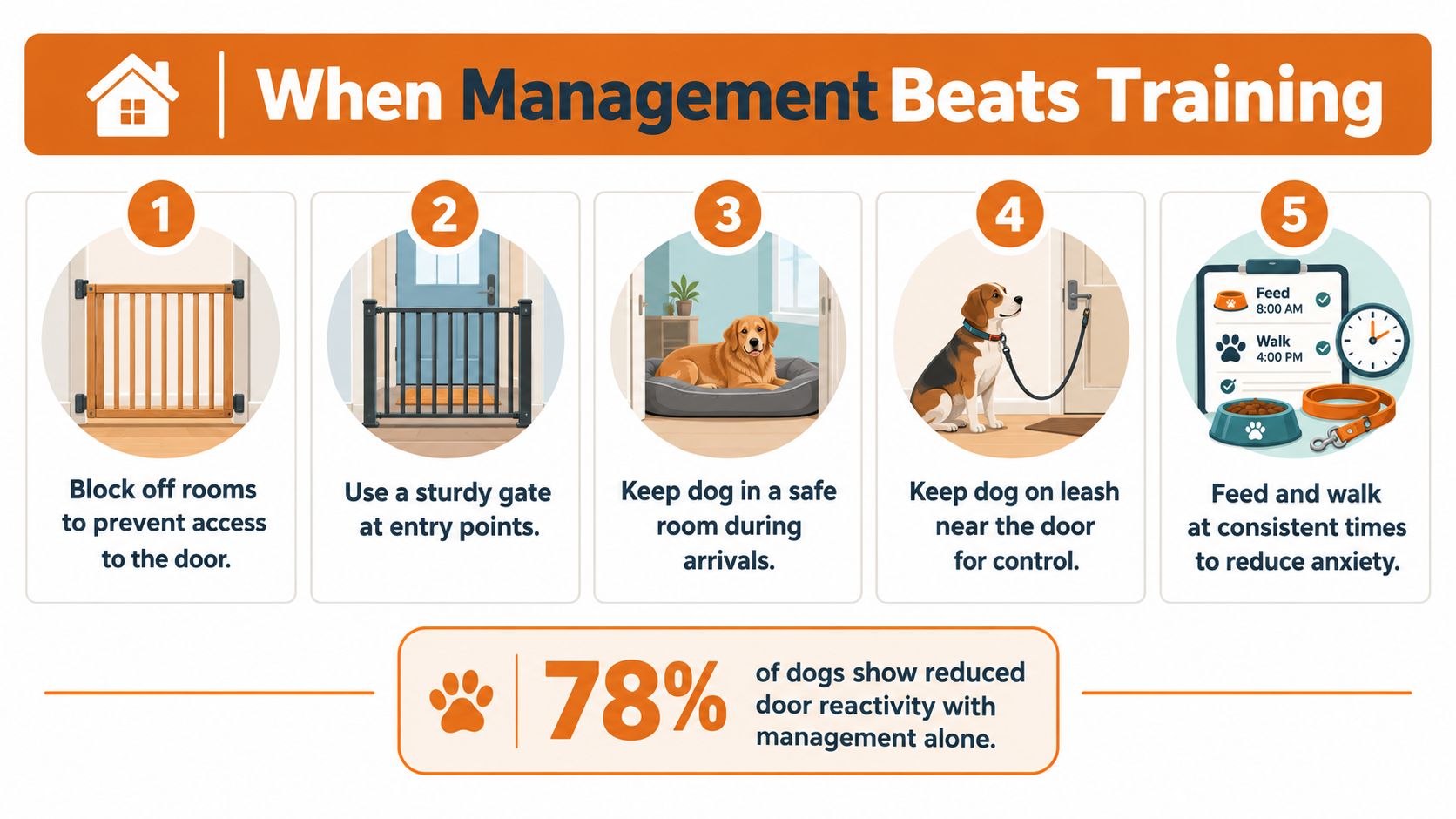
Training helps, but management is often the safer first move. A gate, a closed room, a leash protocol, or a no-greeting rule can stop rehearsal while the dog is still learning. That's not cheating. That's preventing the dog from practicing the exact behavior you're trying to reduce.
This is especially true in real households with delivery drivers, kids, cleaners, contractors, or anyone who shows up without warning. A dog that has rehearsed door-charging for months or years will not magically become calm because you paired the bell with treats three times. The dog needs fewer chances to fail.
Make the house easier to run
If you want fewer door blowups, make the environment do some of the work. Tell visitors to text instead of ring when possible. Use a sturdy barrier before opening the door. Keep the dog in a separate room if you can't supervise closely. And if your home setup already includes a pet-friendly security device, a guide like pet friendly burglar alarms explained can help you think through how alerts and pet access interact in practice.
Management is not a temporary embarrassment. Sometimes it's the permanent answer. If a dog is safest behind a barrier when the door opens, that's the right system.
Is the Dog Reacting to the Door or to Your Absence
Don't confuse visitor stress with separation stress
Some dogs bark at the door because the door is the problem. Others bark because the owner is gone and the new person at the door changes the whole picture. A 2025 report summarizing a canine behavior study identified separation and attachment behaviors as the most frequently reported issue, affecting 85.9% of dogs in the surveyed population report on canine behavior issues. That makes the distinction worth taking seriously.
A dog may seem fine when the owner is home but unravel when a sitter arrives alone. That's not a simple greeting problem. It can be a routine, attachment, or transition problem. If the dog tolerates the bell when the owner opens the door but panics when the owner leaves, the core issue may be the handoff itself.
Build the handoff before the trip
Use a pre-sit transition plan. Do trial visits while the owner is present. Practice short absences first. Keep feeding, walk timing, and cues identical. Give the dog a quiet retreat that belongs to them. If the dog shows severe distress, stop forcing the issue and get veterinary or qualified behavior support.
A calm door with the owner present does not prove the dog is ready for a stranger-led house. Test the handoff separately.
For deeper planning around travel and distress behavior, this guide to managing pet separation anxiety when you travel is the kind of thing owners should read before they leave, not after the sitter is already stressed at the doorstep.
Train, Manage, or Call a Professional
Use the dog's signals, not your hope
Here's the clean decision tree I use. Calm barking with loose body language gets a training-plus-management plan. Stiff posture, snapping, lunging, escape attempts, or fear signals get physical separation and no forced greeting. If the dog seems unsafe, don't negotiate with the door.
| Signals You See | Recommended Action | Sitter Protocol |
|---|---|---|
| Loose body, recoverable barking | Train and manage | Mat, barrier, controlled greetings |
| Excited jumping, pulling, noisy anticipation | Manage first, train in calm sessions | Keep distance, reward settled behavior |
| Freezing, stiff stare, tucked tail, avoidance | Separate immediately | No greeting, no pressure, no crowding |
| Lunging, snapping, escape attempts | Call a professional | Secure dog, document trigger, avoid exposure |
| Sudden behavior change or fear history | Vet or behavior assessment | Treat as a welfare issue, not a manners issue |
The right professional is someone who talks in behavior terms, not dominance slogans. They should ask about triggers, body language, history, and safety. If they want to “test” the dog at the door, find someone else.
Some dogs should not greet visitors at all. That's not a failure. It's a smart household rule.
Your Sitter Handover Sheet
Turn the dog into a written protocol
A sitter should not have to guess. Leave a one-page sheet that names the dog's likely profile, the specific triggers, the body language to watch, and the exact first move before the door opens. Include where the dog goes, what barrier to use, which visitors may enter, and who to call if the dog escalates.
Use a short structure:
- Trigger list: bell, knock, footsteps, delivery people, maintenance staff.
- Dog profile: alert, fear, excitement, frustration, or guarded.
- Safe setup: mat, gate, separate room, leash, or all three.
- Visitor rule: text first when possible, no forced greeting.
- Contact tree: owner, backup contact, vet, behavior professional.
- Trial plan: one calm practice session before the trip.
If you use a service to arrange care, a simple intake sheet and candidate review process makes this a lot easier to hand over cleanly. The point is not to impress a sitter with detail, it's to make the house safe from the first minute they arrive. For a practical template, see this sitter information sheet.

Leave your sitter a plan, not a guess. If you're traveling, set up your dog's door routine before you go, write down the triggers and the safety steps, and hand the whole thing over in plain language. Visit Global Pet Sitter to post your sit, share the details that matter, and connect with care that keeps your dog calm when the door opens.
Please sign in to leave a comment
