International house sitting is not an immigration-free activity. In 2024, international tourism reached approximately 1.4 billion arrivals, but unpaid pet care can still be treated as work requiring authorization, even when no money changes hands.
You may be looking at a listing that seems perfect: a quiet villa, reliable Wi-Fi, a friendly dog, and several weeks abroad without paying for accommodation. Then an immigration officer asks why you're entering the country, where you'll stay, and what you'll do there. A passport stamp and a platform confirmation may not answer the most important question, which is whether your arrangement is legally permitted.
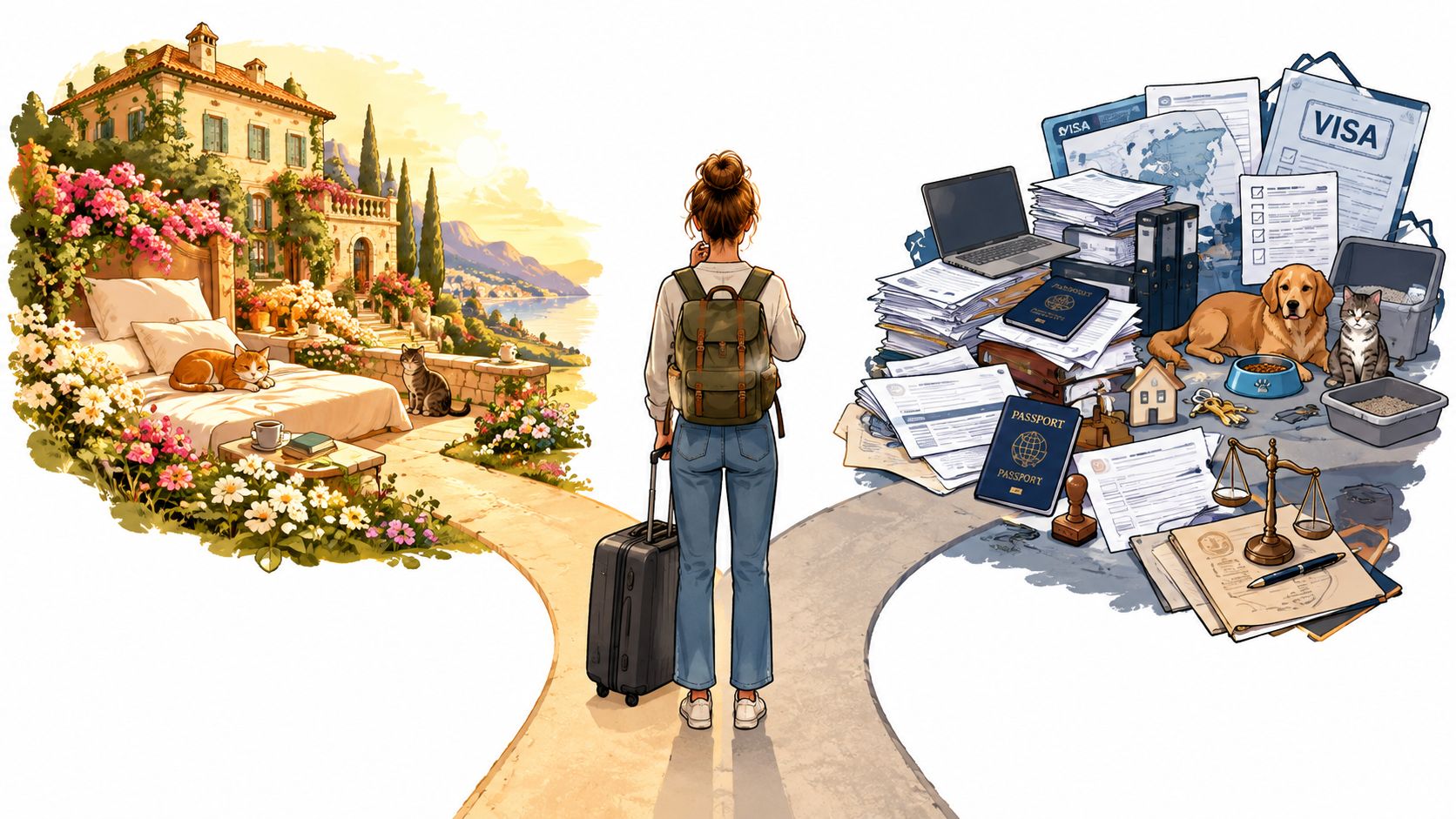
House sitting abroad sits between several systems at once. You're a visitor under immigration rules, a temporary carer for an animal, a custodian of someone else's property, and sometimes an unplanned participant in cross-border pet transport. The safest way to approach it is as a documented risk-and-compliance workflow, not as an informal exchange of a spare room for a few walks.
The Hidden Complexity Behind Free Accommodation Abroad
A house sitter can arrive with good intentions and still create an unclear story at the border. Suppose you're entering a country with a passport that permits tourism, but you're carrying a sit confirmation showing that you'll live in a private home, care for two dogs, water plants, and make veterinary decisions while the owner is away. From your perspective, you're helping a host in exchange for a place to stay. From an officer's perspective, you may be performing services for a local resident.
That distinction matters because the absence of cash doesn't automatically remove immigration risk. Rules can depend on the exchange of services, the beneficiary of the work, the length of the stay, your nationality, and whether your duties resemble locally performed employment. A platform's identity checks can establish trust between users, but they can't authorize entry, redefine work, or replace a visa.
Why the travel market matters
House sitting has a broad audience because international mobility has returned at scale. UN Tourism recorded approximately 1.4 billion international tourist arrivals in 2024, an 11% increase from 2023, or about 140 million additional arrivals, according to its World Tourism Barometer data. The total was roughly 99% of the 2019 pre-pandemic level, while recovery varied by region. Europe exceeded its earlier arrival level, the Americas remained about 3% below it, and Asia-Pacific was approximately 13% below its pre-pandemic benchmark.
Those figures don't measure house sitting itself. They show the size and geographic reach of the travel environment in which the arrangement operates. Travelers are crossing borders again in volumes close to the period before COVID-19, and many want longer, slower, or lower-cost ways to remain abroad. Accommodation exchanged for home and animal care can fit that demand, but only if the legal and practical obligations are understood before the booking is made.
The same operational issue applies to ordinary life administration. A long-term sitter may need bank letters, replacement cards, official notices, or medical correspondence while moving between homes. If you're planning a nomadic itinerary, this practical guide to how nomads receive mail can help you design a reliable address and document workflow rather than relying on a host's mailbox.
The duties are rarely limited to pet care
A listing may say “care for the pets and home,” but that phrase can conceal daily responsibilities. You might need to coordinate a plumber, supervise a gardener, operate an alarm, collect deliveries, manage a pool, or authorize urgent veterinary treatment. A long stay can also expose you to ordinary household failures, from a leaking appliance to a power outage.
Before accepting, ask what the owner means by “house sitting.” A written description should identify the animals, feeding and exercise routines, medication, security systems, visitors, maintenance tasks, transport expectations, and the limits of your authority. If a responsibility isn't written down, both sides may remember the conversation differently when something goes wrong.
Practical rule: Treat free accommodation as part of the exchange, not as proof that the exchange is legally neutral.
Visa Compliance and Border Preparation
Visa preparation starts before you apply for a sit. The right question isn't merely, “Can I enter this country as a tourist?” It's, “Can I enter, remain for these dates, and perform these unpaid duties under the rules that apply to my nationality and circumstances?”
Complete the five checks before accepting
First, verify entry authority. Check passport validity, visa requirements, permitted stay length, onward-travel rules, and the treatment of unpaid home or animal care. A visitor permission may cover sightseeing but not services benefiting a local household. The U.S. Department of State's international travel guidance also reinforces the broader need to understand local conditions and official travel information before departure. For a legal interpretation, use the destination's immigration authority or a qualified lawyer, not a platform forum.
Second, turn the listing into a written agreement. Record the exact dates, full address, duties, pet routines, medication, emergency authority, transport responsibilities, utilities, visitor rules, maintenance expectations, and cancellation arrangements. Include the owner's legal name and a reachable local contact. A message thread can help, but a single consolidated handover document is easier to show, review, and update.
Third, test insurance against the actual sit. Ask whether medical, travel, liability, and personal-property coverage remains valid for an extended stay and for care-related incidents. Confirm treatment of veterinary bills, accidental property damage, lost keys, stolen belongings, and a sit that ends early. Don't assume a standard travel policy covers a person who has accepted responsibility for an animal or is living in a private residence for a prolonged period.
Fourth, prepare evidence for ordinary border questions. Keep return or onward travel evidence, proof of funds, insurance details, the accommodation address, the written agreement, host contact information, and your itinerary together. Carry digital copies in secure storage, but keep offline copies too. You want to explain the arrangement consistently without searching through an app while standing at passport control.
Fifth, record the advice you relied on. Save the relevant official page, the date you checked it, and any written response from an immigration authority or lawyer. Rules can vary by passport, destination, and activity. A screenshot of a sitter's social media post isn't a substitute for official confirmation.
Use the checklist at the border, not just at home
For visa-exempt travelers in Europe, Schengen short stays are generally limited to 90 days in any rolling 180-day period. That calculation applies across the relevant area, so consecutive sits can create a problem even when each individual host believes the arrangement is harmless. Plan dates from your entry and exit records, not from the host's calendar.
The United States has reportedly treated some unpaid house-sitting arrangements as unauthorized work. That doesn't mean every sit receives the same treatment, but it does mean you shouldn't describe a service exchange casually or assume “unpaid” settles the question. If asked, answer truthfully and use your documents to explain the arrangement.
| Document | Purpose | Where to obtain |
|---|---|---|
| Passport and visa or entry authorization | Establishes identity and permission to enter | Passport authority and destination immigration service |
| Written sit agreement | Shows dates, address, duties, and emergency terms | Owner and sitter, signed or confirmed in writing |
| Return or onward travel evidence | Supports the planned departure | Airline, rail operator, or travel provider |
| Proof of funds | Demonstrates ability to support yourself | Bank or financial institution |
| Insurance certificate and policy wording | Clarifies medical, travel, liability, and property coverage | Insurer or broker |
| Local contact details | Provides a reachable person during the stay | Owner, family member, or local representative |
| Official visa guidance or legal advice | Records the basis for your compliance decision | Government immigration authority or qualified lawyer |
A review count, verified profile, or platform membership can make a host more comfortable. None of those items substitutes for immigration authorization, insurance confirmation, or a clear handover agreement.
Cross-Border Pet Logistics and Responsibility Maps
The most overlooked complication arises when the sitter travels with the owner's animal, meets the animal in one country and returns with it to another, or becomes responsible for transport after the owner's flight changes. At that point, the sitter isn't only occupying a home. They may be carrying an animal whose admission depends on documents, timing, airline policy, and border inspection.
Build the timeline around the animal
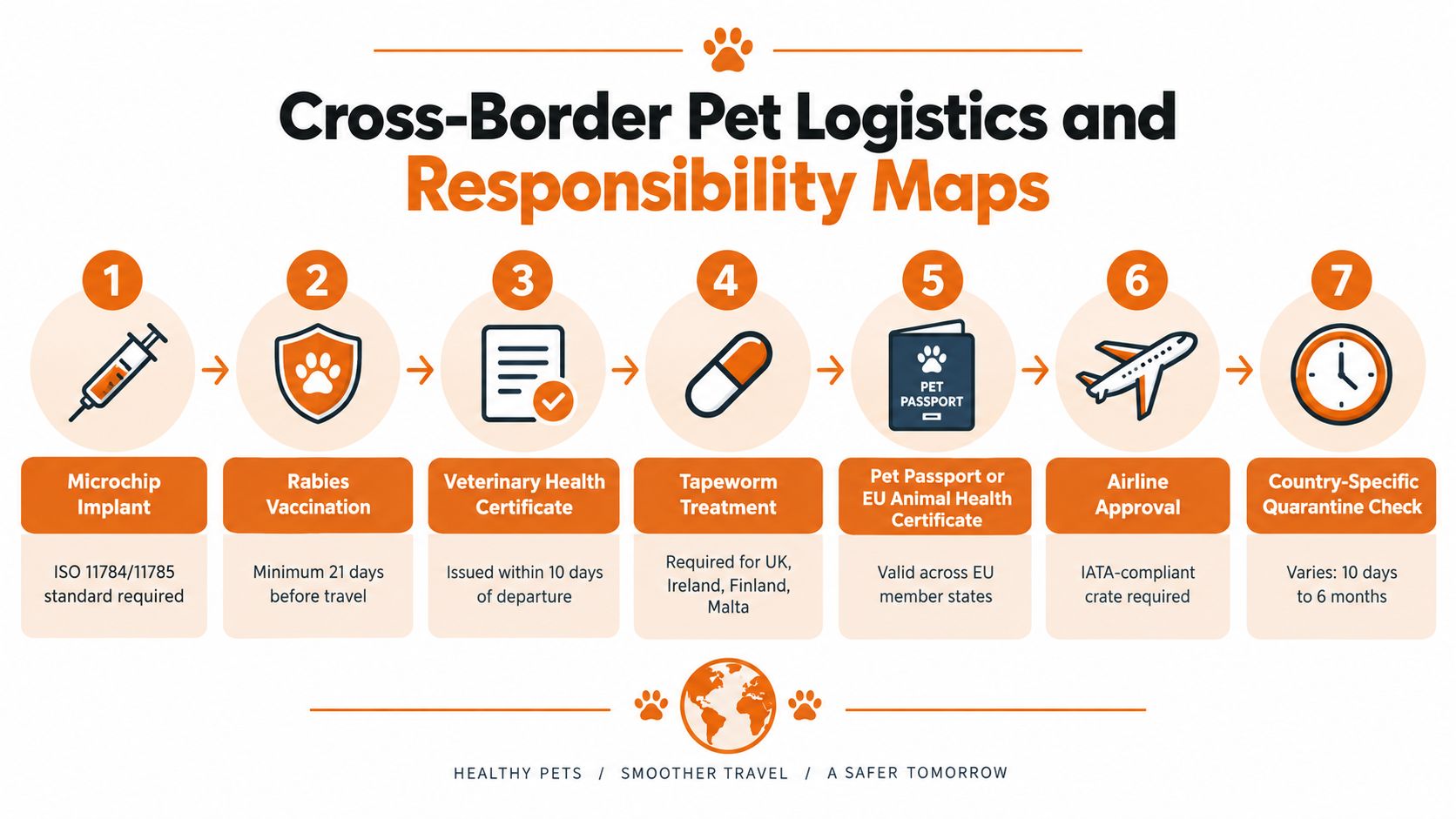
Requirements can include an ISO-compliant microchip before rabies vaccination, waiting periods, government-endorsed health certificates, route-specific airline rules, and country-specific treatments. Some destinations may impose quarantine. The United Kingdom, for example, has tightly timed tapeworm treatment requirements, so a missed appointment can disrupt entry even when the animal appears healthy.
Start with the destination's official veterinary or agricultural authority, then ask the airline to confirm its own rules. Airline approval, crate requirements, cabin or hold restrictions, transfer conditions, and documentation checks can differ from border requirements. A general pet travel article can't replace route-specific confirmation.
A practical sequence looks like this:
- Before booking: Confirm the microchip, vaccination record, destination rules, airline acceptance, crate specifications, and who pays for each requirement.
- Before departure: Obtain the required veterinary examination and official certificate within the permitted window, then verify names, microchip numbers, dates, and destination details.
- At check-in: Carry originals and copies, confirm the pet is accepted on the actual flight, and photograph the document pack before handing anything over.
- At arrival: Keep the animal, documents, and approved route together until clearance is complete. Don't assume a connecting airport applies the same rules as the final destination.
- After disruption: Contact the owner, veterinarian, airline, insurer, and relevant authority before improvising a new route or treatment.
The international pet travel guidance from Global Pet Sitter is useful for identifying questions early, but the destination authority and airline remain the decisive sources.
Assign responsibility before the trip
The owner should normally confirm the animal's identity, health history, vaccinations, microchip record, destination eligibility, and funding. The veterinarian should provide clinically appropriate care and accurate certificates, but doesn't control airline acceptance or border decisions. The airline controls carriage under its contract and may reject an animal for operational or documentation reasons. A transporter may have separate contractual duties.
The sitter's responsibility must be written narrowly. Are you accompanying the pet, collecting it after arrival, arranging a local vet, or transporting it back to the owner? Who authorizes a new ticket, emergency treatment, quarantine accommodation, or a return without the owner? Who bears the cost if a document is rejected?
The expanding complexity of this area is reflected in a projected 8.6% CAGR and an estimated $2.8 billion pet-travel market in 2025, as reported by Sector Data Insights. Those figures concern pet travel generally, not house sitting, but they underline why casual assumptions are unsafe. For a broader operational reference, a complete pet travel guide for jets can help surface transport questions that ordinary house-sitting listings rarely mention.
Before you accept transport duties, write one sentence stating who pays and who decides if clearance fails.
If documents are rejected, keep the animal safe, ask the border or airline authority for the reason in writing where possible, and contact the owner immediately. If a flight is delayed, don't let an informal promise force you into a new route that creates a different entry problem. Emergency veterinary care should follow the owner's written authority and the veterinarian's judgment, subject to local law.
Choosing a Platform That Matches Your Credibility
The platform affects more than the number of listings you can browse. It shapes how hosts assess you, how disputes are handled, how reviews are verified, and whether your reputation transfers from earlier work. A sitter with years of successful stays can look inexperienced if a new service offers no credible way to document that history.
Compare trust systems, not just inventory
A useful comparison starts with four questions:
| Decision criterion | What to examine |
|---|---|
| Review verification | Can hosts tell who wrote a review and which sit it relates to? |
| Reputation portability | Can established sitters import prior reviews without presenting them as native platform reviews? |
| Community feedback | Do members have a visible way to report issues and influence platform decisions? |
| Support responsiveness | Can users reach a real support channel when a sit or profile needs attention? |
Some services rely on paid membership tiers and centralized matching. Others emphasize community governance, verified members, direct applications, and visible feedback. Neither model removes the need for your own checks. A polished interface doesn't tell you whether a listing has realistic duties, whether the owner understands immigration boundaries, or whether an insurer will accept the arrangement.
For experienced sitters, importing five-star reviews through screenshots can preserve earned credibility when done transparently. The important distinction is that an imported review should remain identified as evidence from another platform. Never copy testimonials, alter dates, or imply that a review originated on the new service.
Match the service to your role
Owners should look for complete pet details, exact dates, clear application messages, profile history, and an easy way to confirm emergency arrangements. Sitters should assess whether the service supports direct communication, location-based searching, documented expectations, and a credible review trail.
Global Pet Sitter is one option for worldwide house and pet sitting. It provides owner-posted dates and pet details, map-based browsing, direct messaging, and a way for experienced sitters to import five-star reviews through screenshots. Its stated flow is straightforward: create a profile, find a match, then connect and care.
The practical workflow is the same regardless of platform. Build a factual profile, apply only when the dates and duties fit, arrange a video call, inspect the home and pet routine remotely, and put the agreement in writing. A platform can introduce the parties, but it can't validate every visa interpretation, airline requirement, insurance exclusion, or emergency decision.
For a closer comparison of service models and user considerations, review this guide to house sitting platforms. Use it to frame your questions, then judge each platform by the evidence it lets you inspect.
Risk Management, Insurance Gaps, and Contingency Planning
The expensive mistake usually isn't the original sit. It's the unplanned event that exposes a gap between what the owner assumed, what the sitter agreed to, and what the policy excludes. A dog may need urgent care, a flight may be canceled, a key may disappear, or the owner may need to return before the agreed date.
International tourism generated approximately USD 1.6 trillion in receipts in 2024, a 3% increase over 2023 and about 4% above 2019 in real terms, according to preliminary UN Tourism estimates. That indicates a substantial travel economy, but it doesn't measure house sitting or prove that a non-cash exchange is insured. The financial value of the broader travel market makes it even more important to define which costs belong to the owner, sitter, airline, veterinarian, or insurer.
Create an authority map
Write down who can make each decision:
- Routine care: feeding, walks, medication, and ordinary supplies.
- Veterinary care: the treatment threshold, approved clinic, spending limit, and payment method.
- Property incidents: who can authorize a locksmith, plumber, electrician, or security call.
- Travel disruption: who books alternative transport and who pays.
- Early termination: notice requirements, replacement care, and the sitter's onward accommodation.
Then test your insurance policy against those decisions. Look for exclusions involving extended stays, unpaid work, animal care, personal liability, property damage, medical evacuation, and cancellation. Ask the insurer for written clarification when the wording is ambiguous. If your route includes Spain, a broker's guidance on compliant Spanish travel insurance can help you examine local requirements without assuming that a generic policy is sufficient.
Keep a disruption pack
Store the agreement, passport copy, policy certificate, veterinary record, owner authorization, emergency contacts, local clinic details, airline confirmation, and proof of payment in one offline-accessible folder. Keep a second copy with a trusted person who isn't traveling with you. Agree on a communication cadence and a backup channel for when the owner is asleep, unreachable, or without service.
The pet-sitting liability insurance guidance can help owners and sitters identify policy questions before they commit. It shouldn't be treated as a substitute for reading the actual policy or obtaining destination-specific advice.
A good contingency plan answers four questions quickly: What happened? Who has authority? Who pays initially? What evidence must be preserved? Record photographs, receipts, airline messages, veterinary notes, and border instructions. Clear evidence won't prevent every loss, but it reduces arguments when several parties remember the incident differently.
Final Checklist and Next Steps for Owners and Sitters
Owners should finalize the pet's travel documents, medication instructions, feeding schedule, emergency authority, local contacts, insurance information, keys, alarms, and payment arrangements before departure. During handover, walk through the home, demonstrate equipment, introduce the sitter to the vet where possible, and confirm the first scheduled update. After returning, document any damage, outstanding bills, and changes to the pet's condition while the details are fresh.
Sitters should confirm entry permission, permitted stay, duties, insurance, onward travel, proof of funds, local contact, and the exact home address. Keep the written agreement and document pack offline, disclose any transport role, and import prior reviews transparently if the chosen platform allows it. During handover, photograph meters, appliances, keys, pet supplies, and existing damage, then send the owner a concise confirmation.
A responsible arrangement gives both parties an answer before the emergency occurs. If the owner won't clarify who pays for a rejected pet document, or the sitter won't verify whether the stay is permitted, walk away before accepting the listing.
Global Pet Sitter connects owners with sitters for live-in care, direct messaging, worldwide listings, and documented pet and home details, while experienced sitters can preserve credibility by importing prior five-star reviews through screenshots. Review the available matches and prepare your visa, insurance, and handover documents before you commit by visiting Global Pet Sitter.
Please sign in to leave a comment
