U.S. house sitting with dogs typically falls around $80 per overnight or $16 to $23 per hour, with a seven-night overnight stay commonly running about $560 before add-ons. Treat that figure as a starting reference, not a rule, because the dog's routine, the sitter's daytime availability, and the dates can change the fair price.
You're probably comparing options while your travel dates get closer and the good sitters start disappearing from the calendar. One listing charges by night, another charges by visit, and a third says “live-in care” without explaining whether the sitter can leave the house during the day. That isn't a minor wording problem. It can mean very different workloads and very different house sitting fees for dogs.
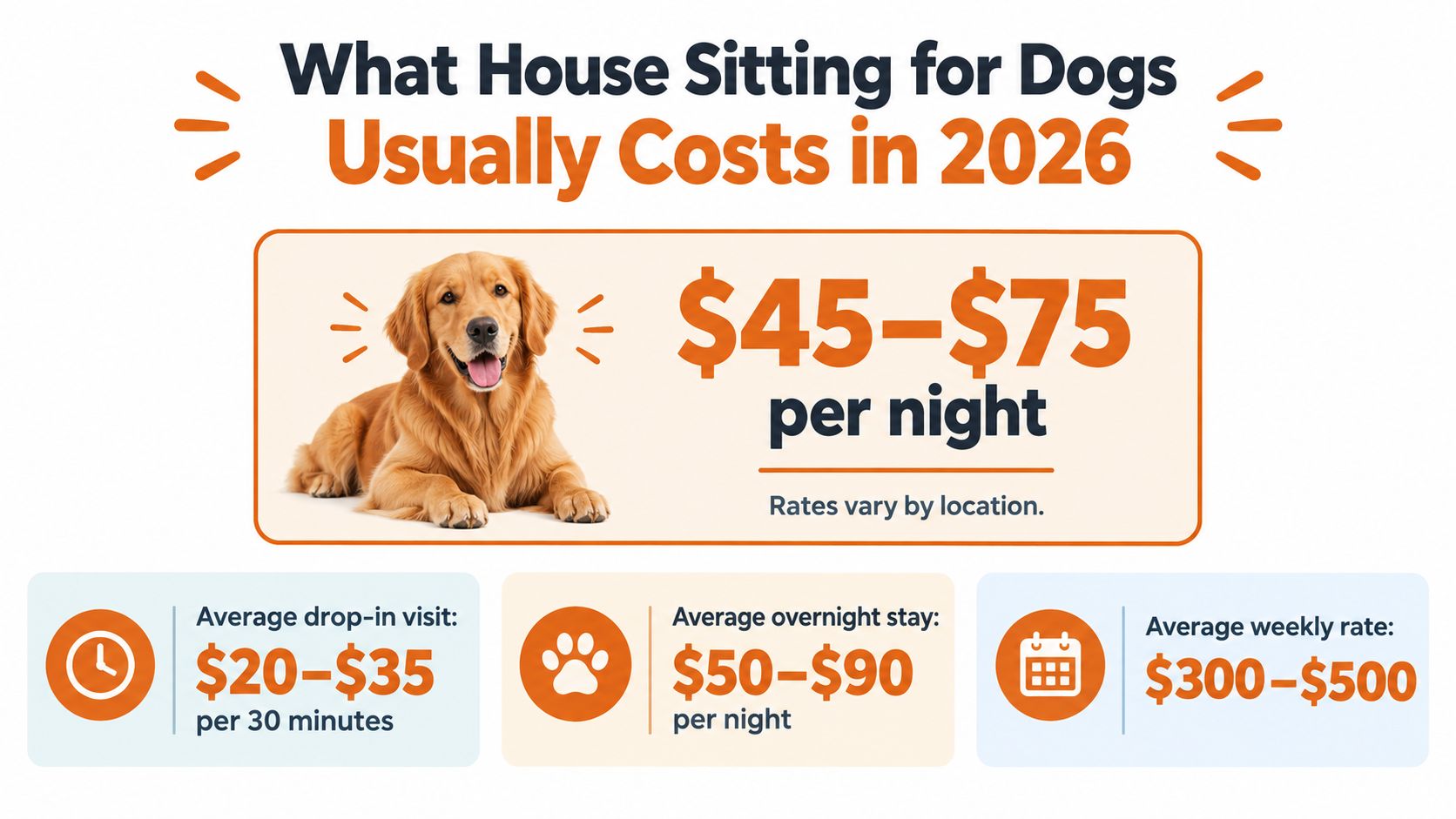
What House Sitting for Dogs Usually Costs in 2026
If a sitter will sleep at your home, handle the dog's routine, and stay available overnight, use about $80 per night as the starting reference. Time-based dog-sitting labor commonly falls between $16 and $23 per hour. Keep those units separate. A nightly fee pays for presence and responsibility across the evening, while an hourly fee measures active care or supervision. Industry benchmarks place a 30-minute visit near $25 and an overnight near $80.
For seven nights, the basic calculation is 7 × $80, or about $560. Treat that as a clear example, not a finished quote. A second dog, medication, continuous daytime supervision, extended walks, holiday demand, transport, or extra household duties can all change the total.
The headline rate is only the starting point
Ask what the quoted rate buys. An overnight price may cover sleeping at the property, morning and evening care, and reasonable periods away. Another sitter may need to remain available for most of the day. Both quotes can be fair, but they describe different workloads.
Rising demand and greater professionalization make itemized quotes more useful than unexplained flat fees. The sitter and owner should be able to identify the base service, the time commitment, and each added responsibility.
| Service Type | Typical U.S. Reference | What It Usually Includes |
|---|---|---|
| 30-minute drop-in | About $25 per visit | Feeding, water, toilet access, basic attention, and a short walk |
| Overnight sitting | About $80 per night | Night presence, routine care, and use of the client's home |
| Hourly dog-sitting labor | $16 to $23 per hour | Active care or supervision billed by time |
| Seven-night overnight example | About $560 before add-ons | Seven nights at the overnight reference |
Use the reference rate to begin the conversation, then convert the arrangement into comparable line items. A practical guide to pet and house sitting prices can help compare service models. Owners should state the dog's schedule and daytime expectations, while sitters should specify when they can leave, what care is included, and which duties cost extra. That shared formula produces a fairer quote than guessing from a national average.
Overnight Stays Versus Drop-In Visits
A dog that settles alone for several hours may need only scheduled visits. A dog that becomes distressed without company needs a different service. A 30-minute drop-in covers a defined task: the sitter arrives, provides food and water, offers toilet access and attention, then leaves. An overnight stay adds evening and morning routines, continuity, access to the home, and responsibility outside normal working hours.
As a practical U.S. reference, a 30-minute visit is about $25, while an overnight stay is about $80, as reported in national pet-sitting benchmarks. Those figures are starting points, not interchangeable prices. Quote the time, supervision, and duties the dog requires, then compare the total with the same formula.

What the overnight fee should cover
An overnight fee pays for more than a bed in the client's home. It may cover settling the dog, following its routine, responding to accidents or anxiety, securing the property, and giving up other evening or travel commitments. With an anxious dog, continued presence can be the main service.
“Overnight” needs a precise definition. Some owners need sleep-only presence, with the sitter free to work elsewhere during the day. Others expect daytime company, several walks, and only brief absences. Confirm these points before quoting:
- Daytime availability: How long may the sitter leave the dog alone?
- Active care: Are walks, play, feeding, and medication included?
- Night coverage: Does the booking require sleep-only presence or active monitoring?
- House duties: Are mail, plants, bins, or cleaning included?
A visit-based plan can cost less when the dog is comfortable alone and needs routine breaks. It stops being good value when the dog needs company between visits, has separation anxiety, or requires tasks that one short appointment cannot cover.
Practical rule: Price the time the dog needs, not the label attached to the listing.
Sitters should explain any difference from a basic visit, while owners should ask for a clear breakdown of availability and responsibilities. A guide to dog sitter pay rates can provide useful context when comparing service models. The final quote should state what is included, when the sitter may leave, and which duties require an added charge. Both sides can then judge the fee against the same care requirements.
What Moves the Fee Up or Down
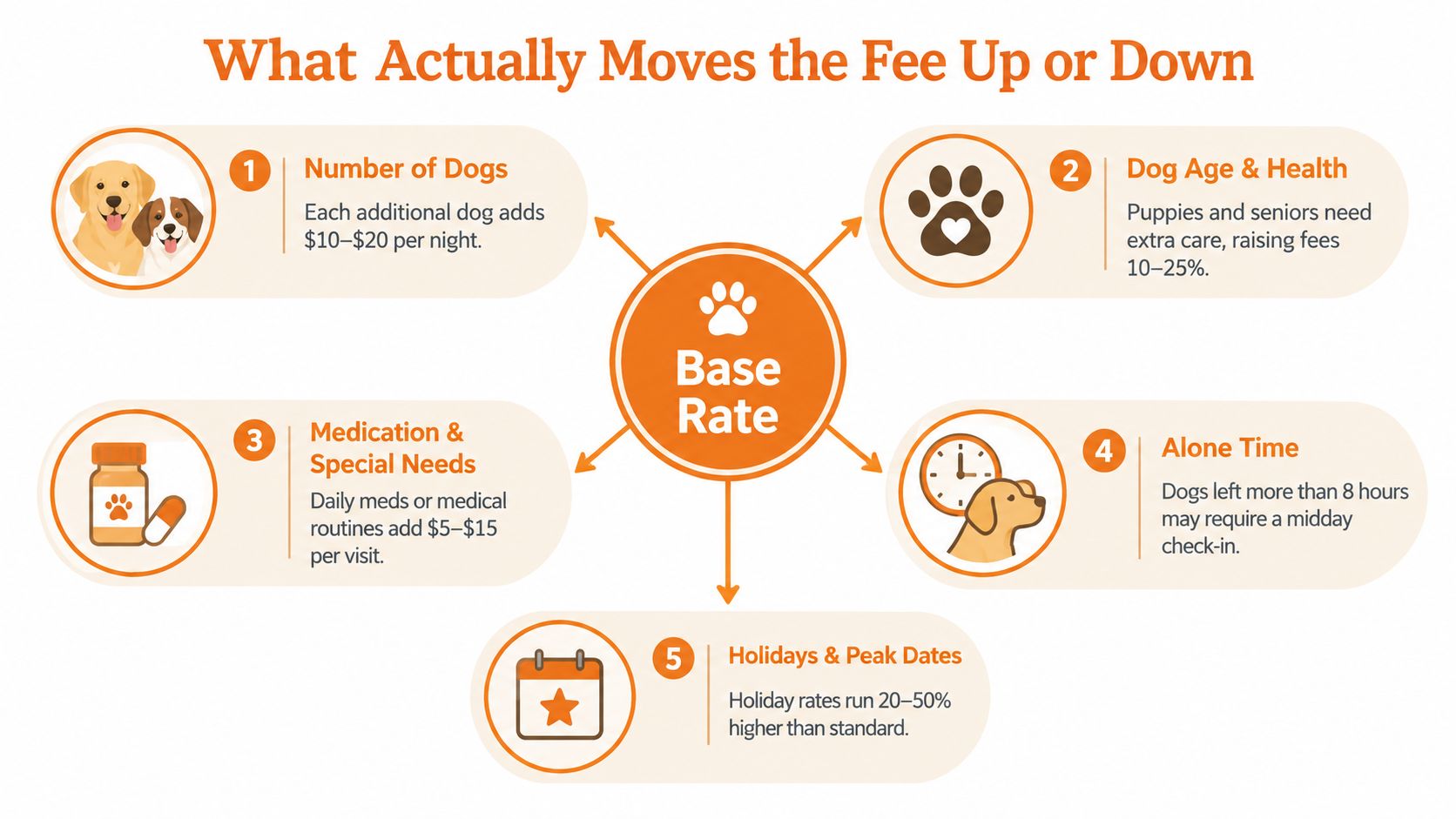
A fair quote starts with a base overnight amount, then shows how care complexity, time restrictions, location, and demand change it. Owners should see what they are paying for. Sitters should be able to deliver the agreed care without absorbing unpaid work.
Five questions that change the quote
How many dogs need care? A second dog adds feeding, walking, supervision, and risk. It may not double the workload, but a single-dog rate becomes too low when the dogs have different routines or cannot be handled together.
What does each dog require? Medication, mobility support, special diets, frequent toilet breaks, and medical monitoring increase the sitter's responsibility. A separate adjustment is reasonable when the care plan includes tasks where one missed step could create serious consequences.
How long can the dog be alone? A relaxed adult dog may manage ordinary absences. A puppy or dog with separation anxiety can turn an overnight booking into near-continuous care. If the sitter must remain home during the day, the quote should cover that presence, not only the night.
When is the booking? Demand rises around Thanksgiving, Christmas, and spring break, when travel increases and caregiver availability tightens, according to Quartz's analysis of pet-care costs. A peak-period supplement is fair when disclosed before confirmation. Adding it afterward is poor practice.
Where is the home? Local rates vary substantially. Posted hourly rates range from about $13.38 in San Antonio to $21.94 in Seattle, as documented by Care.com's rate guide. Travel time, parking, and the location's effect on other bookings also belong in the quote.
Use one formula so both sides can compare offers: base overnight rate + care adjustment + peak-date adjustment + agreed extras. The honest pricing guidance from Global Pet Sitter follows the same standard, showing what changes the total instead of hiding every adjustment inside a flat fee.
Compare services on their terms. Professional overnight sitting averages roughly $96.66 per night, while standard facility boarding commonly falls around $30 to $60 per night, according to the cited Quartz source. In-home care can cost more because the sitter works around one household's routine and provides individualized attention. Owners and sitters should compare the care delivered, then agree on the adjustment each requirement deserves.
Three Realistic Pricing Scenarios for a Week Away
The clearest way to quote house sitting fees for dogs is to show the arithmetic. The examples below use the $80 overnight reference as a base, then add qualitative adjustments for extra work. They are planning examples, not universal tariffs.
Scenario one, one healthy adult dog
The dog is comfortable alone for ordinary periods, needs a morning and evening routine, and has no medication. The owner books seven nights and asks for one additional 30-minute daily drop-in as backup.
The base is 7 × $80 = $560. The extra daily visit uses the $25 visit reference, producing 7 × $25 = $175. The example total is therefore $735 before any holiday or travel adjustment.
This arrangement makes sense when the owner wants an overnight presence plus a guaranteed daytime check. It may not be necessary if the sitter is already available for the dog during the day.
Scenario two, two dogs and daily medication
Two dogs share the home, one needs daily medication, and the owner requests daytime coverage. The base overnight amount remains the starting point, but the quote must reflect additional feeding, supervision, medication reliability, and reduced freedom to leave.
A transparent quote might list 7 × $80 = $560 as the base, then add a separately negotiated multiple-dog and medication adjustment. Don't invent a precise surcharge just to make the table look complete. The correct amount depends on whether the dogs can be walked together, how medication is administered, and how much daytime presence the owner expects.
Scenario three, an eight-month-old puppy
The puppy can't be left alone for more than a few hours and needs several walks and play sessions each day. This isn't a normal sleep-only sit. The sitter is providing daytime availability, training consistency, accident management, and repeated active care.
The base calculation is again 7 × $80 = $560, but the final quote should add a clearly stated high-attention adjustment. If the sitter must decline other work or remain at the home for most of the day, an hourly or daily care component is more honest than pretending the puppy fits a standard overnight package.
| Scenario | Base, 7 nights | Add-Ons | Estimated Total |
|---|---|---|---|
| One healthy adult dog | $560 | Seven 30-minute backup visits at $25 each, $175 | $735 before other adjustments |
| Two dogs, one medicated | $560 | Multiple-dog, medication, and daytime-coverage adjustment | $560 plus negotiated add-ons |
| Eight-month-old puppy | $560 | High-attention daytime care, walks, and play sessions | $560 plus negotiated high-care adjustment |
Peak dates change the conversation. Sitting prices rise during Thanksgiving, Christmas, and spring-break periods, so the same care plan may receive a disclosed demand adjustment. The right comparison is between the actual service bundle and the alternative, not between one unexplained nightly number and another.
Quoting Fairly on Both Sides of the Conversation
Owners should disclose the details that determine workload before asking for a final price. A sitter can't quote if "one easy dog" turns into two dogs, daily medication, a puppy schedule, and a house that requires constant attention.
Send this information in the first message:
- Dog count and ages: Include each dog's temperament and whether they can be handled together.
- Care routine: State meals, walks, toilet breaks, play, and sleep arrangements.
- Alone-time tolerance: Say the longest the dogs can comfortably remain alone.
- Health requirements: List medication, mobility concerns, special diets, and emergency instructions.
- Dates and demand conditions: Identify holiday or peak travel dates.
- Home responsibilities: Mention plants, mail, bins, cleaning, or transport expectations.
A defensible quote format
Sitters should send one short itemized message:
Base overnight care: the amount for the agreed number of nights.
Care adjustment: additional dogs, medication, daytime presence, or special handling.
Peak-date adjustment: included only when the dates create unusual demand.
Extra services: transport, extended visits, or duties outside ordinary pet care.
Total: one final amount, with the pricing unit clearly stated.
A useful script is: “The base rate covers overnight presence and the agreed routine. The total changes because your dog needs daytime company and daily medication. Here are those items separately.” That wording keeps the discussion about work rather than personality or perceived worth.

Owners should ask what the sitter's rate excludes. A low overnight fee can become expensive if every walk, medication task, or daytime check appears later as an add-on. A high quote can be reasonable when it buys near-continuous availability, experienced handling, and a clearly defined routine.
Global Pet Sitter offers a marketplace flow where owners can post dates and pet details, message candidates, and compare arrangements through profiles and reviews. Whether you use a marketplace, a local professional, or a personal referral, the same rule applies: settle the scope before arrival.
When No Money Changes Hands
Cash isn't the only way to compensate a sitter. In a house-sitting exchange, the owner may offer a private room, utilities, local transport, workspace, flexible dates, access to a garden, or a stocked kitchen. Those benefits can offset a cash fee when the sitter values them.
That doesn't make every free stay fair. Accommodation in an inconvenient location may have little value to one sitter and substantial value to another. Flexible dates may help a traveler but do nothing for someone with fixed work commitments. Both parties need to name the trade rather than assume the other person sees it the same way.
Put the exchange into words
Start with the care obligation, then describe the accommodation:
- Pet care: Dogs, routines, walks, medication, and maximum absence time.
- Home access: Bedroom, bathroom, workspace, kitchen, garden, and parking.
- Living costs: Utilities, internet, transport access, and any excluded expenses.
- Schedule: Arrival, departure, flexibility, and whether the sitter can host anyone.
- Fallback plan: What happens if the dog's needs change or the sit ends early?
The fairest comparison is an effective exchange rate. Ask what the accommodation would be worth to this sitter, then compare that value with the time, restrictions, travel, and care responsibility being requested. Don't assign a fictional market value just to justify a preferred outcome.
Fairness isn't determined by whether money changes hands. It's determined by whether both people understand the trade and would choose it knowingly.
This model works particularly well for travelers and owners who prefer in-home continuity, but it isn't suitable for every dog. A medically complex dog or a puppy needing near-continuous supervision may require a professional paid arrangement, regardless of the accommodation offered. Non-cash compensation is a deliberate agreement, not a way to disguise an under-scoped job.
A Short Checklist Before You Confirm a Sit
Before either side confirms, put the agreement in writing. A short message prevents most disputes because it turns vague expectations into visible terms.
- Define “overnight”: State sleeping hours, daytime availability, and the maximum time the sitter can leave.
- Confirm the base rate: Specify whether payment is per night, per visit, per hour, or exchanged for accommodation.
- List every add-on: Include extra dogs, medication, extended walks, transport, household duties, and daytime care.
- Record the routine: Write down meals, medication times, walks, anxiety triggers, and emergency contacts.
- Set peak-date terms: Agree any holiday or high-demand adjustment before the booking is accepted.
- Confirm changes: Decide how last-minute care changes will be priced and approved.
- Check the home arrangement: Cover keys, internet, workspace, parking, visitors, and departure instructions.
Pay special attention to two common problems. First, an owner discloses medication only after the sitter arrives. Second, a sitter adds a holiday surcharge after the dates are locked. One direct message avoids both: “Please confirm that the total includes the listed routine, medication, daytime availability, and any peak-date adjustment.”
A transparent quote is the simplest trust signal in a marketplace. When the numbers are settled before arrival, the sitter can focus on the dog and the owner can leave without wondering what the final bill will become.
Global Pet Sitter connects pet owners with reviewed house and pet sitters, letting you post dates and care details, compare candidates, and agree on a clear arrangement before the sit begins. Visit Global Pet Sitter to find an in-home care match or create a sitter profile with your experience and reviews.
Please sign in to leave a comment
