Your suitcase is open on the bed. Your dog has noticed. She's sitting a little too close, watching every folded shirt like she already knows you're leaving.
That's the moment most of us start asking the same question. Who can stay here, in her home, and keep her routine normal while you're gone? If you're on the other side of that question, traveling slowly and missing having an animal around, a house sitting network is built for exactly this meeting point.
What a House Sitting Network Actually Is
The packing-day problem is simple. You need someone in the house. Not just someone to drop in, lock up, and leave, but someone to feed breakfast at the usual time, notice if the cat is off her food, and bring the bins in.
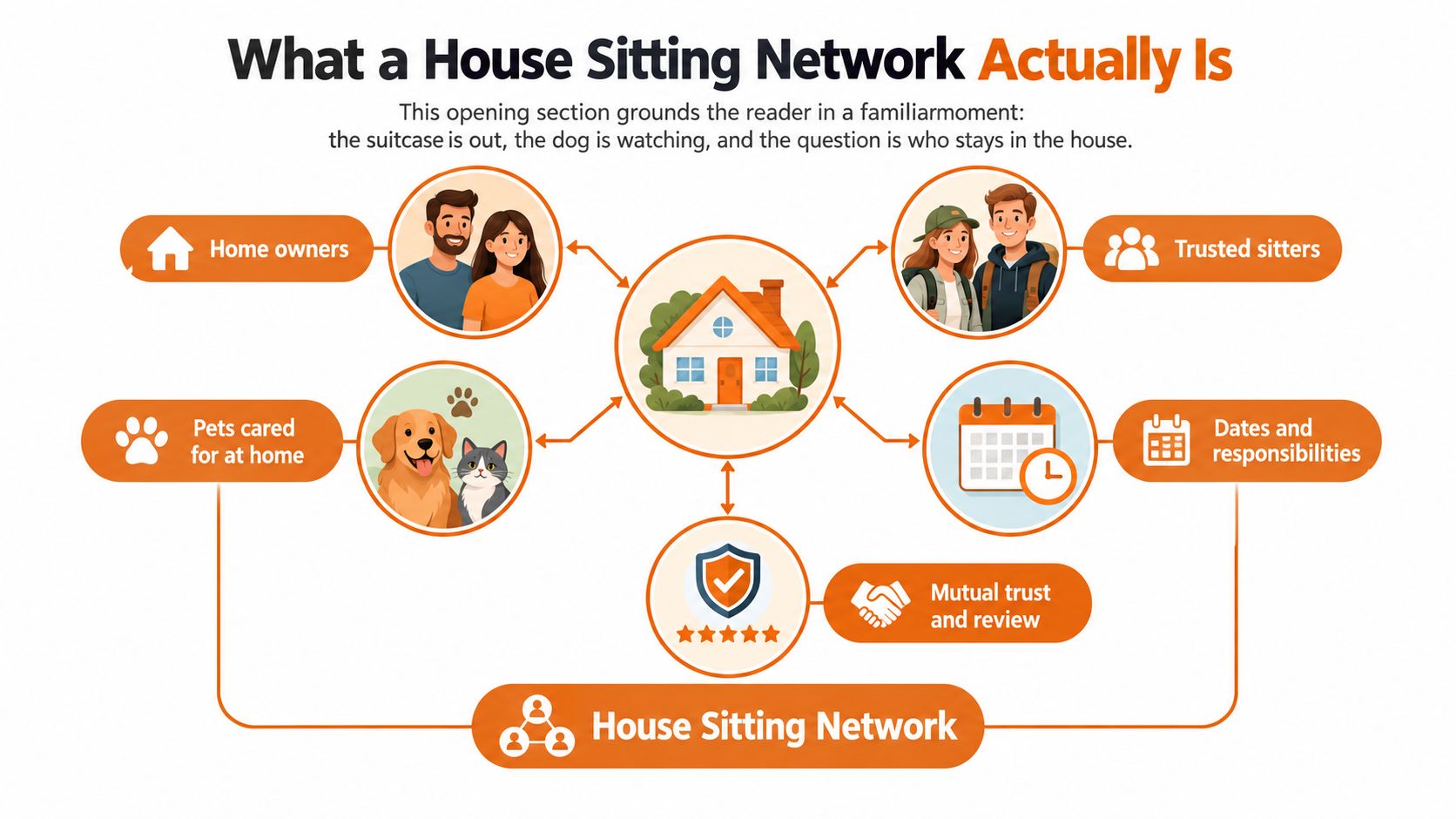
A house sitting network is a platform where pet owners and sitters find each other, and the sitter provides in-home care and companionship in exchange for accommodation rather than payment.
Think of it as a neighborhood noticeboard with a reputation system attached. A noticeboard alone only says who needs help and when. A network adds the parts that help strangers decide whether to trust each other.
What Makes It a Network
A listing board posts opportunities. A network surrounds those listings with profiles, verification, messaging, reviews, and some form of community governance. That difference matters because you're not hiring a task, you're handing over keys and a living animal.
- Owners bring the home base: They describe the house, the pets, the dates, and the care that can't be missed.
- Sitters bring presence: They live in the home, follow the routine, and keep the owner updated.
- The platform brings structure: It holds the conversation, the agreement, and the record of how past sits went.
I've learned to read that structure carefully. A pretty listing tells you where you'll sleep. The profile history, the questions in messages, and the handover notes tell you whether the sit will work day to day.
The Two Jobs You're Probably Here to Do
Most readers arrive with one of two jobs. Owners want trusted care at home so a pet can stay in familiar surroundings. Sitters want a place to stay, animal company, and a slower way to travel or work remotely.
Neither job is just about finding a match. You'll also need a clear care plan, an honest talk about money and emergencies before anyone travels, and, for international sits, a check on entry rules and insurance. By the end of this guide, you should be able to judge a network, set up a sit in the right order, and spot the risks that reviews alone won't show you.
Why House Sitting Networks Exist at Global Scale
This isn't a tiny travel hack. It's a response to how many households now share their homes with animals.
A study described in Mars' summary of its 2024 global pet-parent research surveyed more than 20,000 people across 20 countries and found that 56% of respondents owned a cat or dog, 47% of those pet owners were first-time owners, and the worldwide population of cats and dogs kept as pets exceeded 1 billion.
That last number explains the geography. The need isn't confined to one country. Owners in many places travel for holidays, work, and family, and sitters cross borders for accommodation and companionship. If you're also trying to prepare for life in another country, pet care quickly becomes part of the practical planning, not an afterthought.

A United States Benchmark
The United States shows how ordinary this problem has become. Figures cited in a regulatory submission referencing the American Pet Products Association survey estimated that 66% of U.S. households, just under 90 million homes, owned a pet, including approximately 65.1 million dog-owning households and 46.5 million cat-owning households, with overlap where homes keep both.
The same verified summary notes a separate analysis reporting U.S. pet ownership at about 70% of households in 2020 before falling to 63% in 2024. I read that as a pandemic surge followed by normalization, not a disappearance of demand. Millions of households still have to solve care whenever they leave.
What Each Side Actually Exchanges
Owners often prefer in-home care because the animal keeps its bed, smells, walking route, and routine. That continuity can be kinder than moving a nervous pet to a kennel or boarding facility, especially for older animals or pets with medication schedules.
Sitters receive a home to live in, a kitchen, a neighborhood, and animal company. They give time, attention, property care, and reliability.
No wage changes hands in the classic model, so trust is part of the currency.
That's also the trade-off. Because there's no conventional lodging transaction, both sides need clearer expectations than they'd need for a paid, tightly defined service. The value is real on both sides, housing and companionship in one direction, continuity and peace of mind in the other. The network exists to make that exchange findable, checkable, and repeatable at global scale.
How a House Sitting Network Works from Profile to Review
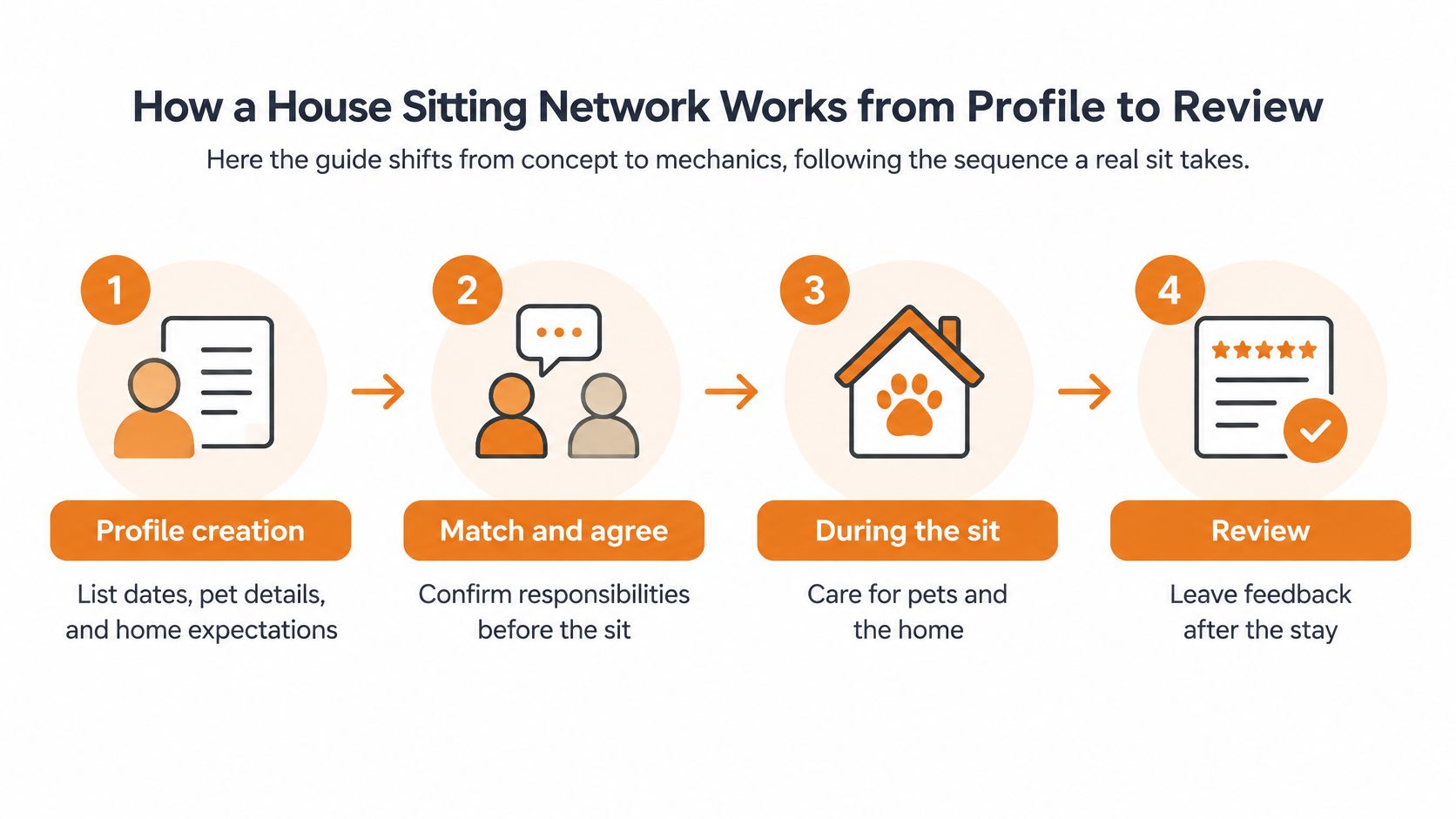
A real sit follows a sequence. If you understand the order, you won't confuse a friendly first message with a confirmed, well prepared arrangement.
Profiles and Verification Come First
Owners list dates, pet details, and home expectations. Good listings say more than cute dog, lovely house. They name feeding times, walking needs, medication, sleeping arrangements, and any quirks, like a cat who must not slip out the front door.
Sitters present experience, animal preferences, and availability. They should also state their limits. If you can't manage a large reactive dog or daily injections, saying so early protects everyone.
Verification then splits into two kinds of signals. Identity verification confirms an account maps to a real person. Performance signals are different. They include references, imported evidence, repeat bookings, response behavior, and dispute history. Don't treat an identity badge as proof someone gives medication on time. It's only the first layer.
Messaging, Matching, and Handover
Messaging is where fit gets tested. Ask about arrival time, overlap with the owner, exercise limits, vet arrangements, visitors, cars, and what happens if travel plans change. Sitters should ask what a normal day looks like, hour by hour.
- Confirm responsibilities in writing: Agree dates, duties, house rules, and emergency contacts before travel is booked.
- Transfer the handover properly: Walk through feeding, locks, alarms, plants, bins, and pet routines in the home when possible.
- Keep a simple record during the sit: Send agreed updates and note any incident while details are fresh.
Reviews Close the Loop
Reputation here should work as a two-sided trust system, not a popularity score. Research summarized in Harvard Business School marketplace trust research identifies three core levers, bilateral reviews, controlled disclosure of participant information, and user choice over counterparties, with double-blind review publication reducing retaliation effects.
Bilateral means owners review sitters and sitters review owners. Double-blind means neither review appears until both are submitted or the window closes. That makes honest detail safer to give.
Read review recency and completed-sit counts alongside any average score. A recent review mentioning medication compliance, arrival reliability, property care, and clear communication tells you far more than a bare five stars. Our linked reputation and reviews guide goes deeper on reading those signals. Controlled disclosure also matters, because addresses, full names, and documents shouldn't be shared before they're needed.
How to Choose and Join a Trustworthy Network
Don't start by collecting brand names. Start by deciding what would make you comfortable handing over, or accepting, a set of keys.
Check verification depth first. Does the network only confirm an email address, or does it verify identity and show performance history separately? Then look at how reviews work, how fees are explained, and whether support answers like a real team when a sit goes sideways.
It's also sensible to check any unfamiliar platform as you would any site asking for personal details, and Digital Footprint Check's website safety guide is a useful prompt for those basic safety checks before you upload documents or pay.
| Criterion | What to Look For | Why It Matters |
|---|---|---|
| Verification | Identity checks shown separately from references and sit history | You can tell who someone is from how reliably they've acted |
| Reviews | Bilateral reviews, ideally published double-blind, with dates and completed sits | Recent, specific feedback is harder to game and easier to judge |
| Imported reviews | A clear process with evidence, such as screenshots, and labeling of source | Experienced sitters don't have to start from zero, but claims stay checkable |
| Pricing | Fees, renewal terms, and future paid plans stated plainly | Surprises erode trust before a sit even begins |
| Support | Visible contact routes and incident escalation | Problems need a person and a process, not a help page loop |
| Governance | Member feedback channels and visible responses to suggestions | A community that can raise issues is easier to correct over time |
How One Community-Driven Option Fits
For comparison, Global Pet Sitter describes itself as a community-driven house and pet sitting marketplace that is free for early adopters with lifetime-favored rates when paid plans launch. It uses verified members, presents pricing as an honesty point, and lets experienced sitters import 5-star reviews from other platforms via screenshots so prior credibility isn't lost.
Its flow is three steps, create a profile, find your match, and connect and care. It also points to community governance through member votes on features and feedback shared in an active Facebook group. Treat those as claims to test against the table above, not as a reason to skip your own checks.
If you're comparing several options side by side, the linked overview of house sitting platforms can sit next to your notes.
Before joining anywhere, ask five plain questions. Who is verified and how? When do reviews publish? What will I pay now and later? Who helps if a sitter cancels or a pet gets ill? Can members influence how the platform changes? If answers are vague, keep looking.
Best Practices for Safety, Communication, and Etiquette
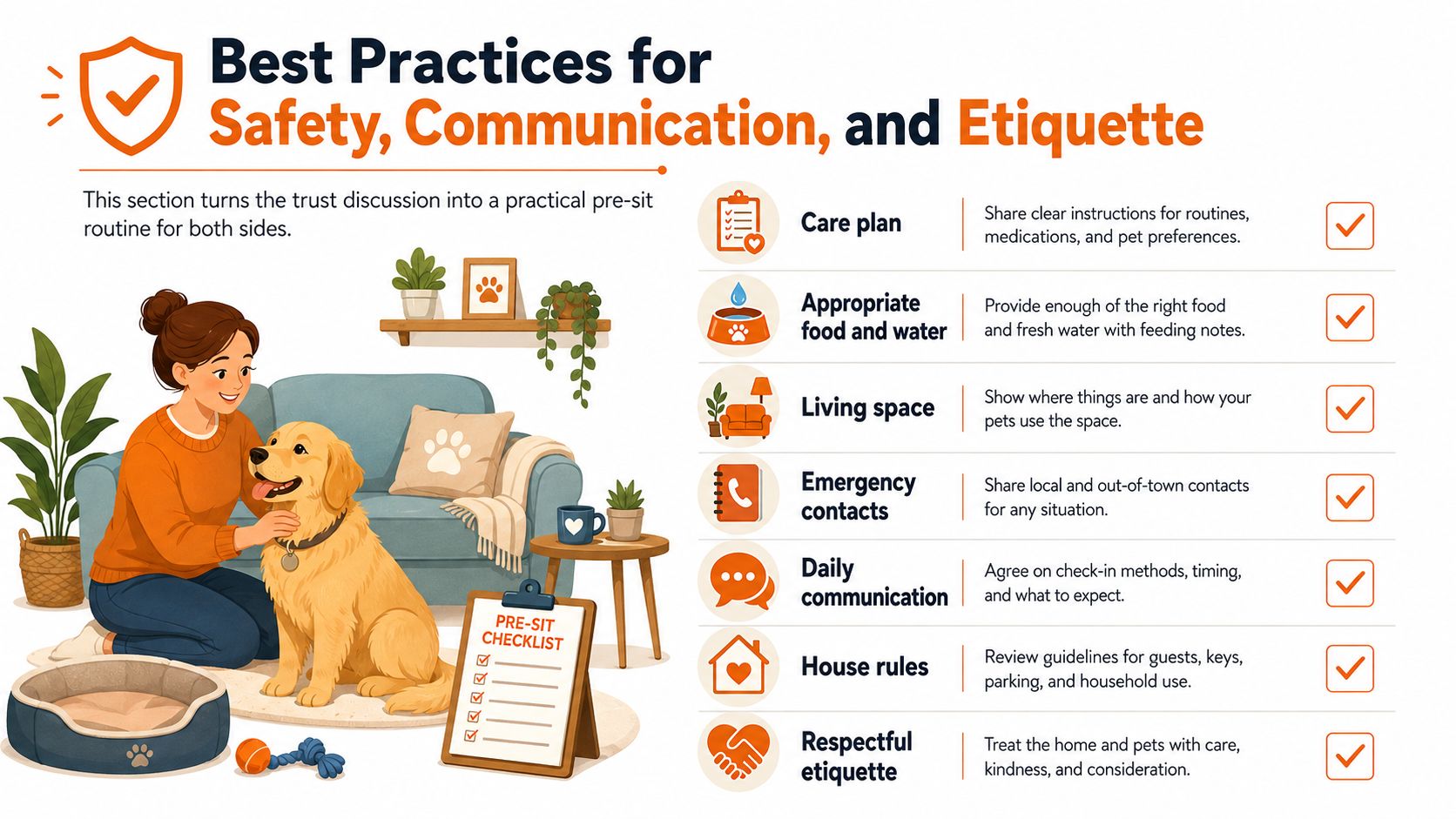
Good sits rarely depend on one big gesture. They depend on small details being written down before the owner leaves and followed without drama.
Build the Care Plan Around Welfare
Use welfare as your backbone. Guidance in the American Veterinary Medical Association pet ownership guidelines recommends appropriate food, water, living space, preventive and therapeutic healthcare, companionship, species- and age-appropriate physical and mental stimulation, and advance emergency planning, and specifically advises owners to arrange care when they're temporarily unable to do so.
Turn each item into a handover field. Don't write feed twice daily and hope for the best. Write the amount, the time, where the food lives, and what to do if the pet refuses a meal.
- Food and medication: Record quantities, timing, medication dose and route, and where supplies are stored.
- Health and identity: List the vet, emergency authorization, microchip information, allergies, and current conditions.
- Behavior and exercise: Note triggers, walking routes, exercise limits, and safe ways to provide stimulation.
- Home and emergency basics: Add living space rules, evacuation instructions, utility shutoffs, and a local backup contact.
Matching should use those needs as constraints, not just dates. A sit involving medication, a reactive dog, a senior animal, or several pets needs a sitter who's done that kind of care before. Availability alone isn't qualification.
Agree How You'll Stay in Touch
Set a communication cadence before departure. Some owners want a photo every evening. Others prefer a short note every few days and a call only if something matters. Either is fine, as long as you both agreed it.
Timestamped updates and optional photo check-ins create a simple trail. They don't replace judgment. If a dog stops eating or a cat hides all day, say so early and plainly rather than sending a cute photo and hoping.
Practical rule: Raise a small concern while it's still small, and put the agreed next step in the message thread.
Etiquette is mostly reliability made visible. Arrive when promised. Keep the home as you found it, or cleaner. Follow house rules about visitors, smoking, cars, and bedrooms without renegotiating mid-sit. Owners, in return, should leave a clean home, enough supplies, working keys, and instructions that match reality.
I've found the kindest handovers are also the most specific. Warmth helps, but a labeled medication box and a vet number on the fridge help more at midnight.
The Risks Reviews Cannot Cover
Free accommodation does not mean free of risk. That's the assumption I'd most like new users to drop.
A trusted sitter can still lose a key. A healthy pet can still need an emergency vet at night. A pipe can leak, a flight can be canceled, or an owner can return to damage that both sides remember differently. Reviews describe past behavior. They don't allocate cost or legal responsibility when a rare, expensive event happens.
Who Pays When Something Goes Wrong
Talk through accidental property damage, veterinary emergencies, key loss, cancellation, and theft allegations before the sit. Ask whether homeowner, renter, travel, or personal-liability insurance might respond, and ask the insurer directly rather than assuming the platform covers it.
International sits add another layer. Coverage can change across borders, and the fact that no money changes hands may affect how the relationship is classified for insurance, tax, or local regulatory purposes. That classification question is exactly why a plain-language written agreement helps. It should distinguish complimentary care from paid employment and state what each side has agreed.
Longer stays raise exposure. One analysis linked in Marketintelo's pet-friendly hotel market report reports average pet-related trips increasing from roughly 3 to 4 days before the pandemic to 8 to 12 days, while extended-stay bookings now represent 19% of pet-friendly hotel bookings. More days mean more chances for a medication mistake, an illness, a maintenance issue, or a schedule disruption.
Use a jurisdiction-neutral pre-sit risk checklist:
- Emergency spending limit: State how much a sitter may spend at a vet before approval, and how repayment will happen.
- Veterinary authorization: Name the clinic, account holder, and who can consent to treatment.
- Incident documentation: Agree to timestamped photos, receipts, and a written note in the shared thread.
- Insurance questions: List the exact questions each side will ask their own provider before travel.
- Backup care: Name a local person who can step in if the sitter becomes ill or must leave.
Background checks sit in this wider safety picture too, and the overview of background check requirements helps separate identity checks from other screening. None of it removes risk. It makes responsibility visible before stress hits.
Cross-Border Sits Are Not Frictionless
A sitter arriving from another country may need to distinguish tourism from work authorization, respect visa duration limits, prove accommodation, complete local registration where required, and check travel insurance exclusions. If a pet is being transported, pet-specific documentation and transport rules may also apply.
That caution fits a wider mobility picture. A 2025 analysis referenced in Marketintelo's pet flight nanny services market report estimated 57 million international assignees and linked increased cross-border mobility to rising demand for pet relocation services.
Don't assume no payment automatically means no immigration or employment ambiguity. Owners should care about this too. If your sitter can't legally enter or stay for the full sit, your care plan fails at the border, however strong their reviews are.
Your Next Step into the House Sitting Community
You don't need to master every scenario before your first sit. You need a decision path you can follow in order, and the discipline not to skip the uncomfortable questions.
Owners, your job in one line is to make your pet's normal routine easy for a stranger to reproduce. Sitters, yours is to prove you can follow that routine reliably in someone else's home, and communicate before small issues grow.
A Short Path for First-Time Users
Start by deciding which side you're on for this trip. Listing a sit and seeking a sit need different preparation, even if you'll do both over time.
- Prepare the essentials: Owners gather dates, pet details, vet information, medication instructions, and home expectations. Sitters gather experience, references, availability, limits, and any review evidence they can import.
- Choose a network using criteria: Check verification, bilateral reviews, pricing clarity, support, and governance rather than joining the first search result.
- Match by constraints: Filter by location, animal type, dates, and care requirements, then use messages to test the details that profiles can't show.
- Run the risk checklist: Confirm emergency spending, vet authorization, insurance questions, backup care, and cross-border status where relevant.
- Complete the loop: Do the handover carefully, keep agreed updates, and leave a specific bilateral review afterward.
That last review is your contribution back. Mention arrival reliability, property care, medication compliance, and communication if they applied. Future owners and sitters can make better decisions from that kind of detail than from stars alone.
Community Is Part of the Safety System
A house sitting network isn't only software matching dates. It's a community whose members teach each other what a good handover looks like, flag unclear listings, and tell the platform when support or features aren't working.
That's why governance and responsiveness belong in your choice. A network that listens in public, acts on feedback visibly, and keeps pricing honest gives you more than listings. It gives you a place where problems can be surfaced and norms can improve.
Your concrete next step is small. Create your profile before you urgently need a sit. Owners can post dates and pet details while the routine is fresh in mind. Sitters can add references or imported review screenshots, state their limits clearly, and start conversations early.
Travel with animals in the picture asks for trust, but it doesn't ask for blind trust. Bring warmth, bring checklists, and choose people and platforms that make both possible.
Create your profile on Global Pet Sitter to post a sit with your dates and pet details or, as a sitter, import your existing 5-star reviews and start finding matches. You'll join a community-driven network built around verified members, honest pricing, and care that keeps pets comfortable at home.
Please sign in to leave a comment
