You've just landed with a backpack, a phone at 12% battery, and directions to a house you've never seen. Somewhere under the doormat is a stranger's key. Inside, a dog is waiting for its evening walk, a cat expects medication, and the kitchen table may become your office for the next few weeks. That's house sitting travel at its most appealing, and at its most misleading. The accommodation may be exchanged rather than paid for, but the trip still has transport costs, time constraints, care duties, and trust decisions.
House sitting works when you treat it as a budget strategy with measurable trade-offs, not as a holiday hack. The strongest sitters plan their applications, protect gaps between assignments, verify hosts, and understand what “free accommodation” leaves out. They also know that a polished profile alone doesn't guarantee a booking. Competition can be intense, and reputation is often the deciding factor.
Why House Sitting Travel Works in 2026
A house sit can replace a hotel, short-term rental, or part of a monthly housing bill while giving you something a paid room rarely provides, a lived-in base with a kitchen, local routines, and an animal that needs you there. Market estimates place global house sitting travel at about USD 2.1 billion in 2024, with a projection of USD 4.05 billion by 2033 at a 7.2% CAGR. Another industry estimate puts the category at USD 1.9 billion in 2024 and projects USD 5.3 billion by 2033 at 12.1% annual growth. The methodologies differ, but both estimates point to sustained expansion. See the market overview and house sitting statistics for the source comparison.
The appeal is practical. Travelers want lower-cost lodging, while owners want someone to care for pets and property at home. Online trust platforms have made it possible to match those needs across borders, and the post-COVID period brought many new participants into the category. Survey reporting from 2023 found that 68% of house sitters had started since COVID, while 46% were sitting abroad and 44% found sits through house-sitting websites. The same reporting found that 51% of homeowners would only hire sitters with references, which explains why profile quality matters so much. These figures are reported in house-sitting travel coverage from Route for Less.

The exchange only works if you accept the constraints. You can't choose a new city on a whim when a dog needs a walk at a fixed time. You may spend nights between assignments, pay for long-distance transport, or handle an unexpected appliance failure. A travel article on the operational pitfalls of becoming a house sitter notes that sitters are commonly tied to pet routines, may need relief cover for overnight trips, and can absorb unplanned costs involving animals, utilities, or household problems.
Practical rule: Calculate the cost of the entire route, not just the nights inside the house.
The market's scale also means you shouldn't assume every desirable listing will be easy to secure. One large platform forum example records three successful offers from 48 applications, an application success ratio of roughly 6% to 7%. That's not a universal rate, but it's a useful warning. House sitting travel rewards customized applications, fast responses, accurate availability, and proof that you understand the specific pets and home.
Building a Sitter Profile That Gets Replies
Hosts are handing over keys, animals, routines, and private space. Your profile has to answer their silent question, “Will this person make my departure easier or riskier?” Scenic travel photos don't answer it. A clear face photo, a calm image with an animal, and a concise value statement do.
Start with a headline that says what you bring. “Remote worker with senior-dog and medication experience” is more useful than “Animal lover exploring the world.” In the opening paragraph, explain your work pattern, the animals you've cared for, your availability, and the home tasks you can handle. Mention specific species and situations, such as administering tablets, walking reactive dogs, caring for indoor cats, watering plants, receiving mail, or managing a security system.
Turn experience into evidence
Past care should read like a record, not a collection of adjectives. Include dates, animal types, the length of the arrangement, and what you were responsible for. A former neighbor can confirm that you cared for their cat. An employer can confirm reliability and communication. A previous host can describe how you left the property.
References from outside a platform still help when they're specific and contactable. Ask each person to describe the situation rather than just stating you are trustworthy. If you're improving your profile photo, use natural-looking images and review Secta Labs headshot examples for ideas on clear, professional framing without making the profile feel like a corporate résumé.
Your availability calendar must be accurate. Hosts often filter for exact dates, and an outdated calendar signals avoidable risk. State whether you can arrive early, stay a night after departure, receive mail, work from home, or manage alarm codes. For a detailed checklist, use these profile tips for pet sitters.
| Profile Element | Reply Impact | Effort to Build |
|---|---|---|
| Clear headline and face photo | Helps hosts understand you quickly | Low |
| Specific pet-care history | Shows relevant capability | Medium |
| References | Reduces perceived trust risk | Medium |
| Accurate calendar | Prevents wasted conversations | Low |
| Remote-work and home-care details | Answers practical concerns | Low |
| Video introduction | Adds personality and context | Medium |
Before submitting, proofread every line and ask someone unfamiliar with house sitting to read it. If they can't tell when you're available, what animals you've handled, or how you'll communicate, the host won't know either. Your profile should feel personal, but it must still function as a fast risk assessment.
Finding and Applying for the Right Sits
Treat applications as a funnel. Begin with hard constraints, then assess fit, then write. The most useful filters are dates, location radius, pet type, sit length, workspace, and internet requirements. A beautiful listing becomes a poor choice if the bus connection is difficult, the dog can't be left alone while you work, or the dates create an expensive gap before your next commitment.
The available evidence suggests you should expect rejection, particularly before you have reviews. A forum example records three accepted offers from 48 applications, or approximately 6% to 7%. Use that as a planning signal rather than a promise. If you need one confirmed sit, apply broadly enough to absorb competition, but never apply for dates you can't honor.
Write a message that proves you read
Your first message should be short and specific. Confirm your dates, identify one detail from the listing, connect it to your experience, and finish with a question that makes conversation easy.
“Your dates work for me, and I saw that Luna needs a quiet walk before breakfast. I've cared for anxious dogs who do better on consistent routes, and I work remotely from a dedicated setup. Is her usual morning route close to the house, and would you be open to a video call?”
That structure works because it addresses availability, attention, competence, and next steps in a few lines. Avoid generic openers, long autobiographies, and questions about nightlife or sightseeing before you've discussed the animals. Don't negotiate dates or ask for special arrangements before the host has shown interest.
Use alerts when possible, then apply while the listing is still fresh. This guide to finding house sitting jobs covers the sourcing process, but the operating principle is simple: shortlist quickly and personalize every application.
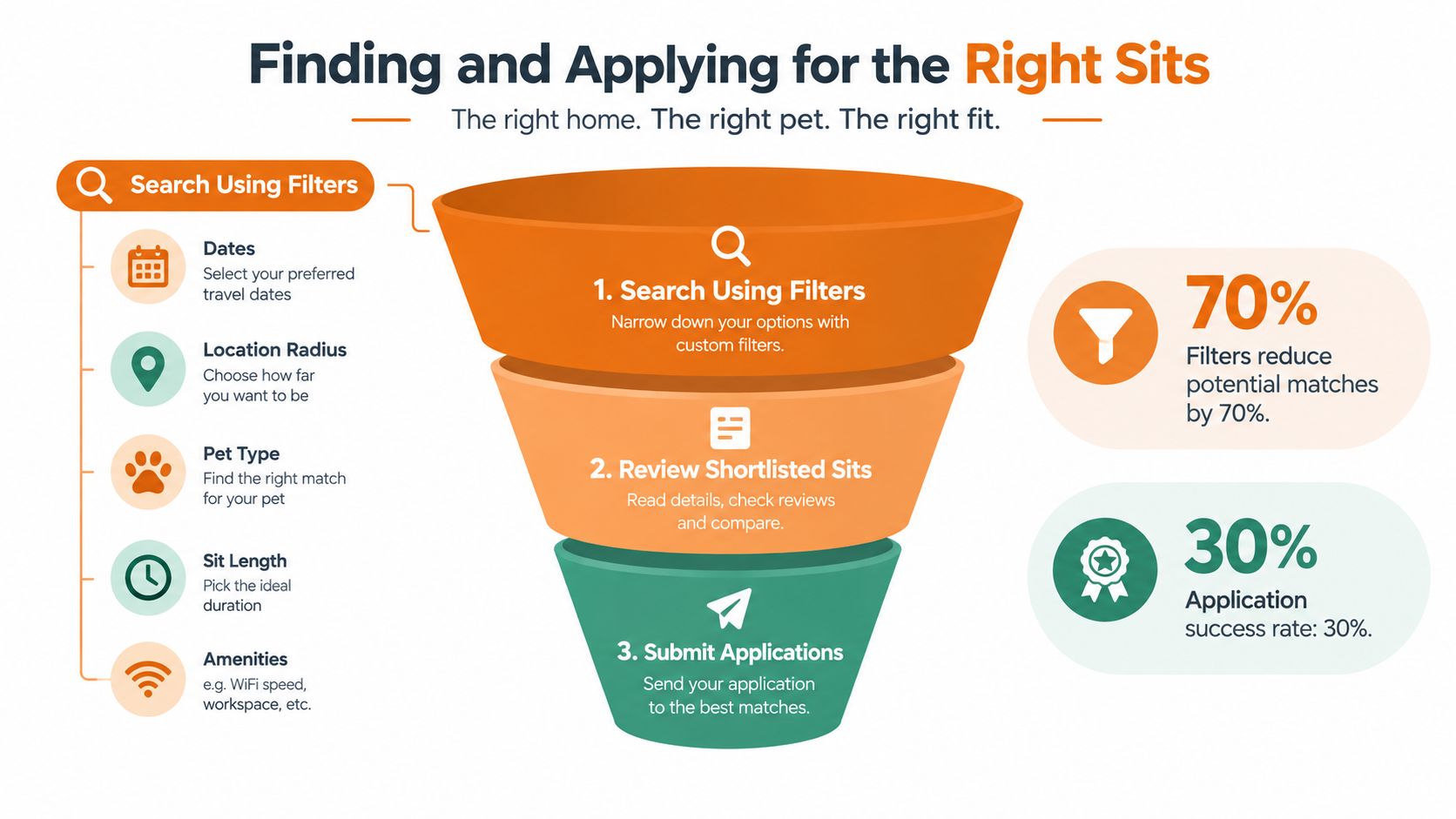
Calendar planning determines whether house sitting saves money. Back-to-back assignments can reduce gap nights, but only if transport between them is realistic and the handover timing leaves room for delays. Tell hosts about partial availability when it's genuine. A sitter available for the final part of a longer listing may still be useful, while a false commitment creates a much bigger trust problem.
Vetting Hosts and Choosing the Right Platform
A host profile deserves the same scrutiny as a sitter profile. You're not only choosing an address. You're choosing the instructions, communication style, pet temperament, household expectations, and support available when something breaks.
Start by checking whether the host has reviews from previous sitters, whether those reviews appear consistent, and whether the listing explains daily duties plainly. Imported reputation can be useful, but it should be verifiable. Ask how the reviews were collected and whether the platform distinguishes identity verification from references. Recent industry discussion also points to growing interest in reviews, background checks, AI matching, and community-owned alternatives. The broader house sitting platforms market coverage provides context for those governance questions.
Use the first call as an interview
Ask about:
- Pet health: medications, allergies, mobility issues, escape risks, and emergency history.
- House boundaries: rooms that are off limits, visitors, candles, heating, and cleaning expectations.
- Local support: emergency vet, neighbor, cleaner, gardener, and the person who can authorize repairs.
- Travel freedom: whether you can leave for a day, how long pets can stay alone, and whether relief cover is allowed.
- Handover quality: a video walkthrough, written instructions, keys, alarms, utilities, and rubbish collection.
Vague descriptions, refusal to hold a video call, pressure to commit immediately, or sudden edits that remove context should slow you down. A host who treats reasonable questions as distrust may be difficult when a pet becomes ill or an appliance fails.
| Platform | Annual Fee (USD) | ID Verification | Built-in Insurance | Global Listing Density | Dispute Resolution |
|---|---|---|---|---|---|
| Platform A | Verify current terms | Compare depth | Read exclusions | Check destination coverage | Review written process |
| Platform B | Verify current terms | Compare depth | Read exclusions | Check destination coverage | Review written process |
| Regional platform | Verify current terms | May vary | May vary | Often stronger locally | Check local rules |
| Community marketplace | Verify current terms | Check member status | Confirm separately | Depends on adoption | Review community policy |
Don't copy availability across multiple platforms without updating it. Dual-platform accounts with conflicting calendars make hosts doubt whether you'll manage the basics. Compare fees, insurance exclusions, identity checks, geographic density, and dispute procedures before you pay. A niche regional service may suit a flexible traveler better than a large global network if it has stronger coverage in your target area.
For a practical overview of platform differences, consult this guide to house sitting platforms.
Preparing for the Stay
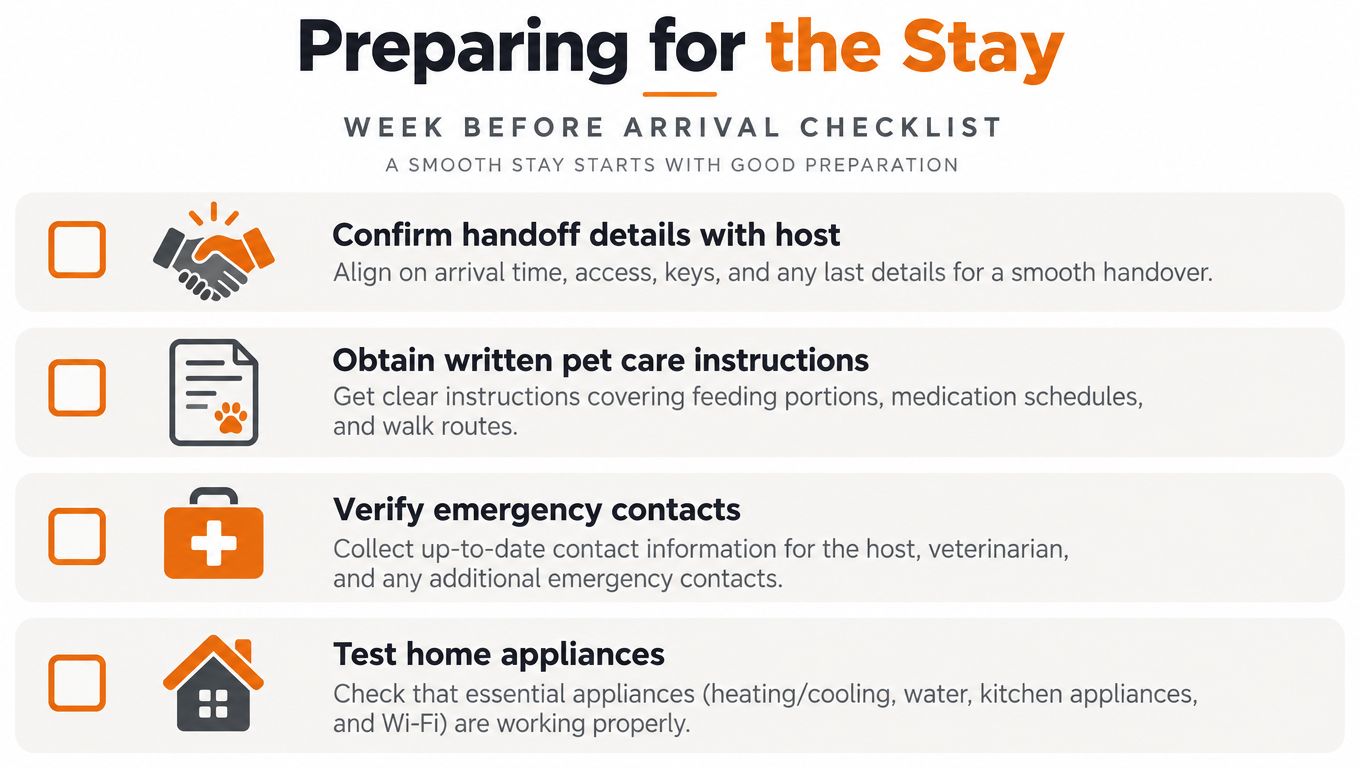
The week before arrival should be a handoff, not a casual exchange of messages. Ask for written instructions that cover each pet's feeding portions, medication, walking route, behavior triggers, preferred contacts, and emergency vet. If the host says, “It's all obvious,” ask for the details anyway. Stress makes familiar routines easy to forget.
Build a handoff record
Request a video walkthrough before the host leaves. Locate the fuse box, water shutoff, smoke and carbon monoxide detectors, router, spare keys, heating controls, cleaning supplies, and rubbish collection point. Confirm the arrival window and key exchange method, then identify a local person who can make decisions if the host is unreachable.
Photograph existing damage in bedrooms, living areas, gardens, entrances, and pet spaces. Keep the images with timestamps and store copies offline. This isn't an accusation. It protects both sides when a scratch, stain, or broken handle becomes difficult to date.
Pack a compact sitter kit:
- Cleaning basics: pet-safe cleaner, microfiber cloths, waste bags, and disposable gloves.
- Small repairs: a multitool, tape, spare batteries, and supplies for sticky handles or blinds.
- Access backup: a secure spare-key holder and a written local contact.
- Work essentials: headphones, charging cables, and a backup connection plan.
Remote workers should test the internet before committing to a long sit. Ask whether the connection supports video calls, whether there's a workspace with a proper chair, and what happens if the router fails. For planning reliable internet for working abroad, consider both the host network and a separate mobile-data option.
Set up your workspace away from food bowls, litter trays, and high-traffic pet zones. Your workday will be easier when the animals have a predictable area and you don't turn the kitchen into a permanent office. Send the host a short arrival confirmation, then follow the written routine rather than improvising.
Real Costs, Safety, and Visas Most Sitters Miss
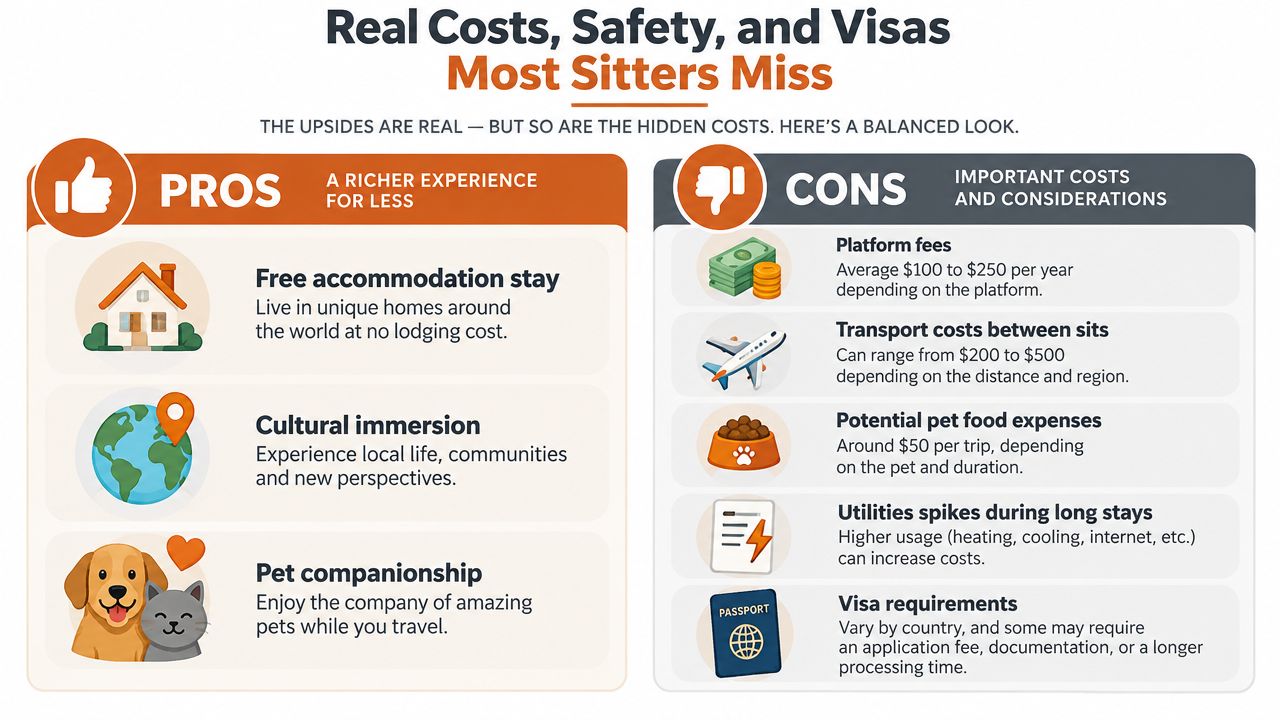
“Free accommodation” describes the exchange, not the full economics of the journey. You still pay to reach the house, move to the next sit, cover nights that don't align, and manage ordinary travel infrastructure around a fixed pet schedule. Reporting on the category notes that sitters usually cover their own transport and need a plan for gaps between sits, while affordability pressure is one reason more travelers are considering the model. Reuters' reporting on house sitting and rent pressure is useful context for that shift.
Build a trip budget with separate lines for:
- Transport: trains, buses, flights, taxis, and local transfers between assignments.
- Gap nights: accommodation when one sit ends before another begins.
- Pet supplies: food or medication if the host's stock runs out and reimbursement isn't immediate.
- Household costs: agreed utilities, heating, laundry, or small approved purchases.
- Connectivity: mobile data or backup internet when remote work depends on it.
Ask in writing who pays for pet food, repairs, emergency transport, and utility increases. Don't assume a homeowner's policy covers an unpaid sitter's personal injury, property damage, or pet-care liability. Read your travel insurance exclusions and look for explicit coverage inside a third-party home.
Treat immigration as a separate risk
A house sit can resemble volunteering, tourism, or work depending on the destination and the arrangement. Visa-free entry may not cover the full stay, and some border authorities may treat services exchanged for accommodation as work. Check official immigration guidance for the country, the permitted stay length, and whether pet or property care creates an issue. Don't rely on a forum post or a platform's general reassurance.
Share your live itinerary and check-in rhythm with one trusted person. Keep the host agreement, pet records, emergency contacts, insurance details, and passport copies available offline. If you access banking on a host's network, use a reputable sitter-specific VPN and enable multifactor authentication.
This video offers another practical introduction to the exchange model and the responsibilities attached to it:
Community Habits and Your 30-Day Sitter Plan
Repeat approvals come from small behaviors that reduce uncertainty for the next host. Leave the home cleaner than you found it, send a brief mid-stay update with a useful photo, and report problems before they become emergencies. After departure, request a review promptly and save references in a portable format so your reputation isn't trapped on one platform.
The habits hosts remember
A good update doesn't need a travel diary. “Milo ate normally, the medication was given at 8, the boiler pressure is unchanged, and the bins are out for tomorrow” tells the host that you're paying attention. A clean handover, labeled keys, washed bedding, and a clear note about supplies can matter as much as an enthusiastic review.
Keep your response time consistent, especially when you're already discussing a sit. If your plans change, tell the host immediately and update every active calendar. Trust grows through predictable behavior, not profile language.
A workable 30-day launch plan
Days 1 to 7: Rewrite your headline, replace unclear photos, complete the availability calendar, and describe your pet and home-care experience with concrete examples. Ask an outside reader whether the profile answers the questions a cautious host would ask.
Days 8 to 14: Request references from former hosts, neighbors, employers, or friends who can describe your reliability. Complete identity checks where available, organize documents, and decide which platform policies you can accept.
Days 15 to 21: Shortlist suitable destinations and batch-apply to 8 to 12 sits with personalized messages. That application target is a planning recommendation, not a market statistic. Track dates, host response, pet duties, transport options, and whether each listing creates a gap.
Days 22 to 30: Hold video calls, confirm written instructions, map the handoff, and prepare a backup plan for transport and accommodation. Keep applying to the next suitable sits rather than waiting for one answer to determine your entire route.
Global Pet Sitter is one marketplace option for this workflow. It lets owners post dates and pet details, while sitters create profiles, browse opportunities, connect with hosts, and import reviews from other platforms through screenshots. Its community model also emphasizes member feedback and visible governance, which can be relevant when you're comparing trust systems rather than looking only at listing volume.
The repeat sitter's advantage is boring consistency. Accurate calendars, clear messages, clean exits, and useful updates create the reputation that makes the next application easier.
House sitting travel becomes sustainable when you measure the whole exchange, protect your time, and choose assignments that fit your actual life. Start with one manageable sit, document what you learn, and improve the profile and process after every handoff.
Global Pet Sitter connects pet owners with sitters for in-home care and travel-based house sitting, with profiles, dates, pet details, messaging, and portable reputation features. Create your profile, review suitable opportunities, and visit Global Pet Sitter to find a house sitting arrangement that matches your route and responsibilities.
Please sign in to leave a comment
