You're probably here because a trip is coming up, your bag is half packed, and your dog is watching you with that look that says, “Something's changing, and I'd like an explanation.”
That's the moment when people type in how does dog sitting work. They're not really asking only about booking. They're asking who will feed the dog, who will notice if dinner is skipped, who will lock the back gate, who will handle the bedtime routine, and who they can trust with both the pet and the house.
Dog sitting is basically a temporary handover of routine. Instead of moving your dog into a kennel or asking for a quick favor from a neighbor, you arrange for someone to step into your dog's normal world and keep life steady while you're away. For many dogs, that matters more than people expect. The bowl stays in the same place. The smells are familiar. The sleeping spot doesn't change. The day feels recognizable.
That promise is a big reason in-home pet care has grown into a large category. One industry report estimated the global pet sitting market at USD 2,685.2 million in 2024 and projected USD 5,143.3 million by 2030, with 11.8% compound annual growth from 2025 to 2030. In the same report, dogs accounted for USD 2,430.9 million in revenue in 2024, which shows how strongly this service centers on dogs and their routines in the home (Grand View Research pet sitting market analysis).
What many first-time owners miss is that dog sitting works as a shared trust system. The owner trusts the sitter with a pet, keys, instructions, and private space. The sitter trusts the owner to describe the dog, leave clear guidance, and set up a safe environment. When it goes well, it feels smooth. When it's vague, small problems multiply fast.
Practical rule: A good dog sit is less like hiring a helper for a task and more like handing over the controls for a few days to someone who follows your map.
Introduction What Dog Sitting Really Means for Dogs and Owners
A good dog sit starts long before the sitter walks through the door. It starts with a routine that already matters to your dog, and with two people agreeing to protect it.
For the dog, daily life is built from small repeats. Breakfast happens in the same bowl. The walk follows a familiar rhythm. The evening settles down in a predictable way. Dogs often read that pattern the way people read a calendar. When the pattern stays steady, home still feels safe even when you are away.
That is why dog sitting is more than arranging coverage for a pet. It is a shared trust system. The owner hands over access to a dog, a home, and a set of habits that keep the day running smoothly. The sitter takes responsibility for carrying that routine carefully, noticing changes, securing the home, and sending clear updates so the owner is not left guessing.
First-time owners often picture dog sitting as simple company for the dog. Company is part of it. The full job can also include meals, walks, medication, cleanup, behavior management, entry instructions, bedtime habits, and quick judgment calls if something changes unexpectedly.
A helpful way to view it is this. The sitter is stepping into an already-running household, much like a substitute teacher walking into a classroom with its own rules, schedule, and personalities. The goal is to keep things steady enough that the dog does not have to figure out a whole new world while missing you.
That handover usually includes three layers:
- Care details such as feeding times, exercise, medication, sleep habits, and stress triggers.
- House details such as keys, alarms, Wi-Fi, trash day, lights, and areas that are off-limits.
- Backup plans such as your vet's information, emergency contacts, and what to do if plans change.
This hidden work is where many sits succeed or fall apart.
When the instructions are clear and the expectations go both ways, the arrangement feels calm for everyone involved. The owner can leave without wondering what was forgotten. The sitter can care for the dog without filling in gaps. The dog gets the simplest benefit of all: a day that still makes sense.
How In Home Dog Sitting Differs from Boarding and Drop Ins
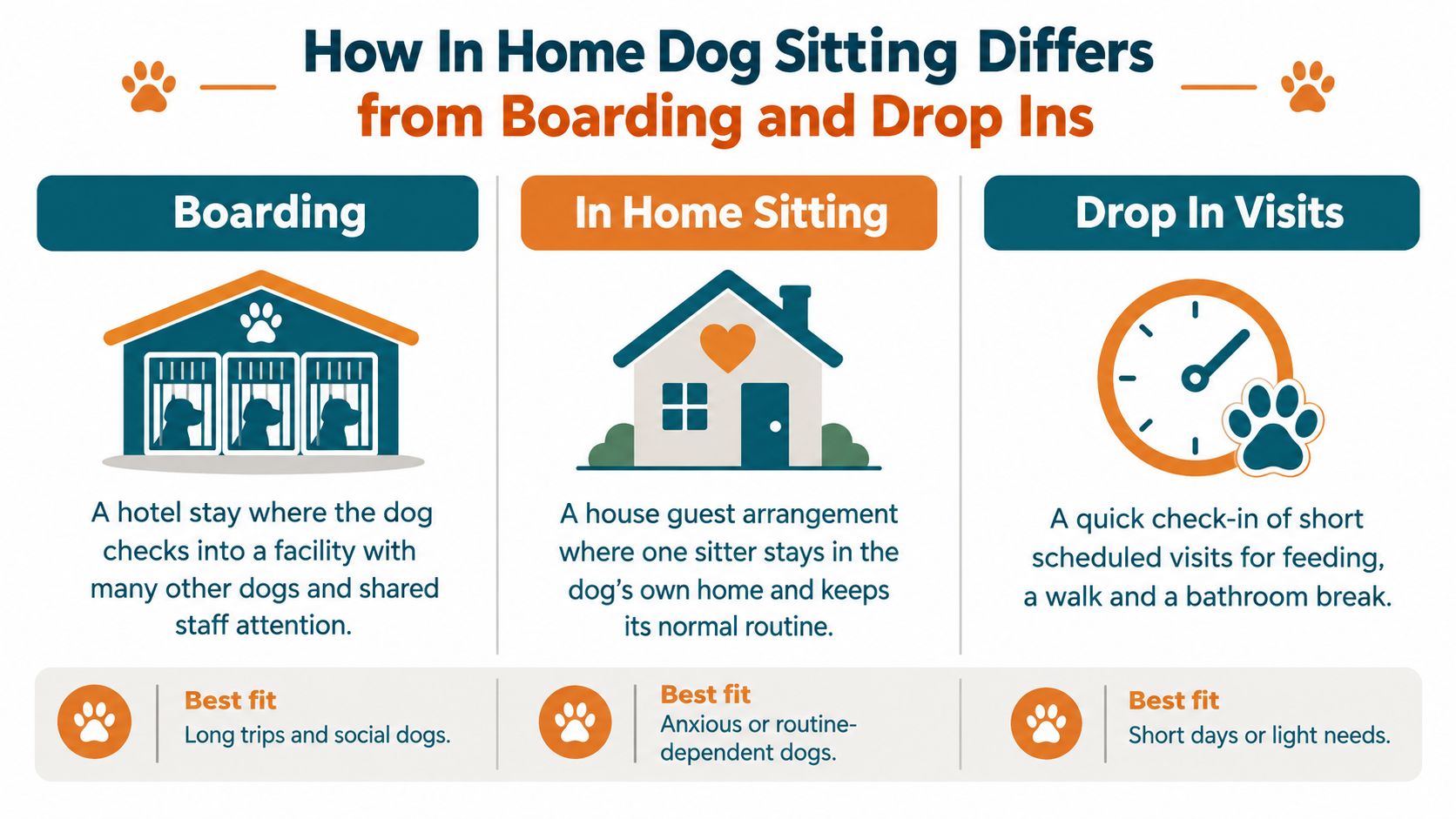
The three options solve different problems, and the right choice depends less on price labels than on how much change your dog can handle and how much trust work you want the sitter to carry.
Boarding is a facility stay
With boarding, your dog leaves home and stays at a kennel, daycare, or pet care facility. Staff manage feeding, bathroom breaks, exercise, and supervision within the facility's system.
That setup works well for dogs that settle quickly in new places, tolerate noise, and do fine around unfamiliar animals and people. The main tradeoff is routine. Your dog adjusts to the facility's schedule, staffing pattern, and environment rather than keeping your household rhythm.
In-home sitting protects the routine, but asks for more trust
With in-home sitting, care happens in your dog's own space. The sitter stays overnight or spends long blocks of time in the home, depending on the agreement. Meals happen in the usual bowl, walks start from the usual door, and bedtime often happens in the usual spot.
For many dogs, that continuity matters more than owners expect. Older dogs, anxious dogs, multi-pet homes, and dogs with strong habits often do better when the surroundings stay familiar. A clear side by side overview in this pet sitting versus boarding comparison can help if you are choosing based on temperament and daily rhythm.
There is another layer that guides often skip. In-home sitting is also a shared trust system. The owner is handing over access to a home, keys, routines, and emergency instructions. The sitter is accepting responsibility for a living space, a dog's behavior, and small judgment calls that can carry real liability if something goes wrong. That is why a good in-home sit depends on clear expectations from both sides, not just affection for dogs.
Drop-ins cover tasks, not full-time presence
Drop-in visits are shorter scheduled stops during the day. The sitter comes in, handles specific care jobs, and leaves. That might include feeding, potty breaks, a short walk, fresh water, medication, or a bit of play.
This option fits dogs that can stay alone comfortably between visits and owners who mainly need coverage for workdays, evenings out, or short stretches away. The limit is simple. Drop-ins maintain tasks, but they do not recreate household presence. If your dog needs companionship, supervision, or help settling at night, a few visits will feel very different from someone staying.
| Care option | Best fit in plain terms | Main tradeoff |
|---|---|---|
| Boarding | Dogs comfortable away from home | New environment and shared staff attention |
| In-home sitting | Dogs that do best with familiar routines | Requires strong trust, home access, and clear handover |
| Drop-ins | Shorter absences or lighter daily needs | No steady overnight presence |
A practical way to choose is to ask one question first. Does your dog mainly need a place to be, a person to stay, or a few care visits at set times? That answer usually points you in the right direction faster than comparing service names.
If your plans include pet-friendly travel before or after the sit, this guide to animal friendly hotel booking can help you line up the travel part with the care plan.
How the Dog Sitting Process Works from Posting to Match
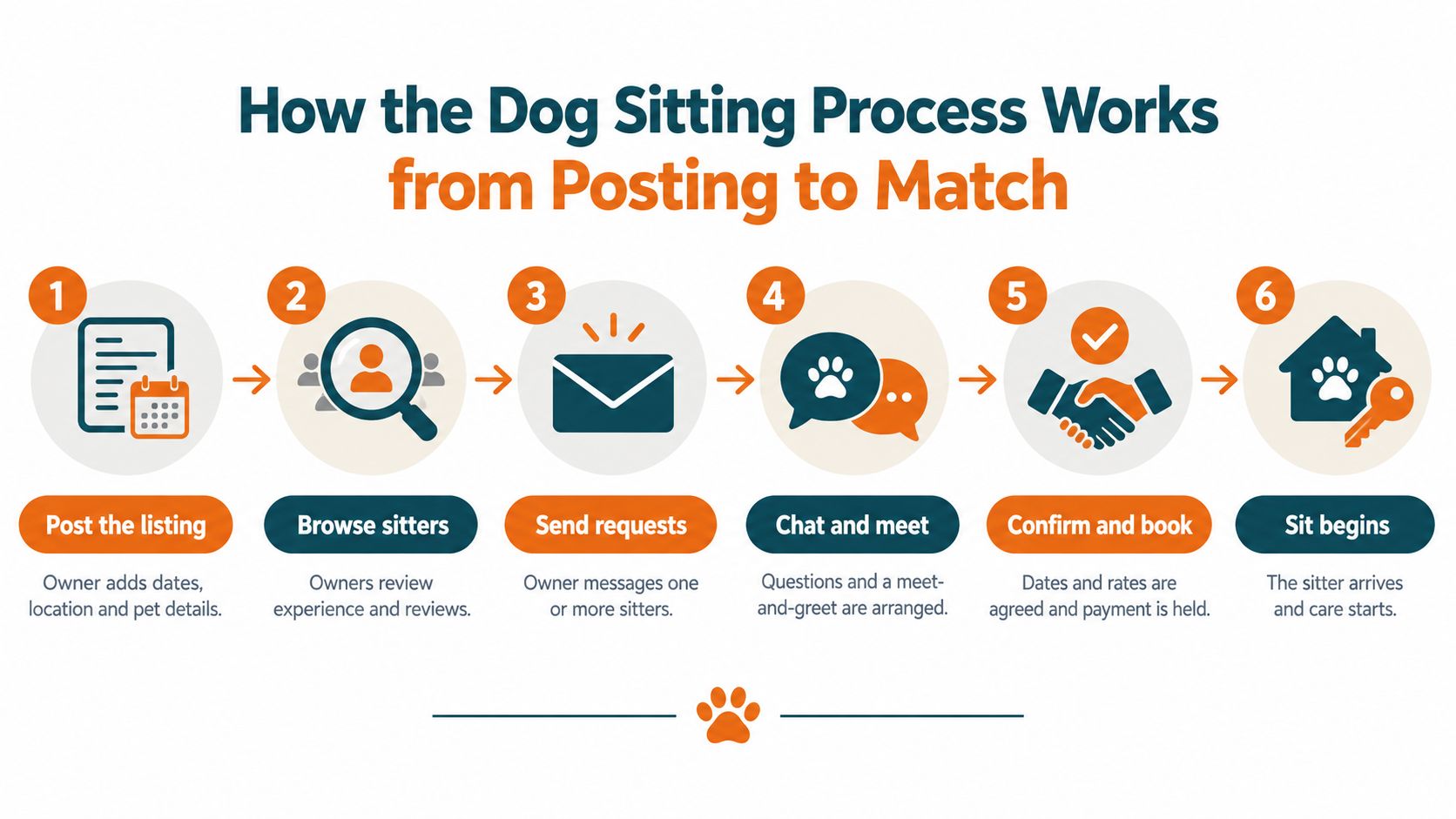
Most platforms follow the same basic flow. The details vary, but the logic stays familiar. An owner describes the sit, a sitter reviews it, both sides talk, and then they decide whether the fit is right.
Step one starts with a clear listing
The owner posts the dates, location, pet details, and the shape of the sit. Good listings answer practical questions before anyone asks them. How many dogs? What's the sleeping arrangement? Are there medications? Can the dog be left alone for a while, or does someone need to stay close by?
The more specific the listing, the better the match.
A useful starting point is this guide on how to find a pet sitter, because it shows what makes a profile or request easier to evaluate from the beginning.
Sitters review the details and apply
A sitter usually scans for fit first, not just destination. They're checking whether the dog's needs match their experience and whether the home setup sounds workable. A calm adult dog with a simple schedule is a different sit from a young dog that needs structure, training consistency, and close supervision.
Strong applications usually mention the dog, not just the dates. Owners want to see that the sitter read the listing.
For example, a better message sounds like this:
“I've cared for dogs that need set walk times and medication with meals, and I'm comfortable following a detailed routine.”
That lands better than a generic “I'm available.”
Then the conversation gets specific
Once there's mutual interest, messaging becomes a sorting tool. Both sides check for practical fit. The owner may ask about dog experience, work schedule, and comfort with things like leash reactivity or early wake-ups. The sitter may ask how long the dog can be left alone, whether there are cameras, and how the dog reacts to strangers entering the home.
A quick list of smart questions helps here:
- Routine questions: What time does the dog eat, walk, rest, and go out last thing at night?
- Behavior questions: How does the dog react to guests, traffic, other dogs, or being left alone?
- Home questions: Where does the sitter sleep, how is entry handled, and are there any house rules that matter daily?
The match is really about alignment
The final choice usually comes down to whether expectations line up. Some owners want frequent updates. Some prefer one evening message unless there's a problem. Some dogs want near-constant company. Others are easygoing as long as the basics stay on track.
On exchange-based house and pet sitting platforms, the arrangement may involve no money changing hands, while paid services often confirm rates and payment terms at booking. Global Pet Sitter is one example of a marketplace built around owners posting sits, sitters applying, and both sides arranging in-home care through profiles and direct messaging.
Once both sides say yes, the process shifts from matching to preparation.
Vetting Introductions and Building Trust Before the Stay
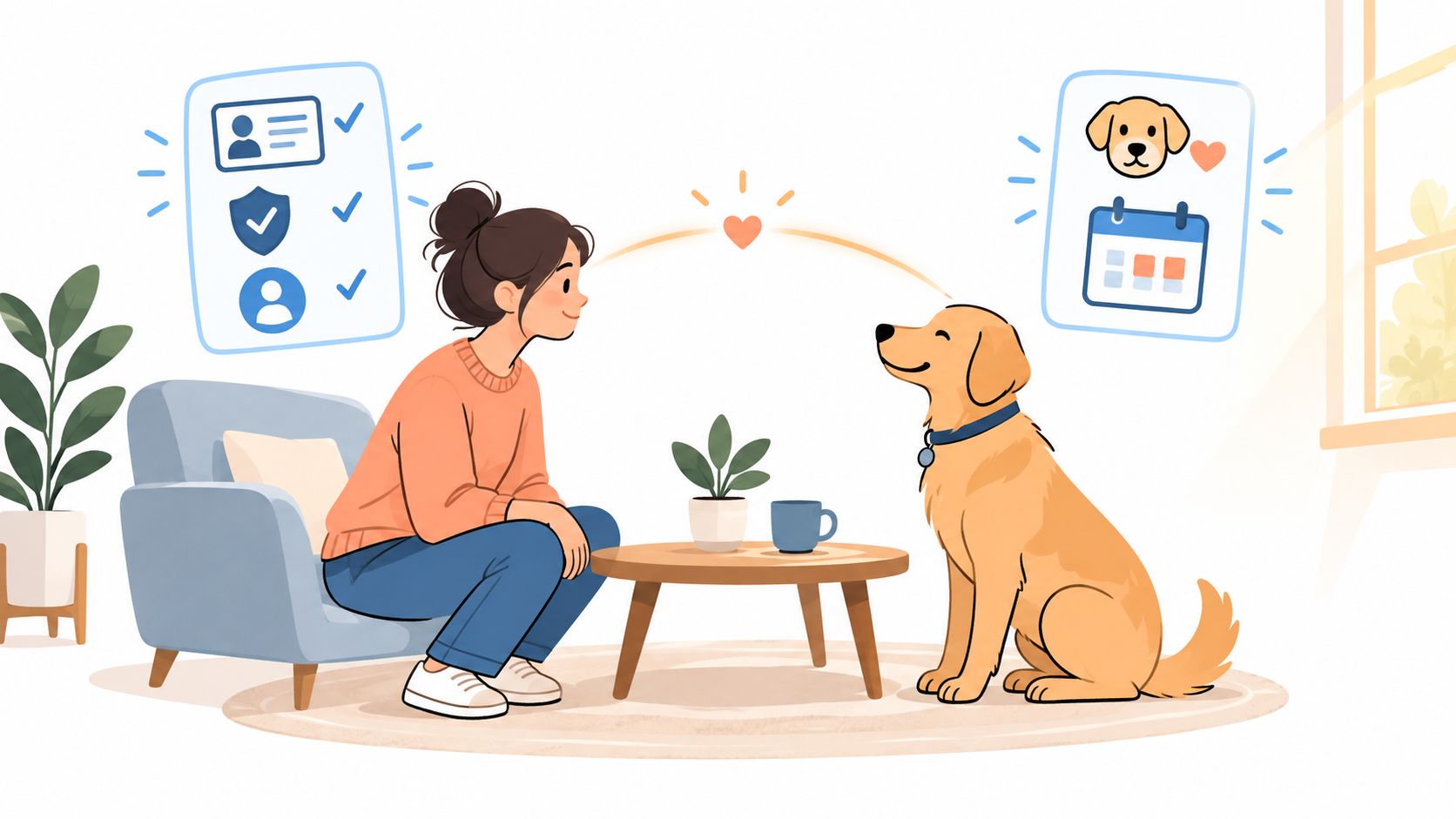
Trust is the engine behind dog sitting. Without it, the whole arrangement feels shaky. With it, even a first sit can feel calm and workable.
A national survey in the United Kingdom found that only 9% of dog owners had ever used a dog sitter who visits the home. The same source reported 17% had used a dog walker and 9% had used daycare, which helps explain why in-home dog sitting often requires stronger trust signals than more familiar pet-care options (Dogster pet sitting statistics roundup).
What owners should check first
Start with the sitter's profile and read it like you're hiring someone to run your household rhythm for a few days. Experience matters, but relevance matters more. A sitter who understands senior dogs, nervous dogs, or multi-pet homes may be a better fit than someone with a longer but more general background.
Look for signals that reduce uncertainty:
- Identity and profile depth: A complete profile is easier to trust than a sparse one.
- Reviews with detail: Specific comments about reliability, communication, and routine-following tell you more than broad praise.
- Consistency: If the profile says “I love all pets” but never explains how they handle practical care, keep asking questions.
Some marketplaces also allow sitters to import outside review history through screenshots of prior five-star feedback. That can help experienced sitters carry over reputation instead of starting from zero.
What sitters should check too
Owners vet sitters, but sitters should vet owners just as carefully. A vague listing can create problems later. If the owner downplays behavior issues, skips details about the home, or can't explain the dog's normal day, that's a warning sign.
A sitter should find out:
- whether the dog has any bite history or escape habits
- how long the dog can safely be left alone
- whether medication, mobility support, or behavior management is part of the sit
A good introduction doesn't try to sound perfect. It tries to sound accurate.
Meet-and-greets matter because dogs are part of the decision
A video call helps first. An in-person meet-and-greet is even better when possible. Owners get to see whether the sitter asks thoughtful questions. Sitters get to see how the dog responds in real time. Some dogs lean in and settle quickly. Others stay watchful and need a slower handoff.
This short video gives a helpful visual sense of how a dog-sitting interaction can feel when the energy is calm and patient.
During the introduction, cover the details people often skip:
| Topic | What to ask |
|---|---|
| Access | Who has keys, codes, and backup entry instructions? |
| Dog habits | What does the dog do when stressed, excited, or left alone? |
| Updates | How often should the sitter message, and by what method? |
| Boundaries | Are there off-limit rooms, furniture rules, or guest rules? |
When both sides leave that conversation feeling clearer, not just friendlier, trust has started to do its job.
Daily Care Routines Communication and Keeping Dogs Comfortable
Your sitter arrives, your dog watches the door, and the first few hours set the tone for the whole stay. If dinner shows up at the usual time, the leash comes out in the usual way, and the house feels familiar, many dogs settle faster. If everything shifts at once, even an easy dog can become restless, clingy, or off routine.
That is why daily care is more than a checklist. It is the part where trust gets carried out in real life. The owner trusts the sitter to keep the dog's day steady. The sitter trusts the owner's notes to be accurate enough to prevent avoidable problems. A good sit works like borrowing someone else's routine and handling it carefully until they return.
Routine is the care plan
Dogs usually respond to patterns more than explanations. They do not know why you are away. They notice that breakfast came late, the evening walk was skipped, or bedtime felt noisy and different.
The closer the sitter stays to the dog's normal rhythm, the easier it is to tell the difference between stress from change and a real problem. That hidden part matters. Routine is not only about comfort. It is also how a sitter notices when something has started to drift.
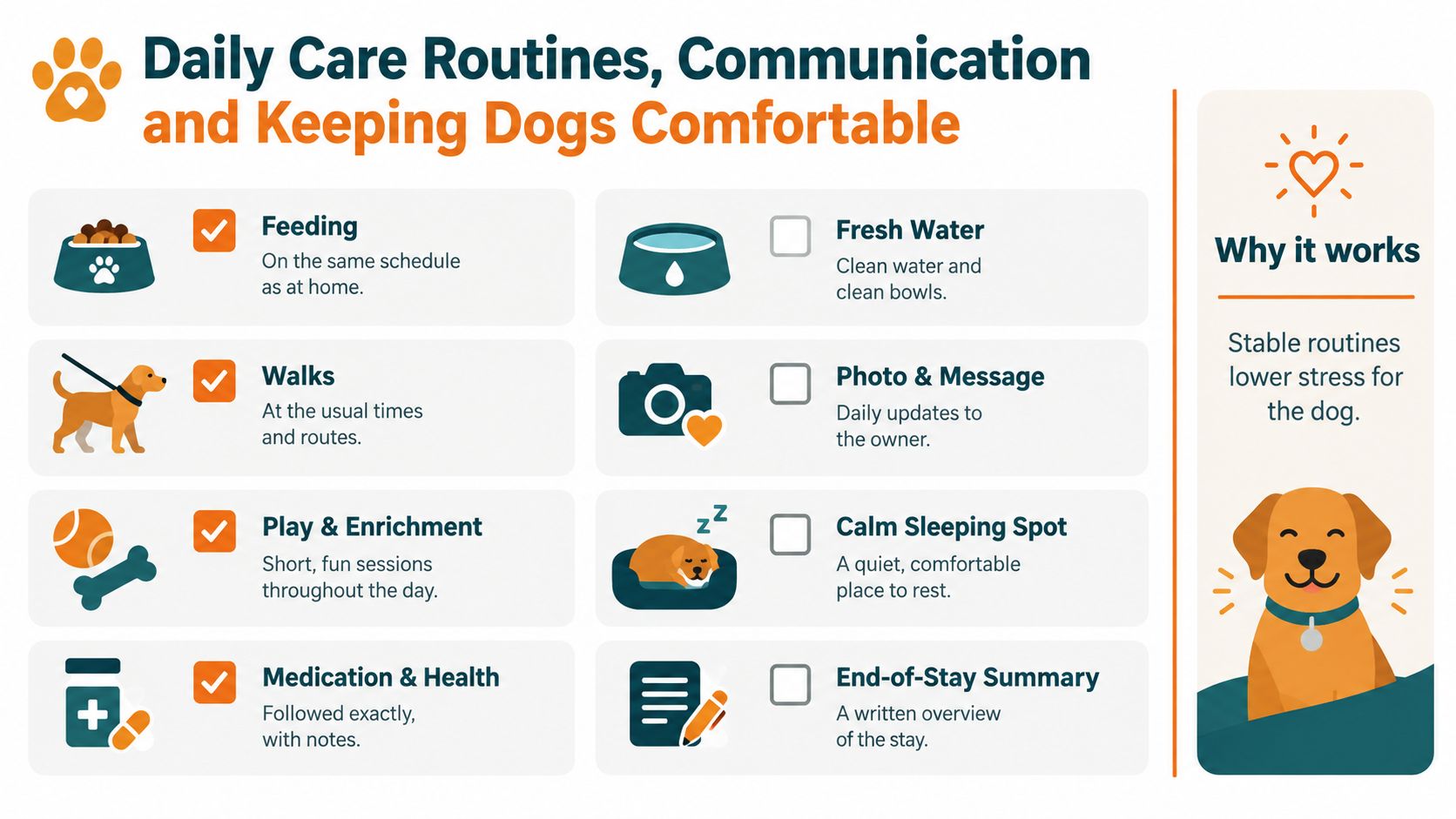
A practical care sheet should give the sitter enough detail to repeat the dog's normal day with confidence:
- Meal details: brand, portion, timing, treats, and foods to avoid
- Walk details: usual times, preferred route, leash or harness setup, and common triggers
- Comfort details: sleeping spot, favorite toys, noise sensitivities, and how the dog likes to be greeted
- Medication details: what to give, when to give it, and how the dog usually takes it
Clear notes reduce guesswork. Guesswork is where mistakes start.
A good sitter observes the dog, not just the clock
Feeding, walking, and letting the dog out are the visible tasks. Observation is the quieter part of the job, and it often matters just as much.
A sitter should notice whether the dog is eating normally, drinking normally, resting normally, and using the bathroom normally. Small changes can be early clues. A dog who usually finishes meals but suddenly walks away from the bowl is giving information. So is a dog who becomes unusually withdrawn after a walk, paces at night, or cannot settle in a room where they are usually calm.
Watch the dog in front of you. Use the written routine as a map, not a substitute for attention.
Many experienced sitters keep short daily notes for that reason. They are not trying to make the sit feel clinical. They are creating a simple record so changes stand out instead of getting missed.
Updates work best when they follow a pattern
Owners often want reassurance. Sitters often want to avoid sending too many messages. Both problems get easier when the update rhythm is agreed on before the stay.
A simple pattern usually works well:
- Arrival update after the sitter gets in and the dog has settled
- Daily update with a photo and a short note on meals, walks, mood, and anything unusual
- Immediate message if there is a change that affects the dog's health, safety, or normal routine
This helps both sides. Owners are not left wondering whether silence means everything is fine. Sitters are not trying to guess whether a minor change is worth reporting.
Comfort comes from predictability
Some owners assume comfort means extra play, extra treats, or constant attention. Sometimes it does. Often it means the opposite. It means keeping the day boring in the best possible way.
A nervous dog may relax faster with the same sleeping spot, the same water bowl location, and the same short evening walk they always get. An energetic dog may need a familiar game and a predictable cooldown period afterward. The sitter is not trying to create a vacation experience. The sitter is trying to keep the dog emotionally steady while life feels temporarily different.
According to The International Dog Sitter's guide to professional dog sitting tips, the safest approach is to match the dog's usual routine closely, track basic daily patterns such as appetite and bathroom habits, keep communication expectations clear, and escalate quickly when symptoms suggest more than ordinary stress or adjustment (professional dog sitting tips).
Safety Liability and Payment Expectations You Should Know
This is the part many guides rush past. It's also the part that protects everyone.
The moment a sitter has your key and enters your home, the arrangement becomes bigger than feeding and walks. There are safety risks inside the house, possible damage issues, emergency decisions, and questions about who is responsible if something goes wrong.
Home safety starts before the sitter arrives
In-home safety guidance recommends removing or securing medicines, scissors, cords, cleaning products, and toxic foods or plants such as chocolate, grapes, and lilies. It also recommends securing windows, doors, gates, carriers, stairs, and kitchen access to reduce escape and ingestion risks (in-home pet sitting safety guide).
A quick prep list helps:
- Remove hazards: Put medications, cleaners, and tempting food well out of reach.
- Secure exits: Test gates, latches, doors, and any weak spots in fencing.
- Write emergency details: Leave vet contact information, backup contacts, and clear instructions if you can't be reached.
If you want a deeper look at the business side of that responsibility, this article on pet sitting liability and insurance is worth reading before a first sit.
Care custody and control is the hidden issue
Insurance guidance uses the term care, custody, and control, often shortened to CCC. In plain language, it means the sitter may be responsible for both the pet and the property while those are under their control.
Recent guidance says many sitters still buy low CCC limits even though specialists recommend at least $25,000, and sometimes $50,000 for large-breed or multi-dog households (pet sitter insurance coverage gaps article).
That doesn't mean every owner needs to quiz a sitter like an insurance adjuster. It does mean both sides should understand the risk. If a dog is injured, a key is lost, or property is damaged, everyone will wish the expectations had been clear before day one.
The biggest risk in dog sitting often isn't the walk. It's the responsibility that comes with home access.
Payment and exchange models aren't all the same
Some dog sitting arrangements are paid. Others are exchange-based, especially in house-sitting communities where the sitter provides care in return for staying in the home. Neither model is automatically better. They create different expectations.
With paid services, rates, cancellations, and payment timing should be agreed upfront. With exchange-based sits, both sides still need clarity on dates, duties, house rules, and what “full care” really means.
If a medical dispute ever gets more serious than expected, legal questions can become complicated. For owners trying to understand one piece of that broader situation, this explainer on whether you can sue a vet for negligence gives useful context around what negligence discussions can involve after a bad outcome.
Making Your Next Dog Sit Smooth and Successful
The easiest way to make a dog sit work is to stop thinking of it as a simple booking and start treating it like a shared operating manual. Your dog already has one. The sitter just needs access to it.
If you're an owner, your best move is clarity. Write down the routine, prepare the house, and be honest about quirks. “He's friendly” is less useful than “He gets overstimulated when guests enter and settles faster if ignored for a minute.”
If you're a sitter, your best move is precision. Repeat key instructions back, ask what counts as normal, and don't assume silence means flexibility. Most owners relax when they can tell you're not winging it.
A short checklist that prevents a lot of stress
- Confirm the routine: Meals, walks, sleep, medication, and time alone should be explicit.
- Prepare the home: Keys, hazards, emergency contacts, and access instructions should be ready before arrival.
- Set communication rules: Decide update timing so nobody has to guess.
- Align on boundaries: Cover guests, cameras, off-limit spaces, and furniture rules.
- Start with a fit, not a fantasy: The best sit is usually the one where the dog's needs and the sitter's style naturally match.
A low-pressure first sit can help both sides build confidence. A weekend away is often easier than starting with a long trip if nobody has worked together before.
Dog sitting works best when it feels predictable for the dog, transparent for the owner, and manageable for the sitter. That's the whole system in one sentence.
If you want a simple place to put this into practice, Global Pet Sitter connects pet owners and sitters through in-home house and pet sitting arrangements where pets stay comfortable at home. You can post a sit, review profiles and reputation signals, message candidates directly, and work out the routine before anyone hands over the keys.
Please sign in to leave a comment
