Your holiday dates are pencilled in, your dog's favourite walking route is ready to share, and someone friendly has offered to stay. Then you picture handing over your keys, and the questions start: do you really know who they are, can they manage your pet's medication, and what happens if something goes wrong?
Learning how to vet a house sitter means replacing that uncertainty with evidence. At Global Pet Sitter, we recommend a fixed sequence: confirm identity, check references, test relevant pet-care skills, interview for judgement, and complete a written handover. You don't need to become an investigator, but you do need answers before committing.
Vetting Stages at a Glance
Your sitter should clear five checks in a fixed order before you hand over keys or finally confirm dates. They're receiving access to your private home and responsibility for your animals, not visiting as a guest.
Start with identity because references mean little if you haven't established who the applicant is. Then speak to referees, assess pet-care competence and use the interview to test those skills against your pet's actual routine. Finish with written responsibilities and a handover.
The Office for National Statistics crime bulletin provides wider home-security context, not evidence that house sitters cause burglary. Your practical response should be proportionate verification, not suspicion of every applicant.
Vetting stages, evidence and stop signals
| Stage | What you check | Evidence to keep | Stop if |
|---|---|---|---|
| Identity and address | Full name, date of birth, current address, previous names and five years of previous addresses | Record that original photo ID and proof of address dated within three months were seen | Name, address or documents don't match |
| References | Two recent, independent referees who have hosted or employed the sitter | Named contacts and notes from a phone call | Referees are friends or family, or cannot be reached |
| Pet-care competence | Species, medication handling, senior or anxious animals | Notes from a demonstration of tablets, feeding and handling | They cannot describe basic routines or warning signs |
| Interview | Experience, judgement, boundaries and availability | Notes from a live video call or meeting | Answers about animals, emergencies or security are vague |
| Written handover | Care plan, emergency contacts, access rules and key return | Signed agreement and handover record | They refuse written terms or pressure you to skip them |
The identity-document timings above follow the official process explained below; they aren't a separate legal requirement for ordinary house sitting. For a broader introduction to structured screening, VolunteerBadge's guide to how to vet volunteers safely offers useful context for unpaid arrangements.
Save this table and tick each stage in writing before sending your final acceptance.
Practical rule: No single check is enough. Completing all five gives you a stronger basis for a safe stay, but no checklist guarantees safety.
Verify Identity and Address Before Anything Else
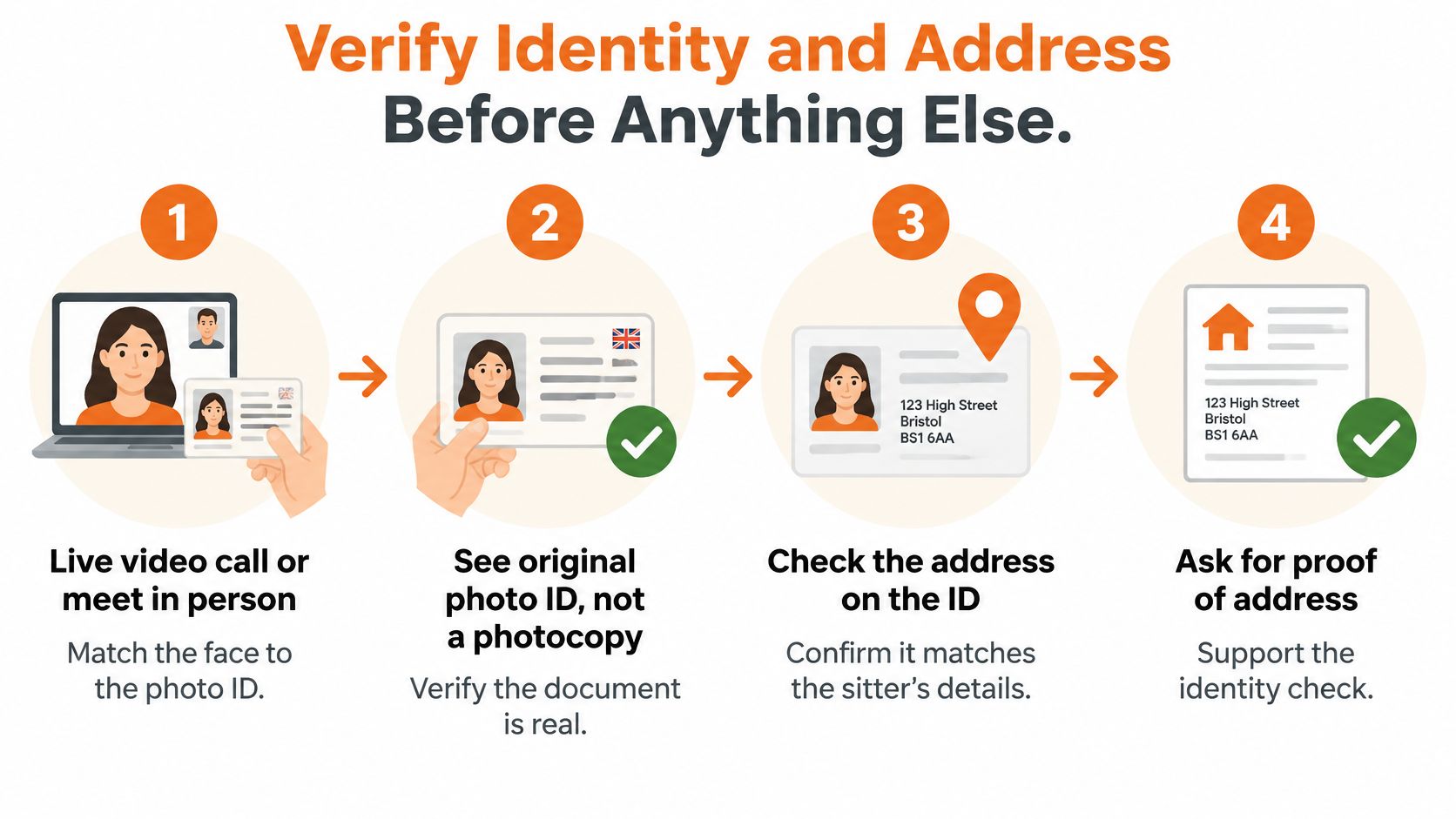
Arrange a live conversation and ask the sitter for their documents directly. A profile photograph or someone else's reassurance isn't a substitute for matching the person to their identity.
Use this visual reminder alongside the document checks.
Check the person and the paperwork
- Match the face. Meet in person or start with a live video call. Compare the person's appearance with their photo ID.
- Inspect originals. Ask to see current original documents, not screenshots, photocopies or photographs on a phone. Record the document type and expiry date rather than keeping an unnecessary copy.
- Compare details. Check that the full name, date of birth and current address agree with the application. A passport won't establish an address, so supporting evidence matters.
- Use a consistent document standard. The DBS identity-checking guidelines describe a Group 1 document, such as a passport or photocard driving licence, plus two further permitted documents, including evidence of date of birth and current address; address evidence should generally be no more than three months old, with a continuous five-year address history.
- Resolve discrepancies. Ask about previous names and unexplained address gaps. Pause the booking until inconsistent details have a clear explanation.
You're borrowing a careful checking method, not conducting an official DBS identity check or establishing eligibility for every DBS level. Under the DBS identity-verification guidance, relatives, partners, housemates and personal friends cannot act as independent identity checkers.
Keep enquiries proportionate
At Global Pet Sitter, every sitter and owner must verify their identity with an ID before they can apply for or post a sit. That doesn't establish animal-care competence or insurance cover, which needs its own insurance verification checks.
If an unresolved discrepancy raises a separate tracing question, Sentry Private Investigators Ltd's people tracing London service is a specialist resource, not a routine booking step. You can decline an arrangement you cannot verify.
Your notes should be factual: face matched on video, original passport seen, recent address document checked.
Check References and Experience Without Relying on Reviews
Reviews are a starting point, especially when an applicant chooses which ones to send. They may describe a pleasant stay without telling you whether the sitter followed medication instructions or secured the garden gate.
References answer different questions from a criminal-record check. The government's guide for private individuals engaging workers explains that DBS results aren't pass-or-fail assessments and that access to higher-level checks depends on eligibility. For day-to-day reliability, a detailed conversation with a previous owner is more informative than a certificate alone.
Ask questions that produce examples
Request two recent, independent references from people who hosted or employed the sitter, rather than friends, relatives, partners or housemates. Arrange a call and ask:
- Reliability: Did they arrive when agreed and remain for the full arrangement?
- Honesty and instructions: Did they report mistakes and follow the written care plan?
- Emergency judgement: Did an animal become unwell, and what did they do?
- Property security: Were doors, gates and keys managed properly?
- Repeat trust: Would you give them access to your home again, and why?
Superstar Nannies' private household hiring compliance guide provides additional context for checking employment history in a private-home setting. Keep your own questions focused on the responsibilities you're handing over.
Match the history to your household
Ask how many sits the applicant has completed, which species and breeds they've cared for, and whether that included senior, anxious or medicated animals. A convincing answer names the tasks involved, not just the animal.
The DBS announcement on self-employed workers and personal employees confirms that an application route doesn't remove role-eligibility rules. Ordinary pet care shouldn't be assumed to qualify.
Global Pet Sitter doesn't run background checks or vet members unless explicitly stated otherwise. Undated reviews, email-only referees and pressure to bypass checks warrant clarification; our house-sitting red flags guide covers further warning signs.
Call both referees and record their answers before moving on.
Match Care Needs to Your Pets
Write your pet's routine before judging whether someone can manage it. Include feeding quantities, medication doses and times, exercise limits, behavioural triggers, insurance details and your registered veterinary practice.
General confidence isn't enough. The PDSA pet population report distinguishes the different animals living in households; your assessment should likewise focus on the species and individual needs in your home.
Care needs and what the sitter must show
| Pet or care need | What the sitter must show | Question to ask |
|---|---|---|
| Senior dog | Experience with older dogs, safe handling on stairs, recognising pain | What do you do when an older dog stops wanting to walk? |
| Cat on daily tablets | Confident tablet administration and dose recording | What do you record after each dose, and how do you check the cat swallowed it? |
| Injectable medication | Prior practice or supervised training, clean technique and safe sharps disposal | Have you given injections before, and under whose supervision? |
| Anxious or reactive pet | Calm routine, safe door discipline and understanding of triggers | How do you settle a dog who panics when left alone? |
| Rabbit or small pet | Diet, hay and enclosure routine, recognising signs of gut stasis | Which signs would make you call the vet the same day? |
| Insulin-dependent or complex care | Written protocol, timed dosing and direct veterinary contact | Walk me through your timed dosing routine and the vet contact you'd use. |
Watch a relevant task
For prescribed medication, arrange a supervised demonstration at an appropriate scheduled dose. Watch the sitter prepare it, handle your pet calmly and record what was given; never give an extra dose for practice. For injections or complex treatment, ask your veterinary practice what training is appropriate.
For reactivity or separation anxiety, demonstrate the actual harness, door routine and settling arrangements. Someone who can feed your dog may still be unsuitable if their planned absences exceed what your dog can tolerate.
Provide veterinary details and written emergency-care authorisation before the sit begins. The sitter should contact you before incurring veterinary expenses where possible.
Finish with a concise care sheet and ask the applicant to explain it back. Record gaps rather than assuming confidence means understanding.
Interview Questions That Show Real Judgement
Use a live video conversation to test the details you've gathered. Set aside around 20 to 30 minutes as a practical planning allowance, and listen for specific decisions rather than reassuring adjectives.
Keep your checklist beside you during the call.

Ask for actions, not promises
- A previous routine: Ask about the last animal they cared for for more than a week. Strong answers describe feeding, walks, rest and overnight responsibilities.
- An appetite change: Ask what they'd do if your dog stopped eating for a day. Listen for observation, prompt communication and veterinary advice appropriate to your dog's condition, not automatic waiting.
- A refused tablet: Ask how they'd handle your cat refusing medication. They should recognise their limits and seek advice rather than improvise a different dose.
- A night-time alarm: Ask which immediate security steps they'd take and whom they'd contact. They shouldn't put themselves at risk investigating.
- Daily records: Ask how they log feeding, medication and walks. A shared note or paper chart is useful only if they'll keep it current.
- Availability and boundaries: Confirm the full dates, possible interruptions, decisions they'd make independently and willingness to follow written instructions and share emergency contacts.
A suitable sitter may admit they haven't handled a particular situation. That's more useful than an unsupported promise, especially when they ask sensible questions about your pet.
A good sitter asks you more questions than you expect.
Use the accompanying video as a conversation aid, not a replacement for your own assessment.
Mark answers as demonstrated, needs clarification or unsuitable. Generic affection for animals, vague availability and no interest in your home's practicalities shouldn't earn a pass.
Test Judgement With an Emergency Scenario
Your dog's heart medication has been missed and you're unreachable. Does the sitter contact the veterinary practice that day, or decide it can wait until you return? The safer plan is to seek medication-specific veterinary advice promptly, without doubling or changing doses independently.
A clean record and positive references cannot answer that question for this person. The government's DBS guidance collection makes clear that criminal-record information supports wider suitability decisions rather than replacing references, experience and qualifications.
Send a scenario pack
Include a missed medication dose, escaped pet, heating failure, alarm activation, bite or injury, and urgent veterinary admission. For each, ask the sitter to explain:
- Immediate response: What are their first three actions?
- Contacts: Who would they call, and what if nobody answers?
- Records: What times, symptoms, messages or photographs would they preserve?
- Escalation: When would they involve you, the vet or an emergency service?
A strong response prioritises immediate welfare and safety, then communication and documentation. It doesn't involve chasing an escaped frightened animal into danger or waiting for permission while a pet deteriorates.
Observe the practical response
At a supervised meet-and-greet, watch how they approach your pet, recognise stress signals and close doors and gates. For medically complex pets or higher-risk homes, consider a short trial and staged access, such as a limited key handover or controlled key-safe access.
Agree daily time-stamped updates, an emergency spending limit and veterinary authorisation. Our pet-care emergency authorisation form helps you record permission clearly; a spending limit shouldn't become an instruction to delay urgently needed treatment.
If you cannot be reached, the sitter should use their best judgement to protect your pet's welfare, including seeking veterinary care when necessary. Name a backup person who can answer a call or attend your home if the sitter cannot continue.
Send the scenarios and request written answers before confirming. Hesitation can reveal a training need; unsafe answers reveal an unsuitable match.
Confirm the Sit Only After a Handover
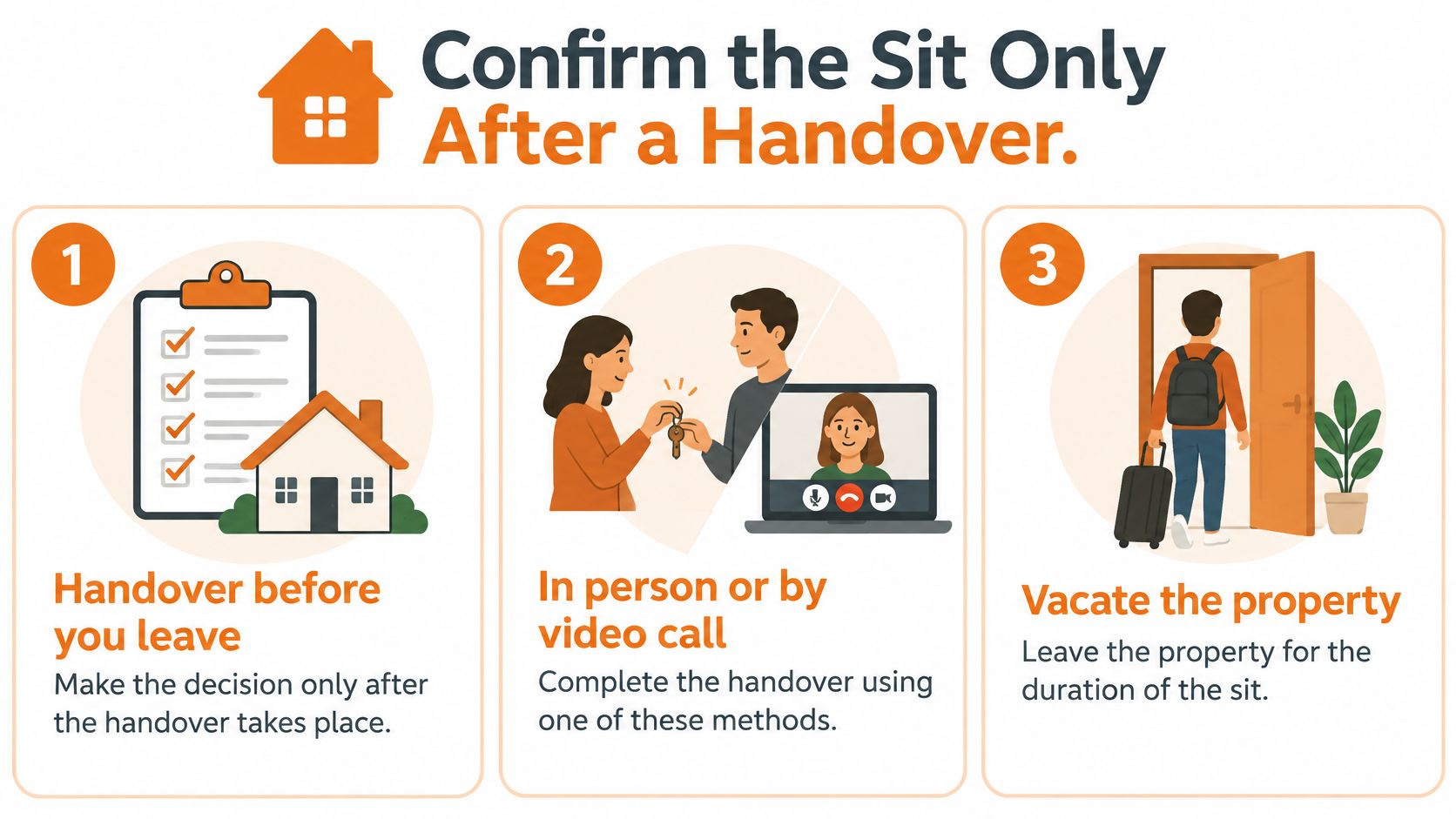
Treat the handover as your final go-or-no-go decision, not a hurried exchange beside a packed car. At Global Pet Sitter, owners must complete a handover before leaving, either in person or by video call.
You must also vacate the property for the sit's duration. Your sitter must have sole occupancy unless you've agreed otherwise in advance, so disclose any planned access by relatives, cleaners or other visitors.
Use this final reminder before you leave.
Tick off the home arrangements
Put the practical expectations in writing, including:
- People and access: Guest rules, neighbour contacts, authorised visitors and any rooms that are off limits.
- Security and belongings: Alarm operation, key return and the valuables policy. Secure private possessions rather than leaving the sitter to guess what they may use.
- Household tasks: Thermostat settings, bins, parking, plants and post.
- Vehicle boundaries: Whether your car must remain untouched or any use is expressly agreed and appropriately insured.
A written agreement turns assumptions into something both people can check. Use our pet-sitting contract template to record the arrangement without treating paperwork as a guarantee of performance.
Complete the final practical checks
Test the backup contact's number and confirm whether they have working key access. A name in a document won't help if the number is wrong or the person is away.
During a video walkthrough, ask the sitter to show or identify where food, medication and veterinary details are kept. If you're handing over remotely before arrival, arrange confirmation once they reach the property.
As a preparation target, send your written care plan 48 hours before the sit, giving both of you time to resolve questions. Our pet-care instructions template can help organise it.
Once those items are complete, confirm arrival, departure and the agreed dates by message. If an essential task remains unclear, pause rather than hoping it will work itself out.
At Global Pet Sitter, we connect owners with sitters who care for pets at home in exchange for a free stay. Use these checks to assess your match and agree the care your pet needs before you travel. Find a trusted house sitter for free.
Please sign in to leave a comment
