In-home pet sitting in Atlanta averages $16.49 per hour or $58.13 per night, depending on whether you need visits or overnight care. For anxious pets, keeping care at home is usually the stronger choice because it preserves familiar routines, smells, and surroundings.
You may be staring at a packed suitcase while your dog watches from the hallway, or wondering whether your cat will eat normally once you leave. Atlanta offers plenty of pet-care options, but the important decision isn't just finding someone available. It's choosing a sitter who can enter your home responsibly, follow the routine precisely, and respond calmly if something goes wrong.
That trust model matters in a city where pet ownership is widespread and demand varies from brief drop-ins to overnight house sitting. The practical approach is to compare service types, vet local candidates in person, prepare clear instructions, and use community reputation rather than relying on a single app score.
Why In-Home Care Matters More in Atlanta
A nervous dog may pace through a boarding facility, while an older cat may stop eating after its familiar room disappears. Medication schedules, feeding habits, and quiet sleeping spots can become harder to maintain when care takes place elsewhere. In-home sitting keeps those daily details in the setting where the pet already understands them.
The sitter adapts to the animal's established routine: the usual food location, walking route, litter area, and sleeping place. American Humane's pet sitter guidance also emphasizes preparation, home safety, written instructions, and emergency contacts. Those steps reduce avoidable mistakes when an owner is away.

Familiar territory reduces avoidable stress
A dog that reacts badly to unfamiliar animals can settle faster around its own scent markers and household cues. A cat that hides from visitors can keep access to a preferred room instead of adjusting to a new enclosure. The sitter still provides food, exercise, medication, observation, and companionship, but the pet does not have to learn a second environment at the same time.
Home care also exposes practical trade-offs. A sitter must enter the property reliably, follow access instructions, and notice problems such as a leaking water bowl or a door that fails to latch. Owners should therefore choose someone who can handle the home as carefully as the pet.
Atlanta's neighborhood layout adds another consideration. A sitter who knows the area may plan visits around traffic, apartment access, severe weather, and nearby veterinary options. Local familiarity supports consistency, but it does not replace references, clear communication, or a meet-and-greet.
The community connection matters
A community-verified sitter may come through a neighbor, veterinary recommendation, local pet group, or marketplace with visible reviews. These routes can reveal how a person handles keys, documents visits, follows special instructions, and communicates after an unexpected event.
Owners comparing candidates can use Atlanta in-home pet sitting listings to build a local shortlist. A profile shows availability and stated services, not whether the sitter suits a particular animal or home. Ask direct questions, confirm the routine, and arrange an in-home meeting before handing over keys.
Practical rule: Choose the arrangement that changes the fewest parts of your pet's day, then verify that the sitter can provide dependable supervision inside your home.
Understanding Atlanta's Pet Sitting Landscape
A sitter who lives ten minutes away may keep a dog's morning walk on schedule, while someone crossing the metro could lose that window to traffic. That local constraint matters because Atlanta has a large pool of pet owners and potential caregivers. The 2021 American Housing Survey found that 44.3% of Atlanta households had at least one pet, placing the metro eighth among the 15 largest U.S. metros, according to the U.S. Census-based Atlanta market summary. The same market overview estimated roughly 970,000 Atlanta households with pets, with 34% of residents owning at least one dog and 17% owning at least one cat.

A large pet-owning base can make community referrals more useful than an anonymous search result. Neighbors, veterinary teams, local pet groups, and visible marketplace reviews may reveal whether a sitter arrives as agreed, follows medication instructions, handles keys responsibly, and reports unusual behavior. Availability still needs verification. A profile shows what a sitter offers, not how that person will respond to your pet or property.
Dogs set the pace for many visits
A 2022 Atlanta metro analysis using Census data reported nearly 750,000 households with at least one dog in the Atlanta-Sandy Springs-Roswell metro, describing that figure as nearly one-third of regional households. The analysis ranked Atlanta sixth among major metros for the share of households with dogs and reported about 55,000 households with three dogs.
Dogs often need more than food and a quick check. Walks, outdoor access, timed medication, and daytime company can turn a short visit into a schedule the sitter must protect. Ask how long the visit lasts, what happens if traffic delays arrival, and whether the sitter can cover the route during severe weather. Distance is a practical risk, especially when a dog needs several visits each day.
Cats still require a deliberate schedule
The same Atlanta metro analysis reported that about 16% of households had cats, ranking the region ninth nationally in that comparison. A cat that appears independent may still need observation, fresh water, litter care, medication, or companionship.
Cutie Paws Atlanta's FAQ says visits are required at least every other day and recommends daily visits when possible. Broader guidance often considers in-home care appropriate when an owner is away longer than roughly 8 to 10 hours. Treat those recommendations as starting points, not fixed rules. Age, health, temperament, medication, water consumption, and the number of pets should determine the plan.
A healthy adult cat may manage with a well-planned daily visit. A senior, anxious, or medically fragile pet may need more frequent checks or overnight supervision. Ask the sitter what they will observe and document, not only which chores they will complete. For a local shortlist, compare Atlanta in-home pet sitting listings, then arrange an in-home meeting before providing keys.
Real-World Pricing and Service Models
Atlanta pricing becomes easier to understand once you separate time-based visits from overnight occupancy. A local listing snapshot reports an average of $16.49 per hour for in-home pet sitting in Atlanta as of September 2026, while an independent market page reports averages of $58.13 per night, $406.91 per week, and $1,743.90 per month for in-home care, as listed by Care.com's Atlanta pet sitting information.
Those figures aren't competing answers to the same question. An hourly arrangement usually covers drop-ins or shorter blocks. A nightly rate generally reflects staying in the home, maintaining an overnight presence, and accepting additional household and security responsibilities.
| Service model | Best fit | What to confirm |
|---|---|---|
| Hourly visit | Feeding, litter care, medication, walks, and brief companionship | Visit length, arrival window, photo updates, and travel expectations |
| Overnight sitting | Pets that need nighttime supervision, company, or a stable overnight routine | Sleeping arrangements, departure times, daytime absences, and household duties |
| Weekly or monthly arrangement | Extended travel with a clearly defined live-in schedule | Total duration, included services, extra-pet terms, and cancellation policy |
Compare like with like
A common mistake is comparing an hourly quote with a nightly quote as though both represent the same service. A sitter who visits for a short period isn't providing continuous presence, while an overnight sitter may be responsible for the home as well as the pet.
Before accepting a price, write down the service unit. Does “overnight” mean a specific evening-to-morning stay, or does the sitter leave for work during the day? Are walks, medication, extra pets, holidays, plant care, or extended visits included? The cheapest headline rate can become less attractive once those details are added.
The Global Pet Sitter guide to pet sitter costs is useful for framing the questions, but the final comparison should use Atlanta quotes with identical requirements. Ask each candidate to price the same dates, pet count, visit duration, and responsibilities.
Choose the model by risk, not just budget
Hourly care can work well for a healthy, settled pet whose routine is straightforward and whose owner is away for a limited period. Overnight care becomes more sensible when the pet is anxious, elderly, medically complex, prone to nighttime problems, or uncomfortable being alone for long stretches.
A written schedule protects both sides. It also gives the sitter a clear basis for explaining why a higher-touch arrangement costs more than a simple check-in.
The Vetting Checklist for Local Sitters
A sitter may live nearby and still be a poor fit for your home. In Atlanta, the safer choice comes from checking specific behavior, communication habits, practical skills, and emergency preparation before handing over keys.
Start with reputation, then test the details
Read reviews for evidence, not warm descriptions. Look for punctuality, accurate medication, clear updates, cleanliness, and sensible responses when plans changed. If a profile only says pets “loved” the sitter, request a reference who can discuss the actual care provided.
Arrange a meet-and-greet at your home before booking. Watch how the sitter approaches your pet, respects its boundaries, and listens to instructions. Walk through feeding areas, medication storage, the carrier, alarm system, waste supplies, and shutoff points. Ask what they would do if your pet refused food, became ill, or could not be reached during an expected visit.
Confirm safety credentials and coverage
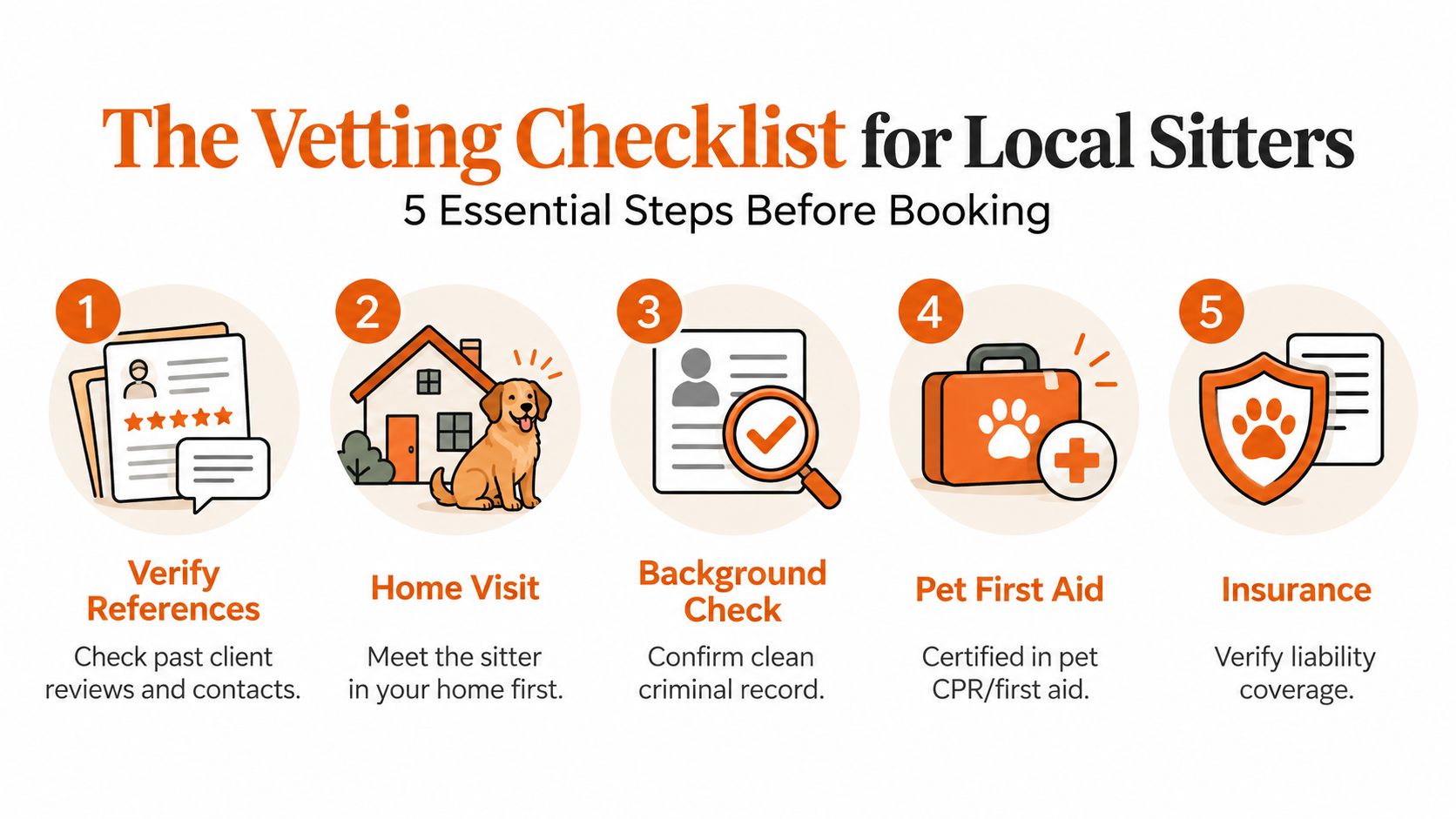
Use this checklist to separate verified information from assumptions:
- Verify references: Read past client reviews and, where appropriate, speak with contacts who can describe similar in-home care.
- Meet at home: Confirm that the sitter can enter, secure the property, and move through the home without confusion.
- Ask about screening: If background screening matters to you, ask what was checked and when. A marketplace badge may not explain every detail.
- Discuss first aid: Ask about pet CPR or first-aid training, especially when an animal has medical risks.
- Confirm insurance: Ask whether liability coverage applies to the services and property duties you are assigning.
The final three items require direct confirmation from the sitter or marketplace. Do not infer them from a friendly profile. Ask who takes over if the sitter becomes ill, loses access, or has a transportation problem.
Emergency standard: Before the first visit, the sitter should know your veterinarian, backup contact, preferred emergency clinic, and the limits of their authorization.
Create a written home guide covering feeding, medication, exercise, behavior triggers, household rules, and emergency contacts. American Humane's pet sitter guide also recommends a pre-sit meeting, written instructions, and a defined emergency contact sequence.
Finish with a short verbal test. Ask the sitter to repeat the medication plan and emergency steps in their own words. Vague answers usually mean the instructions, access plan, or backup arrangements need more work.
Using Global Pet Sitter to Simplify the Search
Atlanta owners often find sitters through neighbors, local groups, and scattered recommendations. That community input can be useful, but dates, pet routines, and availability are easily lost across messages. A marketplace brings those details into one place while keeping the trust decision with the owner and sitter.
Global Pet Sitter allows owners to post dates and pet details, message candidates, and arrange care in their own home. This suits Atlanta's in-home model because the owner can explain the household routine before accepting a booking. A category such as “pet sitting” alone cannot show whether someone can handle a reactive dog, medication schedule, or overnight stay.

Reputation needs context
Ratings provide a starting point, not a decision. Ask about medication, overnight expectations, home access, and emergency choices. A profile with visible history can make those questions more specific and help distinguish recent experience from a single favorable review.
Experienced sitters can import 5-star reviews from other platforms via screenshots, keeping reputation that might otherwise be divided among different services. Screenshots do not verify the review independently or prove a sitter fits your pet. They give both sides more information before arranging a home visit.
Keep the match practical
Availability is only one condition. Check whether the sitter can reach your Atlanta neighborhood reliably, accepts the required care arrangement, and has experience with your pet's temperament and instructions.
Use the first messages to settle four points:
- Dates and access: Confirm arrival, departure, keys, alarms, and building requirements.
- Care duties: List feeding, walks, litter care, medication, updates, and household tasks.
- Emergency response: Agree on contacts, veterinary authorization, and backup coverage.
- Communication: Set update frequency and define which changes require a call.
The marketplace shortens the search, while the meet-and-greet and written plan test whether the arrangement works inside your home. That combination gives Atlanta owners community context without handing the decision to an algorithm.
Preparing Your Home and Pet for the Sit
Most avoidable problems begin before the sitter arrives. The owner forgets to explain a medication, leaves food in an unlabeled container, or assumes the sitter will know which door sticks. A short preparation routine removes those guesses.
Build one sitter dashboard
Choose one visible location, physical or digital, for the information the sitter needs. Include:
- Daily routine: Feeding times, portions, walks, play, sleep preferences, and normal behavior.
- Medical details: Medication names, doses, timing, administration method, and veterinarian information.
- Emergency sequence: Your contact, a backup contact, the veterinary practice, and the authority the sitter has to seek treatment.
- Home instructions: Alarm, locks, waste collection, heating or cooling, plant care, and areas that are off limits.
- Supplies: Food, medication, cleaning products, spare litter, leashes, carriers, and backup keys.
Walk through the dashboard during the meet-and-greet. Have the sitter demonstrate how they'll give medication or secure the pet after a walk. Written instructions work best when the person using them has already seen the setup.
Remove hazards before departure
Secure windows and doors, clear toxic items, store cleaning products, and check that gates and carriers work properly. Put identification and veterinary records where the sitter can reach them without searching through drawers.
Atlanta's heat and wildlife can also affect the routine. Ask the sitter to avoid unsafe outdoor conditions, keep the pet hydrated, and prevent contact with animals or plants that could cause harm. If your yard receives treatments, review guidance on natural lawn care for pet owners before the sit and tell the sitter which areas are safe.
Rehearse the handoff
A trial visit can expose confusion before you're traveling. Let the sitter complete the feeding or walk routine while you observe, then correct small details. Leave clear authorization for emergency treatment and identify who should be contacted first if you can't answer.
For additional preparation ideas, use this guide to preparing your home for a pet sitter. The aim isn't to create a complicated manual. It's to make the correct action obvious when you're unavailable.
Global Pet Sitter helps Atlanta owners post in-home sits with dates and pet details, compare interested sitters, and discuss care directly before making arrangements. Visit Global Pet Sitter to start your profile, describe your pet's routine, and find candidates you can meet and vet before you leave.
Please sign in to leave a comment
