You're halfway through packing, your flight is approaching, and your dog is watching every move from the kitchen floor. Your cat may be less obvious, but a changed feeding routine, an unfamiliar boarding room, or a missed medication can cause just as much disruption. The right caregiver keeps your pets in their own home, follows their normal schedule, and knows what to do when travel plans go wrong.
That's why in-home pet sitting in San Diego demands more than a friendly meet-and-greet. You need a sitter who understands your pet's behavior, your home's risks, local responsibilities, veterinary access, and the financial decisions that may arise when you're unreachable.
Finding the Right In-Home Pet Sitting in San Diego
San Diego has a large pool of potential pet-care customers, but that doesn't mean every sitter is equipped for your household. A countywide survey found that 46.1% of households owned at least one dog or cat, and, using an estimated 887,403 households, calculated approximately 746,660 dogs and cats combined in its household and pet ownership research. That scale gives owners plenty of options, but it also makes careful screening essential.
Start by defining the care your pet needs. A healthy adult dog that enjoys walks may need a different arrangement from a senior cat requiring medication, a reactive rescue dog, or a household with multiple animals that cannot be left alone for long stretches. Decide whether you need overnight care, several daily visits, transportation, medication administration, plant watering, mail collection, or someone who can stay flexible if your return flight changes.
Look for evidence, not reassuring language
A polished profile saying “animal lover” tells you very little. Look for clear descriptions of previous animals cared for, experience with medications or behavioral challenges, references that discuss reliability, and a willingness to follow written instructions. A sitter who asks detailed questions about escape risks, feeding restrictions, emergency contacts, and household access is showing better judgment than one who focuses only on dates and payment.
The meet-and-greet should happen inside your home, with your pets present. Watch whether the sitter lets an anxious animal approach at its own pace. Ask them to repeat the feeding and medication routine in their own words. If they can't explain the plan back to you, they're not ready to manage it alone.
Practical rule: Choose the sitter who understands your pet's ordinary routine and has a credible response for an abnormal day.
San Diego households also vary widely by neighborhood, housing type, and travel distance. A sitter who works well in a quiet suburban home may not be comfortable handling apartment access, busy streets, steep outdoor areas, or a dog that needs careful heat management. The right match is local enough to respond reliably, but experienced enough to manage the specific demands of your home.
Exploring Different Pet Sitting Platforms and Communities
Owners usually choose among three broad arrangements: a commercial agency, a peer-to-peer service, or a community marketplace. Each can work, but each places responsibility in a different location.
An agency may coordinate scheduling and provide a formal service process, but you might not get much choice over the individual who arrives. A transactional booking service can make dates and payments simple, yet the profile may tell you less about how a sitter handles unusual medical or household situations. A community-driven marketplace puts more emphasis on direct communication, reputation, and the owner's role in selecting the match.
Global Pet Sitter is a community-driven house and pet sitting marketplace that connects owners and sitters, with profiles, member verification features, direct messaging, and owner-posted sits containing dates and pet details. That model can suit San Diego owners who want to compare candidates personally and keep pets in familiar surroundings rather than moving them to a boarding facility. You can also review how house-sitting platforms differ before choosing where to search.
Compare the trade-offs
| Option | Cost Structure | Owner Involvement | Environment |
|---|---|---|---|
| Commercial agency | Usually arranged through the service provider | Moderate, with less control over assignment | Often in your home, depending on the agency |
| Peer-to-peer booking service | Set through a platform or individual sitter | Moderate to high | Your home, the sitter's home, or scheduled visits |
| Community marketplace | Terms discussed directly with the matched sitter | High | Usually the pet's familiar home |
| Personal referral | Agreed privately | Very high | Usually your home |
The cheapest option isn't automatically the safest, and the most formal option isn't automatically the best fit. Ask who verifies identity, how references are handled, what happens if the sitter cancels, and whether you can communicate directly before committing. You also need to clarify whether the sitter stays overnight or only visits, because “house sitting” can mean different things to different people.
For many San Diego households, continuity matters more than novelty. Cats often settle better when their litter, food, hiding places, and people remain in place. Dogs with separation anxiety, medical routines, or strong territorial preferences may also do better when a capable caregiver works within the home.
Vetting Your Sitter with the Right Questions
The interview should uncover how a sitter thinks under pressure. Don't ask only whether they love animals. Ask for a specific example of a difficult situation, then listen for the actions they took, the information they recorded, and the point at which they contacted the owner or a veterinarian.
A useful interview covers care routines, safety, communication, and authority. The sitter should know what they can approve without calling you, what requires written permission, and how they'll reach your backup decision-maker when you're on a plane or outside coverage.
Ask questions that expose gaps
| Category | Sample Question | What to Listen For |
|---|---|---|
| Routine | “Walk me through a normal morning for each pet.” | They take notes and distinguish each animal's needs |
| Medication | “How would you handle a missed or refused dose?” | They won't improvise and know when to contact you or a clinic |
| Behavior | “What would you do if my dog slipped a leash?” | Immediate containment, identification, communication, and escalation |
| Home safety | “Which doors, gates, chemicals, or foods need special attention?” | They look beyond feeding and walks |
| Emergency care | “What treatment can you authorize if I can't respond?” | They understand written authority and spending limits |
| Communication | “What updates will you send, and what triggers an urgent call?” | A defined update routine and clear escalation standards |
You can use this pet sitter interview question guide to expand your conversation, but don't outsource your judgment to a checklist. Observe the sitter handling the leash, carrier, medication container, and front-door routine. Ask them to practice locking gates and showing where they'd find the emergency folder.
Red flags deserve a firm no
Be cautious if a candidate dismisses written instructions, says they “usually figure it out,” refuses a backup contact, or can't explain how they protect keys and access codes. A sitter who promises constant updates but won't agree to a specific communication routine is offering reassurance instead of a process.
Ask how they handle heat. San Diego's weather can make a midday walk unsafe for some pets, especially on exposed pavement or in areas without shade. The answer should include adjusting timing, checking the animal's condition, and prioritizing indoor enrichment when outdoor conditions are poor.
Do a paid trial visit or short local assignment before a longer trip whenever possible. You'll discover whether the sitter follows instructions, notices changes in appetite or behavior, and communicates without being prompted.
Understanding Local Rates and Market Expectations
Pet sitting prices in San Diego vary because the service itself varies. Overnight care, drop-in visits, several pets, medication, transportation, cleaning, plant care, and last-minute booking all change the workload. A low quote may reflect a simple arrangement, limited experience, or a misunderstanding about what you expect.
The broader U.S. market provides useful context. One estimate places the U.S. pet-care and services market at $62.10 billion in 2025, with 94 million pet-owning households reported for 2024 in its market analysis. The same estimate says only 4% of pets are insured, which means an emergency can create substantial out-of-pocket costs for many owners.
Price the risk, not just the visit
Before you agree to a rate, write down exactly what it includes:
- Overnight presence: Confirm whether the sitter sleeps at the property or only visits late and early.
- Pet complexity: List medication, mobility support, separation anxiety, reactivity, feeding restrictions, and multiple-animal care.
- Household duties: Separate essential pet tasks from optional chores such as watering plants or handling deliveries.
- Travel requirements: Clarify whether transport to a veterinarian, groomer, or training appointment is included.
- Schedule changes: Decide how cancellations, delayed flights, and extra nights will be handled.
The most important financial question is not “What's the nightly rate?” It's “Who pays first if the pet needs treatment?” Leave a clearly documented payment method or spending authorization, identify whether the sitter may approve urgent care, and explain how you'll reimburse expenses. Don't make a sitter choose between waiting for an unreachable owner and personally absorbing a veterinary bill.
A cheap arrangement becomes expensive when nobody has agreed on emergency authority, transport, or payment.
Compare quotes only after you've normalized the scope of care. A sitter offering brief check-ins cannot be compared directly with someone staying in your home and managing medication, walks, meals, and an emergency response.
Preparing Your Home and Pets for a Sitter
A sitter should be able to enter your home and operate safely without guessing. Prepare the environment as if someone will need to manage a stressful situation at night, during a power interruption, or while trying to secure a frightened animal.

Complete the handoff before departure
Put food, medication, leashes, carriers, litter supplies, cleaning materials, and records in clearly labeled locations. Photograph unusual equipment, write down feeding portions and timing, and list forbidden foods. Secure medications, cleaning products, pesticides, gardening chemicals, toxic plants, and trash where pets and visiting children can't reach them. If you have a curious cat, use this practical guide to keep your cat safe at home.
Create a written home guide using a structured pet care instructions template. Include alarm instructions, utility shutoffs, spare keys, Wi-Fi access if needed for communication, waste collection details, and the location of the emergency kit. Keep the document current, and walk through it in person instead of assuming the sitter will read every page carefully.
San Diego owners also need to address local dog responsibilities. County rules require dogs to be licensed, generally require rabies vaccination by five months of age, and require dogs away from home to use a handheld leash no longer than six feet under the county's licensing and animal-law guidance. County Animal Services licensing jurisdiction is limited to unincorporated areas, so confirm which rules and agency apply to the exact municipality where your home is located.
Leave a usable daily plan
Give the sitter a simple schedule, but include flexibility for behavior and weather. Note the dog's preferred walking route, triggers, recall limitations, hiding places, and signs of illness. For cats, specify litter-cleaning expectations, appetite monitoring, and whether a normally social cat should receive play or quiet company.
Test the front door, gates, carriers, and alarms with the sitter present. Have them demonstrate how they'll secure the property after every entry and exit. A prepared home reduces improvisation, and reduced improvisation is what keeps routine care from turning into an avoidable emergency.
Creating a Foolproof Emergency and Vet Plan
A phone number on the refrigerator isn't an emergency plan. The sitter needs authority, records, transport options, and supplies in a format they can use while managing a frightened or injured animal.
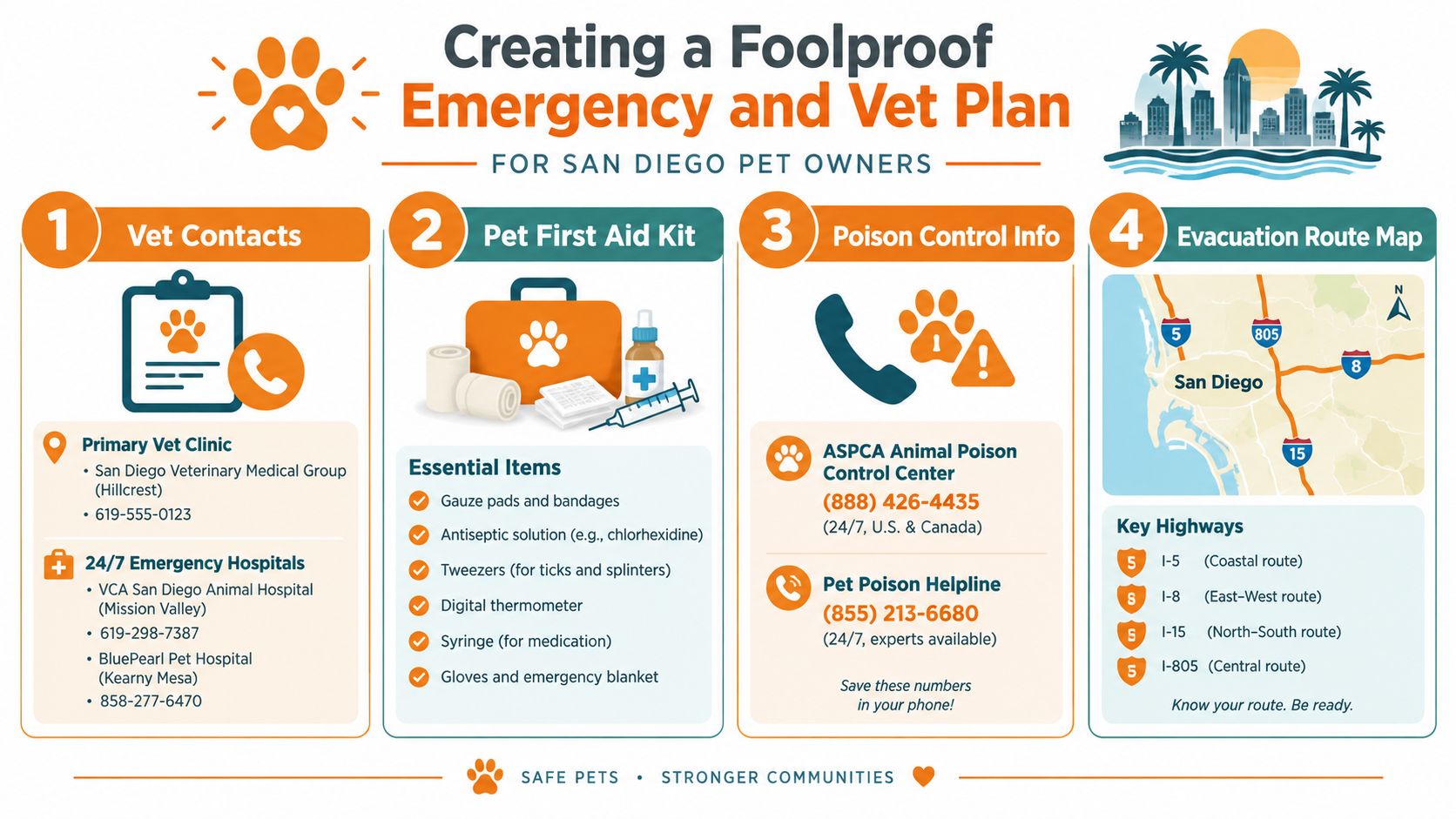
Build the plan in five steps
-
Walk through the property. Identify escape routes, carriers, gates, utility shutoffs, medication storage, fire hazards, and places where an animal could become trapped. Select pet-friendly destinations in more than one direction in case wildfire or evacuation conditions make one route unusable.
-
Record every contact. List the primary veterinarian, a 24-hour emergency clinic, your number, a backup decision-maker, and poison-control information. Include full names and directions, not just a clinic name in a phone.
-
Authorize action in writing. State which treatment and spending decisions the sitter may approve if you can't respond. Identify who can make a non-urgent decision, who can transport the pet, and how payment will be handled.
-
Prepare a waterproof grab kit. Include identification and microchip details, vaccination and medical records, food, water, first-aid supplies, medication, sanitation items, and transport equipment. The AVMA's emergency planning guidance recommends updated identification, accessible records, evacuation practice, an alternate caregiver, 3 to 7 days of food, and up to two weeks of medication.
-
Rehearse the response. Have the sitter locate the kit, secure the pet in a carrier or vehicle, follow the evacuation route, and contact the backup person. Practice turns a written plan into a usable response.
Use this video as a visual reminder to review household evacuation preparations before you leave.
Treat poisoning prevention as daily control
During intake, inventory medications, cleaning chemicals, pesticides, toxic foods, plants, and veterinary drugs. Photograph storage locations and write down feeding restrictions. The sitter should keep doors, gates, storage areas, and trash containers secured, then log meals, medication doses, elimination, behavior, and unusual symptoms at every visit.
In 2021, ASPCA Poison Control received more than 401,550 calls involving toxic exposures. Over-the-counter medications represented 19.7% of reported cases and human prescriptions represented 17.2% in the available poison-control summary. The figures aren't a San Diego sitter success rate, but they show why intake questions should explicitly cover ibuprofen, acetaminophen, ADHD medications, antidepressants, xylitol, grapes, raisins, onions, garlic, chocolate, antifreeze, and veterinary drugs.
| Contact Type | Information Needed | Action Item |
|---|---|---|
| Primary veterinarian | Clinic name, phone, address, records access | Confirm the clinic knows the sitter may bring the pet |
| Emergency hospital | 24-hour location, route, transport plan | Drive the route or review it with the sitter |
| Owner and backup | Phone numbers and decision authority | Define who acts when the owner is unreachable |
| Poison control | Contact details and pet information | Escalate suspected ingestion immediately |
| Identification records | Microchip, license, vaccination, medical history | Keep copies in the waterproof grab kit |
Don't wait for symptoms after suspected ingestion. The sitter should contact the appropriate veterinary or poison-control resource immediately and provide the exact substance, estimated amount, time of exposure, and the pet's weight if known. Ambiguous medication instructions are preventable, so write every drug name, concentration, dose, and timing clearly.
Global Pet Sitter gives owners a way to post dates, location, and pet details, compare sitter profiles, and message candidates directly for in-home care. If you're planning travel in San Diego, use Global Pet Sitter to find a compatible caregiver, then complete the written home, legal, financial, and emergency handoff before you leave.
Please sign in to leave a comment
