Pets were cared for in 133 countries and 2,234,436 nights of pet sitting were facilitated in a single year, according to an independent impact report discussed in the TrustedHousesitters community forum. That changes how you should think about international house and pet sitting. It isn't just a clever way to avoid hotel costs anymore.
It's a cross-border trust operation.
The owners who get good outcomes don't rely on charm and luck. The sitters who keep getting invited back don't treat each booking like an informal favor. They run clean communication, verify expectations, document handoffs, and prepare for the awkward parts most guides skip, including insurance gaps, unclear house rules, and what happens when a pet gets sick in a country that isn't yours.
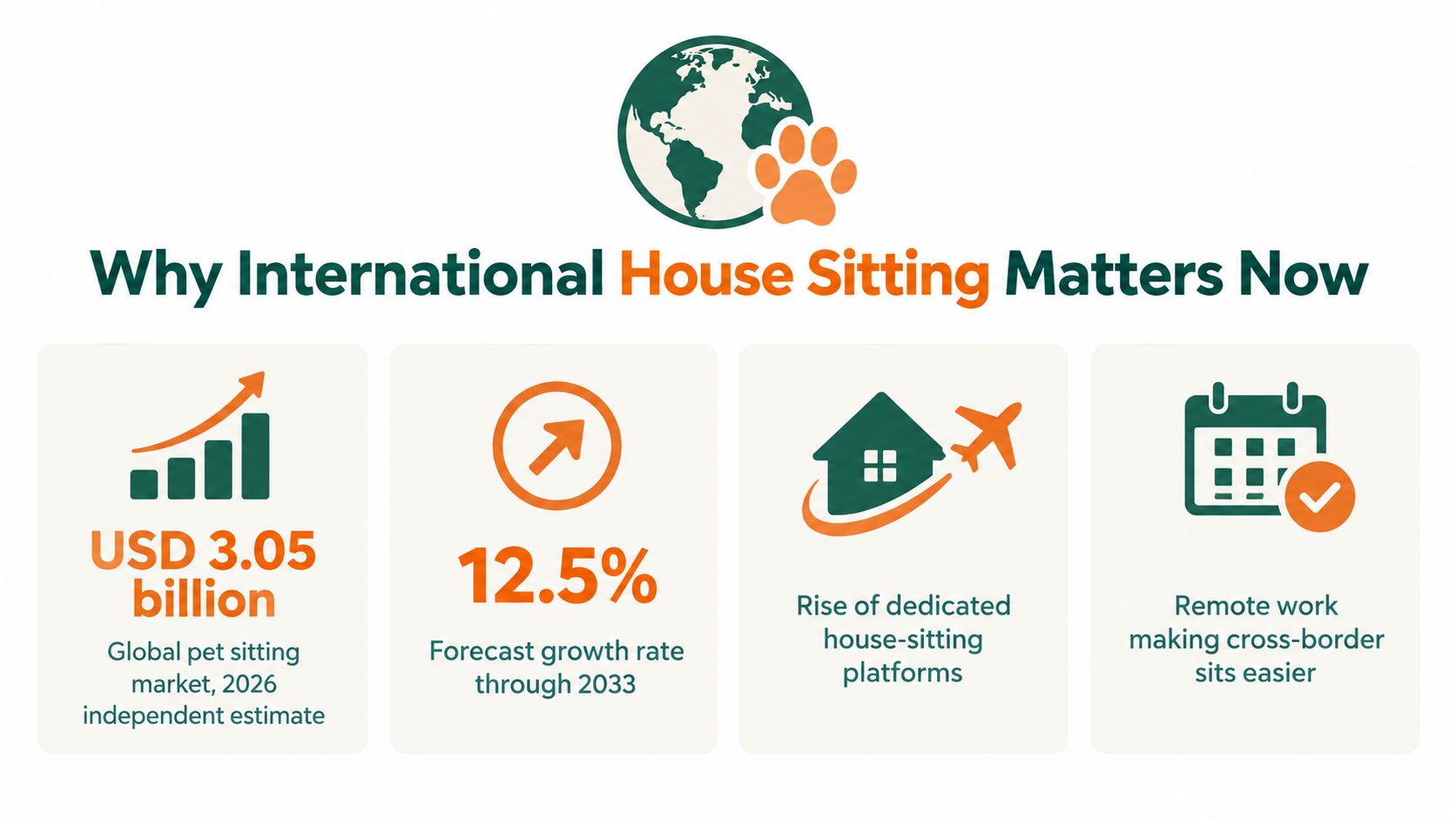
Why International House Sitting Matters Now
The scale shift is easy to miss if you only read lifestyle blogs. Independent market estimates put the pet sitting market at about USD 3.05 billion in 2026, with a forecast CAGR of 12.5% to 2033, while house-sitting platforms are estimated at USD 1.1 billion in 2026 and growing at 11.2% CAGR, according to Coherent Market Insights. That's not hobby-level activity. That's an expanding service category with real operational pressure behind it.
Demand is growing faster than trust systems
Owners choose in-home care because pets stay in familiar surroundings. Sitters choose it because longer trips become financially possible when accommodation is covered. Add remote work to the mix and it's easy to see why more people are trying to combine travel and care work, especially those already living a location-flexible life like a digital nomad.
The problem is that platform growth doesn't automatically create good matches. A listing can look polished and still hide a dog with separation anxiety, a cat on medication, or a homeowner who answers messages quickly before the booking and disappears once you're in the house.
Practical rule: The bigger the market gets, the less useful enthusiasm becomes on its own. Process starts mattering more than personality.
The real bottleneck isn't finding sitters
A few years ago, the common story was scarcity. Owners worried they wouldn't find anyone willing to travel. That's not the main issue now. In practice, the harder question is whether the sitter and owner can trust each other across borders, time zones, and different assumptions about home care.
I've seen strong arrangements come from simple listings with excellent communication. I've also seen glossy listings go wrong because nobody clarified daily routines, emergency contacts, or whether "low maintenance" meant one easy cat or an elderly pet who needed close monitoring.
International house and pet sitting works best when both sides stop framing it as free accommodation exchanged for basic pet care. It's a temporary care contract without the legal clarity of a standard rental and without the backup systems of a hotel or kennel. If you enter it with that mindset, your decisions get sharper very quickly.
Building a Profile That Crosses Borders
A weak profile makes international applications feel risky. A strong one lowers the owner's uncertainty before you even send a message. That's the whole job.

Start with proof, not personality
Owners looking at overseas applicants usually scan for three things first:
- Identity checks: Complete every verification step the platform offers, including ID and phone confirmation.
- Traceable presence: Link professional or social accounts if the platform allows it.
- Relevant experience: Put actual pet-care history near the top, not buried halfway down your bio.
If your first paragraph says you love travel, you're leading with the wrong thing. Owners care about whether you can handle their home, their pet, and a problem at 7 a.m. if something goes sideways.
A better opening is specific. Say what kinds of pets you handle confidently. Mention whether you've managed medication, nervous rescues, multi-pet homes, or rural properties. If you're calm with older animals, say that. If you're not, leave it out.
Make credibility portable
One of the most useful changes in this space is that experienced sitters can import five-star reviews from other platforms via screenshots on community-driven marketplaces, preserving hard-earned credibility and helping them stand out immediately. If you're moving between platforms, don't start from zero if you don't have to.
That matters most when you're entering a new country where nobody knows you. Imported reviews won't replace a live conversation, but they shorten the trust gap.
For practical profile tuning, the Global Pet Sitter profile tips guide is useful because it focuses on what owners scan for rather than generic bio advice.
Write for a tired homeowner
Most owners don't read profiles like recruiters reviewing a CV. They skim while juggling trip planning, pet anxiety, and too many tabs open. That means your profile should answer friction points fast.
Use this order:
-
Who you are now
Keep it short. Remote worker, full-time traveler, couple, solo sitter, retired professional, or local expat. -
What pets you handle best
Dogs that need long walks, apartment cats, seniors, shy animals, or mixed households. -
How you communicate
Say whether you send daily updates, photos, or quick check-ins at agreed times. -
Where you can realistically sit
Be honest about regions, seasons, and date flexibility.
Owners rarely reject a sitter for being narrow. They reject sitters who sound vague.
Small signals that matter more than people think
A few details consistently help:
- Response windows: Say when you usually reply. Time-zone delay feels less worrying when it's explained upfront.
- House standards: Mention that you leave homes clean and document issues early.
- Arrival habits: State that you prefer a live walkthrough before the owner departs, even if it's brief.
A cross-border profile should feel less like a travel diary and more like a clean operating sheet. That's what gets replies.
Finding and Vetting Your Ideal Match
The easiest way to wreck an international sit is to apply too broadly. The listing might be attractive, the city might be somewhere you've wanted to visit, and the dates might look close enough. That's how people end up saying yes to arrangements they were never equipped to handle.
Go where the market is deep
An independent listing snapshot shows that the United States had about 6,330 house-sitting listings, the United Kingdom about 3,786, France over 1,000, Australia about 569, and Canada about 504, with New Zealand and Australia showing especially high listing availability per capita, according to House Sitters Guide. For sitters, that means two things.
First, some countries give you more choice. Second, per-capita concentration matters because it often reflects stronger owner familiarity with the model. When people already understand house and pet sitting, onboarding tends to be smoother.
Vet the listing like a service agreement
Read the full listing once for fit and a second time for risk. Different passes reveal different things.
| What to check | Why it matters | What to ask |
|---|---|---|
| Pet routine | Reveals time commitment | What time are meals, walks, meds, and bedtime? |
| Medical details | Shows skill needed | Any medication, mobility issue, allergies, or vet history I should know? |
| Time alone | Flags behavior problems | How long can the pet comfortably stay alone? |
| Home logistics | Prevents arrival stress | Are there alarm systems, parking rules, key procedures, or building access quirks? |
| Owner style | Predicts the working relationship | How often would you like updates, and in what format? |
A listing that says "easy dog" means nothing by itself. An easy dog for one owner may still mean two long walks, no off-leash time, reactive behavior around other dogs, and strict medication timing.
Watch the messaging, not just the pet details
The first exchange tells you almost everything you need to know about the likely sit dynamic.
Good signs:
- Specific answers: The owner replies directly to the questions you asked.
- Routine clarity: They know the pet's day well and can describe it without hand-waving.
- Practical transparency: They mention house quirks, neighbors, or upcoming construction before you arrive.
Concerning signs:
- Deflection: They keep selling the location instead of explaining the care.
- Inconsistency: Dates, duties, or sleeping arrangements keep shifting.
- Defensiveness: Normal questions about vets or access seem to irritate them.
If a simple pre-booking question creates friction, a real emergency probably won't get handled well either.
A personalized application still matters. Reference the pet by name, mention one detail from the listing, and ask one careful question. That's enough to show attention without sounding scripted.
Preparing for Your First International Sit
Preparation is where confidence comes from. Not optimism. Not vibes. Preparation.
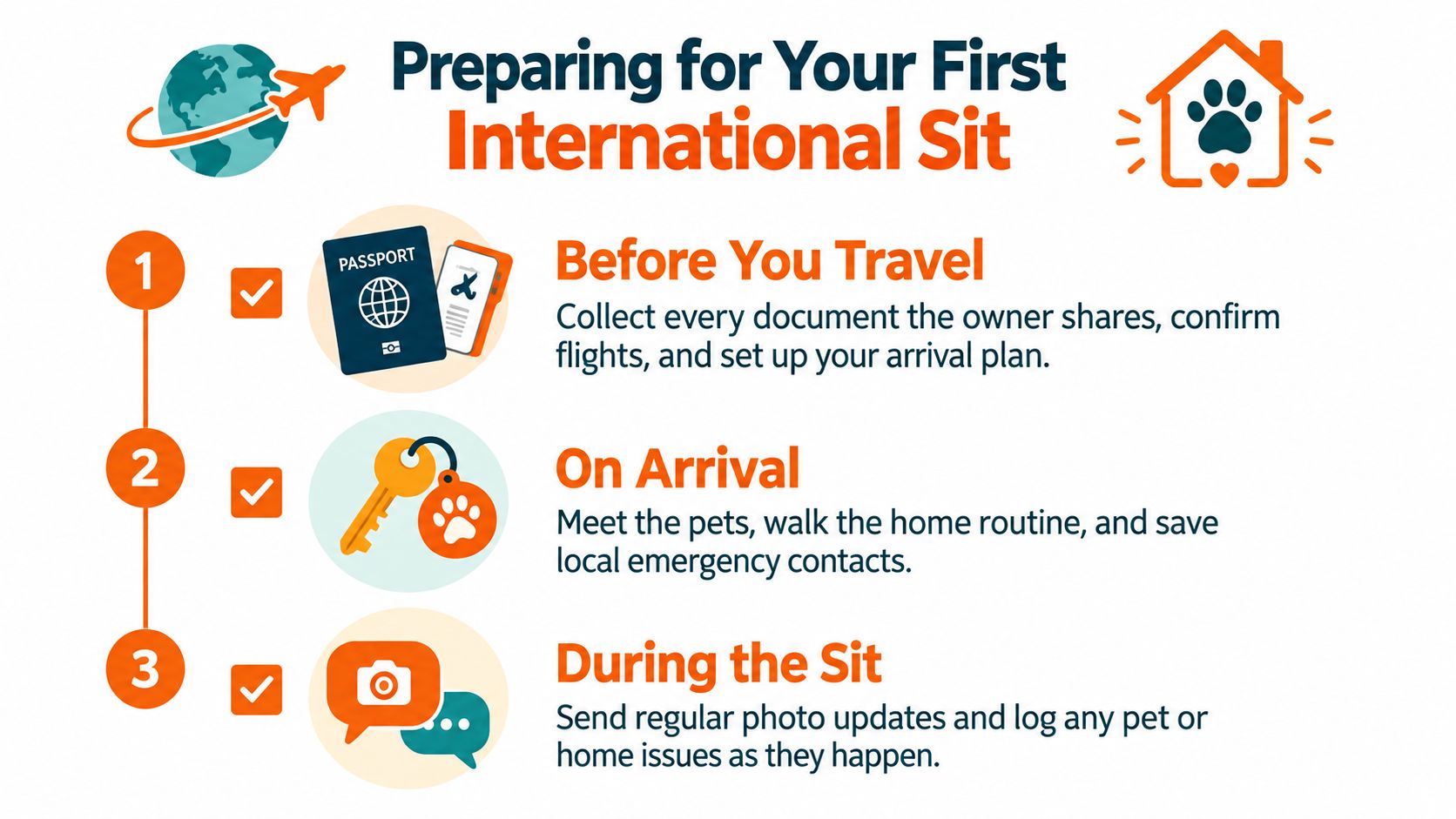
Before you travel
International sits get harder when all the essential information lives in a message thread and your phone battery dies in transit. Pull everything into one offline folder before you leave.
Keep copies of:
- Owner contacts: Primary number, backup number, and travel itinerary if shared.
- Pet care notes: Feeding schedule, medication, walk routine, triggers, and preferred commands.
- Emergency details: Vet clinic, neighbor contact, building manager, alarm instructions.
Pack a small sitter kit. Mine usually includes a notebook, spare waste bags, a pen, a reusable water bowl, and basic cleaning supplies if the owner hasn't specified what they keep on hand. You won't use all of it every time, but the few times you need it, you'll be glad it's there.
If you're worried about language friction on arrival, especially with neighbors, taxi drivers, or clinic staff, a quick review of basic travel phrases helps. The ChatPal guide to confident speaking is a practical way to warm up before a trip because it focuses on natural conversation rather than textbook language.
On arrival
Do the walkthrough slowly. Future misunderstandings either get prevented or planted.
Check these in person:
- Entry and exit: Keys, spare keys, gate codes, alarm steps, and what to do if a lock jams.
- Home systems: Wi-Fi, hot water, heating or cooling, fuse box, and shut-offs if the owner knows them.
- Pet gear: Leashes, carriers, food storage, medication tools, litter setup, and cleaning materials.
Take photos of any existing damage that could later be mistaken for something that happened during your stay. Keep them private unless needed. This isn't about being suspicious. It's about removing ambiguity.
Leave with fewer assumptions than you arrived with.
During the sit
The first day sets the rhythm. Follow the owner's routine before you start "improving" anything. Pets notice small changes fast, especially after their people leave.
A simple daily log helps more than most sitters expect:
- Appetite
- Toilet habits
- Walk length or play level
- Medication given
- Anything unusual
Owners don't need constant messaging unless they've asked for it. They do need consistent evidence that the pet is stable and the home is fine. Short updates sent on schedule work better than a flood of random photos.
Legal, Insurance, and Liability Realities
Cross-border house sitting works on trust, but trust alone does not settle a vet bill, answer an immigration officer, or resolve a dispute over damaged property.
As noted earlier, international pet sits now happen at enough scale that informal assumptions break down fast. Once a sit crosses borders, the arrangement stops being a casual favor and starts looking more like a private trust agreement between strangers. That is the right standard to use.
What platform terms do not solve
A platform can verify identity, hold messages, and set member rules. It cannot override local law, a lease, a condo board rule, or a border official's interpretation of what you are doing in the country.
I treat three questions as basic screening before I accept any international sit:
- Entry status: Will this stay clearly fit the terms of my visa or tourist entry?
- Occupancy rules: Does the owner actually have permission to host a sitter under local building or rental rules?
- Authority on the ground: If police, building management, or a neighbor raises a complaint, who can confirm I am supposed to be there?
These problems are rare. They are also the problems that turn a simple sit into a stressful one because the platform is usually several steps removed from the first response.
Where insurance gets misunderstood
Insurance is where I see the biggest gap between what people assume and what is covered.
Sitters often assume the homeowner's policy covers any accidental damage caused during the stay. Owners often assume a platform protection plan covers the pet, the sitter, the home, and any third-party claim. Policies usually have exclusions, limits, and reporting conditions that only become visible after something has gone wrong.
Use this check before you confirm:
| Risk area | Common assumption | Better question |
|---|---|---|
| Home damage | "Someone's policy will cover it" | Which policy applies first, what is excluded, and how quickly must damage be reported? |
| Pet injury or illness | "Emergency care is automatically covered" | Who pays upfront, who authorizes treatment, and is there a spending limit in writing? |
| Theft or loss accusation | "Our message thread is enough" | Do both sides have photos, inventory notes, and a clear handover record? |
| Personal injury | "Travel insurance covers anything abroad" | Does the policy cover liability inside a private home, or only your own medical and trip disruption? |
The pet sitting liability insurance guide is a useful starting point because it lays out the exposure areas that sitters and owners regularly miss.
One hard lesson from international sits: "covered" is not the same as "easy to claim." If a pipe leaks in Spain, a dog bites another dog in Canada, or keys go missing in Australia, the paperwork matters as much as the event itself.
Documentation decides how disputes end
Good records do two jobs. They reduce the chance of a dispute, and they make the dispute shorter if one starts.
Keep these every time:
- A written agreement or confirmed platform message thread
- Arrival photos of the home, including any existing damage
- Written pet care instructions, especially medication and emergency thresholds
- A dated log of updates, incidents, and owner approvals
- Proof of who can make local decisions if the owner is in transit or unreachable
I also want one point of local backup. That can be a relative, neighbor, building manager, or regular vet. Without that contact, small issues drag out. With one, you can get permission, access, or context in minutes.
Professional sitters document routine details because routine details are what people argue about later.
Owners should do the same. Clear written instructions, honest disclosure about the pet's behavior, and upfront notice of any legal or insurance limits protect both sides far better than goodwill alone.
Turning One Sit Into a Sustainable Practice
The difference between a lucky sit and a repeatable practice is what you do after the keys are handed back.

Send a closing note while the sit is still fresh. Summarize how the pet settled, mention anything the owner should monitor, and thank them for clear instructions if they gave them. That last part matters. Good owners remember being treated like competent partners, not just review sources.
Build your own operating manual
After each sit, write down what worked and what drained you.
A few questions are worth revisiting every time:
- Did the communication style suit you?
- Were the care expectations realistic?
- Did the travel effort match the quality of the sit?
- Would you say yes again to this exact setup?
Patterns emerge quickly. Some sitters do best with cats in cities. Others thrive on slower rural stays with one older dog and a predictable routine. The more honest you are about your fit, the fewer messy bookings you'll accept.
This short video is a useful companion if you want a visual reset on how to think about sits as a repeatable system rather than a one-off trip.
A sustainable international house and pet sitting practice runs on the same foundations every time. Clear vetting. Clean handoffs. Realistic boundaries. Good records. That's what turns trust from a hopeful feeling into something durable.
Global Pet Sitter gives owners and sitters a practical place to manage that trust, with worldwide sits, verified member profiles, messaging, and support for importing existing review history from other platforms. If you're planning cross-border pet care or trying to build a more credible international sitting profile, it's worth exploring how Global Pet Sitter handles the parts that matter before and during a sit.
Please sign in to leave a comment
