You're standing at the door with your keys in hand, watching your dog rest his chin on the sofa. The sitter has arrived, the bags are packed, and everything should be ready, yet leaving still feels wrong. Cats hide when routines change. Senior pets need their medication at the right time. An anxious dog may notice a different voice, a different scent, or a missed walk before you've reached the airport.
Just like home pet sitting works when the sitter protects more than the property. They preserve the animal's familiar rhythms while preparing for the moments that won't follow the plan. A spare key helps with access, but it doesn't explain what to do during a lockout, a missed medication, a sudden illness, or a sitter cancellation. The strongest arrangements combine empathy with clear operating procedures, so pets feel secure and people know what happens next.
That approach matters in a growing service category. One 2026 estimate of the global pet sitting market valued it at USD 2.685 billion in 2024 and projects USD 5.143 billion by 2030, with an estimated 11.8% CAGR from 2025 to 2030. More owners are choosing in-home care because familiar surroundings can support comfort, but familiarity alone doesn't create reliability. Preparation does.
Preparing for Peace of Mind on Your Next Trip
The quiet moment before departure often exposes the underlying concern. You're not only wondering whether your pet will be fed. You're wondering whether someone will notice that your cat has stopped eating, recognize that your dog's limp is unusual, or know which cupboard contains the backup food. You're also wondering whether your home will remain secure while you're far away.
That's why “just like home” should describe a repeatable care system, not merely a warm promise. The sitter needs to understand the household as it operates on an ordinary day, including the small details that make an animal settle: which door stays closed, where the leash hangs, how loudly the food bowl should be placed, and whether the dog sleeps beside the bed or downstairs.

Familiar care begins before the booking
Start by describing the pet rather than the trip. A useful profile explains personality, triggers, social preferences, medical needs, and the difference between normal behavior and warning signs. “Friendly” isn't enough if a dog is friendly indoors but reactive near bicycles, or if a cat accepts attention only after the sitter remains still for a while.
Then describe the home as a working environment. Identify entrances, alarms, heating controls, waste arrangements, cleaning supplies, and rooms that are off limits. Keep instructions practical. A sitter who has to interpret vague notes during a stressful moment is already at a disadvantage.
A practical guide to pet care while on vacation can help owners compare in-home care with other arrangements and think through the handoff before the final evening. The useful question isn't just, "Will my pet be comfortable?" It's, "Can another person provide that comfort consistently, even when the ordinary plan breaks?"
Practical rule: If a detail could change a sitter's decision, write it down instead of relying on memory.
Comfort and resilience belong together
In-home sitting can reduce disruption, but it also places responsibility inside a private household. The sitter must care for the animal, operate the home respectfully, communicate clearly, and escalate concerns without waiting for permission that may be impossible to obtain. Owners should judge the arrangement by how it handles uncertainty, not only by how pleasant the first meeting feels.
A calm departure comes from knowing that the sitter has the information, authority, and backup contacts needed to act. The result isn't a promise that nothing will go wrong. It's a plan that keeps a manageable problem from becoming a crisis.
Choosing and Onboarding Your Trusted Sitter
Availability is the weakest screening criterion. A sitter can have open dates and still be a poor match for a nervous cat, a powerful dog, a multi-pet household, or a home with detailed access requirements. Choose for fit, judgment, and communication, then confirm availability.
A reliable search process has several distinct stages.
Start with evidence, not presentation
Read the profile for operational detail. Does the sitter explain the animals they've cared for, the type of routines they can follow, and how they communicate during a sit? Generic enthusiasm tells you little. Specific experience with medication, senior mobility, separation anxiety, escape risk, or reactive behavior tells you more.
Reviews deserve the same scrutiny. Look for references to punctuality, instruction-following, cleanliness, updates, and response under pressure. A glowing comment about a friendly personality is useful, but it doesn't answer whether the sitter checked the back gate after a storm or called promptly when a pet's behavior changed.
Owners can use this guide to finding a pet sitter to build a shortlist around the animal's actual needs rather than choosing the first person who responds.
Treat the meet-and-greet as a working interview
The meeting should happen in the home whenever possible. Watch how the sitter enters the animal's space. A confident dog may approach immediately, while a cautious cat may need distance. The right sitter doesn't force contact to create a reassuring performance. They observe, ask, and adjust.
Discuss the following in plain language:
- Routine tolerance: Can the sitter follow exact feeding, exercise, and sleep patterns?
- Behavior judgment: What would they consider unusual, and who would they contact first?
- Medical confidence: Are they comfortable administering the required medication?
- House access: How will they handle keys, alarm codes, visitors, deliveries, and locked rooms?
- Communication style: What updates will they send, and how will they respond if plans change?
The sitter should ask questions too. A person who never asks about triggers, escape routes, veterinary authorization, or emergency contacts may not yet understand the responsibility involved.
Add a trial before a long sit
A short trial or preliminary visit reveals problems that conversation hides. You'll see whether the dog accepts the leash routine, whether the sitter can find the food, and whether the cat remains settled after the owner leaves the room. It also gives the sitter a chance to decline if the arrangement doesn't match their skills.
A clear agreement should define dates, overnight expectations, pet duties, household boundaries, communication, cancellation handling, and emergency decision-making. Professional guidance from Pet Sitters International treats contracts, risk management, animal care, sanitation, emergency preparedness, client security, privacy, and professional conduct as core operating areas. Those standards aren't paperwork for its own sake. They turn a personal favor into a service that both sides can understand.
The Essential Handoff and Safety Briefing
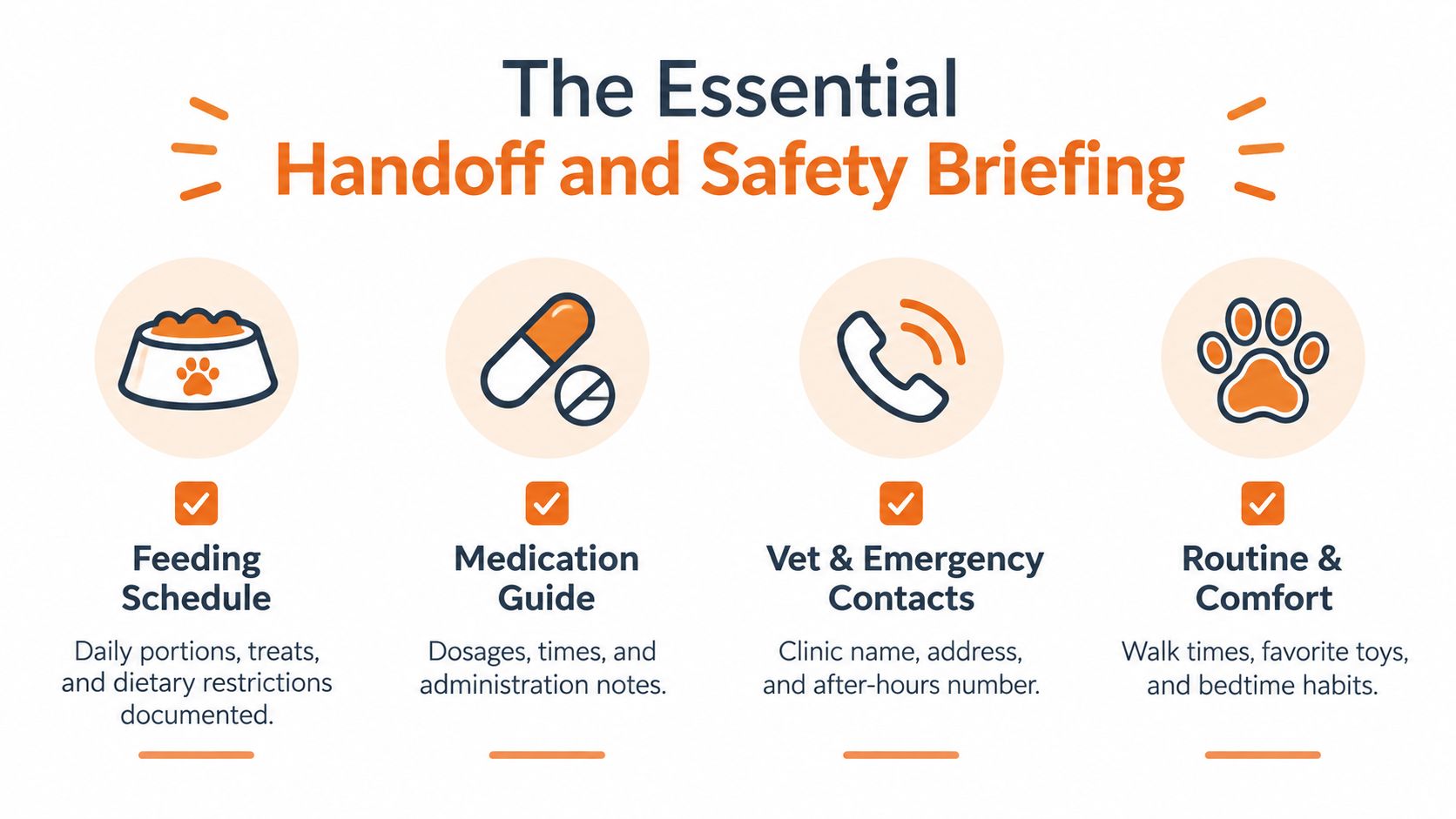
The handoff should make the sitter faster, not overwhelm them. Put the most urgent information in one visible packet, then walk through it in person. A long document buried in an email is less useful than a short emergency card beside the food, backed by fuller notes in a known location.
Veterinary guidance recommends including the primary veterinarian's name, location, and phone number, the nearest 24-hour emergency clinic, the ASPCA Poison Control Hotline, and pet insurance information where applicable. It also recommends medication instructions, feeding notes, behavior details, and emergency authorization. These details give the sitter a clear path when the owner can't respond.
Build the packet for a tired person
Use headings, large type, and direct instructions. Include the pet's name, normal appetite, bathroom pattern, known triggers, and the signs that require a call. Avoid language such as “a little medication with dinner.” State the amount, timing, method, storage location, and what to do if the pet refuses it.
A practical packet includes:
- Feeding: portions, times, treats, dietary restrictions, and food storage.
- Medication: dosage, schedule, administration technique, and missed-dose instructions.
- Medical escalation: veterinarian, emergency clinic, insurance details, authorization, and payment arrangements.
- Household access: keys, alarm procedures, doors, gates, cameras, and trusted backup contacts.
- Comfort and behavior: preferred sleeping place, hiding areas, handling limits, fears, and calming routines.
Keep cleaning instructions equally concrete. Pet-safe products matter when accidents happen, especially around animals that lick floors or investigate freshly cleaned areas. A resource on pet safe cleaners for Florida homes can help owners review safer cleaning choices, but the sitter still needs to know which products are approved in that particular home and where they're stored.
Practice the handoff instead of performing it
Ask the sitter to repeat the critical points back to you. Have them demonstrate the medication routine if the task is unfamiliar. Walk the route to the food, litter, leash, fuse box, water shutoff, and emergency exit. If the sitter can't locate something while you're present, they may struggle to find it during a late-night incident.
Use a structured sitter information sheet to organize the details, then leave a printed copy where the sitter can reach it quickly. Confirm who the backup sitter is, how they'll gain access, and when the primary sitter must contact them.
Emergency information should be visible before it's needed.
End the briefing with a short rehearsal. Ask: “What would you do if the pet vomits?” “Who would you call if I don't answer?” “What happens if you can't enter the house?” Clear answers reduce hesitation, which is often the most dangerous part of an otherwise manageable problem.
Maintaining Comfort Through Routine and Enrichment
Pets don't experience a familiar home as comforting by default. They experience it as comforting when the people caring for them preserve the cues that make the environment predictable. A changed breakfast time, an unfamiliar walking route, or a forced interaction can create more strain than the owner realizes.
The sitter should record the ordinary rhythm before the sit begins. Feeding frequency, exercise timing, medication, rest, play, toileting, and bedtime all belong in the care plan. The aim isn't rigid perfection. It's to avoid unnecessary variation while giving the sitter enough flexibility to respond to the animal in front of them.
Match enrichment to the individual animal
A young, social dog may benefit from scent games, measured training sessions, and familiar toys. A cat may prefer a quiet rotation of puzzle feeders, window access, and play that stops before overstimulation. A senior pet may need shorter walks, non-slip surfaces, easy access to water, and rest between activities.
Separation anxiety requires restraint as much as attention. Constant reassurance can become another unpredictable pattern if the sitter changes it from one visit to the next. Calm arrivals, familiar phrases, gradual departures, and a consistent room setup usually work better than dramatic greetings.
For multi-pet households, document separate needs. One animal may guard food, another may need medication alone, and a third may retreat when the home becomes noisy. “They get along” doesn't replace instructions about feeding distance, door management, or safe separation.
Use the home as a behavioral tool
Familiar furniture, smells, sleeping areas, and routes can support emotional stability, but only if the sitter preserves them. Don't relocate a fearful cat's hiding box because it looks inconvenient. Don't insist that a dog sleep in a new room because the sitter prefers it. Don't introduce unfamiliar treats shortly before departure.
A simple daily log can track appetite, medication, bathroom habits, exercise, and behavior. The log gives owners useful information without requiring constant messages, and it helps the sitter identify changes early. It also separates normal variation from a developing problem.
A familiar home helps only when the care remains familiar too.
Accidents and cleanup deserve a prepared response, particularly with puppies, senior animals, or pets experiencing stress. The sitter should know where washable bedding, gloves, bags, and approved cleaners are stored. Owners dealing with broader household accidents may also find practical context in this resource on parenting bed-wetting help, although pet care instructions must remain specific to the animal and the home.
The best enrichment plan is modest enough to follow. A sitter who has five elaborate activities but no time to complete them may provide less useful care than someone who reliably offers one familiar game, a measured walk, and a quiet rest period.
Building Trust with Community and Transparency
Traditional marketplaces often make trust a one-directional purchase decision. An owner reads reviews, a sitter presents a profile, and both sides hope the written reputation reflects the current person and situation. That model can work, but it places heavy pressure on a limited set of signals.
A community-driven model adds different evidence. A sitter can explain how they work, answer questions, participate in shared standards, and show a history that isn't limited to one marketplace. Owners can assess communication before committing to a booking.

Reputation should travel with the sitter
Experienced sitters often have credibility scattered across previous services. Rebuilding that reputation from scratch makes it harder for owners to distinguish a newcomer from an established caregiver. Global Pet Sitter allows sitters to import 5-star reviews through screenshots, preserving evidence of prior work while keeping the new profile understandable to prospective owners.
That feature doesn't eliminate screening. A review still needs context, and owners should ask whether the earlier sits involved similar pets, homes, and responsibilities. Reputation portability is valuable because it starts a more informed conversation. It isn't a substitute for the meet-and-greet or written agreement.
Governance changes the relationship
A conventional platform usually controls the product roadmap from the center. Members may submit feedback, but they don't necessarily see how decisions are made. Community governance gives participants a clearer role in shaping features and standards, especially when the platform invites voting and makes acted-on feedback visible.
That transparency matters in a service built around private homes and vulnerable animals. People want to know how disputes are handled, how safety concerns are escalated, and whether support remains responsive when a booking becomes complicated. A Facebook group or community forum can also help sitters exchange practical knowledge about access, routines, and regional expectations.
Compare the models directly:
| Traditional marketplace | Community-driven arrangement |
|---|---|
| Reputation is usually tied to the current platform | Prior reputation can be brought into the profile |
| Trust depends heavily on reviews and booking signals | Trust also develops through participation and visible feedback |
| Product decisions are generally platform-led | Members can have a role in feature discussion and voting |
| Communication often centers on a transaction | Communication can continue through a broader support community |
Transparency still needs boundaries. Owners shouldn't expect constant surveillance, and sitters shouldn't share private household information casually. Agree on update frequency, approved communication channels, photography rules, and what requires an immediate call.
The platform's stated flow is straightforward: create a profile, find a match, then connect and care. That simplicity works best when users add the human detail that software can't infer, including how a pet behaves at 6 a.m., what a locked gate looks like, and which changes require escalation.
Here's a closer look at how the service presents its community and matching approach:
Trust grows through small confirmations. The sitter sends the agreed arrival message, the owner replies to confirm receipt, the pet's routine stays visible, and both sides know who can step in if communication fails. Those habits make the relationship dependable without making it impersonal.
Navigating Emergencies and Unexpected Changes
“Just like home” is often treated as a comfort promise. That's incomplete. A home sitting arrangement is only resilient when it still protects the pet after the original plan stops working.
Market coverage frequently emphasizes booking and pricing, while contingency planning receives less attention. Yet the category is expanding. One market report projects growth from USD 3.2 billion in 2025 to USD 3.53 billion in 2026, and another projects the market from USD 3.43 billion in 2026 to USD 8.47 billion by 2034. These projections point to a larger service environment, but they don't solve the practical question of what happens when a sitter cancels or a pet becomes ill.
Define the failure paths before departure
Write down the response sequence for the situations most likely to create panic:
- Sitter cancellation: Identify the backup person, access method, and point at which the owner or platform must be contacted.
- Pet illness: Specify observable warning signs, the approved veterinary route, spending authorization, and transport arrangements.
- Lockout: Keep a second access method with a trusted contact and document alarm procedures.
- Travel disruption: Agree how care continues if the owner's return changes or communication becomes unreliable.
Use time-based instructions rather than vague promises. “Call me immediately, then contact the emergency clinic if I don't respond” is clearer when paired with the owner's authorization and the clinic's details. The sitter shouldn't have to negotiate basic authority during a crisis.
Operational resilience doesn't make a sit cold or bureaucratic. It gives anxious people and animals fewer unknowns. The pet keeps familiar surroundings, the sitter has a workable decision path, and the owner can respond to a real update instead of imagining every possible failure.
Global Pet Sitter connects owners with house and pet sitters who care for animals in their familiar home, with profiles, messaging, reputation information, and a community-led approach to trust. Create your profile or post your next sit through Global Pet Sitter, then build the handoff and backup plan that will keep care steady when travel doesn't go exactly as expected.
Please sign in to leave a comment
