You've accepted a job abroad, signed a lease, or booked a long assignment, and your dog or cat is still asleep beside you. Then you start searching for airline rules and discover that moving pets internationally isn't one task. It's a chain of medical appointments, government approvals, airline decisions, crate preparation, timing windows, and arrival logistics. The process feels intimidating because one missed requirement can disrupt the entire journey.
Relocation can be the right choice, especially when the move is permanent. But it isn't automatically the kindest or most practical option. A temporary assignment, extended trip, or uncertain move may make long-term in-home pet sitting a better fit. The decision should begin with your pet's welfare, your timeline, the destination's rules, and the full landed cost, not with a flight search.
Your Pet Relocation Timeline From Six Months to Go-Time
Your move may be permanent, temporary, or still uncertain when the airline search begins. Start by testing whether relocation fits your pet, timeline, destination, and budget. International entry rules can require microchips, vaccinations, blood tests, treatments, certificates, permits, or quarantine. The USDA pet travel process overview recommends contacting a USDA-accredited veterinarian early and checking requirements for each trip because regulations can change.
Industry data from commercial pet shipper Starwood Pet recorded pets moving to 38 countries in 2025, including the United States, United Kingdom, Australia, Spain, Germany, and New Zealand (Starwood Pet annual report). Treat that figure as a view from one relocation company, not an independent measure of global travel. The practical lesson remains clear: international routes demand early coordination.
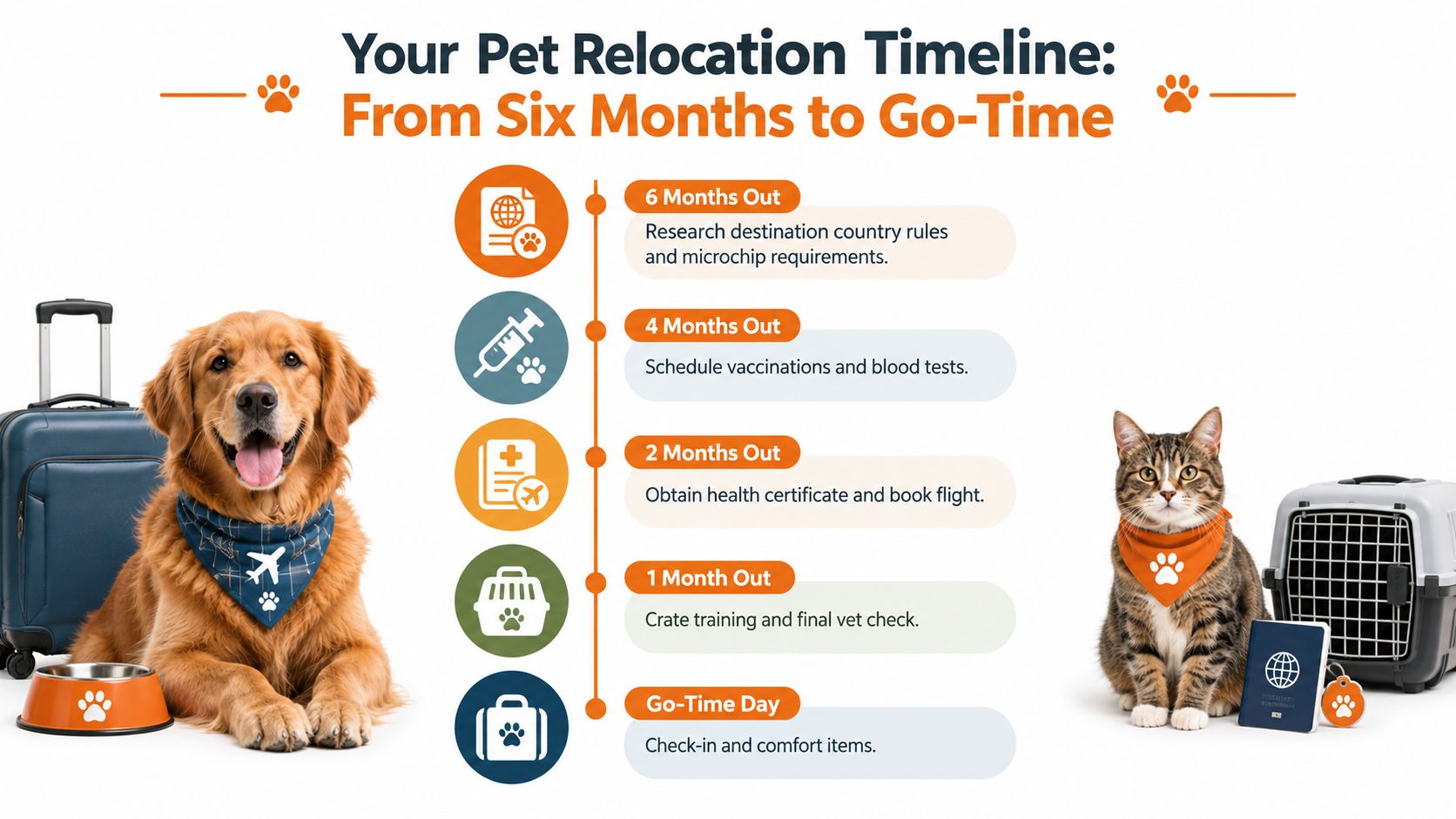
Six months out
Confirm entry rules through the destination's official authority, embassy, or consulate. Check for an ISO-compliant microchip, a rabies vaccination given after implantation, a serology titer test, parasite treatment, an import permit, or quarantine. Have your veterinarian review the sequence before booking appointments. The order can determine whether a vaccination or treatment is accepted.
Use this point to assess the life your pet will have after arrival. Housing restrictions, veterinary access, climate, transport, and the length of your stay may matter as much as the flight. City and neighborhood ratings can help you compare areas before committing. If the assignment is short or uncertain, long-term in-home pet sitting may spare your pet the journey and give you time to decide.
Three to four months out
Complete medical steps with waiting periods. Follow the destination authority's instructions for blood tests, vaccinations, and treatments, then retain original records and digital backups. A scanned copy may not replace an endorsed document, so identify which papers must remain physical.
One to two months out
Confirm the airline's animal policy, crate dimensions, routing, temperature limits, and booking procedure. Arrange professional assistance if the route includes cargo, multiple connections, customs coordination, or strict import controls. Start crate acclimation now, using meals and calm practice to make the crate familiar.
Final week and go-time
Book the final examination and health certificate only after confirming the permitted arrival window. Keep the travel folder, crate labels, handoff instructions, food, water equipment, bedding, and emergency contacts together. Build the schedule backward from the arrival deadline and reserve time for delays or changed instructions.
Practical rule: Treat every deadline as a hard compliance boundary, not a planning suggestion.
Health Foundations Vets Microchips and Vaccinations
Your pet's medical preparation determines whether the rest of the plan is usable. A healthy animal can still be refused boarding or entry if the identification, vaccination sequence, or test timing doesn't match the destination's rules.
The first appointment should be with a USDA-accredited veterinarian when you're exporting from the United States. A regular veterinary practice may provide routine care, but the accredited vet understands export certificates, destination-specific forms, and the endorsement process. Bring every existing record, including prior rabies certificates and microchip details.
Verify identification before treatment
Some destinations require an ISO-compliant microchip, and some require the chip to be implanted before the rabies vaccination is administered. The chip number must match across veterinary records, certificates, permits, and airline documents. Ask the clinic to scan it in front of you and confirm that the recorded number is accurate.
Don't wait until the final appointment to discover that an old chip can't be read by the destination's scanner. If the country accepts an alternative reading method, document that process in advance. If it doesn't, your veterinarian needs time to advise on the appropriate remedy without disrupting the vaccination sequence.
Build a medical compliance record
Official guidance describes a broad matrix that may include updated vaccinations, parasite treatments, ISO-compliant microchips, serologic titer tests, and specific health certificates. U.S. import guidance also notes that state, federal, customs, and wildlife rules may apply at the same time (CDC guidance on traveling with pets and service animals).
Ask your vet to write the requirements as a dated sequence:
- Identification: Record the chip number and implantation date.
- Vaccinations: Confirm which vaccines qualify and when they must be given.
- Testing: Check whether a rabies antibody test or other laboratory work is required.
- Treatments: Schedule parasite treatments inside the permitted window.
- Certification: Reserve the examination and certificate appointment around the arrival deadline.
The cost of routine care varies by location and practice. If you're preparing a cat in the United Kingdom, a guide to 2026 UK cat vaccination costs can help you estimate ordinary vaccination expenses before adding international testing or certification.
Keep vaccination records legible and consistent. The pet vaccination records guide can also help you organize the documentation you'll need to share with your vet, airline, or sitter. That organization matters if plans change and another professional has to take over quickly.
Navigating the Paperwork Maze Country Rules and Health Certificates
A correct certificate can still fail if it is issued too early, uses the wrong form, or does not match the destination's entry rules. Treat the paperwork as a sequence of linked approvals, not as a folder of unrelated documents. That approach also helps you compare relocation with alternatives, since the administrative workload may outweigh the benefit of taking your pet on a short or temporary move.
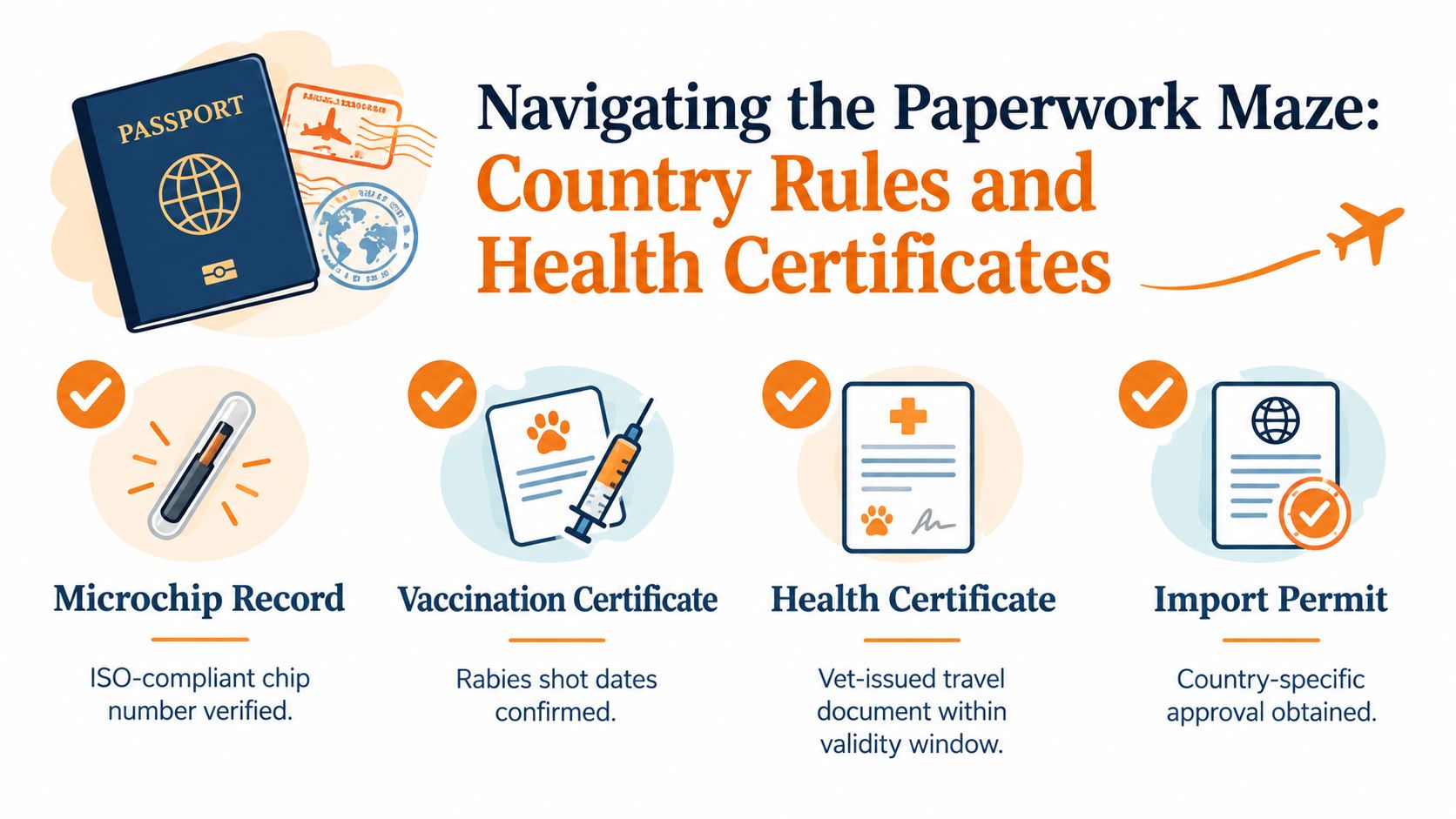
Start with the destination authority
Use the destination country's official import portal as the controlling source. Confirm the rules with the relevant authority or embassy, then ask your accredited veterinarian to match them to the available certificate forms. Airline staff can explain their own acceptance requirements, but they cannot replace government guidance.
Depending on the route, you may need:
- A microchip record matching every other document.
- Vaccination evidence showing an accepted product and administration dates.
- A health certificate completed by an authorized veterinarian.
- Government endorsement if the destination requires it.
- An import permit or prior approval.
- A certified translation if officials require documents in another language.
The CDC travel guidance stresses that certificates must be legible, accurate, and complete. A translation, microchip compliance, or serology testing may also be required, depending on the destination. Check whether the authority wants originals, copies, or a particular certificate format before booking the appointment.
Protect the validity window
The main risk is timing drift. Airline and government rules may require a pre-travel examination and health certificate dated within 10 days of arrival, while another destination may set a different or shorter window (USDA pet travel process overview).
An early examination can leave the certificate expired before arrival. A late appointment can leave too little time for endorsement, corrections, translation, or airline review. Build the schedule backward from the arrival deadline, not forward from departure.
Plan the document date against arrival.
Create a compliance matrix with four columns: requirement, issuing authority, valid date range, and confirmation status. List the airline's cargo department and the destination authority as separate checkpoints. Recheck the rules shortly before travel because an old form or search result may no longer apply.
Keep originals in a waterproof folder and give copies to the person transporting your pet. Send a digital set to yourself and your relocation coordinator, but do not rely on digital files unless the authority explicitly accepts them. If the move is temporary and the documentation burden feels disproportionate, long-term in-home pet sitting may offer a calmer option while you travel, especially when the destination rules are complex or the stay is brief.
Choosing Your Pet's Transport Air Cargo vs Professional Movers
Your pet's size, temperament, route, airline rules, and destination requirements should drive the transport choice. Cabin travel keeps an eligible small pet nearby, but carrier limits and airline policies can exclude it. Larger animals often travel as cargo, while some routes require a freight forwarder or professional pet shipper.
Air transport moves pets internationally at scale. U.S. regulators reported 161,335 animals transported by airlines in 2024, with 13 incidents, or 0.81 incidents per 10,000 animals (air cargo reporting on animal transport). Those figures indicate oversight, not the absence of risk. Your decision should weigh the route, your pet's tolerance, and how much coordination you can manage.
Compare the practical options
In-cabin travel keeps the handoff simpler and lets you remain close, provided your pet qualifies. The animal must fit comfortably in the airline-approved carrier, and some routes do not permit pets in the cabin.
Manifest cargo serves pets that cannot travel in the cabin and may provide specialized handling. It requires more coordination, including cargo booking, crate inspection, airport handoff, and customs procedures. A direct flight can reduce separation during layovers and limit exposure to changing airport conditions, so check the airline's animal-transport policy before booking.
Ground transport may suit a nearby border or a route with reliable roads. Longer journeys can still create welfare, feeding, rest, and scheduling demands, so compare the complete travel time rather than the flight length alone.
Decide whether to hire help
DIY relocation fits a straightforward route when you understand the documents and the airline accepts direct arrangements. You retain control, but also handle errors, booking changes, customs questions, and missed deadlines.
A professional relocation company can justify its fee when several authorities, cargo requirements, quarantine arrangements, or difficult connections are involved. Request an itemized quote. One provider may coordinate only flights, while another may manage veterinary paperwork, endorsements, customs clearance, local transfers, and delivery.
Also decide whether your itinerary needs to match your pet's. Review guidance on whether dogs can travel on planes alone before separating your bookings. If the relocation is temporary, the destination is complicated, or your pet is poorly suited to air travel, long-term in-home pet sitting may be the kinder choice. Keeping your pet in a familiar home can remove airport transfers and flight stress, while giving you time to decide whether relocation is necessary.
The Final Mile Crate Prep Comfort and True Costs
A compliant crate should feel ordinary before it becomes essential. Introduce it at home, leave the door open, place meals or treats inside, and allow your pet to choose it without pressure. Gradually increase the time spent inside, then practice short periods with the door closed while you remain nearby.
The aim isn't to exhaust your pet or sedate them. It's to make the crate a predictable resting place. Discuss anxiety, motion sickness, and any medication questions with your veterinarian, and don't introduce a calming product for the first time on travel day.
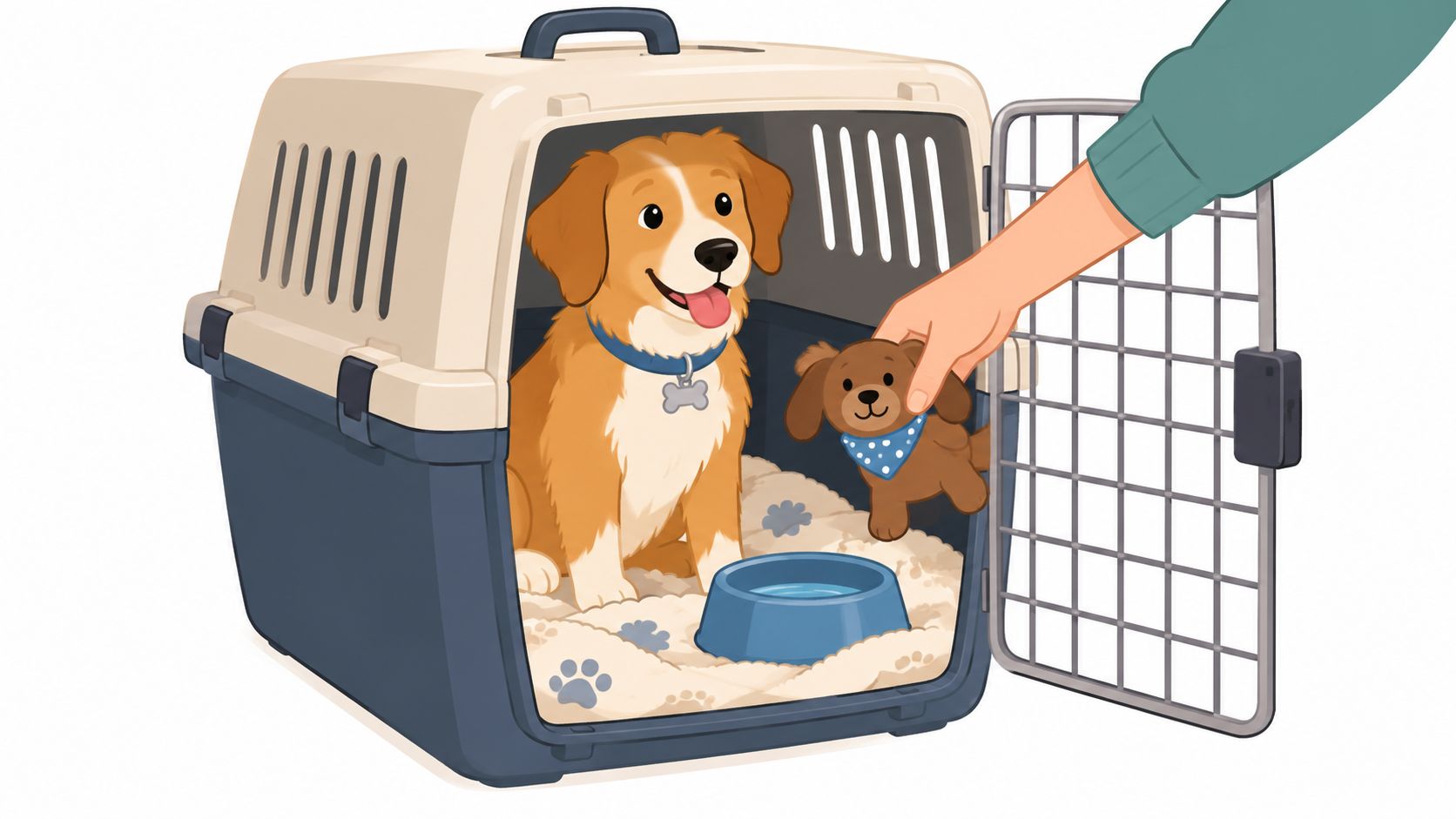
Set up the crate for welfare
The CDC recommends a USDA-approved crate large enough for your pet to stand, sit, and turn around comfortably. Use absorbent bedding, provide water in a secure container, fasten the door hardware without locking it in a way handlers can't open, and mark the exterior clearly as a live-animal shipment.
Pack only what handlers and airline rules permit. A familiar washable blanket can provide reassurance, while loose toys, bulky items, or anything that could obstruct ventilation may create problems. Attach feeding and watering instructions to the crate, and keep a duplicate in the travel folder.
Before departure, verify the crate's dimensions against the airline's current policy. A crate that seems appropriate at home can still be rejected if it doesn't meet the carrier's specifications or the aircraft's handling limits.
Budget the landed cost
The flight is only one line in the budget. Add veterinary examinations, vaccinations, testing, parasite treatments, certificates, government endorsements, permits, crate purchase, airport transfers, cargo handling, customs support, and possible quarantine or contingency expenses.
A 2026 industry report found that many single-pet relocations cost about $4,000 to $6,000 or more, multi-pet family moves often reach $6,000 to $9,000 or more, and highly regulated routes can exceed $10,000 (2026 international pet travel cost report). These are broad planning ranges, not a quote for your route.
Ask providers for an itemized estimate and identify what could change the price. Destination rules, breed or crate size, routing complexity, season, government fees, and last-minute corrections can all affect the final amount. Keep a contingency reserve rather than spending the entire budget on the initial booking.
Watch this practical overview of crate and travel preparation after you've reviewed your own airline's instructions:
An Alternative to Relocation When In-Home Pet Sitting Is the Answer
Relocation makes sense when your move is permanent, your housing is ready, and your pet can meet the destination's health and entry requirements. It becomes harder to justify when the trip has a defined end date, the accommodation is temporary, or the destination imposes a demanding process that would expose your pet to avoidable travel and adjustment stress.
Long-term in-home sitting keeps the animal in familiar surroundings. Your pet retains its bedding, smells, routines, local veterinarian, and usual walking environment. You also avoid the flight, airport handoffs, crate confinement, and the possibility that your temporary housing won't suit the animal once you arrive.
This option requires serious planning, not a casual favor. You need a sitter who can commit for the whole period, follow medication and feeding instructions, handle emergencies, maintain the home, and communicate reliably across time zones. Meet candidates by video or in person, check references, agree on expenses, and prepare written instructions before departure.
Match the choice to the type of move
A sitter may be the more compassionate decision for a temporary work assignment, extended travel, digital-nomad stay, or exploratory move. It can also give you time to confirm whether the destination is suitable before you put your pet through an international relocation.
Relocation remains the better fit when you're building a permanent life abroad and leaving the pet behind would create a longer separation than the journey itself. Consider your pet's age, health, temperament, dependence on routine, and ability to tolerate a new climate and home. The cheapest or fastest option isn't automatically the least stressful one.

Global Pet Sitter is a community-driven marketplace where owners can post dates and pet details, review sitter profiles, message candidates, and arrange care in the pet's home. Its approach gives owners another structured option when pet sitting vs boarding is part of the decision.
A temporary human move doesn't always require a permanent animal move.
If you choose sitting, prepare the home as carefully as you'd prepare a crate. Leave veterinary contacts, feeding portions, medication instructions, emergency authorization, insurance details, access information, and a clear communication schedule. A thoughtful sitter arrangement protects stability without treating your pet as an obstacle to your plans.
Your Final Pre-Flight Checklist for a Successful Move
The final review should confirm decisions, not create new ones. Use the destination authority's current instructions, your accredited veterinarian's records, and the airline's written acceptance requirements as separate sources of confirmation.
Confirm compliance
- Check the microchip: Scan it and compare the number with every certificate and permit.
- Review medical dates: Confirm vaccinations, tests, treatments, and any waiting periods.
- Validate the certificate: Make sure the health certificate is complete, legible, correctly dated, translated if required, and endorsed when necessary.
- Confirm entry approval: Keep the import permit or destination authorization with the original paperwork.
- Re-verify the rules: Ask the destination authority and veterinarian to confirm that nothing has changed.
Confirm the transport
- Call the airline cargo department: Verify the booking, crate acceptance, route, connection policy, and check-in location.
- Prefer a direct route: Use the shortest practical itinerary and confirm the airline's handling plan.
- Inspect the crate: Check ventilation, secure hardware, absorbent bedding, water equipment, and visible identification.
- Prepare handoff details: Write the destination address, emergency contacts, feeding instructions, and handler notes clearly.
Protect the arrival
Keep your pet's first hours calm. Arrange transport from the airport, prepare a quiet room, locate a local veterinarian, and avoid adding unnecessary activity immediately after arrival. If customs, quarantine, or a professional handler is involved, confirm who is responsible for release and delivery before departure.
If the move is temporary, revisit the sitting decision before committing to a complex relocation. A well-organized in-home arrangement may preserve your pet's routine while you complete the assignment and make a permanent decision with better information.
Moving pets internationally is manageable when you treat it as a compliance project and a welfare decision at the same time. Start early, verify every rule, budget for the complete journey, and choose the arrangement that best protects your pet's health and stability.
If your international plans are temporary or you'd prefer to keep your pet in familiar surroundings, Global Pet Sitter helps owners connect with trusted in-home sitters and organize care around their travel dates. Create a profile, share your pet's needs, and start looking for a suitable match before you finalize the relocation.
Please sign in to leave a comment
