You're leaving town, but your dog can't come with you. The boarding facility has space, yet your cat hides whenever the carrier appears, and your older dog settles only when breakfast, medication, and evening walks happen at home. Searching for a pet sitter in Austin, TX isn't just about finding someone available. It's about finding someone who can repeat the same safe routine when you're not there.
Austin gives pet owners plenty of options, from marketplace profiles and neighborhood referrals to independent sitters and house-sitting communities. That abundance helps, but it also creates noise. The strongest choice usually isn't the closest profile or the lowest quote. It's the sitter who responds clearly, handles access and emergencies systematically, and can show that other Austin owners trusted them more than once.
Why In-Home Pet Sitting Is the Smart Austin Choice
A typical Austin travel plan starts innocently. You check flights, arrange a neighbor to collect mail, and then realize your dog needs several days of care. Boarding might be convenient, but your pet may sleep better in its own room, follow its normal feeding schedule, and avoid the noise and unfamiliar smells of a busy facility.
Austin has an unusually engaged pet community. A pilot study of Austin residents found that 83% of respondents currently owned a pet, while 73.3% were both current and previous pet owners. The study also found that 52.2% acquired pets through local Austin shelters or shelters elsewhere, a sign of strong local involvement and adoption culture. These figures come from the Austin pet acquisition study, and they help explain why owners often expect more than a quick check-in.

Familiar surroundings change the handoff
A good in-home sitter preserves the details that make a pet feel secure. That includes the same food location, the same leash, familiar sleeping areas, and the same response to thunderstorms, delivery drivers, or an anxious dog at the front window. For cats, staying home can eliminate the disruption of transport and an unfamiliar enclosure.
Austin's broader pet-services market also appears large and premium-oriented. One independent market analysis estimates roughly 950,000 households in the Austin metro, with about 75% identified as pet-owning households, and reports annual pet spending above $2.8 billion. It also identifies dogs in 68% of Austin pet households. Those figures come from WagBar's Austin pet-market analysis, not a government dataset, so treat them as market estimates rather than official counts.
Practical rule: Choose the sitter who can reproduce your pet's ordinary day, not the sitter who promises the most exciting one.
Neighborhood familiarity helps with travel time, but proximity alone isn't a trust signal. A nearby sitter who rushes visits can be less useful than someone slightly farther away who communicates well, follows instructions, and has a dependable backup plan. In Austin, reputation and routine consistency matter more than a map pin.
Where to Start Your Austin Pet Sitter Search
Your flight leaves early, your dog needs medication that evening, and the sitter who seemed available cannot cover the departure morning. Search results are only useful when they match the full care schedule. Start broadly, then narrow the list around service, timing, travel distance, and the sitter's ability to follow a repeatable routine.
Search by the care you actually need
Use precise service terms. “Dog walking” may return someone who offers only short visits, while “house sitting” generally means the sitter stays in your home. Search separately for overnight care, drop-in visits, medication support, puppy care, and multi-pet households. Prices and availability can vary across platforms, so compare like-for-like services before treating a low quote as a better option.
Filter in this order:
- Dates and service type: Remove profiles that cannot cover the entire schedule. A sitter available for most of the trip but unavailable on departure day creates an avoidable handoff problem.
- Neighborhood or travel radius: Begin near home, then widen the search if the shortlist is weak. Ask how the sitter handles Austin traffic and whether they leave enough time between visits.
- Recent activity: Look for current availability, recent reviews, and detailed updates. An old profile without recent evidence needs closer scrutiny.
- Response behavior: Send the same concise inquiry to several candidates. Compare who answers each question, confirms the schedule, and explains how visits are documented.
Austin listings show a dense supply environment. The Austin pet-sitting marketplace reports 11,420+ Austin pet parents who booked pet sitting and 7,624 listed sitters as of July 2026. Those dated figures are not permanent market totals, but they show why availability alone does not distinguish one profile from another. A dependable option should also have a workable route, clear visit timing, and a process for reporting missed access or unexpected changes.

Use profiles as a starting point, not proof
Read reviews for specific evidence. “Great sitter” says little. Useful reviews mention punctual updates, medication, multiple pets, home access, or how the sitter handled a changed plan. Look for the same strengths across different clients, then check whether those strengths fit your pet's routine.
The The Companion Project blog can help you prepare practical questions about routines, travel, and companion-animal care before contacting candidates.
Keep candidates who match the service, dates, communication expectations, and operational demands of the job. Schedule meet-and-greets only after the shortlist survives those checks.
How to Vet a Sitter Before You Book
A polished profile can still conceal weak follow-through. Before booking an Austin pet sitter, test whether the person can provide repeatable care when traffic, heat, schedule changes, or an access problem disrupt the original plan.
Compare evidence, not presentation. A marketplace may combine reviews, identity checks, booking history, and response information. An independent sitter may have stronger local references, but you may need to verify insurance, background screening, and emergency procedures yourself. Each option shifts part of the verification work to you.
Compare the trust signals
A five-star rating helps only when the reviews explain why. Check how recent they are, whether they describe pets and routines similar to yours, and whether the sitter answers questions directly. Experience with calm adult dogs does not automatically transfer to a reactive rescue, a cat needing medication, or a home with several animals.
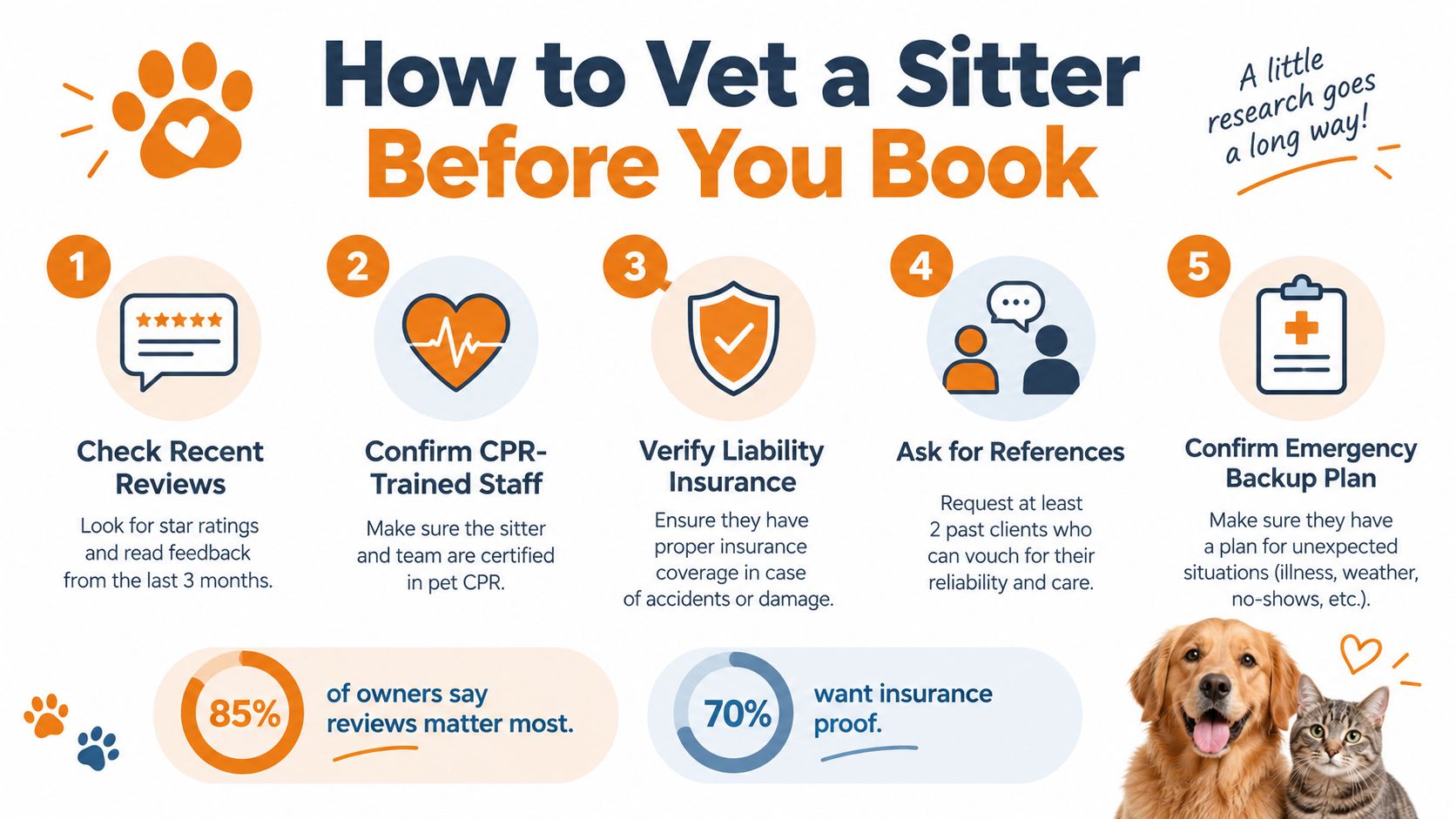
Ask each candidate:
- Recent experience: “What similar pets have you cared for recently?”
- Screening: “What background check or identity verification has been completed?”
- Insurance: “Can you explain what liability coverage applies to this booking?”
- Continuity: “How many repeat clients do you currently serve?”
- Emergency response: “Who takes over if you become ill or lose access to my home?”
Marketplace benchmarks can help you judge response speed and repeat-client experience, but they are screening prompts, not quality guarantees. A quick reply matters only if the sitter also documents care, follows instructions, and communicates when conditions change.
Use this pet sitter interview questions guide to structure the conversation. Listen for concrete answers about responsibility, escalation, and backup coverage. “I'll figure it out” leaves too much risk unresolved.
Watch for avoidable red flags
A long gap in reviews does not prove poor service, but ask what caused it. Vague descriptions, refusal to meet before payment, pressure to skip a written agreement, or reluctance to discuss backup care all deserve caution. The same applies to a sitter who leads with discounts before asking about behavior, medication, or home access.
Trust grows when the care plan is inspectable. A reliable sitter can explain what happens before, during, and after each visit, including who acts when the original plan fails.
The Meet-and-Greet Checklist Every Owner Should Use
The meet-and-greet should feel conversational, but it needs a clear purpose. You're checking whether the sitter can understand your pet, your home, and the failure points that matter when you're several hours away.
Start with the routine. Walk through feeding times, water changes, walks, litter care, sleeping arrangements, outdoor access, and household restrictions. Show the sitter where food, leashes, cleaning supplies, medication, and carriers are stored. Explain behavior triggers plainly, including resource guarding, escape attempts, fear of visitors, or sensitivity to heat.
Test access instead of describing it
Keys and codes cause more problems than owners expect. Test the key with the sitter present. If the home uses a keypad, demonstrate the code, the locking sequence, and what happens if the battery fails. Agree on where a key will be stored, and avoid leaving instructions that depend on memory.
The safety guidance in this pet-sitting security guide recommends testing keys with the client present, using secure key storage, and photographing where keys are left. It also emphasizes written emergency information, including veterinary contact details, the nearest emergency clinic, travel itinerary, backup contacts, medical conditions, medications, and treatment authorization.
Make emergency decisions explicit
Write down who can approve treatment and what the sitter should do if you can't be reached. Include your regular veterinarian, a nearby emergency clinic, your travel details, and at least one local backup contact. Austin heat also deserves a direct conversation. Confirm when outdoor time should be shortened, where your pet can cool down, and whether the sitter knows the safest route for walks.
Finish by agreeing on communication. Decide whether you want a daily message, photos, immediate calls for health changes, or updates only when something unusual happens. Ask the sitter to repeat the plan in their own words. That simple step exposes misunderstandings before the booking begins.
Austin Pet Sitter Pricing Explained
Austin prices vary because “pet sitting” describes several different services. A short drop-in, an overnight stay, and extended care for a medically complex pet shouldn't be compared as if they were interchangeable.
Care.com reports about $15.54 per hour for pet sitting in Austin, while Rover reports a $20 median cost per visit and overnight rates around $97.50. Local providers advertise prices ranging from $28 for a 30-minute visit to $120 for overnight care. These figures are compiled in the Austin pet-sitter pricing comparison, and the spread is the important lesson. A single average can hide the service differences behind the quote.
Read the quote line by line
Ask whether the price covers:
- Drop-in duration: Confirm whether the visit includes travel, feeding, exercise, medication, and cleanup, or only time inside the home.
- Overnight presence: Clarify arrival and departure windows. “Overnight” may mean sleeping at the property or only visiting late and early.
- Additional pets: Ask whether cats, birds, puppies, or extra dogs add a fee.
- Special handling: Medication, injections, mobility support, separation anxiety, and accident cleanup can change the rate.
- Timing: Same-day requests, holiday periods, and schedule changes may carry separate charges.
A lower quote can make sense for a simple visit near the sitter's home. It can also indicate that the sitter hasn't priced travel, preparation, or responsibility accurately. Conversely, a higher quote isn't automatically better. Ask what additional reliability or care it buys.
For a broader explanation of service categories and cost drivers, see this pet-sitting cost guide. Before booking, request one written total for your exact dates and pet profile. That prevents a cheap headline rate from becoming an expensive final invoice.
Contracts, Insurance, and Backup Plans
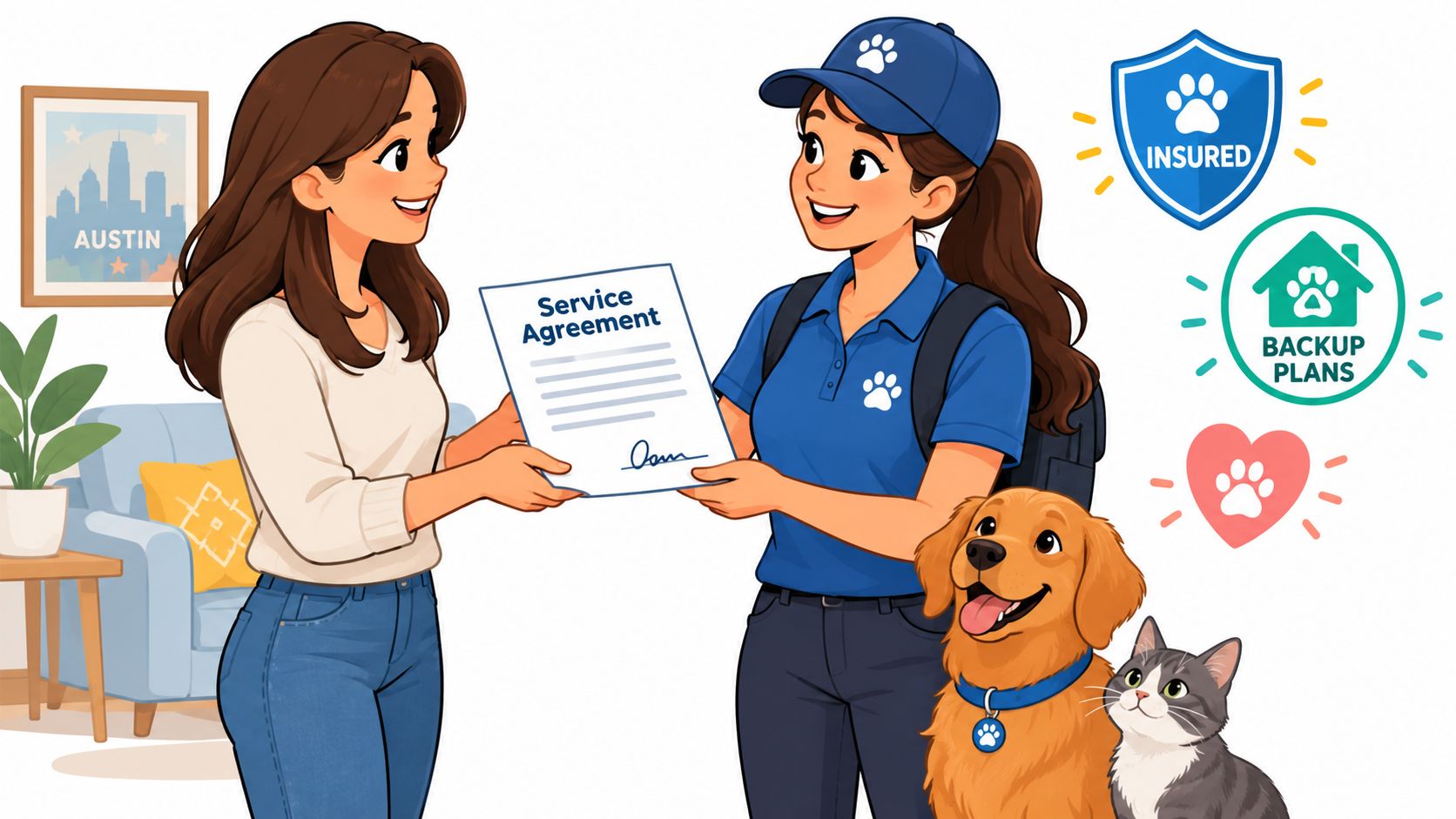
A written agreement turns a friendly arrangement into an operating plan. It should state the dates, service type, visit or overnight expectations, price, payment terms, cancellation rules, access instructions, medication responsibilities, and communication schedule. Include what happens if your return is delayed or the sitter can't complete the booking.
Clarify responsibility before departure
Ask whether the sitter carries liability insurance and what it covers. Don't assume a platform guarantee, homeowner policy, or personal policy handles every situation. If the sitter uses subcontractors, confirm who may enter your home and who is responsible for the animals.
Your agreement should also identify a backup person. That person needs access, permission to authorize urgent care, and enough information to step in without reconstructing the entire routine. A backup plan shouldn't exist only in your head or in a text message buried under travel updates.
The pet-sitting contract template can help organize the details. Adapt any template to your home, pets, and local arrangements rather than signing a generic document without reading it.
Use simple messages that remove ambiguity:
“Please confirm that you'll arrive between [time] and [time], complete the feeding and medication instructions, and send an update after the evening visit.”
“If [pet] shows [specific symptom], contact [veterinarian] first, then call [backup contact]. You have permission to authorize urgent treatment if I can't be reached.”
After the sitter accepts, send one final summary with the address, access steps, pet profiles, supplies, veterinary details, travel dates, and backup contact. Ask for confirmation before you leave.
A short video can reinforce the written handoff, especially for locks, medication preparation, or unusual equipment. Use it as a supplement, not a replacement for a document.
How Global Pet Sitter Can Simplify Your Search
A community-driven house and pet-sitting marketplace can reduce some of the friction between finding a candidate and verifying the relationship. Owners can post dates and pet details, review sitter profiles, message candidates, and compare people who are interested in caring for pets in their own homes.
That model is useful when a standard marketplace search produces too many interchangeable profiles. A sitter who has built a reputation elsewhere may be able to preserve that credibility through imported review screenshots, while an owner can still ask direct questions about Austin availability, access, routines, and backup care.
The platform also supports a straightforward flow: create a profile, find a match, and connect before care begins. Transparent pricing and visible community feedback help owners understand the arrangement instead of relying only on a headline rate. The practical limitation is the same as with any directory. A profile reduces search friction, but it doesn't replace a meet-and-greet, a written agreement, or an emergency plan.
For Austin owners, the strongest use is as one part of a disciplined search process. Filter for the dates and care type, message candidates with the same questions, inspect their reviews and experience, then confirm the operational details in person. Trust is built through repeated evidence, clear expectations, and reliable follow-through.
Global Pet Sitter gives Austin pet owners a place to post care needs, find and message sitters, and evaluate reputation before arranging in-home care. Visit Global Pet Sitter to start a more organized search and connect with candidates who fit your dates, pets, and care routine.
Please sign in to leave a comment
