Your trip is booked. Your sitter said yes weeks ago. Then life happens.
A pet gets sick. A flight changes. A sitter's family emergency lands the night before departure. On a paid service, people usually jump straight to fees. On a house and pet sitting marketplace where no money changes hands, the problem is different. It's trust, calendar loss, backup planning, and whether both sides know what happens next.
That's why every arrangement needs a written pet sitting cancellation policy, even if the agreement feels friendly and informal. I've seen owners assume “we'll figure it out if something comes up,” and I've seen sitters block travel dates for a long sit only to get a vague cancellation message at the last minute. In both cases, the damage isn't just inconvenience. It's stress, rushed rebooking, and avoidable resentment.
A good policy doesn't need legal theater. It needs clarity. Who can cancel, how much notice counts as fair, what changes for holidays, what qualifies as a no-show, and which exceptions get handled differently. That's the difference between a community that runs on trust and a community that burns trust down every peak season.
Introduction to Pet Sitting Cancellation Policies
An owner books flights before confirming the cancellation terms. A sitter reserves the dates, turns down another sit, and starts planning the trip. Then plans change, and both sides find out too late that they were working from different assumptions.
That is why a pet sitting cancellation policy needs to be settled early and written down. On paid bookings, people usually focus on charges and refunds. On a trust-based arrangement such as Global Pet Sitter, the bigger issue is how both sides protect time, pet care, housing plans, and backup options when a sit falls through.
Why cancellation policies matter more on trust-based sits
A no-fee sit still carries real costs.
Owners are trusting someone with their pets, home, routine, and travel schedule. Sitters are committing dates, transport, and in many cases temporary accommodation. If one side cancels late, the loss shows up as rushed rebooking, disrupted care, wasted planning, and avoidable friction.
A good policy sets the rules for fair notice and fair response.
That is also why notice windows should differ by service type. A midday drop-in can often be replaced faster than a two-week live-in sit over Christmas. The policy should reflect the replacement difficulty, not copy a generic penalty chart. Time To Pet makes the same practical point in its guidance on putting cancellation terms into the service agreement and onboarding process, instead of leaving them implied (Time To Pet guidance on setting and enforcing a cancellation policy).
What a good policy is designed to do
Treat the policy as trust design, not punishment.
It should set expectations before anyone packs a bag or hands over keys. It should make clear how much notice is fair for each kind of service, what happens if the cancellation is unavoidable, and what both sides are expected to do next. On a marketplace where money may not be the main issue, those practical steps matter more than a fee table.
A workable pet sitting cancellation policy does three jobs:
- Protect continuity of care: pets still need a safe, realistic backup plan if a sitter cancels
- Protect reserved time: sitters should not carry all the risk of blocked dates and lost opportunities
- Protect trust in the community: clear rules reduce blame, panic, and last-minute arguments
Force majeure belongs in that design too. Illness, severe weather, transport disruption, and family emergencies should be handled differently from casual plan changes. Fair treatment does not mean no accountability. It means spelling out what happens next, such as prompt notice, reasonable proof when needed, help with rebooking, and immediate release of dates. Calm agreements produce better outcomes than improvised apologies.
Essential Clauses Every Cancellation Policy Should Include
A usable policy has a small set of clauses. Skip one, and that's usually where the argument starts.
Put the rules in the agreement, not just the profile
If you're a sitter, don't bury cancellation terms in a long bio. If you're an owner, don't assume a message thread counts as mutual understanding. Put the policy in the service agreement, confirmation message, or onboarding checklist.
This visual is a good checklist to keep beside your draft:
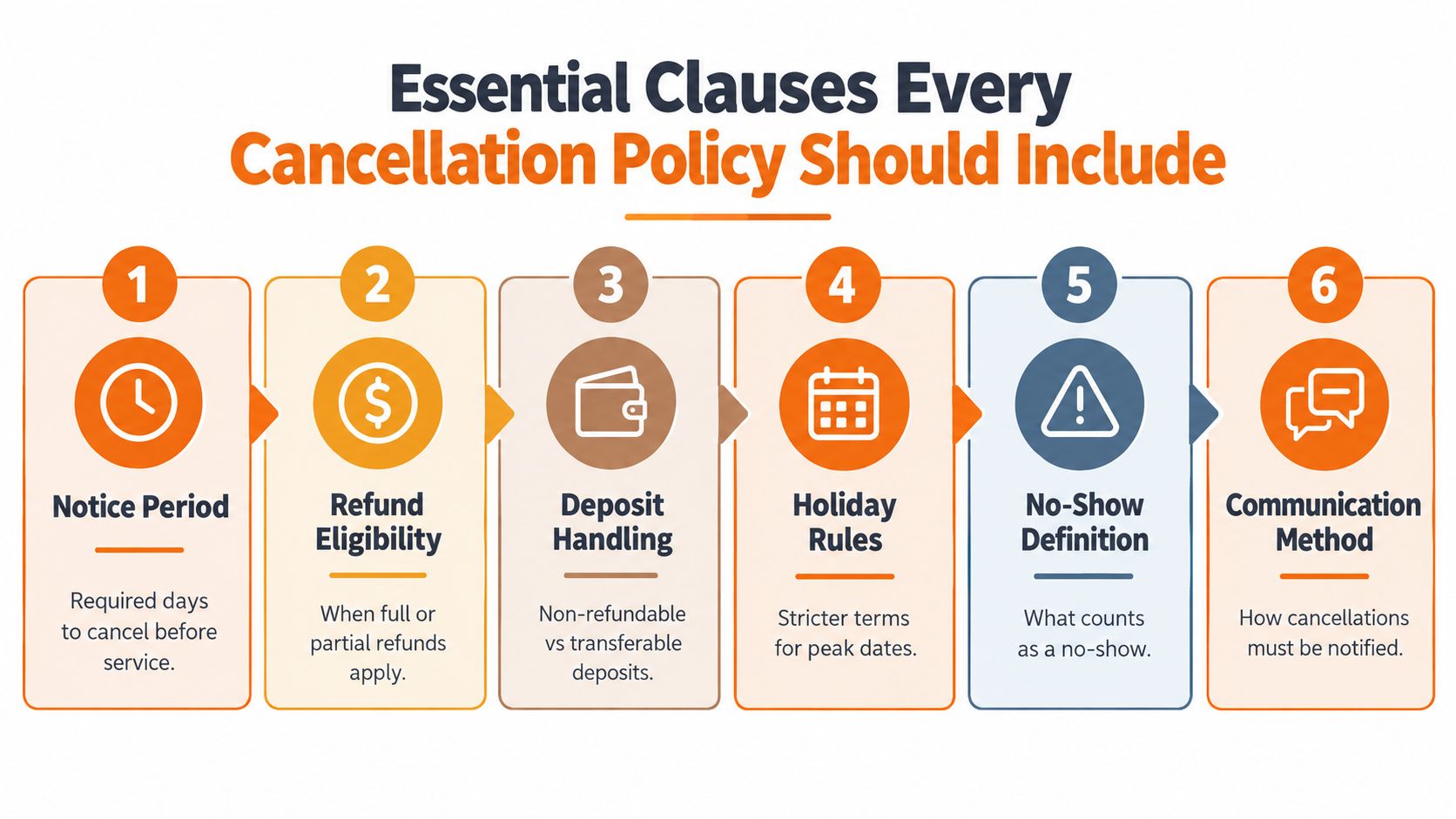
The six clauses that matter
-
Notice period: State how far in advance someone must cancel. This is the backbone of the policy. Example: “Routine visits may be cancelled with advance notice; overnight sits require a longer notice period.”
-
Refund eligibility: If money is involved, say when a full refund, partial refund, credit, or no refund applies. If no money is involved, translate this into practical remedies like helping rebook or reopening dates immediately.
-
Deposit handling: If you charge a deposit, say whether it's refundable, transferable, or forfeited in specific situations. Don't leave deposits in a gray area.
-
Holiday rules: Peak dates need their own terms. If Christmas, New Year's, or Thanksgiving are treated differently, say that plainly at booking.
-
No-show definition: Define what counts as a no-show. Is it silence past the handover time? Is it failure to arrive by an agreed window without communication? Don't improvise this later.
-
Communication method: Specify how cancellations must be given. Message, email, app notification, or phone call for urgent same-day changes. Pick a method that creates a record.
For readers drafting wording from scratch, a short reference like this practical guide to a cancellation policy can help you sanity-check your structure before you publish it.
Here's the operational point that people miss. A policy isn't only about what the fee is. It's about how the cancellation gets communicated and recorded so both sides can act fast.
Example wording that works
Practical rule: “Cancellations are valid only when sent through the agreed communication channel. Urgent same-day changes must also be confirmed by direct message or phone.”
That sentence does two useful things. It sets a standard, and it prevents “I thought you saw my message” disputes.
Keep the language plain. If a normal person can't understand the clause on first read, rewrite it.
Standard Timelines and Notice Windows by Service Type
A client cancels a lunchtime drop-in the night before. Annoying, but usually recoverable. A five-night house sit falls apart two days before departure. That can wreck travel plans, leave a sitter with blocked dates they cannot refill, and force the owner into a last-minute scramble.
Those two cancellations should not be treated the same. Good policy design matches the notice window to the replacement difficulty.
On a marketplace like Global Pet Sitter, that matters even more because trust is the product. You are not only setting fees. You are setting expectations about how much time each side needs to adjust fairly.
Match the notice window to the actual disruption
Short services usually justify shorter notice. Dog walks and drop-ins are easier to reshuffle, and the financial hit from one cancellation is smaller. Overnight care, boarding, and live-in sits need longer notice because they block more calendar space and usually involve handoff planning, key exchange, and a pet routine that cannot be patched together casually.
One published pet-sitting contract uses a practical middle ground. Either party can cancel at least 48 hours before the first visit without penalty, while later cancellations can trigger a 30% fee, with carve-outs for severe weather, death in the family, and medical emergency (independent pet-sitting contract example).
That approach works because it reflects risk instead of chasing symmetry. Equal treatment sounds fair. Matched consequences are fairer.
Typical Notice Windows and Fees by Service Type
| Service Type | Standard Notice Window | Late Cancellation Fee | No-Show Fee |
|---|---|---|---|
| Drop-in visits | Often 24 to 48 hours | Often partial charge | Often full charge |
| Dog walks | Often 24 to 48 hours | Often partial charge | Often full charge |
| Overnight pet sitting | Commonly 48 hours or longer | Often higher partial charge | Often full charge |
| Boarding or extended overnights | Often several days | Often partial to substantial charge | Often full charge |
| Holiday or peak sits | Longer and stricter than standard bookings | Often increases as start date gets closer | Can reach full forfeiture |
Use the table as a starting point, not a script. If your service requires a meet and greet, medication training, or travel to the client's home, extend the notice window. If it is a simple recurring walk that another sitter can cover, keep the rule shorter.
No-show is its own category
A late cancellation still leaves a narrow chance to react. A no-show wipes out that chance.
If you want a plain-English definition of the metric behind that distinction, this glossary on what No Show Rate means is useful. In pet care, a no-show is not just a booking problem. It can disrupt feeding, medication, access, and the pet's routine.
My recommendation is simple. Set shorter notice windows for low-complexity services, longer windows for overnight care, and separate force majeure from ordinary cancellation. That is how you build a policy people will trust.
Holiday and Peak Period Rules That Protect Both Parties
A client cancels their Christmas sit three days before departure. A sitter blocks New Year's week for one booking, turns down others, and then gets a last-minute change. That is the problem holiday rules need to solve.
Holiday and peak-period terms should protect time, planning, and trust. They are not just a penalty chart. On high-demand dates, the notice window gets longer because replacement is harder, preparation starts earlier, and both sides are giving up other options.
Use tiered rules that match how hard the sit is to replace
A flat holiday rule is lazy. Use a tiered structure that gets stricter as the start date gets closer and as the sit becomes harder to refill.
One published pet-sitting contract uses a stricter holiday model, including a four-day travel cancellation requirement and a 50% holiday charge for shorter notice (published pet-sitting contract example). That general structure is the right one. Early cancellation can allow a partial refund, relisting, or date transfer. Very late cancellation should usually lead to a much smaller refund or none at all, because the sitter is unlikely to replace those dates.
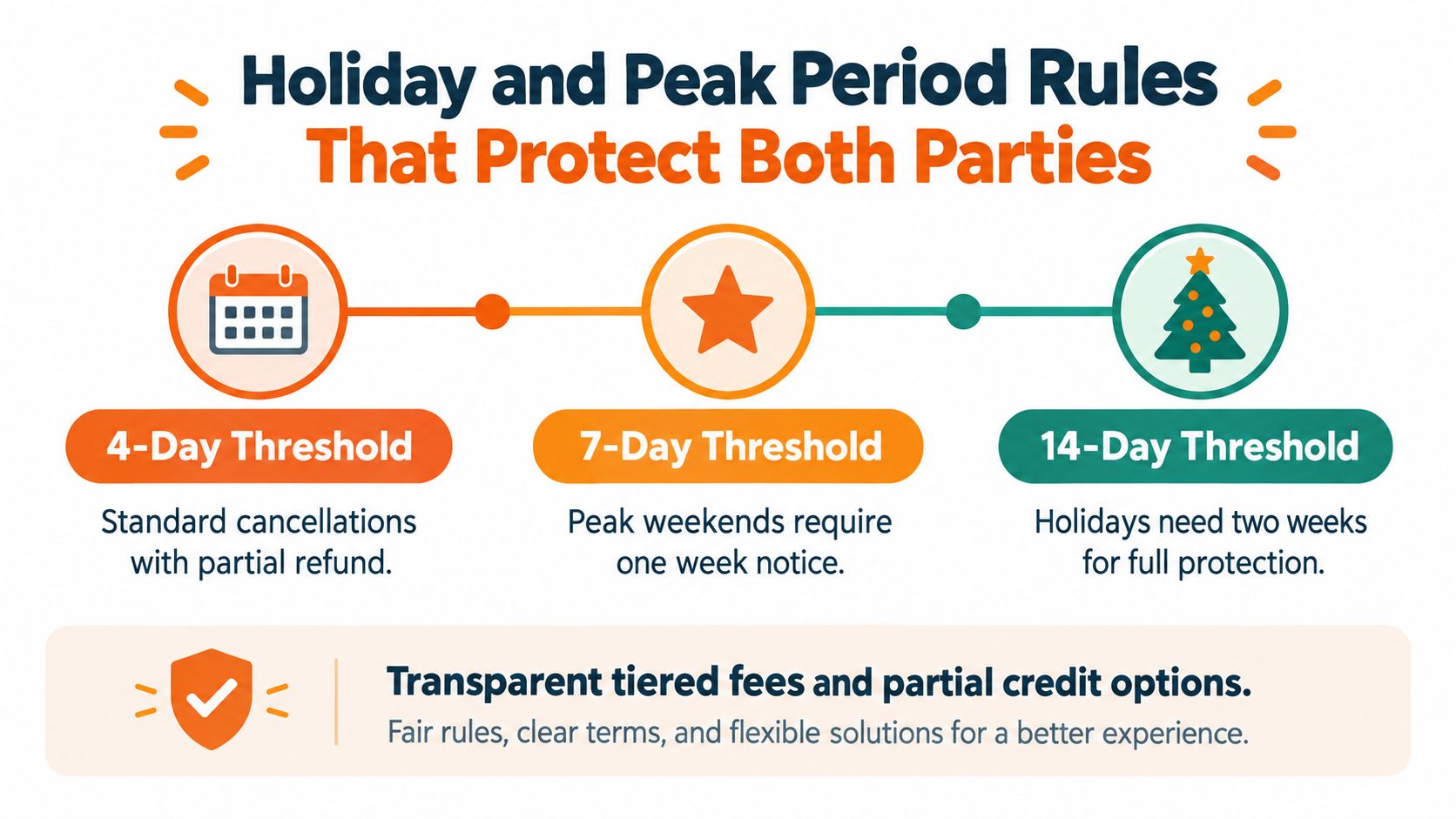
The notice window should also reflect the service type. A holiday dog walk that can be covered locally does not need the same rule as a seven-night in-home sit with medication, key handoff, and a meet and greet. Treating those as identical makes the policy look arbitrary.
Define peak periods before anyone books
Write down the dates that trigger holiday terms. Do not leave “peak period” open to argument.
Spell out whether the rule applies to:
- major public holidays
- school-break weeks
- long weekends
- local event periods with unusually high demand
- any booking that overlaps those dates, even by one night
That last point matters. If a sit starts before the holiday but runs through it, say which policy applies. My recommendation is simple. If any material part of the booking falls inside the peak window, apply the peak-period rule to the whole sit unless you clearly split pricing and cancellation terms by date.
Put the off-ramp in writing
People accept strict holiday terms when the process is clear. They do not accept surprises.
State, in plain language:
- what counts as a holiday or peak booking
- what happens if the owner cancels early
- what happens if the owner cancels close to arrival
- what happens if the sitter has to cancel
- whether rebooking, credit, or a replacement sit is possible
- how emergencies are reviewed
On a marketplace like Global Pet Sitter, that last part matters even more. Many bookings are built on trust, planning, and reciprocal commitment rather than a simple paid transaction. Your policy should reflect that. The fair question is not only “what fee applies?” It is also “who carried the planning risk, and what is the cleanest way to make the other party whole?”
Tie any retained amount to real loss, not frustration
Do not write “all holiday bookings are non-refundable” and call it done.
UK consumer guidance says a business is generally entitled only to keep or receive an amount sufficient to cover losses directly caused by cancellation, such as incurred costs or lost profit (UK consumer guidance on cancelling goods or services). Even outside that framework, the principle is sound. If the sitter easily refills the dates, a full forfeiture looks excessive. If the cancellation leaves an empty holiday week that cannot realistically be rebooked, stricter terms are easier to defend.
Holiday policies work best when they are strict, specific, and fair. That combination prevents arguments better than any hardline sentence ever will.
Fee and Refund Scenarios With Practical Examples
A common failure looks like this. The owner cancels on Tuesday, the sitter had blocked the weekend, and both sides believe the policy favors them. That is not a pricing problem. It is a trust-design problem.
Good examples solve that fast. They show who absorbs the planning loss, what gets refunded or credited, and what each person must do next. On Global Pet Sitter, that matters as much as money because many arrangements rely on coordination, housing access, travel timing, and reciprocal commitment.
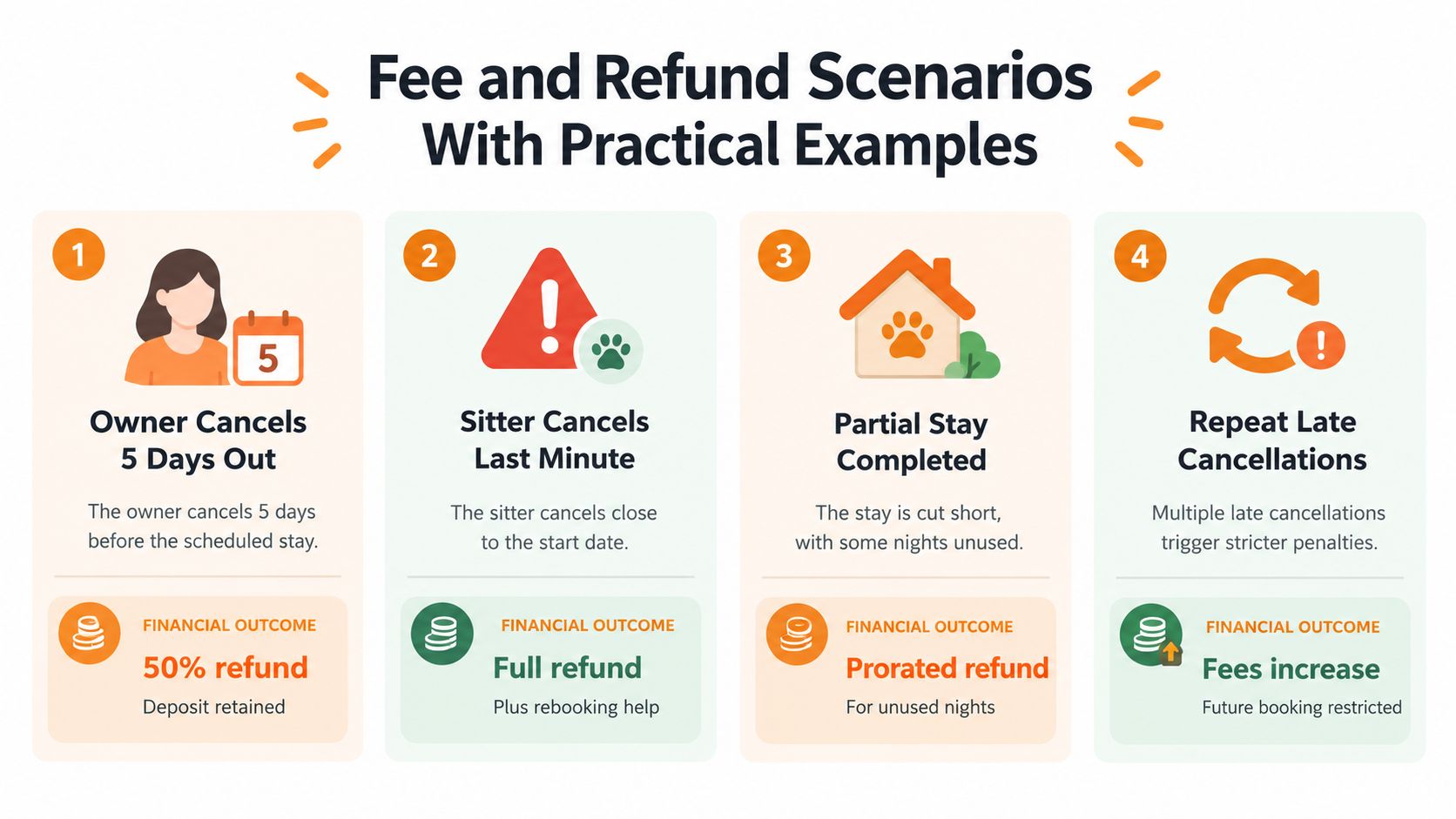
Four scenarios that should already be in your policy
-
Owner cancels with moderate notice
State the outcome in one line. Refund in full, keep the deposit, issue credit, or offer a partial refund. Pick one rule and use it every time. Moderate-notice cancellations usually justify a lighter charge for drop-ins or walks, and a firmer charge for overnights or holiday blocks because the rebooking risk is different. -
Sitter cancels late
The sitter should carry the practical burden. Immediate notice is the minimum. The sitter should also help protect the owner from the fallout by sharing handover notes, key details, timing flexibility, or any useful information that makes a replacement easier to arrange. -
Partial stay is completed
Write this out before it happens. If a paid sit ends early, a prorated refund for unused days is usually the cleanest rule unless the policy clearly says certain prep work or reserved dates are nonrefundable. In an unpaid exchange, fairness usually means practical repair: help the other side relist, adjust dates, or confirm what care was completed. -
Repeat late cancellations by the same person
Treat repeat behavior as a reliability issue, not a one-off annoyance. Your policy should allow stricter terms for future bookings or refusal to rebook after repeated late cancellations. Trust is built by patterns, and it is lost the same way.
Use copy-paste language, not vague promises
Policies break down when they leave too much room for improvisation. Use wording people can read once and understand under stress.
“If you cancel, send written notice through the agreed channel immediately. Refund, credit, or retained-fee treatment follows the notice window and service type listed in this policy.”
“If I cancel as the sitter, I will notify you immediately and help with reasonable rebooking support, including schedule details, handover information, and prompt communication.”
“If a stay ends early, unused services are handled under the partial-completion rule in this policy. Any retained amount must match time already delivered, reserved dates that could not be rebooked, or agreed nonrefundable costs.”
My advice on fairness
Do not rely on blanket “non-refundable” language. It creates arguments and usually overreaches.
Match the outcome to the loss. A short-notice cancellation with no valid exception can justify a retained fee. A documented disruption outside someone's control should trigger review for credit, transfer, or a reduced charge. A sitter-caused cancellation should shift the burden toward making the owner whole in practical terms, not just apologizing.
That is how a cancellation policy earns trust.
Ready to Use Cancellation Policy Templates
A cancellation policy fails at the worst moment. The owner is at the airport. The sitter has blocked the dates. The pet still needs care. Your template should tell both sides what happens next without a long debate.
Use a short policy that matches the kind of booking. Paid pet sitting needs clear fee and refund terms. A house and pet sitting exchange needs clear notice rules, communication steps, relisting expectations, and fair exception handling. That difference matters. Cancellation policy is not just a penalty schedule. It is trust design.
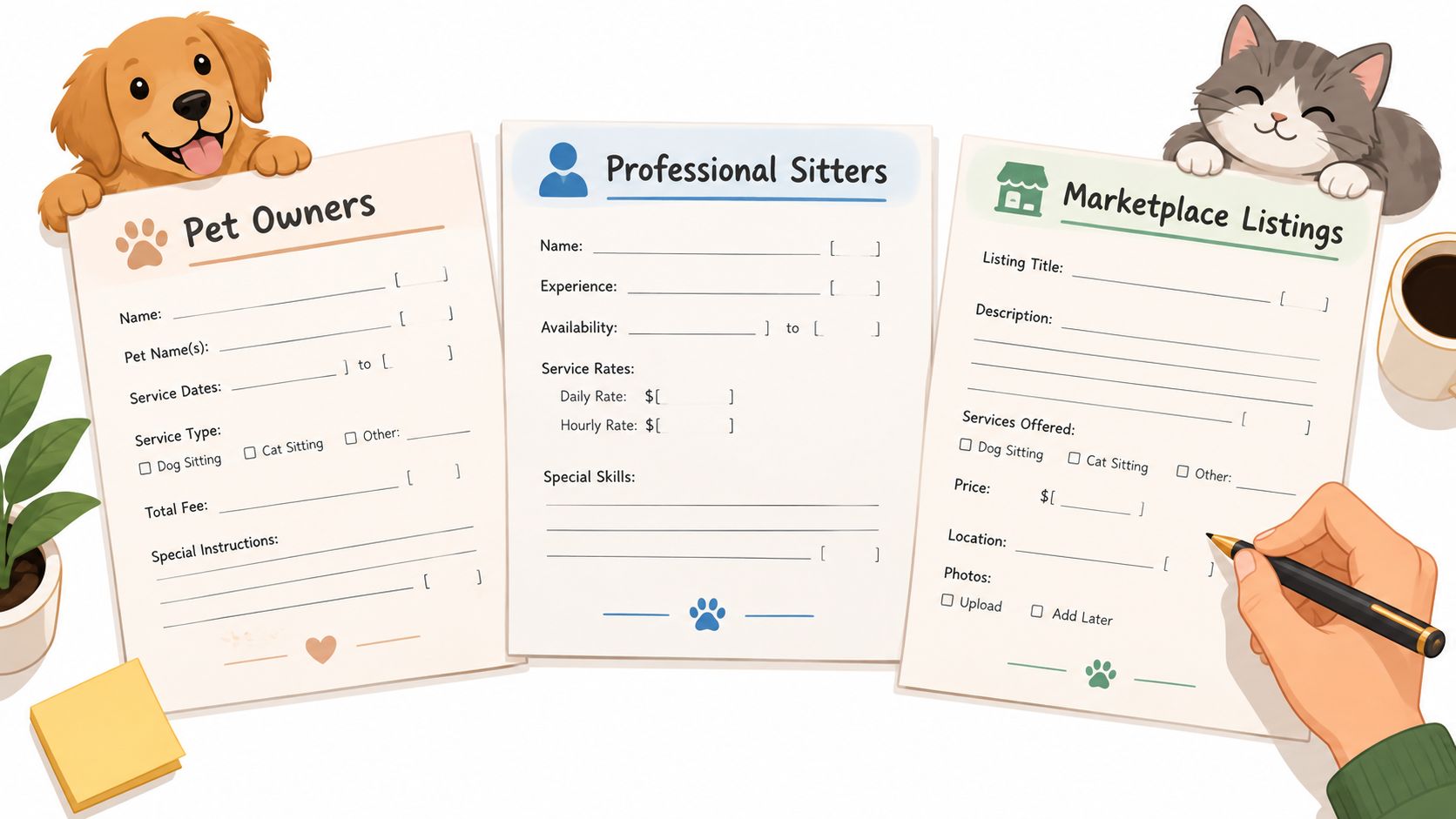
Template for paid pet sitting services
Use this for walks, drop-ins, overnights, and boarding where money changes hands:
Cancellation Policy
Cancellation requests must be sent in writing through [method]. The time of notice is the time the written message is received.Standard visits require [notice window]. Overnight or multi-day bookings require [notice window]. Holiday and peak-period bookings follow the separate terms in this agreement.
If the client cancels within the notice window, [refund or credit rule] applies. If the client cancels after the notice window, [late cancellation rule] applies. No-shows are defined as [definition] and handled under [rule].
If the sitter must cancel, the sitter will notify the client immediately and provide reasonable rebooking support, including schedule details and prompt handover communication.
Documented emergencies, severe weather, serious pet illness, or major travel disruption may qualify for credit, transfer, or reduced charges under the exception rule.
Template for house and pet sitting exchanges
Use this where the main exchange is care, accommodation, and planning rather than direct payment:
Sit Cancellation Terms
If either party needs to cancel, they must notify the other immediately through [platform message] and use [phone or backup method] for urgent changes.Notice expectations depend on the sit. A weekend sit may allow a shorter window. A long sit, holiday sit, or sit that requires flights should require earlier notice because replacement is harder.
If the owner cancels, the owner will reopen the dates promptly, confirm whether travel plans changed, and share any information that helps the sitter adjust. If the sitter cancels, the sitter will respond quickly, answer replacement questions, and help with handover details if another sitter is confirmed.
Emergencies are reviewed case by case. Fast communication and clear evidence matter more than rigid language.
Short version for a profile or listing
Keep the public version brief. Save the full detail for messages and the written agreement.
- Standard sits: “Please cancel as soon as plans change. Send written notice through the platform, then use direct contact for urgent same-day issues.”
- Long or travel-heavy sits: “Long sits and bookings tied to flights or major travel require earlier notice because replacement takes more coordination.”
- Holiday dates: “Holiday bookings follow stricter cancellation terms because sitter availability is limited.”
- Emergencies: “Documented emergencies are reviewed fairly, with priority given to quick communication and workable backup plans.”
Where to place the policy
Put the short version in your profile so nobody is surprised. Put the full version in your booking messages and written agreement so consent is clear.
If you need the rest of the agreement around duties, timing, access, and handover, pair your cancellation clause with a pet sitting contract template.
For Global Pet Sitter, keep the wording practical. The platform is built around profile matching, messaging, and confirmed sits rather than direct payment processing, so your policy should focus first on notice, communication, backup planning, and fair handling of genuine disruptions.
Handling Exceptions and Force Majeure Fairly
A sit is confirmed. The owner is already packed. Then a storm cancels flights, a pet spikes a fever, or the sitter lands in the hospital. If your policy only lists penalties, it fails right when trust is under pressure.
Handle exceptions as trust design, not as a fee chart. The question is not “who pays?” It is “what does each side owe the other when events break the plan?” On Global Pet Sitter, that matters even more because many arrangements rely on matching, notice, and goodwill rather than direct payment processing.
Separate changed plans from disrupted plans
Use three buckets and say so plainly in your policy:
- Standard cancellation: someone backs out for personal convenience, scheduling error, or poor planning.
- Case-by-case exception: the reason is serious but the impact and timing still matter.
- Documented force majeure or emergency: an external event or genuine emergency makes the original plan unrealistic or unsafe.
That distinction keeps your policy fair. A late cancellation because someone changed their mind should not be treated the same as a grounded flight, sudden hospitalization, evacuation order, or urgent veterinary event.
It also explains why notice windows differ by service type. A midday drop-in can often be replaced faster than a multi-night house sit tied to travel dates, medication routines, and key handoff. The harder a sit is to replace, the more your exception process should focus on fast notice, honest documentation, and practical backup steps.
What fairness looks like on a non-monetary marketplace
Fee schedules solve only one problem. Trust-based sits need different remedies.
On Global Pet Sitter, translate the usual late-cancellation logic into actions people can take.
- Immediate notice through the platform
- Proof of the disruption when reasonable
- Help relisting or finding replacement care
- Flexible handover changes if the sit can still happen in modified form
- A written release of dates so nobody is left guessing
That approach protects both sides without pretending every problem fits a refund table.
A simple exception process
Use a short process that works under stress:
- Report the issue immediately. Use the platform message thread first.
- State the impact clearly. Can the sit still happen, be shortened, be delayed, or not happen at all?
- Share reasonable evidence. Airline cancellation notice, vet record, doctor note, weather alert, or similar proof.
- Propose one workable remedy. Replacement sitter outreach, revised timing, partial handover, or full release.
- Confirm the final agreement in writing.
Keep the documentation standard reasonable. Ask for enough to verify the disruption, not a pile of paperwork that turns an emergency into an argument.
If the disruption also raises questions about accidents, property damage, or emergency responsibility, read how pet sitting liability insurance works in practice. Insurance and cancellation rules cover different risks, and people mix them up all the time.
My recommendation
Write the exception clause with plain limits. Name the events you will review. Require prompt notice. Require reasonable proof. Then list the remedies you will consider, especially rescheduling, relisting help, adjusted handover, and written release.
That gives you a policy people can follow when plans go sideways. It also signals something important. Reliability still matters, but genuine disruption is handled with evidence, speed, and basic fairness.
Dispute Resolution and Quick Reference for Global Pet Sitter
Your flight is canceled the night before departure. The sitter has blocked the dates, turned down another request, and now wants to know whether the sit is still on. This is the moment a cancellation policy proves what it is. Not a penalty chart. A trust system for deciding what happens next, fast, with a written record and a fair result.
On a marketplace like Global Pet Sitter, that matters even more because many arrangements involve time, planning, and mutual commitment rather than a simple paid booking. The point of dispute resolution is to protect reliability without treating every disruption like bad faith.
A practical resolution flow
Start in the platform message thread and keep everything there. One thread prevents side arguments and gives support a usable record.
Then work through the dispute in order:
- Lock down the facts: What service was booked, what dates were affected, when notice was given, and whether peak-period rules applied.
- Identify the impact: Can the sit still happen as planned, start late, end early, or does it need a full release?
- Match the remedy to the service type: A missed drop-in visit creates a different problem from a canceled house sit. Your response should reflect that.
- Apply the written policy first: Use the notice window, holiday rule, and no-show definition already agreed.
- Escalate only if needed: If the parties cannot agree on facts or remedy, use platform support instead of repeating the same argument.
That order keeps the dispute tied to care needs and documented expectations. It also reinforces the main idea behind a good cancellation policy. Different notice windows exist because the replacement risk is different. A week lost on a long house sit is not the same as one rescheduled walk.
If you need a broader plain-English comparison of formal dispute paths, this guide on compare mediation vs litigation is useful because lower-conflict methods usually fit scheduling disputes better than turning them into legal fights.
Quick reference to use under pressure
Use this before confirming a sit:
- Service type: Is this a visit, overnight, house sit, or extended stay?
- Notice window: Is the deadline clear for this specific service?
- Peak dates: Are holidays or school-break periods handled differently?
- Release terms: What happens if one side cancels after the cutoff?
- Exception standard: What proof is enough for illness, travel disruption, or severe weather?
- Channel rule: Where must cancellations be sent so there is one official record?
Use this when a dispute starts:
- Send the update immediately in the platform thread
- State whether the sit can continue, change, or end
- Attach only the proof needed to verify the disruption
- Offer one realistic remedy
- Confirm the final outcome in writing
For platform-specific escalation, follow the documented dispute resolution process on Global Pet Sitter so support can review the actual timeline, messages, and agreed terms.
One last rule matters more than people think. Reviews after a cancellation should cover conduct, timing, honesty, and communication. They should not be used to punish someone for a genuine emergency. That is how you keep trust standards high without making the platform harsher than the real life problems people sometimes have to handle.
If you want house and pet sits built around clear expectations, written communication, and profile-based trust, Global Pet Sitter gives owners and sitters a place to match, confirm details, and handle changes with a documented trail. If you're setting your own pet sitting cancellation policy now, use it to make rebooking faster, disputes shorter, and care more reliable when travel plans shift.
Please sign in to leave a comment
