You're leaving for a trip, but the dog can't handle boarding, the cat needs medication, and your neighbor's idea of “checking in” means dropping food into a bowl. Finding dependable pet sitting in the USA is less about locating a warm animal lover and more about matching the right care model, price, insurance, communication routine, and backup plan to your household.
The market can feel inconsistent because it is highly local and fragmented. U.S. pet care services sales doubled over the decade ending in 2017, reaching $5.8 billion, according to the U.S. Census Bureau data summarized by Grand View Research. More recent tracking estimates U.S. pet sitting revenue at $728.3 million in 2024, with a projection of $1,387.1 million by 2030, implying a 10.9% CAGR from 2025 to 2030. Those figures describe a growing category, but they don't tell you what a sitter will do at your front door.
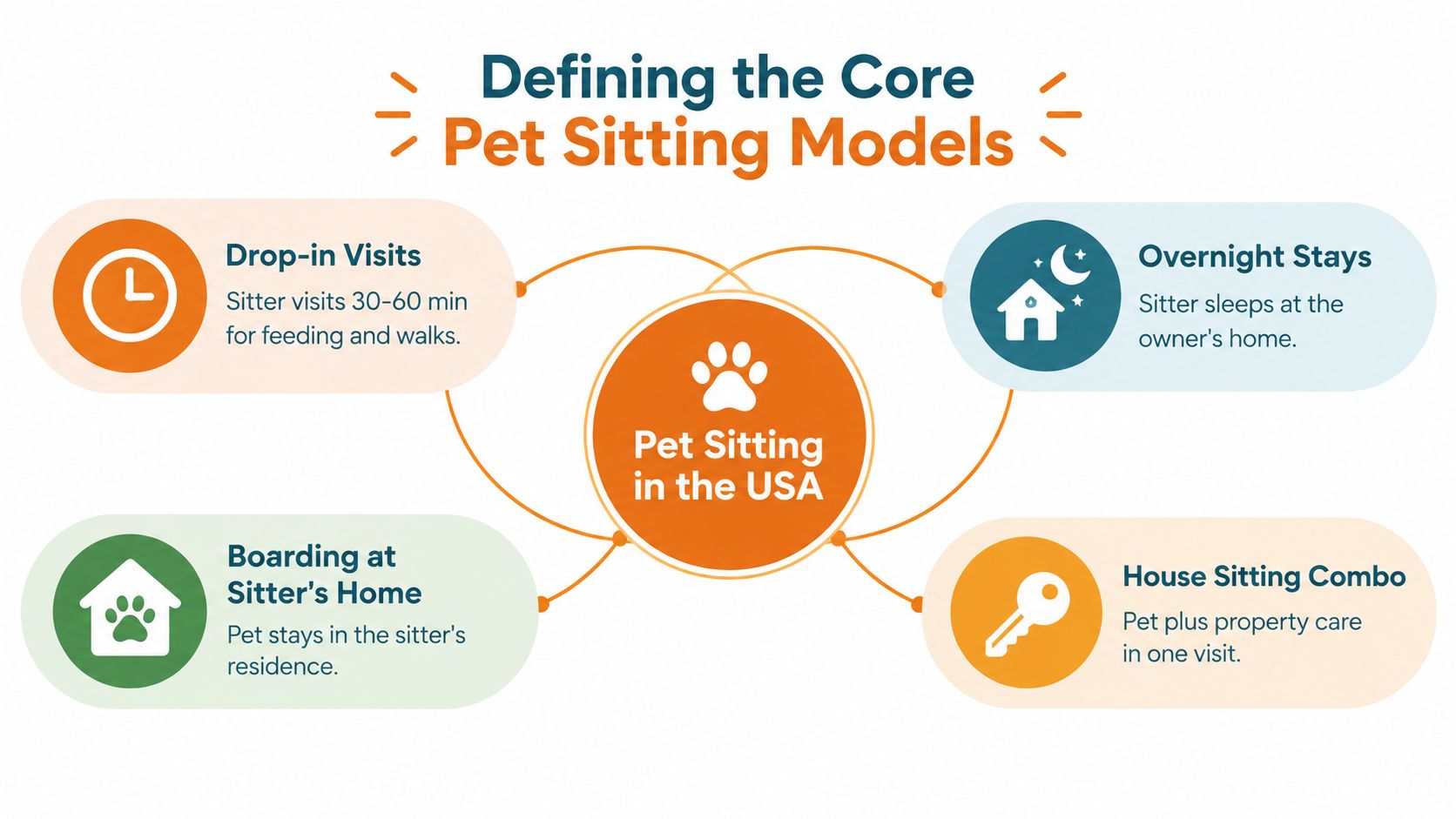
Defining the Core Pet Sitting Models
Suppose your flight leaves tomorrow morning. You need to decide whether someone should visit twice a day, stay in your home, or take your dog elsewhere. Those choices aren't interchangeable, even when listings use the same phrase, “pet sitting.”
Drop-in visits
A drop-in is a scheduled visit to your home for defined tasks, often feeding, water replacement, litter care, medication, a short walk, and companionship. It suits independent cats, adult dogs with reliable bathroom routines, and pets that become more anxious when moved. The important question isn't just how many visits you want. Ask what happens during the visit and whether travel time between clients limits the sitter's flexibility.
Industry data reports that registered sitters completed more than 12 million home visits in 2021, and that the average basic U.S. pet care visit lasted 29.6 minutes, according to industry statistics compiled by Hepper. Treat that figure as market context, not a promise. A “30-minute visit” might include only time inside the home, or it might include arrival, departure, and the walk.
In-home daytime care
Daytime sitting provides longer companionship while you work or travel locally. It can help puppies, senior pets, dogs with separation distress, or animals requiring observation after treatment. Confirm whether the sitter stays continuously or leaves for other appointments, because “daytime care” often describes a block of availability rather than uninterrupted presence.
Overnight stays
An overnight sitter sleeps at the owner's home and follows the pet's nighttime routine. This model works well for dogs that panic when alone, pets needing late-night medication, and households where home security matters. Clarify arrival and departure windows, sleeping arrangements, and whether the sitter may leave during the day.
Boarding and the house-sitting combination
Boarding at the sitter's home moves the animal into a different environment. It can suit social, adaptable dogs, but it may be unsuitable for territorial cats or pets with complex routines. Full house sitting combines live-in pet care with property responsibilities such as bringing in mail, managing bins, and responding to alarms.
For animals with age-related needs, owners may also want specialist guidance on affordable care for aging pets before choosing a sitter. The best booking starts with a precise description: where the pet stays, how often care happens, what “overnight” means, and which household duties are included.
Understanding Regional Pricing and Hidden Costs
A national “average” can mislead you because pet sitting is purchased locally. A sitter in a lower-cost Midwestern area may price differently from one serving a dense coastal metro, where travel, housing, and demand place more pressure on the schedule. The quote should reflect the assignment's actual workload, not just the pet count.
Recent market data estimates online booking at about 62.4% of U.S. pet sitting revenue in 2025, while typical in-home rates range from $35 to $85 per night. Premium coastal metro pricing can reach about $120 for multi-pet or special-care households, according to the Dataintelo pet sitting services market report.
| Service Type | Standard Market Rate | Premium Coastal Rate |
|---|---|---|
| In-home overnight care | $35 to $85 per night | About $120 for multi-pet or special-care households |
| Drop-in visit | Varies by visit length and duties | Varies by visit length and duties |
| Medication or senior care | Usually quoted as an added care requirement | Usually quoted as an added care requirement |
| Multi-pet household | Often priced above the base service | May approach the premium rate described above |
The table's non-numeric rows are deliberate. The verified market data provides a range for in-home overnight care, but not a reliable national dollar rate for every service type. A responsible sitter should quote those assignments after reviewing the pets, tasks, timing, and travel distance.
What changes the invoice
Medication administration can require training, refrigeration, timed doses, or observation after dosing. Senior pets may need slower walks, mobility support, extra cleaning, and more frequent updates. Multi-pet homes create separate feeding, exercise, and behavior requirements even when the animals appear easygoing together.
Holiday demand, short-notice bookings, extended travel, key handoffs, long-distance driving, and additional household tasks can also affect the quote. Ask for each item in writing rather than accepting a low headline price that expands later.
Read the cancellation policy
A fair agreement states when payment is due, what happens if your return flight changes, whether unused visits are refundable, and how emergencies are handled. Compare the final scope with guidance on pet and house sitting prices, then ask the sitter to identify anything not included.
Practical rule: If you can't explain the quote line by line, you haven't finished the booking.
Navigating Insurance and Legal Liabilities
Many owners assume that a sitter's general liability policy will automatically pay the veterinary bill if a pet is injured. In the United States, that assumption can leave a serious gap.
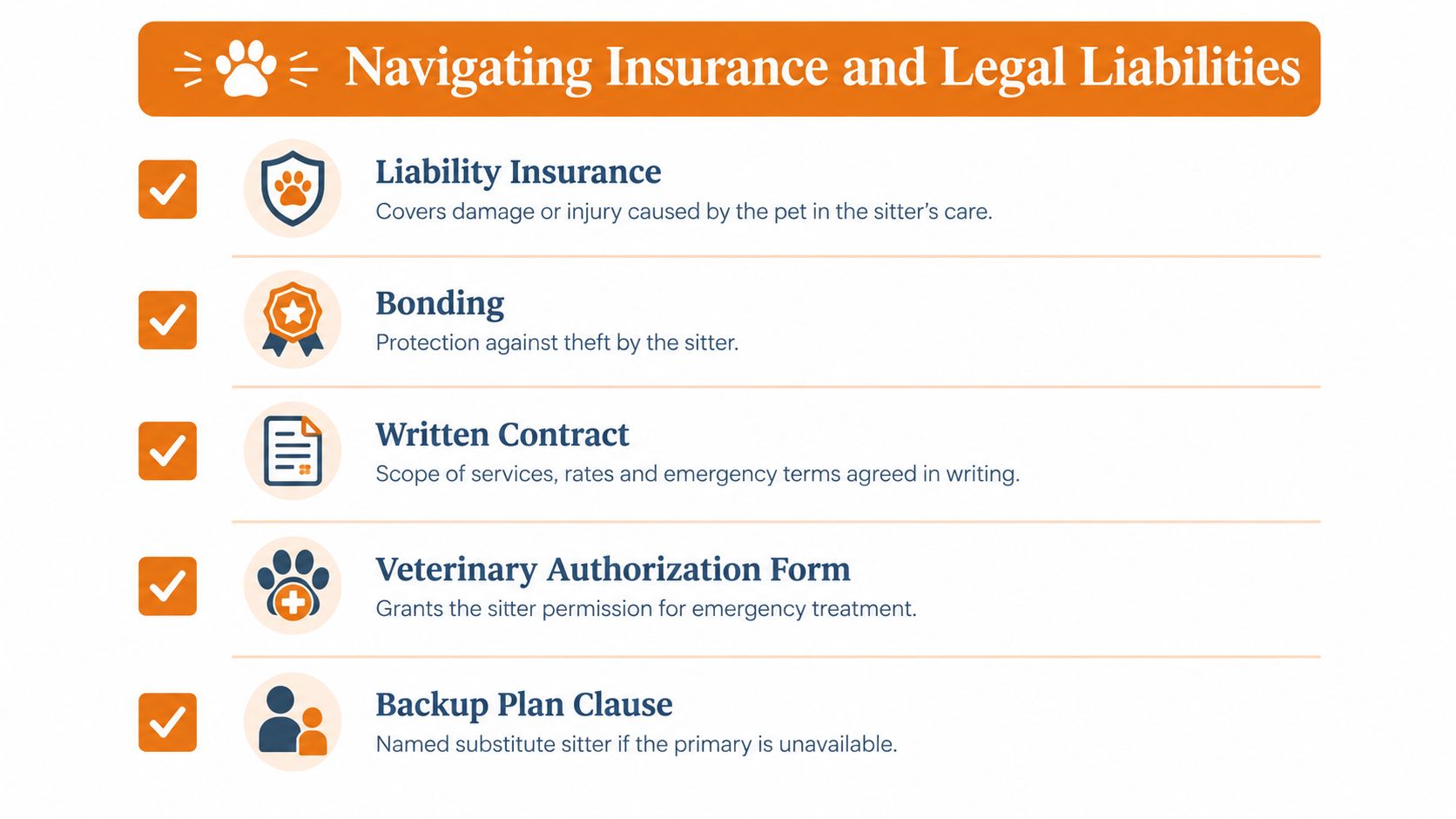
There is no federal license required to become a pet sitter, but standard general liability insurance usually excludes damage to animals in a sitter's care under the Care, Custody, or Control exclusion. Industry guidance therefore treats a CCC endorsement as essential coverage, as explained in this overview of pet care business insurance and requirements.
Questions worth asking
Don't settle for “I'm insured.” Ask what policy applies, whether it covers animals in the sitter's care, and whether the coverage applies inside your home, during transport, or at the sitter's residence. Request proof of insurance with current dates and the insurer's contact details.
Bonding addresses a different concern. It may protect against theft or misconduct, while insurance addresses covered accidents and losses. Neither replaces a written service agreement that defines responsibilities.
Overnight and boarding arrangements can introduce additional local obligations. Depending on the jurisdiction, a sitter may need permits, zoning compliance, or authorization related to kennel or boarding activity. Owners should ask where the pet will stay and whether the sitter has confirmed the arrangement is allowed locally.
A written contract should also cover veterinary authorization, emergency spending authority, access to medical records, cancellation terms, keys, and substitute care. If you want a deeper explanation of the coverage issue, review this guide to pet sitting liability insurance.
How to Find and Vet Trusted Sitters
A polished profile doesn't prove reliability. The useful evidence appears in the details: how quickly the sitter answers, whether they ask about behavior and medication, how they describe emergencies, and whether their availability matches the care you requested.
Start with a shortlist rather than choosing the first person who responds. Then use the same questions for each candidate so you're comparing service, not charisma.
- Confirm the assignment: Ask the sitter to restate dates, visit frequency, location, pet routines, and household duties. Misunderstandings at this stage often become disputes later.
- Inspect the reviews: Look for specific references to communication, punctuality, medication, anxious animals, or house care. Repeatedly vague praise is less useful than detailed descriptions of what the sitter managed.
- Request verification: Ask whether the sitter can provide identity verification, references, insurance information, and any relevant background-check details. Don't treat a background check as a substitute for a meet-and-greet.
- Discuss difficult scenarios: Ask what they would do if a dog refused food, a cat escaped, a pet vomited, a key failed, or their vehicle broke down. Their answer should include communication, containment, and escalation rather than reassurance alone.
- Meet before booking: Watch the pet's response, but don't expect instant affection. A good sitter moves calmly, respects boundaries, and listens while you explain triggers, hiding places, doors, alarms, and feeding habits.
Red flags during communication
Be cautious if a candidate avoids a video call or meeting, refuses to discuss insurance, gives a vague answer about overnight presence, or pressures you to pay before agreeing on written terms. A sitter who says every animal is “easy” may not be evaluating risk carefully.
The meeting should end with a shared handover plan. Walk through the home, demonstrate medication, identify shutoff points and escape routes, and ask the sitter to repeat the emergency procedure. Trust grows from observable behavior and clear records, not from a friendly profile photograph.
The Role of Community Marketplaces in Modern Pet Care
Traditional agencies provide structure, yet their process can make care feel transactional. Community marketplaces give owners and sitters more direct control over the match, the conversation, and the evidence used to build trust.
The U.S. market is fragmented. Industry data describes more than 160,000 U.S. pet care and doggy daycare establishments, while 99% of pet-sitting businesses are independently owned, according to Hepper's summary of pet sitting industry data. That independence can mean strong local knowledge, but it also leaves reputations scattered across personal websites, social platforms, and booking services. A sitter's reviews may not follow them when they change platforms.
Reputation should travel with the sitter
A sitter with a reliable record should not have to rebuild credibility from zero after joining a different service. Global Pet Sitter lets experienced sitters import screenshots of 5-star reviews from other services, subject to the platform's presentation and verification process. Owners can assess that history alongside the current profile, messages, and agreed care details.

Direct matching reduces avoidable friction
The basic process is simple: create a profile, identify a possible match, and talk before care begins. Owners can share dates and pet details. Sitters can explain their experience, preferences, and availability. That exchange does not replace written terms, insurance checks, or clear responsibility for emergencies. It gives both sides better information before either commits.
Community governance adds another layer when members can give feedback, vote on features, and observe how the service handles concerns. The trade-off is accountability. A marketplace is not a managed agency, so owners still need to verify the sitter, define the service, and decide whether the person's communication style fits the household.
Essential Preparation Checklists for Both Sides
Most difficult sits don't fail because a pet sitter can't fill a bowl. They fail because nobody documented the alarm code, the dog's door habit, the medication timing, or the owner's preferred emergency threshold.
Owner preparation
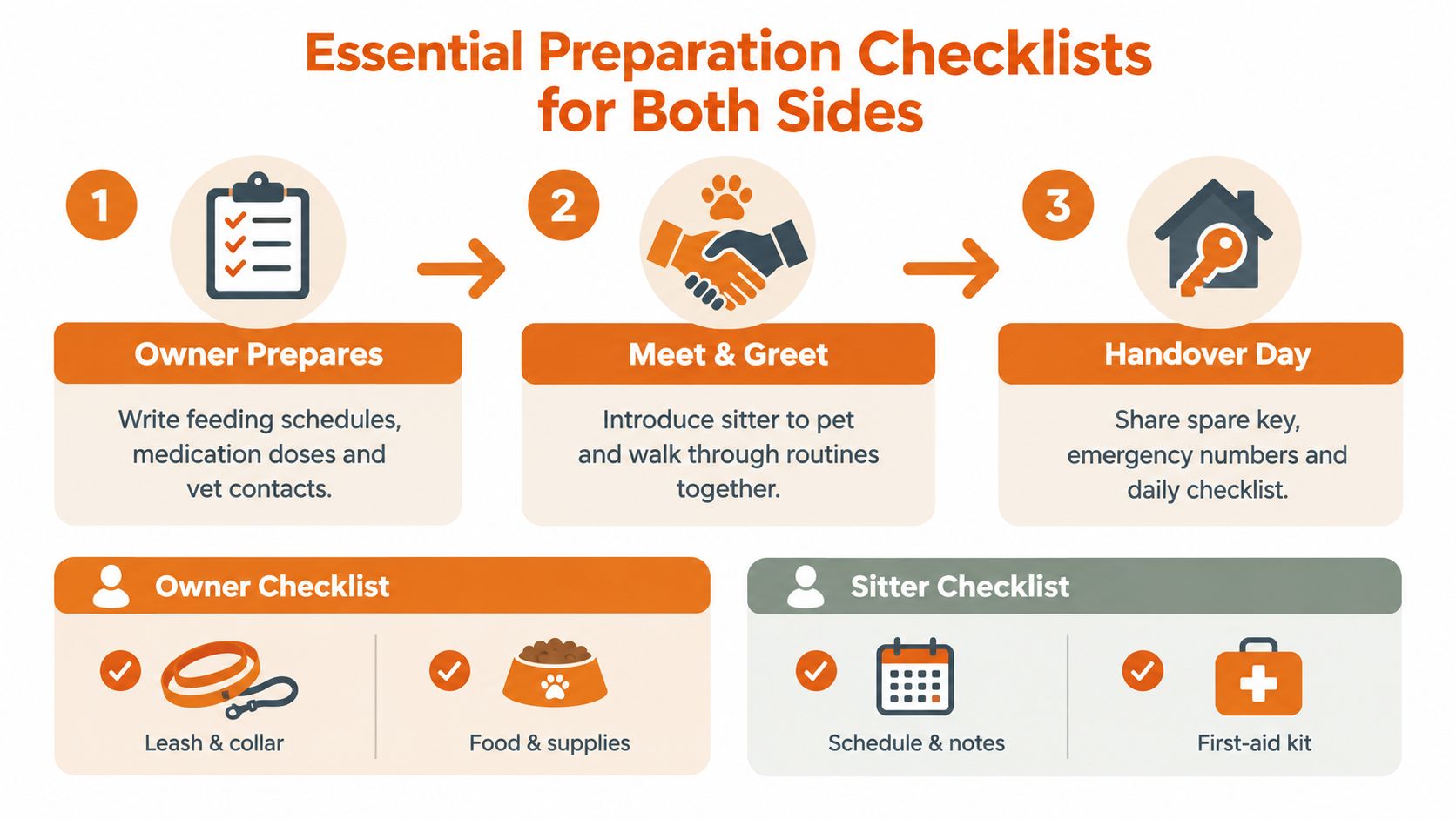
Create one written care sheet and keep a copy at home and digitally. Include feeding quantities, walk routes, medication instructions, behavior triggers, microchip information, veterinary contacts, emergency contacts, and permission to obtain treatment.
- Prepare supplies: Leave enough food, litter, medication, leashes, cleaning products, towels, and enrichment items for the full booking plus a reasonable contingency.
- Secure the property: Test locks, alarms, gates, cameras, thermostats, smoke detectors, and automatic feeders before departure.
- Explain the exceptions: Document what isn't normal, such as hiding, skipped meals, nighttime barking, guarding behavior, or a door that must remain closed.
- Set communication expectations: Agree on update frequency, preferred contact method, and the point at which the sitter should call rather than wait.
A meet-and-greet should be operational, not ceremonial. Have the sitter perform a medication demonstration, walk through entry and exit, and identify where the carrier, first-aid supplies, and emergency documents are stored. The pet sitting checklist can help turn those details into a repeatable handover.
Sitter preparation
Arrive with enough time to inspect the home and meet the pet without rushing. Confirm that doors, windows, gates, and water sources are secure before sending the first update.
Keep a simple daily log with meals, medication, walks, bathroom activity, unusual behavior, and messages sent to the owner. If a pet's condition changes, record what you observed and when you escalated it.
Use the embedded walkthrough below as a prompt for your own handover conversation.
A backup plan should name a substitute sitter, provide access instructions, and explain who can authorize veterinary care. That small amount of preparation protects the animal when flights are delayed, illness interrupts the booking, or a household emergency affects the original sitter.
Final Thoughts on Securing Peace of Mind
The most reassuring pet sitting experience usually starts before the reservation. An owner describes the care precisely, a sitter responds to the actual workload, both sides review the cost line by line, and the contract addresses emergencies rather than assuming everything will go smoothly.
That process is especially important in the USA, where local pricing, independent operators, insurance terms, and boarding rules can vary. A sitter may be kind and experienced yet still lack CCC coverage. An owner may offer a generous fee yet leave medication instructions too vague to follow safely. Good intentions help, but operational clarity protects everyone.
The standard to aim for: Your sitter should know what normal looks like, what requires a message, and what requires immediate professional help.
Think of the first booking as a trial of communication, not merely a test of animal handling. Notice whether the sitter gives precise updates, respects the home, follows instructions, and raises concerns early. If the arrangement works, preserve that relationship with updated records, agreed rebooking terms, and honest feedback that helps the sitter build portable credibility.
For owners, the next practical step is to write the care brief before browsing profiles. For sitters, it's to present services, availability, references, insurance information, and boundaries in a way that lets owners make an informed decision. A clear profile attracts better-fit assignments and reduces the chance that either side accepts work based on assumptions.
Global Pet Sitter connects pet owners with house and pet sitters through profiles, dates, pet details, and direct messaging, with tools for experienced sitters to carry verified review history into a new profile. Visit Global Pet Sitter to describe your next sit, compare potential matches, and start the conversation before your travel plans become urgent.
Please sign in to leave a comment
