The suitcase is by the door. Your dog is flat out in the hallway with one eye on you, and the trip is nine days away. The question you keep circling isn't really about price. It's about who will be in the kitchen at seven in the morning, how many hours your dog will spend alone, and what happens if your cat stops eating on day three.
The decision is wider than picking a name from a list. You can take your pet with you, book a sitter who drops in, hand the keys to someone who lives in for the week, use a kennel, or ask a neighbour. Each one puts your animal in a different place, with a different amount of company and a different set of risks. Matching the choice to your pet's routine and health is the whole job.
Pet Sitting Options in Vancouver, WA Compared
| Option | Where the pet stays | Someone there overnight | Best fit | Main trade-off |
|---|---|---|---|---|
| In-home drop-in visits | Your home | No, visits only | Short trips, settled pets, shorter days alone | Limited time for anxious or medical care |
| Overnight house sit | Your home | Yes, sitter lives in | Longer trips, senior or anxious pets, multi-pet homes | You vacate and the sitter has sole occupancy |
| Kennel or cattery | Facility | Staff on site | Very short trips with no other option | Unfamiliar setting and routine change |
| Friend or family member | Your home or theirs | Yes, if they stay over | Trusted person available nearby | Limited backup and possible strain on the relationship |
| Taking the pet with you | Travel or accommodation | Not applicable | Pets that travel calmly | Journey stress, venue limits and cost of pet-friendly stays |
The two rows owners ask about first are the drop-in visit and the overnight house sit, and what separates them is presence. A drop-in booking buys you frequency: the sitter arrives at set times, measures food, walks the dog or scoops the tray, refreshes water and sends an update. For a settled adult cat or a dog who sleeps through the afternoon, that's plenty. For a dog who paces for the first hour after the front door closes, or a cat on twice-daily medication, three half-hour visits leave an awful lot of hours unaccounted for.
An overnight sit changes the shape of the whole arrangement. Someone sleeps in the house, keeps the lights and curtains on the usual rhythm, and your pet wakes to a person rather than an empty kitchen. Here's how the model works on our platform: sitters care for pets at your home in exchange for a free stay, and no money changes hands. That's the trade. You vacate the property for the duration of the sit, and the sitter has sole occupancy unless you agree something different in advance.
Worth being plain about what we are. Global Pet Sitter connects owners with sitters. We don't provide pet sitting or pet care services ourselves, and we don't employ any sitters. Our community is strongest in the UK and Europe and growing in the US, so for pet sitting in Vancouver, WA, treat the local listings as something to check carefully rather than assume.
Kennels and catteries still work for some animals. A sociable dog who has boarded before and comes home tired and cheerful may cope better there than alone in a quiet house. A cat who hides for two days after a car journey usually won't. Family and friends sit in an awkward middle: genuine affection, no formal backup, and a relationship that strains if your dog chews a door frame.
If you're still weighing the two main routes, our comparison of pet sitting versus boarding sets out what each does to an animal's stress levels. The shortlist rule is simpler than any table. Choose the option that keeps your pet in its own home and routine, and that matches how many hours it would otherwise be alone each day.
Matching Care to Your Pet's Routine and Needs
Age, temperament and health decide this far more than trip length does. A fortnight with a confident cat is an easier job than a long weekend with a dog who has started pacing at night.
| Pet profile | Care to arrange | Check before booking |
|---|---|---|
| Senior dog | Short, regular walks, joint-friendly routine, night toileting plan | Sitter comfortable with stairs, lifting and night outings |
| Anxious dog or cat | Familiar bedding, quiet room, retreat spaces kept, routine unchanged | Sitter experienced with calm handling who lets the pet settle |
| Medicated pet | Written dosing chart, three-day medication reserve, vet authorisation | Sitter willing to give doses and knows the missed-dose plan |
| Cat in a multi-cat home | Litter and feeding stations unchanged, daily observation of each cat | Sitter logs eating, drinking and litter habits for every cat |
| Puppy or young pet | Frequent toileting breaks, short training sessions, socialisation | Visit or stay frequency enough for the pet's age |
| Pet on a special diet or in an enclosure | Exact food measures, enclosure cleaning schedule, written care sheet | Sitter agrees to follow the care sheet without changes |
Anxious pets and the need for a retreat space
For cats, continuity isn't a comfort idea, it's a welfare control. The Code of Practice for the Welfare of Cats calls for a safe, clean, quiet resting area, constant access to hiding places, including spots up high, and protection from hazards. It warns that a cat unable to hide or avoid a threat can become anxious and chronically distressed, which may contribute to illness. In practice, that means the litter tray, feeding station and bolt holes stay exactly where they are. No rearranging the spare room because the sitter needs a desk.
Then watch, and write it down from day one. Scottish Government guidance lists withdrawal, unusual nervousness, aggression, reduced eating or drinking, altered grooming, restlessness and excessive sleeping as stress-related changes worth acting on. A daily note of intake, litter results, hiding places used and mood gives you a pattern instead of a photograph.
Medication is a routine, not a favour
A sitter willing to pop a pill is the minimum, not the answer. Reporting on UK prescribing notes that fluoxetine prescriptions for dogs rose twentyfold over 12 years to roughly one dog in 500, and that medication works alongside handling and behavioural support rather than instead of it (iNews). If your animal is on behaviour medication, the sitter needs the dosing chart, the timing and the handling notes that keep the rest of the plan intact.
The honest framing: for an anxious, elderly or routine-dependent pet, a pet-inclusive holiday isn't automatically kinder. Home with a documented plan often beats a new bed in a new city.
That's the contrarian half of this decision, and the numbers back it. The Pet Set Go report from VAFO found 46% of dog owners and 26% of cat owners intended to take pets on holiday, yet a third of travelling owners had previously changed or cancelled a trip because suitable pet-friendly options weren't available. If your animal finds change hard, staying put isn't the compromise option. It's the sensible one.
What a Pet Sitter Does Each Day at Home
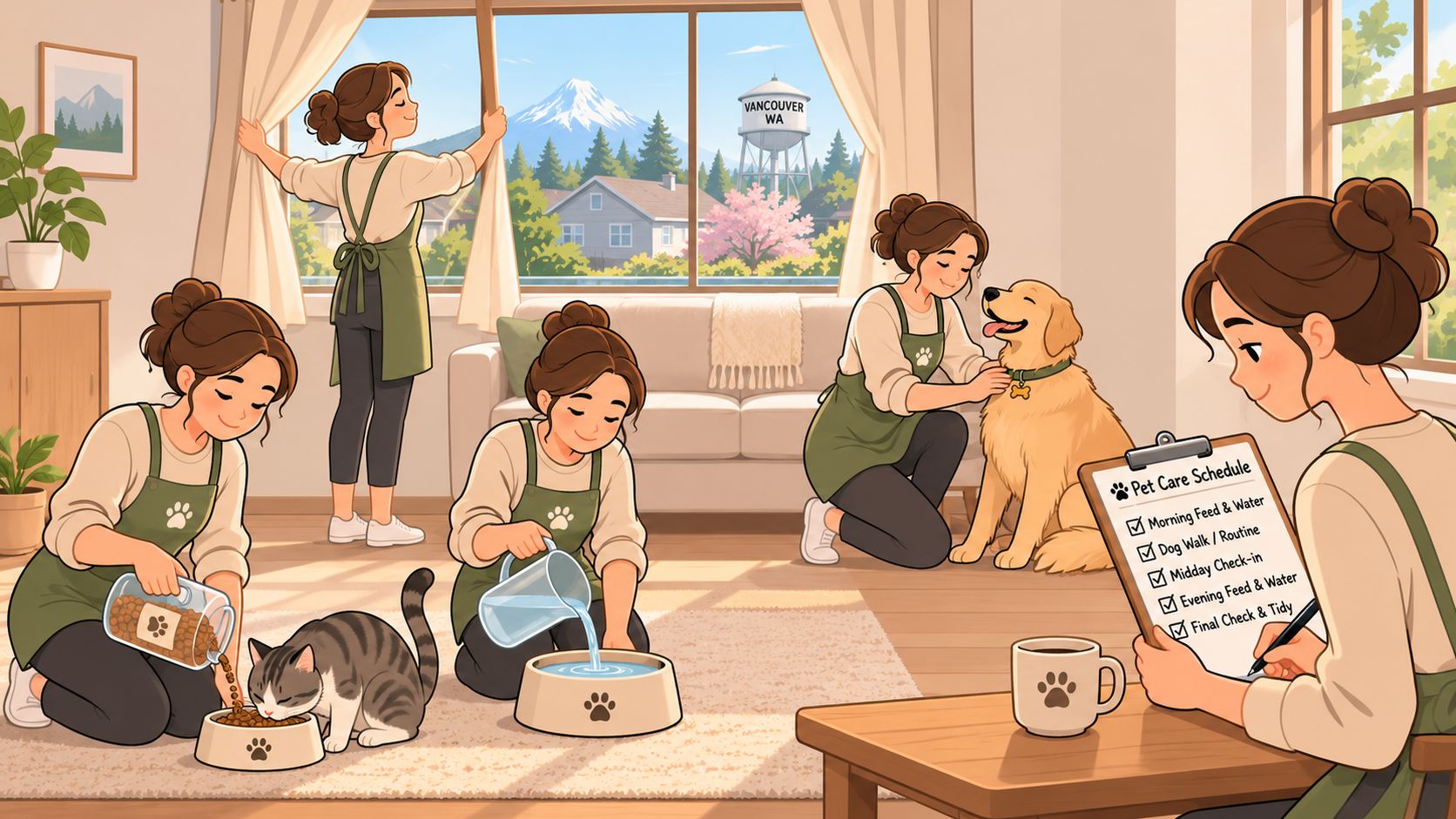
A sitter's day follows your pet's clock, not the sitter's. Think of them as a stand-in household member rather than a stranger doing odd jobs: the job is to keep the house running and the animal's rhythm steady while you're gone.
The day in order
- Morning check. Water refreshed, food measured to the note, litter or garden trip, and a look at whether last night's dinner disappeared.
- Walks and garden breaks at the usual times. If your dog goes out at 7.30, the sitter goes out at 7.30, not at nine when the emails are done.
- Medication and supplements exactly as written. Not "around the same time", not halved because the tablet is awkward to break.
- Evening settle. Same bedding, same room, same order of lights going off.
- Overnight check. Doors locked, alarm set, heating left on the setting you agreed rather than the one the sitter prefers.
Routine is welfare, not sentiment. Dogs learn when meals and walks happen and notice when they don't. Cats notice when the tray moves six feet.
Household tasks come with the territory: bins out on the right day, post brought in, plants watered, a light or two on a timer, and every appliance you've marked as off-limits left alone. If your dog is stiff on the stairs or slow to rise in the morning, dog comfort advice from The Companion Project gives you the vocabulary to describe those changes to a sitter before you leave.
Updates should be short and specific: one photo plus a line on eating, drinking and mood. If something seems off, the sitter doesn't wait for a crisis to mention it.
A simple test before you book: could a sitter run your home for a week using only your written notes and one handover? If not, the notes need work, not the sitter.
How to Vet a Pet Sitter Before You Hand Over Keys
You're inviting a stranger into your home and handing them your pet's routine. Vetting has to be specific, and finished before you confirm dates.
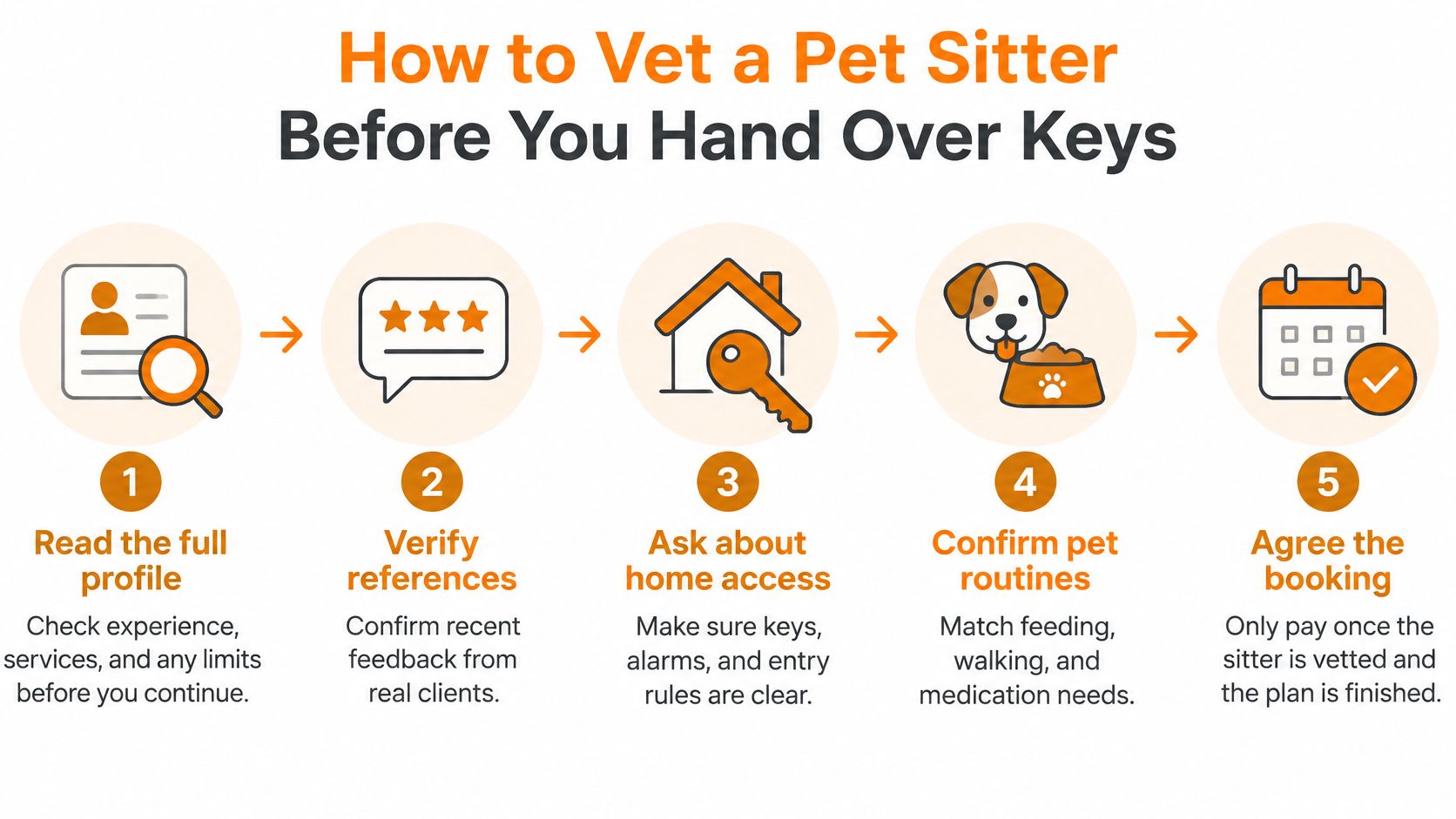
- Read the full profile. Reviews, services listed, and any limits the sitter has stated. Look for feedback from owners whose pets resemble yours in age, size and temperament.
- Ask about your pet's specifics. A twelve-year-old arthritic labrador is a different job from a two-year-old border collie. Ask how they've handled medication, mobility issues or separation anxiety before.
- Hold a video call. Notice whether they ask about your routine and whether they listen to the answer. A sitter who talks over you about their own experience isn't hearing yours.
- Call two references. Ask the direct questions: did the sitter follow instructions, and how did they communicate when something went wrong? Our pet sitter interview questions cover the ones worth asking.
- Verify identity yourself. We don't run background checks or vet members unless explicitly stated otherwise, so ask for photo ID and match the name to the profile.
- Meet at your home. Let your dog see the sitter before you go. Watch how they approach: whether they crouch, whether they let the cat come to them, whether your dog relaxes after ten minutes.
- Listen for a no. Sitters are under no obligation to accept arrangements involving pets they deem unsuitable, and a sitter who declines a nervous, bite-risk dog is showing judgement, not rudeness.
Why step five matters: identity confirmation is your job, not the platform's. Two minutes with a passport or driving licence closes a gap that no review score can.
Watch for these warning signs and stop the conversation if they appear:
- Vague answers about your pet's needs, medication or routine.
- Pressure to book quickly, often framed as limited availability.
- Reluctance to share references or to be contacted by phone.
- Payment requests outside the agreed terms.
Our guide to pet sitting red flags lists the rest, including the behaviours that look friendly but signal a sitter who won't follow your instructions.
Writing a Handover Your Pet and Home Can Rely On
Most first-day problems come from information nobody wrote down. A mandatory handover, in person or by video call, is where that gets fixed: doors, keys, alarms, heating, bins, off-limit areas, and exactly where your pet sleeps. It's also the point at which you check the sitter can operate your boiler.
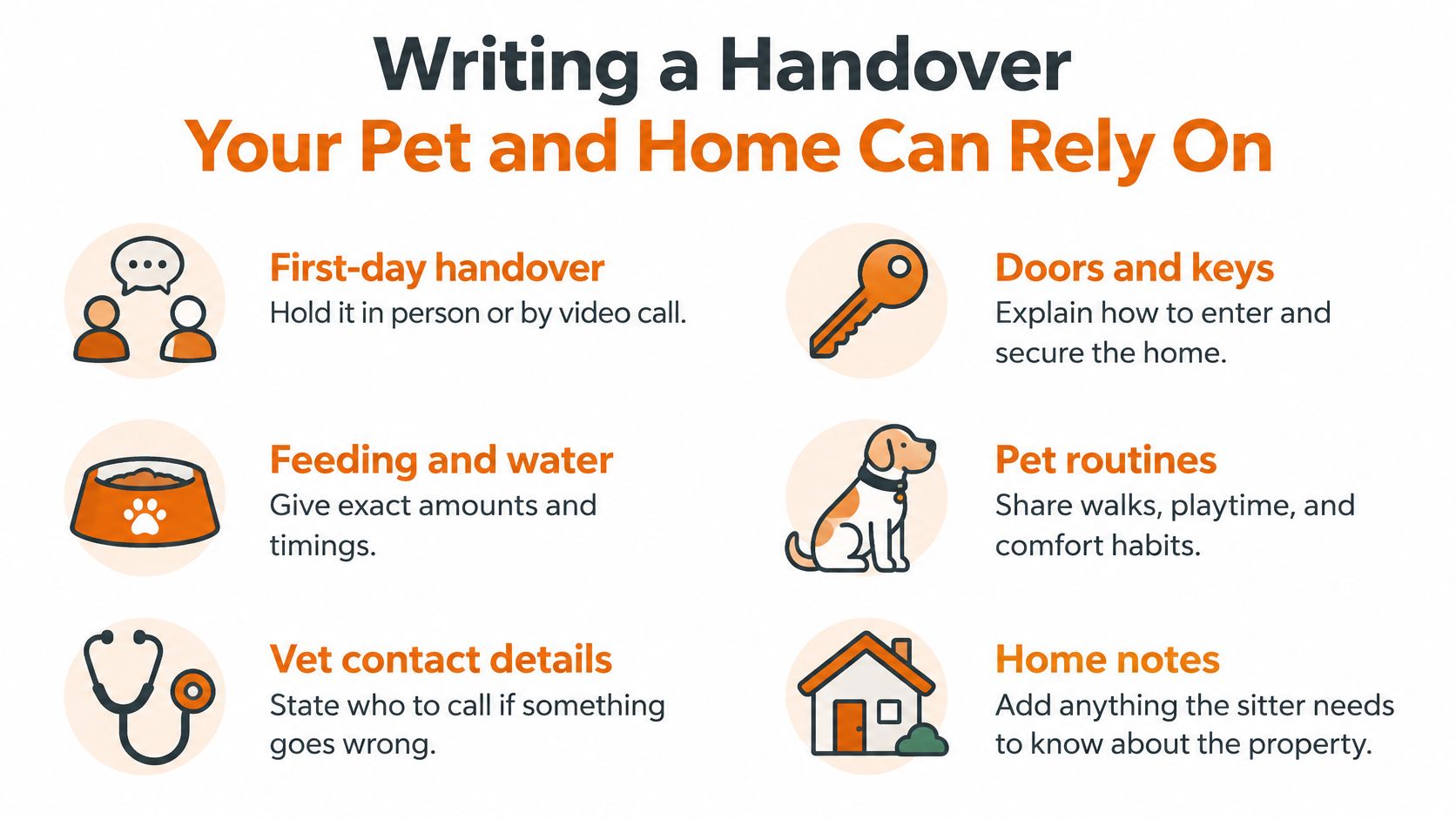
The handover alone isn't enough. Written care instructions should sit alongside it, covering feeding amounts, medication times, walk routes, toileting habits, anxiety triggers and escape risks. You also stay reachable during the sit for questions and emergencies, which is easier to promise when the answers aren't all in your head.
The paperwork to leave with the keys
- Vet details and emergency authorisation, given before the sit begins, so nobody is waiting on a signature while your dog is in pain.
- Microchip number, medical history, allergies, current treatment and insurance details, written down rather than remembered.
- Your usual practice and the nearest out-of-hours one, with both numbers on the same sheet.
- One labelled medication location, with dosing instructions and a reserve supply.
That reserve isn't optional padding. PDSA's emergency preparation advice recommends at least three days of extra medication in case an emergency disrupts supplies, plus a written record of exactly what your pet takes and when.
Preventive care belongs in the same folder. The RSPCA's 2025 Animal Kindness Index found 89% of UK pet owners were registered with a vet and 68% vaccinated annually (RSPCA), so confirm boosters and parasite treatment are current and note the dates. Agree how often updates arrive, then turn the whole thing into shared expectations on paper with our pet sitting contract template.
Emergency Care and Who Decides When You Are Away
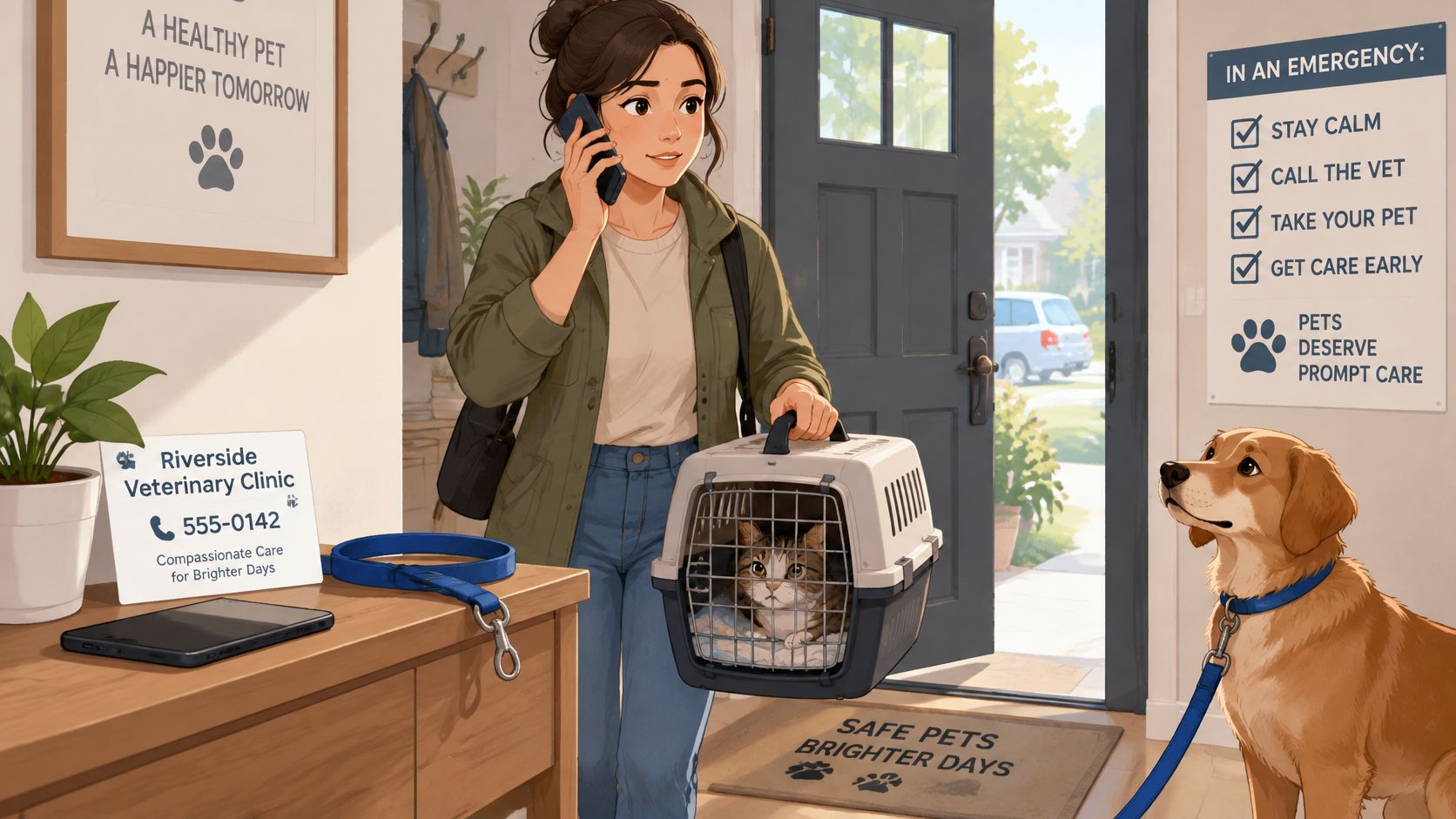
If something life-threatening happens, the answer is immediate veterinary care, not a phone call and a wait. PDSA's guidance on emergency care is to take the pet to a vet straight away, ring ahead where possible so the practice can prepare, and use the nearest vet if the owner is away from home. Every practice must provide an out-of-hours service or point callers to one, so save that number before you leave.
The escalation order
- The sitter contacts you immediately if your pet needs veterinary care.
- The sitter contacts you before incurring vet expenses where possible.
- If you can't be reached, the sitter uses their best judgement to protect your pet's welfare, including seeking veterinary care.
- You are responsible for any injury, damage or loss caused by your pet during the sit, so confirm your cover before you go.
Difficulty breathing, collapse, repeated vomiting or diarrhoea, suspected poisoning, bleeding, or a cat that stops eating for a day or more all count as emergencies. Our guide to pet emergencies covers the rest, and a written escalation card taped inside a kitchen cupboard gives your sitter a plan at the moment they need one.
Budget for the possibility too. Edison Group reported that UK pet product prices rose 3.1% between 2024 and 2025 while veterinary and healthcare costs rose 7.1% (Edison Group). Agree a spending limit for emergency treatment in writing, and check your policy covers the sitter acting on your behalf.
Confirm Your Sitter and Book With Confidence
Shortlist two or three sitters, run the vetting steps above, and hold the handover in person or by video call before anything is finalised. Then confirm the arrangement in writing. Dates, duties, medication authority and your written care instructions should sit in one agreed document, not scattered across a messaging thread.
Two realities shape every booking. Sitters are under no obligation to accept arrangements involving pets they deem unsuitable, and Global Pet Sitter does not confirm that any sit will go ahead as arranged. That makes a named backup carer part of every trip: a neighbour with a spare key, a family member on standby, or a second sitter you have already spoken to.
Practical rule: book the meet-and-greet at least two weeks before departure. Two weeks gives you room to hear a concern, adjust the care sheet or change sitter without panic-booking.
Use the confirmation message to close the gaps owners forget. State that you will be away for the full sit and that the sitter has sole occupancy of the home unless you agree otherwise in advance. Disclose anything in the property a sitter should know about, including weapons on the premises. Put in writing what the sitter may spend on emergency veterinary care, and stay reachable throughout the sit for questions.
This week, do one thing: write the care sheet, then book the meet-and-greet, and post your dates once the plan is ready.
Your pet's routine only holds if the person in your home follows it, and that starts with a care sheet and a handover written properly. Global Pet Sitter lets you post your dates and pet details, read applications from sitters who want a free stay in exchange for care, and choose the one who fits your animal rather than the one who was available. Joining is free and no booking fees apply. Find a trusted house sitter for free.
Please sign in to leave a comment
