Your holiday dates are booked, your dog is asleep on the usual sofa, and the idea of handing over your keys feels heavier than the suitcase. You want meals, walks and medicine to happen as they do on a normal Tuesday. You also want your home looked after, not left dark for a fortnight or opened to someone you have only waved at.
That is the choice inside your place or mine pet sitting. One path keeps your pet in their own bed while a sitter lives in. The other sends your pet to another house and leaves yours empty. A kennel or cattery is the third path many owners hope to avoid.
The postcode matters less than people think. What each trust check proves, and what happens if your pet needs a vet at night, decides whether the trip feels safe. Staying at home does not cancel holiday risk. It only changes who is standing there when something shifts.
Your Place or Mine at a Glance
Your place means a sitter lives in your home and your pet sleeps in their own bed. Their place means your pet travels to the sitter's house and your home stays empty.
| Care model | Where your pet sleeps | Your home | Money | Routine change | Licensing note |
|---|---|---|---|---|---|
| In-home sit at your place | Your home | Sitter lives in while you are away | Exchange with no care fee, or a paid overnight rate | Lowest: own bed, bowls, walks and neighbours | Pet stays in your residence, so boarding licence rules may not apply; still check locally |
| Hosted sit at the sitter's home | Sitter's house | Your home stays empty | Paid per pet per night | Medium: new house, possible other animals, a journey each way | Dog home boarding in England is licensed: 6,004 licences in force on 1 April 2024 |
| Kennel or cattery | Commercial premises | Nobody staying for the pets | Commercial boarding fee | Highest: staff rota, unfamiliar pens or rooms | England, 1 April 2024: 2,142 kennel licences and 1,610 cattery licences |
Read those rows in your own words before you talk about price. The wrong address is what unravels an anxious dog, a senior cat, or a pet on timed medicine. Money can be adjusted later. A new smell, a new floor and a car journey each way cannot.
What those licence numbers mean for you
In England, the latest government licensing return recorded 2,142 licences in force for dog boarding in kennels, 1,610 for cat boarding in catteries, and 6,004 for home boarding of dogs as of 1 April 2024, with 261 of 296 local authorities reporting in the animal activities licensing impact assessment.
Three things follow from that spread. Licensed home boarding is far more common than kennel boarding, yet it is still a regulated commercial setting: your dog is kept at the boarder's premises, not in your kitchen. Any business that boards cats or dogs must hold a licence, so ask to see it when you compare kennels, catteries and paid home-boarders. And an independent sitter living in your house may fall outside that boarding category, because your pet never leaves your residence.
That last point is not a free pass. Check what your council expects, then screen the person properly: identity and references, insurance, authority to speak to your vet, and a written plan for medicine and exercise. Before you leave, walk the sitter through the house in a real handover, leave written care instructions they can check at 2am, and agree that they call you the moment your pet might need a vet. You stay reachable; they stay in charge of the front door.
Practical rule: Shortlist from the table, then keep only the option that can hold your real day, your keys and a vet decision you have already written down.
Which Address Keeps the Normal Day
For dogs, UK welfare guidance sets a planning test you can use before you compare offers. Dogs should have human company and must not routinely be left alone for more than three hours in any 24-hour period, or for a shorter time where that dog's health, safety or welfare needs it, under the home boarding statutory guidance.
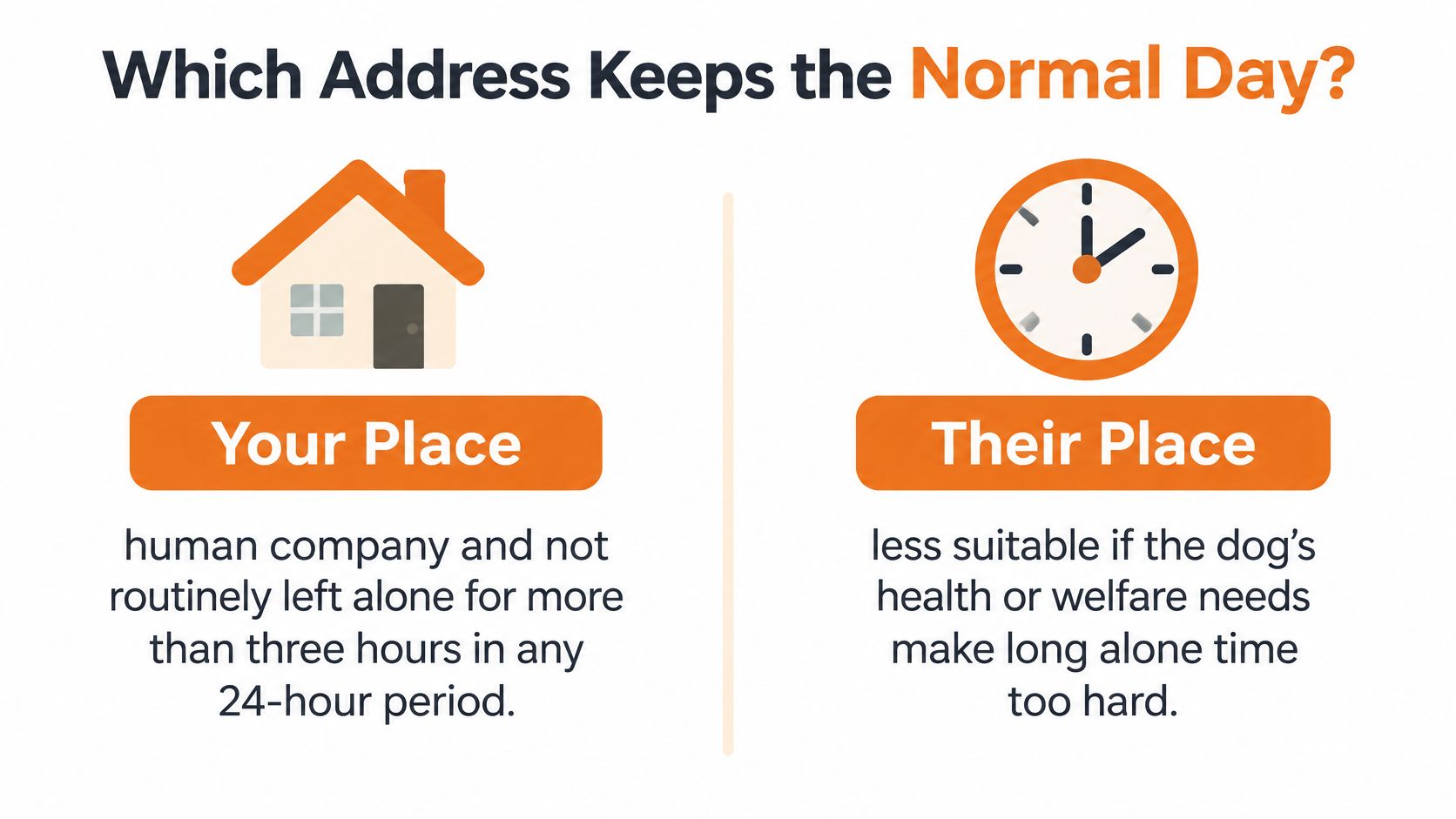
Write the actual day before anyone gives you a price. Toilet breaks, walks, meals, tablets, and the longest stretch your dog is calm on their own. If your dog is elderly, anxious, recovering, or medicated, agree on a shorter limit and state it clearly. A promise that someone will "pop in" is not a schedule.
Your sofa versus a new map
At your place, the sitter can keep the same sofa, bowl, garden and the walk your neighbours already recognise. That continuity is the point for a separation-sensitive dog, and for a cat who stops eating when the house smells wrong.
In an RVC study with Dogs Trust, puppies whose owners were guided on calm departures and reunions spent more time resting when left alone. Gradual alone-time training was also linked with more resting and fewer signs such as panting or lip-licking. The work looked at puppy separation, not holidays, but the signs travel well. Resting, appetite, panting, lip-licking, pacing and sleep tell you whether the day is holding.
At the sitter's house, kindness does not cancel a new map. Other animals, different floors, and a car journey each way all count. Hosted care can still suit a sociable dog who already stays with friends, if someone is home inside your dog's alone-time limit and no resident pet will corner yours.
A kennel fails the test when a rota leaves longer gaps than your dog manages, however clean the run. The same guidance expects dogs to be observed by trained and competent staff. Ask who is watching, and what they do when behaviour or health changes, rather than assuming a building name covers it.
Name what good looks like on the handover sheet, and name the moment the sitter calls you instead of waiting for the evening message.
Trust Checks and the Emergency Pack
A warm meet-and-greet is a start. It does not tell you who holds your keys, what a certificate proves, or who can authorise treatment if your phone is off. Keeping the sit at your own address removes the travel and the strange smells. The remaining risk sits with the person.
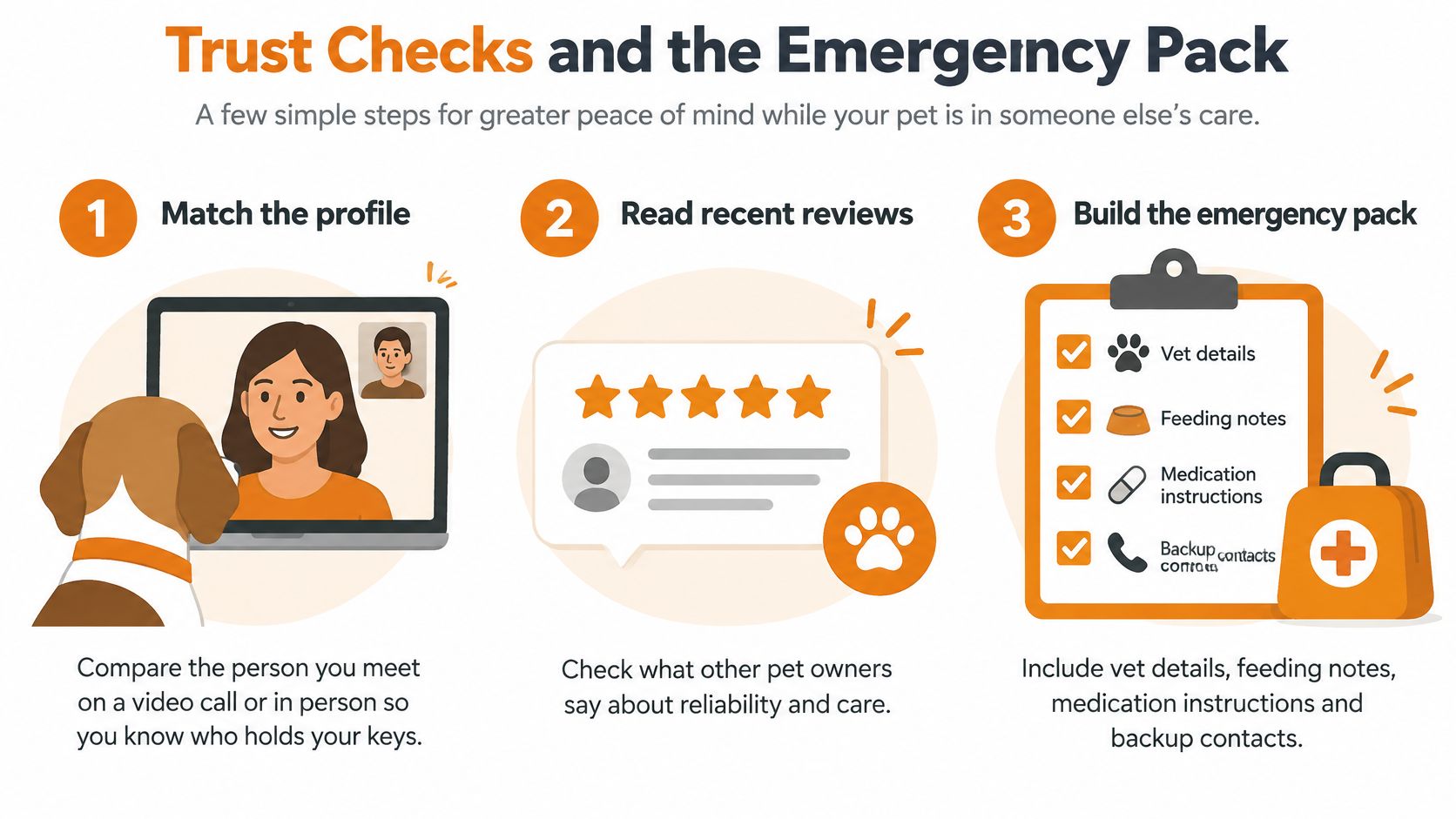
What each check proves
Each check answers a different question, and no single check answers them all.
- Match the profile to the person. On a video call or in person, the face, name and photo should be the same person who will take the keys. We help members find and connect with each other, so confirming who you are speaking to is your step.
- Read recent references for the housework as well as the dog. Sitters are rated on reliability, pet care and cleanliness, while owners are rated on communication, hospitality and listing accuracy. A happy-pet comment is useful. A note about late messages or a messy kitchen answers a different risk.
- Ask what insurance covers. The RSPCA holiday guidance advises you to confirm the carer understands special requirements, to leave vet and emergency contacts, to check references, and to ask for evidence of DBS screening and insurance. No universal UK rule says pet sitters must be insured, so treat "insured" as a question rather than an assumption. Ask which incidents are included and which are not.
- Treat a DBS certificate as a criminal-record snapshot. A certificate works like a photograph: accurate on the day it was taken, silent about everything since. It cannot show that someone gives tablets on time, spots bloat, or stays calm with your senior cat. Competence, references and a clear handover answer those risks.
The same instinct sits behind a homeowner's checklist for booking cleaners: identity and insurance before anyone has reason to be in your rooms.
For the house, give only the keys they need, write the alarm and lock steps down, and lock valuables and papers away. Police.uk's leaving-home checklist says you should know who has every key and should not hide keys under mats. Tell a neighbour who is staying and on which dates. Put indoor camera use, visitors and house rules in writing before arrival.
Then the frame for the sit itself. You leave the property for the whole stay, and the sitter has sole occupancy unless you both agree otherwise in advance. Before you go, you hold a handover, in person or by video call, with written care notes to back it up, and you stay reachable for questions or emergencies.
The pack for a sick pet
Aviva research found that 29% of cat and dog owners had a pet need veterinary treatment shortly before or during a holiday, 26% had to arrange alternative care at short notice, and 23% felt unprepared for unexpected pet costs. Care in your own home does not remove those odds. It makes the written plan matter more, because your sitter may be the only person in the room when something changes.
Build six items, and keep a copy with our pet emergency guide:
- Written consent to treatment, plus a spending limit you can accept if you cannot be reached.
- Your vet, the nearest out-of-hours practice, the microchip number and the insurer, including whether pre-authorisation is required.
- Who pays the clinic first, and how you reimburse them. Ordinary policies can exclude some costs, so read the exclusions before you travel.
- The medication timetable, and what a missed dose looks like.
- A named backup person in the UK, plus how your pet will get to the vet.
- Your wishes if the news is very serious.
Sitters should contact you before veterinary spend where they can, and immediately if your pet needs urgent care. A written answer beats a guess at midnight. These steps lower the chance of that guess. They do not remove the risk, and we do not guarantee the safety of pets, property or members.
What You Pay and What Is Included
Three money shapes hide behind the same word, sitting.
A paid in-home sitter charges for labour, usually a nightly rate, with extras for another dog, medication or bank holidays. Ask for the all-in figure and for the jobs they will not do, such as garden watering or late-night medication.
Hosted boarding is also paid, typically per pet per night. A low rate can hide long hours alone, which is a welfare problem dressed up as a bargain.
An exchange sit, which is how members use Global Pet Sitter, swaps care of your pets and a looked-after home for a free stay. No money changes hands for the care. A tip is not part of that exchange. If you are paying a sitter instead, amounts and alternatives are set out in our note on whether you tip pet sitters. Wider paid-market ranges sit in our guide to pet and house sitting prices.
| Care model | Typical cost | What the price covers | Watch for |
|---|---|---|---|
| Paid in-home sitter | Nightly rate plus extras | Labour in your home and usual care tasks | Extras for a second dog, medication or bank holidays |
| Hosted boarding at sitter's home | Per pet per night | Stay in the sitter's house | Long hours alone behind a low rate |
| Exchange sit (Global Pet Sitter) | No care fee, free stay | Care of your pets for a looked-after home | Vet costs still fall to you |
| Vet bill reference | £685 average UK pet insurance claim in 2024 | Treatment, not sitting | Set a spending limit before you leave |
Put the vet bill next to the nightly saving
Association of British Insurers members paid a record £1.23 billion in UK pet insurance claims during 2024, covering 1.8 million notified claims, with the average claim at £685. Dogs accounted for £933 million and cats for £232 million, the ABI reported. Say a cheaper option saves £10 a night across a ten-night trip. That £100 does not touch an average claim. The spending limit you write down matters more than the nightly gap.
You remain responsible for injury, damage or loss your pet causes during the sit. The agreement between you and the sitter is a private domestic arrangement and should not be a commercial transaction on an exchange. Write included tasks, key rules and the vet limit into a contract, not a chat thread.
If your pet is older and comfort at home is the point of the trip, affordable in-home pet care is a useful contrast: clinical support in familiar rooms is a different service from holiday sitting, and it shows why "at home" can mean very different bills.
Questions to Ask Before You Choose
Ask these before you agree anything. The useful part is the answer that would make you walk away.
- Who else will be in the home overnight, and will you show ID before the handover? You are checking who holds your keys. A partner who "might pop round" is a different arrangement from sole occupancy.
- Have you cared for a senior, anxious or medicated pet, and what did that look like? Listen for a real timetable, not a general love of animals. "I have always had dogs" does not tell you they can give a 7am tablet.
- What will you do if my pet's routine changes or they become unwell? You want a call threshold, a transport plan and a backup, not "I will keep an eye on them".
- Will you call me before any non-urgent vet costs, and what spending limit do you accept? This tests money handling. Hesitation here usually means the limit was never discussed.
- Do you hold pet sitting insurance, and what does it cover? A yes is something to confirm in writing. It is not a guarantee that your particular dog, cat or house is included.
- How will you keep keys, alarms and valuables secure, and who will you tell about your stay? You are testing household security: spare keys, visitors, and whether a neighbour knows the dates.
- What happens if you cannot make a date or fall ill? A named backup, or an honest "I would tell you early so you can rebook", is safer than a shrug. If your own flight slips, flight disruption assistance for travelers is one way to think about getting home, but your sitter still needs a plan for the extra night.
- Can we agree house rules, visitors and any camera use in writing before I travel? If they will not write it down, the arrangement is not clear enough to start.
Record the answers in our pet sitting contract template. Vague or shifting replies belong with the patterns in our red flags guide. A wider prompt list lives in our questions to ask a sitter, but these eight are the ones that change a yes into a no.
Which Trip Should Stay at Your Place
Match the address to the animal in front of you, not to a general preference for guests or privacy.
An anxious or senior dog on medication twice a day, with you away for ten days, belongs at your place. Write the longest calm stretch on the handover sheet and finish the vet pack before you lock the door.
A confident young dog who already sleeps at a friend's house can go to a sitter's home if you do not want a guest in a small flat. The home should be licensed where the law requires it, resident pets introduced carefully, and alone time kept inside what that dog already manages.
Cats, crowds and drop-ins
A cat who hides from visitors and eats only in your kitchen should stay at home. A cattery is a backup when no sitter can be found, not the first call.
Several pets, plus plants and a long holiday, point to an in-home sitter who is also looking after the building. A kennel cannot water the pots, take in a parcel or keep the heating on a frost setting.
If you will still sleep at home and only need two drop-ins a day, you need a visiting service, not a live-in sit. A live-in arrangement assumes you have left.
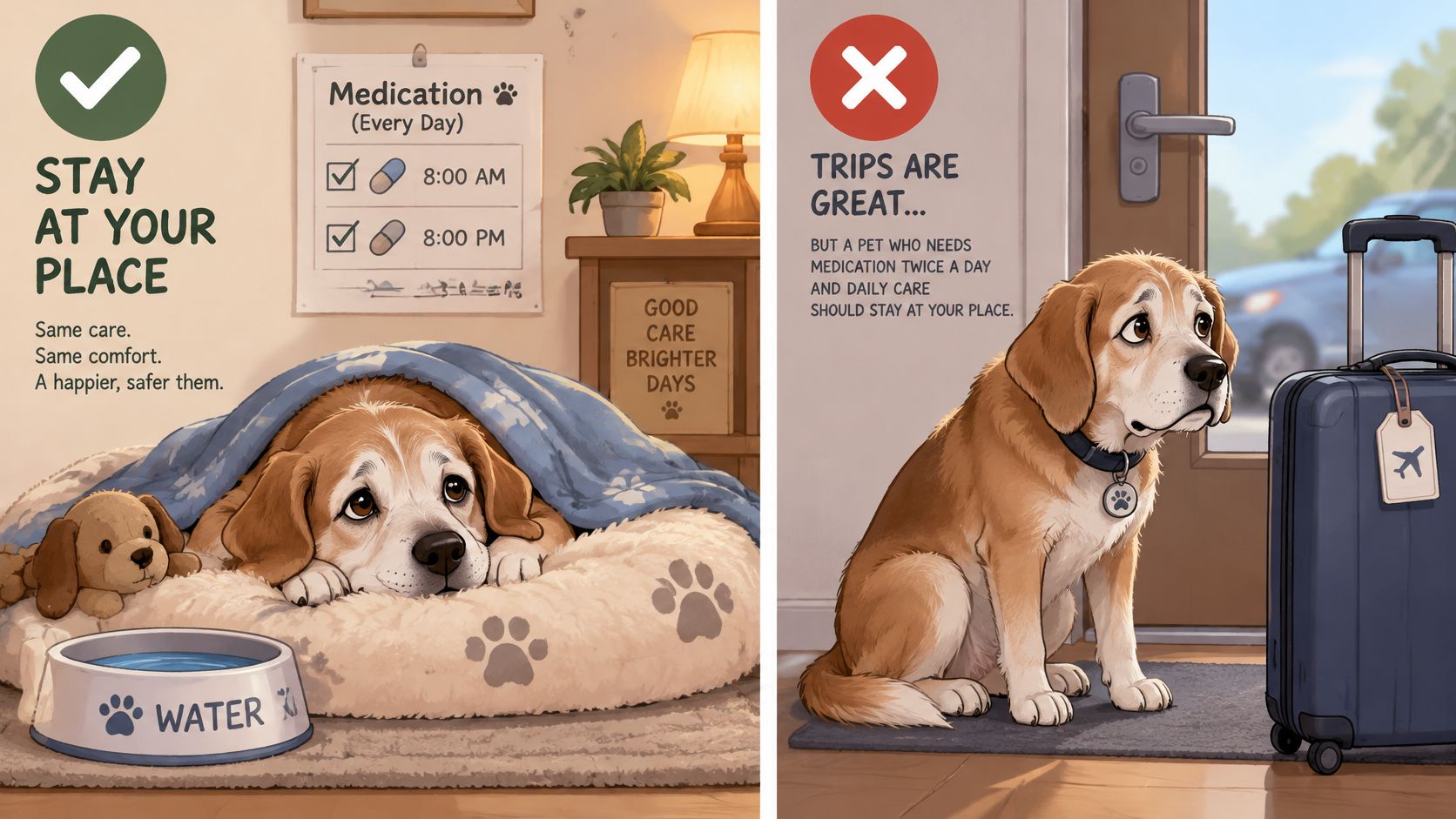
If routine, medication or a fragile pet is the worry, choose your place. If keeping the house private matters more, and this pet already travels calmly, their place can be the fair choice.
Post Your Sit and Stay with Your Pet
If those scenarios point to your place, post a clear listing instead of spending another week on kennel pages.
- Dates and pets: Say when you leave and return, and name each animal, including medication.
- The house: Describe the neighbourhood and anything a sitter must know before they apply, from a nervous cat to a tricky lock.
- The rules: Agree house rules and the vet pack in writing, then hold the handover before you travel.
Owners post sits with dates and pet details. Sitters browse and apply. You choose the person. We do not employ sitters, and we do not provide the pet care ourselves. The arrangement stays between the two of you. We also do not confirm that any sit will go ahead, so keep your dates realistic and your messages prompt.
Joining is free, and we charge no booking fees. When the fit is right, your pet keeps their routine and your home is lived in while you are away. Find a trusted house sitter for free.
Global Pet Sitter connects you with house sitters who stay in your home and care for your pets while you travel, so your dog or cat keeps their own bed, walks and medicine times. You post the dates, read profiles and references, and agree the house rules and vet pack before you leave. Find a trusted house sitter for free and start the listing while the trip is still on the calendar.
Please sign in to leave a comment
