You've found a sitter whose profile feels promising. The photos show a calm home, the description mentions experience with animals like yours, and the dates seem to line up. Then your finger stops above Message. You wonder whether the reviews are genuine, whether the sitter's availability is current, and whether the platform would help if something went wrong.
That hesitation isn't paranoia. It's a reasonable response to an online decision involving your home, your pets, your travel plans, and a person you may never have met. Transparency builds trust when it turns that uncertainty into evidence you can inspect, question, and act on.
The Moment an Owner Hesitates Before Clicking Message
Consider an owner planning a trip with an older dog who needs medication. A sitter appears near the top of the search results with a friendly profile and several five-star ratings. The owner wants to believe the listing, but the important details remain unclear. Were the reviews written after completed sits? Are the dates on the calendar current? Does the verification badge confirm identity, background information, or something narrower?
The owner may also notice small inconsistencies. A profile says the sitter is available throughout the month, while a recent message suggests only a few days are open. A review praises the sitter's care for cats, but says nothing about administering medication. A screenshot shows a glowing comment from another platform, yet the source and date aren't immediately visible.
None of these questions means the sitter is dishonest. They mean the owner lacks enough context to judge the situation responsibly. A marketplace asks strangers to make a decision before they can fully observe the service, so the platform has to expose the signals that help people estimate risk.
A practical test: If a user has to message support to understand a profile's most important claims, the platform has hidden part of the decision.
Trust rarely disappears because one profile is imperfect. It disappears when the user senses that the platform wants confidence without providing inspection. A polished badge can't compensate for unclear dates. A high rating can't answer whether the reviewer's situation resembled yours. A search result can't feel neutral if nobody explains why one sitter appeared before another.
The moment before messaging is therefore a critical point in the relationship. The owner is deciding whether the profile deserves a conversation, not whether the sitter deserves an automatic booking. Good transparency doesn't remove every question. It makes the right questions easier to ask and gives both people a more honest starting point.
That distinction matters for sitters, too. An experienced sitter may have strong evidence from another marketplace, but hiding its origin can make legitimate experience look manufactured. Clear labels preserve credibility because they show users what the evidence proves, what it doesn't prove, and what still needs to be discussed.
What the Trust Gap Actually Looks Like in 2026
Trust may feel personal, but large-scale evidence shows that it also follows recognizable patterns. The 2025 Edelman Trust Barometer surveyed more than 33,000 people across 28 countries and reported a global institutional Trust Index of 56 out of 100. It also found a 30-point gap between respondents with high grievance, who scored institutions at 36, and those with low grievance, who scored them at 66. Among high-grievance respondents, business received ratings 81 points lower on ethics and 37 points lower on competence than among low-grievance respondents. These figures are reported in the 2025 Edelman Trust Barometer.
The lesson for a pet sitting marketplace isn't that every user distrusts every business. It's that people bring existing concerns about fairness, competence, and hidden interests to each digital interaction. When a platform withholds important information, users may interpret the silence through that wider lens.
Suspicion grows around hidden decisions
A marketplace can create uncertainty without breaking a promise. It only needs to leave key decisions unexplained.
A search page that doesn't explain how sitters are surfaced may cause users to wonder whether placement reflects relevance, payment, activity, popularity, or another factor. A profile that shows a rating without review provenance may cause users to wonder whether the platform collected the feedback itself, imported it, or accepted it without verification. A pricing page that avoids explaining future plans may make an initially free service feel conditional.
These questions are especially important when users are assessing someone's home, animals, identity, and availability. Transparency gives them a way to separate what the platform knows from what the member claims.
Make the trust signals inspectable
A transparent marketplace should help users answer four basic questions:
- Who is this person? Show identity status, profile ownership, and relevant verification scope.
- What will this cost? Explain the current arrangement, future pricing approach, and any conditions in plain language.
- Why am I seeing this listing? Describe the main factors that influence search visibility.
- What supports this reputation? Label reviews, references, imported evidence, and incomplete history accurately.
These disclosures don't guarantee a successful sit. They give owners and sitters a clearer basis for judgment. That's the practical meaning of transparency in a low-trust environment. It replaces an invitation to “just trust us” with information users can examine before they commit.
The Four Practical Levers of Marketplace Transparency
Marketplace transparency becomes easier to evaluate when you break it into four working parts: identity, pricing, ranking, and reviews. Each one answers a different question, and weakness in any one area can undermine the others.
Identity tells users who stands behind the listing
Identity transparency starts with the person behind the profile. Users need to know whether the account belongs to the person they'll message, whether the platform has verified that person, and what the verification covers.
A badge without an explanation is decoration. A useful identity signal tells the member what was checked, when relevant, and what remains outside the check. It shouldn't imply that identity verification proves skill, reliability, compatibility with a particular pet, or guaranteed behavior.
Profile completeness matters as well. A recent photo, a description of the sitter's routine, and specific experience with animals help users compare a claim with the situation they're trying to solve. Owners should also describe their pets and expectations with the same candor.
Pricing removes a different kind of uncertainty
Clear pricing means more than displaying a number. A platform should explain whether members pay one another, whether the arrangement involves accommodation exchange, whether optional services exist, and how future plans affect current members.
Global Pet Sitter describes its early-adopter arrangement as free, with lifetime-favored rates when paid plans launch. That kind of commitment needs to appear in language users can understand, rather than being buried in promotional wording. If conditions change, members should be able to find the explanation without reconstructing it from old messages.
Hidden costs damage trust because they change the decision after the user has invested attention. Plain pricing lets people decide earlier and prevents a later disagreement from being mistaken for a service failure.
Ranking affects trust even when nobody sees the algorithm
Search order is a recommendation. If a sitter appears first, users may infer that the platform considers the profile especially relevant or reliable. That inference becomes risky when the platform gives no meaningful explanation.
A useful ranking explanation doesn't need to reveal proprietary code. It can identify the practical factors users care about, such as location, dates, profile completeness, availability, activity, or relevance to the posted sit. It should also avoid implying that a high position equals a guarantee.
Reviews need a visible chain of evidence
Peer feedback carries unusual weight because it comes from people who have experienced the service. The 2015 Nielsen Global Trust in Advertising Report found that 66% of surveyed consumers trusted opinions posted online by other consumers, as documented in this SEC-hosted copy of the Nielsen report.
That trust makes review design a responsibility, not merely a growth feature. A strong review system distinguishes completed sits, imported reputation, references, and self-reported testimonials. It shows dates and context where possible, explains whether both parties reviewed independently, and gives members a route to report disputed or misleading content.
For a practical look at how reputation evidence can be presented, see this guide to trusted review signals. The central question is simple: can a reader understand who made the claim, what event it describes, and how the platform checked it?
Why Transparency Has to Land Before the Message Is Sent
A policy page can be accurate and still arrive too late. If an owner sees the ranking explanation only after searching the help center, the information didn't guide the original decision. If the review-import rules appear after a booking dispute, they can't help the owner interpret the profile beforehand.
Research on platform transparency supports placing information at the point of choice. A study covering Germany, Poland, Spain, and the United Kingdom found that explaining search-ranking criteria, contractual-party identity, and review controls increased trust and the probability that participants selected an offer. Making a review prominently visible increased the probability of choice by 200%, according to the study published in Behavioural Public Policy.
The finding points to a design principle: evidence has value only when users can find it during risk assessment.
Put explanations beside the claim
An owner shouldn't have to interpret a badge in isolation. A profile can place a short explanation beside it:
- “Identity verified” with a link describing the verification scope.
- “Imported review” with the original platform and date, where available.
- “Completed sit” with an indication that the review relates to a finished marketplace transaction.
- “Search result” with a concise explanation of the factors affecting visibility.
The same principle applies to sitter availability. A calendar that reflects current commitments is more useful than a broad claim that the sitter is “always available.” Owners can then ask focused questions instead of discovering a mismatch after several messages.
Make safety information useful, not ceremonial
Background checks and identity checks can support trust, but users need to understand what each signal means. A verification process may confirm a person's identity while leaving experience, pet-handling ability, and current availability for the community to assess.
Anyone evaluating a sitter should also understand background check requirements, including the difference between a completed check and a general safety claim. Clear scope protects both sides. It prevents owners from assuming a badge guarantees more than it does, and it prevents honest sitters from being judged against impossible expectations.
A help center still has a role. It can explain the full process, resolve edge cases, and document policy changes. But the profile and search page must carry the essential signals first. Transparency is effective when users encounter it naturally, while they're deciding whether to start a conversation.
The Contrarian Case Why More Visibility Can Erode Trust
A larger trust badge isn't automatically a better trust system. Verification can create suspicion when the platform displays the result but hides the process, data use, and limits behind it.
Deloitte's 2025 Connected Consumer Survey found that privacy and security concerns rose from 60% to 70% in one year. Only 20% of respondents said technology providers were very clear about the data they collect or how they use it, and only 27% expressed high or very high confidence that providers keep data secure, according to Deloitte's Connected Consumer Survey.
Those figures change how a user may read a verification request. An owner might ask what information the platform collected. A sitter might want to know who can see the result, how long it remains available, and whether an error can be corrected. If the answers are absent, the badge becomes another opaque institutional claim.
Explain the boundary of every signal
A responsible verification label should answer more than “passed” or “verified.” It should clarify:
- Scope: What identity or record did the process assess?
- Limitations: What did it not assess?
- Visibility: Which members, staff, or partners can access the information?
- Retention: How long does the platform keep the underlying data?
- Control: Can the member correct, export, or delete relevant information?
These questions matter because transparency isn't the same as maximum disclosure. A platform can expose too much personal information while explaining too little about its use. That approach may satisfy an internal checklist but leave members feeling watched rather than protected.
The useful standard: Show enough evidence to support a decision, then give the member meaningful control over the information behind that evidence.
Community governance fits this control-first model when feedback is visible and members can see how suggestions, complaints, and policy questions influence the product. The platform doesn't need to promise that every request will be accepted. It needs to show how decisions are made and how members can participate.
Trust grows when users can inspect a decision and challenge it through a clear process. It weakens when a platform responds to doubt with another badge.
How to Read an Imported Five-Star Review Without Getting Fooled
An experienced sitter opens a profile with several five-star screenshots from another platform. The reviews mention calm dogs, tidy homes, and reliable communication. The sitter clearly has a history, but the owner still needs to establish what the screenshots prove.
That caution is justified. The European Commission reported in 2025 that 66% of consumers had encountered fake reviews, while 93% read online reviews before purchasing. Only 34% believed they could accurately identify fake reviews, and 48% said misleading reviews had contributed to poor decisions, according to the BEUC report on making online reviews more reliable.
The answer isn't to reject every imported review. Sitters shouldn't lose legitimate reputation just because they changed platforms. The answer is to label imported evidence transparently and read it with the right questions.
Start with provenance
Ask what each review represents:
- Verified completed sit: The marketplace can connect the review to a completed transaction.
- Imported reputation: The review originated elsewhere and was submitted as evidence, often through a screenshot.
- Reference or testimonial: Someone describes an experience, but the platform hasn't independently confirmed the sit.
- Unverified claim: The platform displays the statement without enough evidence to establish its source.
An imported review can still be useful. It may show the reviewer's name, the original platform, the approximate date, the animals involved, and the wording of the feedback. Those details help users judge relevance, even though they don't turn an external review into a native platform record.
Check context before trusting the stars
Look beyond the average rating. Ask whether the original sit involved a dog, cat, or multiple animals. Consider whether the date is recent enough to reflect the sitter's current circumstances. Notice whether the comment discusses duties similar to yours, such as medication, anxious behavior, long stays, or frequent updates.
A transparent profile should also make unresolved uncertainty visible. If the reviewer's identity can't be matched, the date is missing, or the screenshot is cropped, users should know that before treating the evidence as verified proof.
For broader guidance on how to report fake reviews, use a resource that focuses on identifying suspicious patterns and documenting concerns. On a marketplace, reporting should be easy to find and should explain what happens after a member submits a complaint.
The most credible review system doesn't demand blind belief. It helps the owner distinguish verified proof, imported but informative evidence, and unverified praise. You can also explore how five-star review imports work in a house sitting context, then ask the sitter direct questions before deciding.
A Transparency Checklist You Can Use on Any Sitter Profile
Use this checklist before you message a sitter. It works across marketplaces because it focuses on visible evidence rather than brand language.
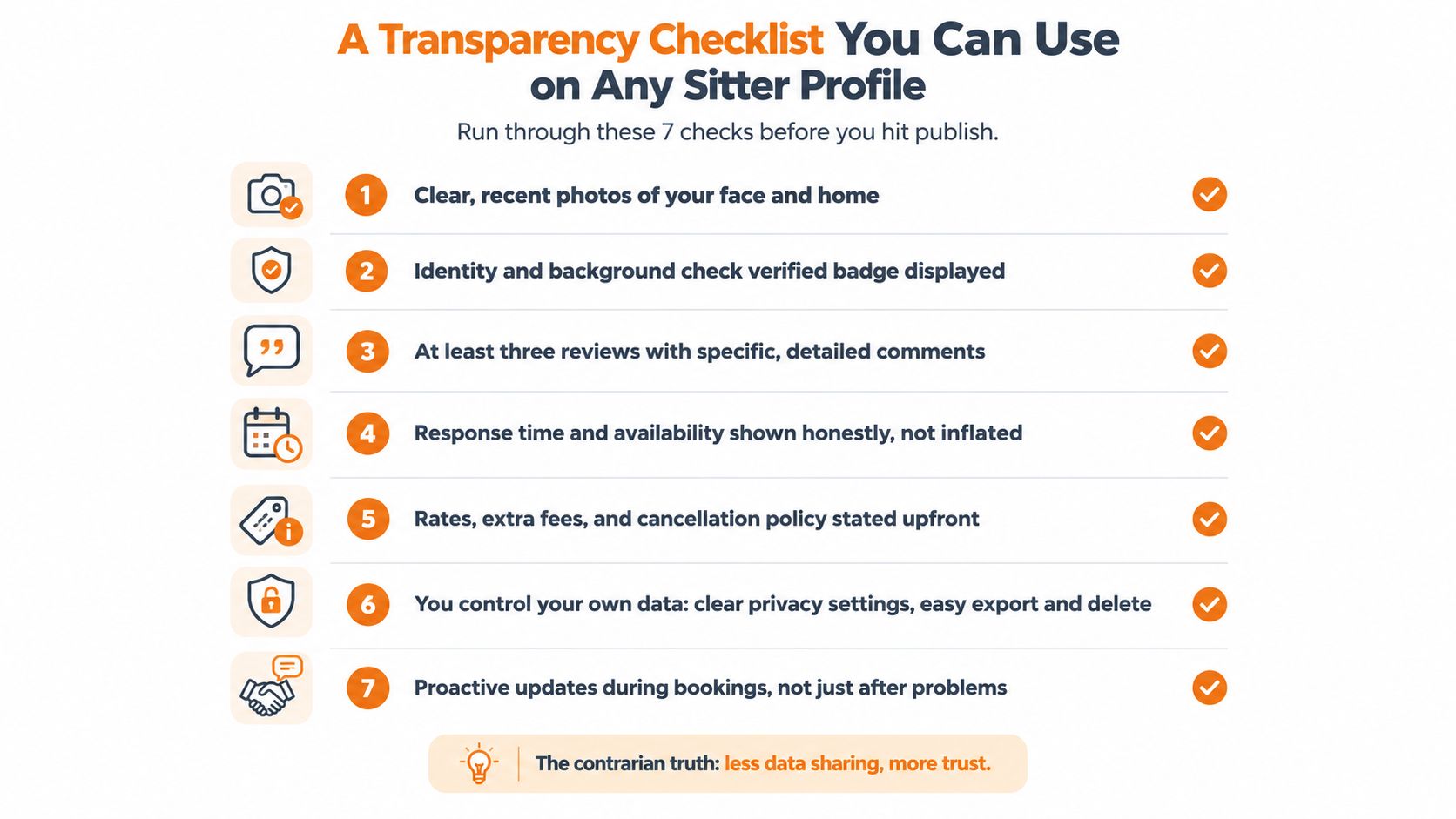
- Identity: Is it clear who owns the profile, and does the verification label explain its scope?
- Availability: Do the dates, response behavior, and current commitments match the sitter's description?
- Pricing: Can you understand the arrangement, future conditions, extra charges, and cancellation expectations?
- Ranking: Does the platform explain why this profile appeared in your results?
- Review source: Are completed sits, imported screenshots, references, and testimonials labeled differently?
- Data control: Can you find privacy settings and understand how verification or messaging data is handled?
- Support: Is there a visible way to report misleading information, ask for help, or challenge a decision?
If a sitter has a background check or similar report, don't treat the label as self-explanatory. Learn how to read your Clear Check report so you understand what the document covers and what questions it can't answer.
The strongest profiles won't necessarily have the most badges. They'll give you enough context to decide what to verify through conversation.
Transparency as a System Users Verify, Not a Slogan They Admire
A trustworthy marketplace makes its decisions inspectable from profile creation through the sit itself. Users should be able to see who stands behind a listing, what evidence supports its claims, why it appears in search, how private communication is handled, and where feedback goes after a problem.
That approach resembles good repair documentation. People want to understand who runs this repair science resource, not because ownership alone proves quality, but because context helps them judge the information they're using.
Before your next booking, ask one question: Can I see who, what, why, and how on this listing, and can I act on what I see? If the answer is yes, transparency is doing real work. If the answer is no, another trust badge won't close the gap.
Global Pet Sitter connects pet owners with house and pet sitters through member profiles, search, messaging, reviews, and imported reputation evidence, with identity verification and community feedback built into the experience. Visit Global Pet Sitter to create a profile, find a suitable match, and begin a clearer conversation before your next sit.
Inicie sesión para dejar un comentario
