You're packing for a work trip or holiday, and your dog is watching every movement as if the suitcase has personally betrayed them. Your cat has claimed the open luggage, your feeding instructions are still in your head, and the thought of leaving a key with someone else feels almost as uncomfortable as leaving home.
That uncertainty is normal. The question isn't only “how does pet sitting work?” It's whether another person can reproduce your pet's routine, recognize a problem, and make sensible decisions while you're away. Reliable pet sitting treats that responsibility as a documented care arrangement, not a casual favor.
The Reality of Leaving Your Pet Behind
You lock the door, start the car, and then remember the small details your pet never forgets. The dog expects breakfast at a certain hour, pauses at one corner on the usual walk, and needs medication tucked into food. The cat may hide when strangers enter, eat less when stressed, or show illness through small changes in litter habits. Leaving a pet behind feels hard because care is built from routines, and routines are easy to overlook when you try to explain them quickly.
A short message such as “food is in the kitchen” leaves too much unsaid. A sitter may also need the portion size, timing, medication method, exercise limits, behavior around guests, and the steps to take if your dog skips dinner. For a cat, the checklist is different but no less specific: food, fresh water, litter, medication, appetite, behavior, and a quick check that the home is secure. Quiet pets can deteriorate without obvious signs, so observation is part of care, not an extra.
Pet sitting is temporary responsibility for that routine while the owner is away. It may involve scheduled visits in the owner's home or an overnight stay. In practice, the job usually includes feeding, water, exercise, cleaning, medication, home security, updates, and emergency contact, all carried out in a way that keeps the pet's normal life as stable as possible.
Delegated responsibility, not simple access
This is closer to a handover between caregivers than to giving someone a key.
The U.S. Bureau of Labor Statistics recorded 268,830 animal caretakers in May 2023, with a mean hourly wage of $16.12 and mean annual wage of $33,530 in the broader animal-care category (Bureau of Labor Statistics animal caretakers data). That group includes kennel attendants, shelter workers, groomers, and related roles, so it does not measure independent pet sitters alone. It still shows that animal care is organized work with real operational demands.
The same practical reality appears on the owner side. The American Pet Products Association reported that 94 million U.S. households owned at least one pet in 2024, up from 82 million in 2023 (APPA State of the Industry report). In households that rely on outside help during trips, long workdays, or emergencies, a friendly promise is rarely enough. What matters is whether another person can repeat the routine, notice a problem, and respond the way the owner would want.
That is why many sitting arrangements use profiles, calendars, references, identity checks, reviews, written instructions, and message records. Those tools help both sides confirm expectations, but they do not replace judgment. Good care depends on a sitter understanding the animal in front of them, not just the booking details.
Practical rule: A sitter should be able to answer three questions before you leave: what happens every day, what counts as a concern, and who makes the emergency decision?
A dependable sit usually follows a clear sequence. The owner explains the pet, the dates, and the routine. The sitter confirms relevant experience and availability. Both sides meet or speak before the stay, and the owner provides a written handover. During the sit, the sitter repeats the routine, sends agreed updates, records concerns, and reports back when the owner returns. That continuity is what makes pet sitting work.
Choosing the Right Care Model for Your Pet
Pet sitting has no single format. The right choice depends on how long your pet can comfortably be alone, how much supervision medication requires, whether the animal is settled by night, and how it reacts to unfamiliar people.
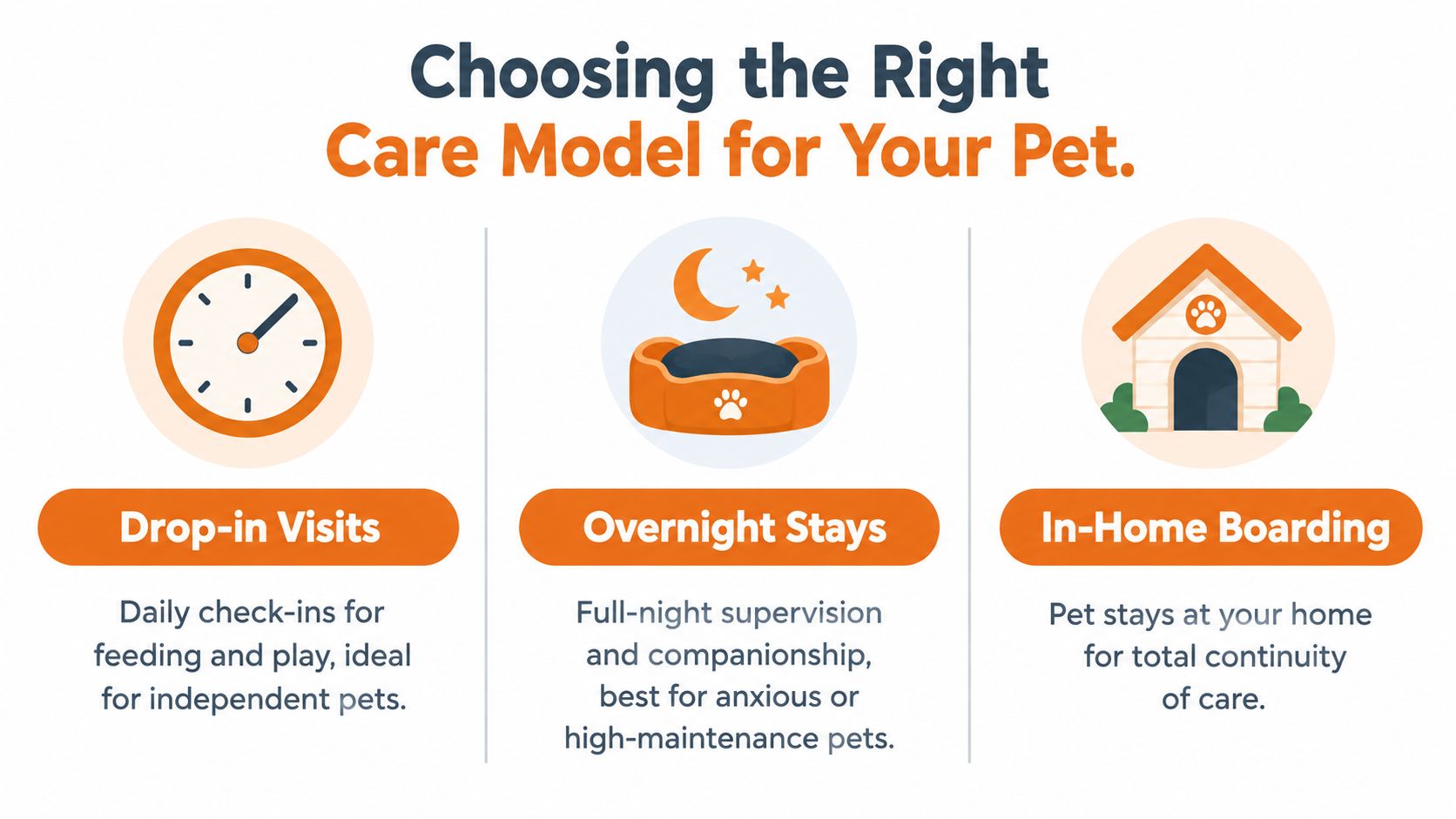
Drop-in visits
Drop-ins work well when a pet can remain alone between planned visits. An independent adult cat may need food, water, litter care, medication, and a welfare check rather than continuous company. A dog may need multiple visits for feeding, toilet breaks, exercise, and interaction.
The key is to define what “a visit” includes. Is the sitter only refilling bowls, or will they administer medication, clean an accident, walk the dog, and send an update? A visit schedule should reflect the animal's actual routine, not the sitter's most convenient availability.
Overnight stays
An overnight stay gives the pet company through the night and places the sitter in the home during the period when some animals become restless or distressed. This can suit a dog that struggles with separation, a senior pet needing observation, or an animal that needs medication at night.
It doesn't automatically mean the sitter provides continuous supervision every hour. Discuss arrival and departure times, periods when the sitter may leave, sleeping arrangements, household rules, and what happens if the pet becomes unsettled.
Live-in house sitting
A live-in arrangement provides the greatest continuity because the pet remains in its familiar environment while the sitter stays at the property. It can be useful for animals with complex routines, home-based equipment, escape risks, or a strong dependence on familiar surroundings.
It also demands the clearest boundaries. Agree on which rooms are private, how keys and alarms work, whether visitors are allowed, what household tasks are included, and how often the sitter sends updates. For a practical comparison of home-based care and boarding, see this guide to pet sitting versus boarding.
| Care model | Often suits | Questions to settle |
|---|---|---|
| Drop-in visits | Independent pets with predictable routines | How many visits, and what does each include? |
| Overnight stays | Pets needing night-time company or observation | How long can the sitter leave during the day? |
| Live-in sitting | Pets needing environmental stability or intensive care | What are the household and availability expectations? |
The choice should follow the pet, not the label. A cat that hides from every unfamiliar person may need gradual introductions even for short visits. A social dog may cope poorly with brief drop-ins if it needs frequent companionship. If you're unsure, test the arrangement with a short visit or trial sit before committing to a long absence.
The ownership profile also differs by species. APPA reported 68 million dog-owning households, representing 51% of U.S. households, and 49 million cat-owning households, representing 37%, in its cited industry report (APPA household ownership figures). Dogs commonly need scheduled outdoor activity and supervision, while cats often need reliable checks for food, water, litter, medication, and welfare.
Building a Documented Continuity of Care Plan
A care plan should let a capable person perform the routine without guessing. Write it for the moment when the sitter is tired, the pet behaves differently, or an instruction needs to be checked quickly.
Start with the daily sequence. Record feeding quantities and times, water arrangements, exercise limits, preferred routes, play preferences, sleep locations, litter or waste duties, and household rules. Include small details that prevent friction, such as whether the dog pulls toward bicycles or whether the cat dislikes the food bowl near the washing machine.
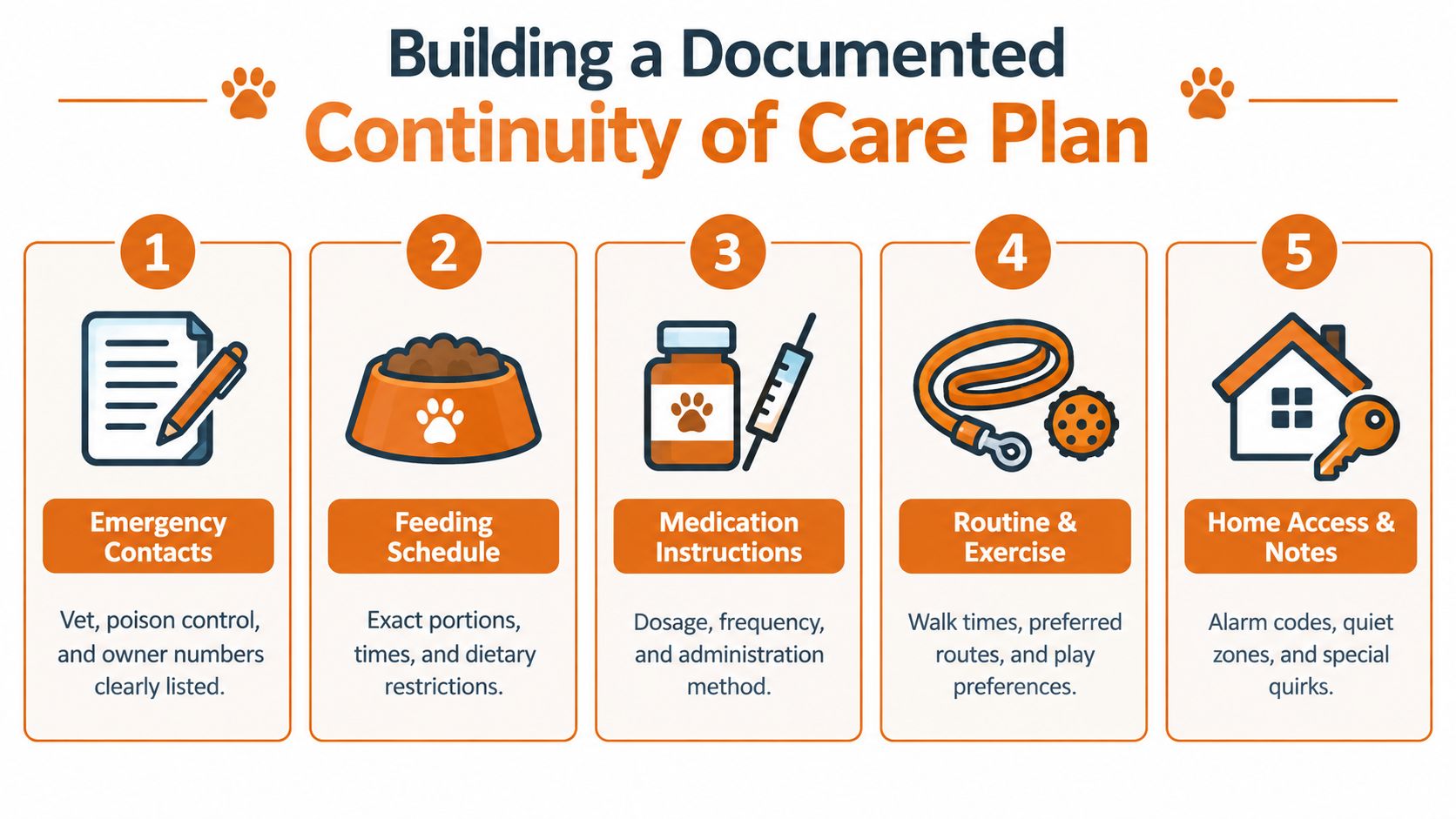
Write instructions the sitter can use
Medication deserves its own section. State the name of the medicine, dose, timing, storage location, administration method, and what to do if the pet spits it out or refuses food. Demonstrate the process in person where possible, then leave the written version beside the supplies.
Behavioral information is equally practical. Describe warning signs, triggers, preferred calming methods, escape risks, interactions with other animals, and situations the sitter should avoid. “He can be nervous” is less useful than “he backs away from unfamiliar visitors and should not be approached while hiding.”
The handover should also include:
- Medical details: Provide the veterinarian's contact information, current records, medication list, vaccination information, and relevant preventive-care details.
- Emergency authorization: State who can approve treatment, how the owner can be reached, and whether a backup contact can make decisions.
- Access instructions: Explain keys, alarm procedures, gates, carriers, transport equipment, and where essential supplies are kept.
- Communication expectations: Set the timing and format for updates, including photos, feeding notes, medication confirmation, and concerns.
- Home rules: Identify quiet zones, restricted rooms, waste procedures, plant care, deliveries, and security requirements.
The pet sitter information sheet can help organize these details into a format that both parties can review before departure.
Use the plan during the sit
A written document isn't useful if it stays in a drawer. The sitter should use scheduled check-ins for arrival, feeding, medication, walks, litter or waste checks, and end-of-day status. Notes can be brief, but they should make changes visible.
Observe the pet against its normal pattern. Appetite, water intake, elimination, mobility, and behavior can reveal a developing problem. The aim isn't to turn the sitter into a veterinarian. It's to notice a meaningful change early and escalate it through the agreed contact chain.
The owner's routine is the sitter's operating manual. Clear instructions give the sitter room to act confidently without asking the same basic question during every visit.
A final handover closes the loop. The sitter should report completed care, unusual observations, remaining medication, damaged supplies, access issues, and anything the owner should monitor after returning. This record helps the next sitting period begin with better information.
Establishing Trust and Verification in Marketplaces
Trust begins before anyone hands over a key. A polished profile isn't enough on its own. Owners need to understand who the sitter is, what they can do, when they're available, and how previous owners evaluated their reliability.
A useful profile answers practical questions:
- Experience: Has the sitter cared for dogs, cats, senior animals, reactive pets, or medication needs similar to yours?
- Availability: Can they meet the required visit or overnight schedule rather than just accept the dates?
- References: Are reviews detailed enough to explain how the sitter handled routines, communication, and unexpected situations?
- Identity: Does the marketplace or sitter provide a meaningful verification process?
- Boundaries: Does the sitter clearly state which tasks, animals, and household responsibilities they will accept?
Reviews matter because they provide context that an introduction can't. A five-star rating without detail says little. A review describing punctual updates, careful medication administration, calm handling, and a clean handover gives an owner evidence related to the actual assignment.
Some experienced sitters arrive from other networks with a history that a new marketplace profile doesn't yet show. Global Pet Sitter allows sitters to import 5-star reviews from other platforms through screenshots, preserving that reputation for owners who are comparing candidates. Treat imported reviews as one part of verification, then discuss the specific care requirements directly.
The background check requirements guide is useful for clarifying what owners should ask about when evaluating identity and screening practices. A marketplace can support transparency, but it can't determine whether a particular sitter is right for a particular animal.
The meet-and-greet is a working test
Use the first conversation to exchange information, not just impressions. Show the sitter where food, medication, carriers, cleaning supplies, records, and emergency contacts are located. Let them see how the pet responds to handling, doors, harnesses, feeding, and unfamiliar movement.
Watch the pet's behavior without forcing interaction. A sitter who respects distance and reads discomfort may be a safer match than someone who tries to win affection immediately. The owner should also notice whether the sitter asks precise questions or accepts vague instructions without checking them.
Trust becomes stronger when both sides document the agreement. Confirm dates, services, access, updates, payment or accommodation terms, cancellation expectations, visitors, transport, and emergency decisions in writing. Transparency protects the owner, the sitter, and the animal because it replaces assumptions with shared expectations.
Assessing If In-Home Sitting Is Truly the Best Option
Keeping a pet at home can preserve familiar smells, rooms, feeding locations, and daily patterns. That can be valuable, but “at home” doesn't automatically mean “least stressful.” An unfamiliar person may create more tension than a well-managed boarding environment, especially for an animal that guards its space or reacts strongly to strangers.
Test suitability before travel
Ask how your pet responds to each part of the arrangement:
- Separation: Does the animal become distressed when you leave, even for a short period?
- Strangers: Will it accept a new person entering, feeding, walking, or giving medication?
- Space: Does it guard rooms, food, toys, doors, or resting areas?
- Escape: Could it bolt through a gate, door, window, or yard boundary?
- Medical care: Can the sitter safely perform every required task?
- Social needs: Does the pet need frequent interaction, a familiar companion, or controlled contact with other animals?
- Environment: Is the home secure, quiet, temperature-controlled, and suitable for the length of the absence?
A senior dog that needs medication may benefit from live-in care, but only if the sitter can administer the treatment confidently. A reactive dog may prefer a familiar local caregiver who already knows its signals. A cat that hides from visitors may need gradual introductions and short trial visits rather than a new person appearing for the first time on departure day.
The AVMA travel guidance for pets supports considering a reliable sitter when a pet isn't suited to travel, but that doesn't mean every unfamiliar sitter will suit every pet. The decision should reflect the individual animal's behavior and care needs.
Compare the alternatives honestly
Boarding may provide a professional facility, staff coverage, and structured supervision. It may also expose a sensitive animal to unfamiliar sounds, animals, handling, or routines. In-home sitting can reduce those environmental changes, while introducing a caregiver into the pet's territory and the owner's home.
A short trial can reveal problems while the owner is still nearby. Ask the sitter to complete a visit, walk, feeding routine, or medication demonstration. Review what happened, how the pet behaved afterward, and whether the sitter followed the instructions without improvising.
Home hygiene is part of suitability too. If accidents, litter, vomit, or waste are possible, give the sitter clear cleaning instructions and keep supplies accessible. For guidance on choosing household products that are safer around animals, owners can review pet safe cleaning products before preparing the care area.
The right answer may be a familiar neighbor, a professional boarding facility, a gradual sitter introduction, or live-in care. Choose the arrangement that gives the animal the most predictable and manageable experience, not the one that sounds most comforting in a listing.
Preparing for Emergencies and Unexpected Events
A sitter doesn't need to predict every possible problem. They do need a clear route from observation to action. Without that route, a pet can wait while the owner, sitter, and veterinarian try to determine who is allowed to decide.
Before departure, identify a local veterinary hospital and keep the address, phone number, transport route, and records accessible. Confirm the primary veterinarian, backup contact, medication instructions, emergency authorization, insurance information if applicable, and any spending or treatment limits. The FDA recommends identifying veterinary care before travel and monitoring a pet's health while the owner is away (FDA guidance for traveling with pets).
Define the decision chain
Write down what the sitter should do if the pet refuses food, vomits, has diarrhea, appears unusually weak, develops breathing difficulty, is injured, escapes, or shows a sudden behavioral change. Not every concern requires an emergency hospital, but the sitter must know when to call the owner, veterinarian, or emergency service.
The chain can be simple:
- Assess immediately: Check the pet's condition without taking unsafe risks.
- Contact help: Call the regular veterinarian or nearest emergency animal hospital.
- Prepare transport: Use a carrier, leash, blanket, or other safe method suited to the animal.
- Notify the owner: Share the symptoms, location, advice received, and next action.
The owner should state whether the sitter can authorize treatment when immediate care is needed, whether a backup contact can decide if the owner is unreachable, and how the sitter should document calls and instructions. A spending limit may be part of the agreement, but it should never create confusion about urgent safety.
Protect the sitter as well
Emergency planning includes infection control and bite prevention. The CDC advises washing hands after handling animals, bowls, toys, waste, or litter, and before eating or preparing food. When soap and running water aren't available, CDC guidance recommends sanitizer containing at least 60% alcohol (CDC hygiene practices around animals).
Sitting also requires behavior awareness. Don't disturb a dog while it's eating, sleeping, or caring for puppies. Stop interaction if the animal appears frightened, sick, or angry. If a bite or scratch occurs, wash the wound with soap and water immediately and seek medical advice for serious wounds, uncertain rabies vaccination, or possible infection.
Stress can change how an animal eats, sleeps, moves, and responds to people. For additional background on recognizing and supporting stress in dogs, sitters may find this resource on dog stress from Pure Paw Labs useful. It shouldn't replace veterinary advice, but it can support better observation and earlier communication.
Global Pet Sitter connects pet owners with sitters through profiles, dates, pet details, messaging, and reputation information, helping both sides agree on care before the sit begins. Visit Global Pet Sitter to create a clear profile, compare suitable arrangements, and connect with a sitter who can follow your pet's documented routine.
Veuillez vous connecter pour laisser un commentaire
