Why do we keep pet animals at home when caring for them demands time, money, planning, and patience? The usual answers, companionship and affection, are real, but incomplete. A pet also reflects thousands of years of domestication, the psychology of attachment, and a daily arrangement that can either support animal welfare or undermine it.
The question matters because loving an animal isn't the same as meeting its needs. Understanding why people bring dogs, cats, birds, and other animals into their homes can help owners make better decisions about adoption, routine, travel, and temporary care.
The Everyday Bond You Might Not Think to Question
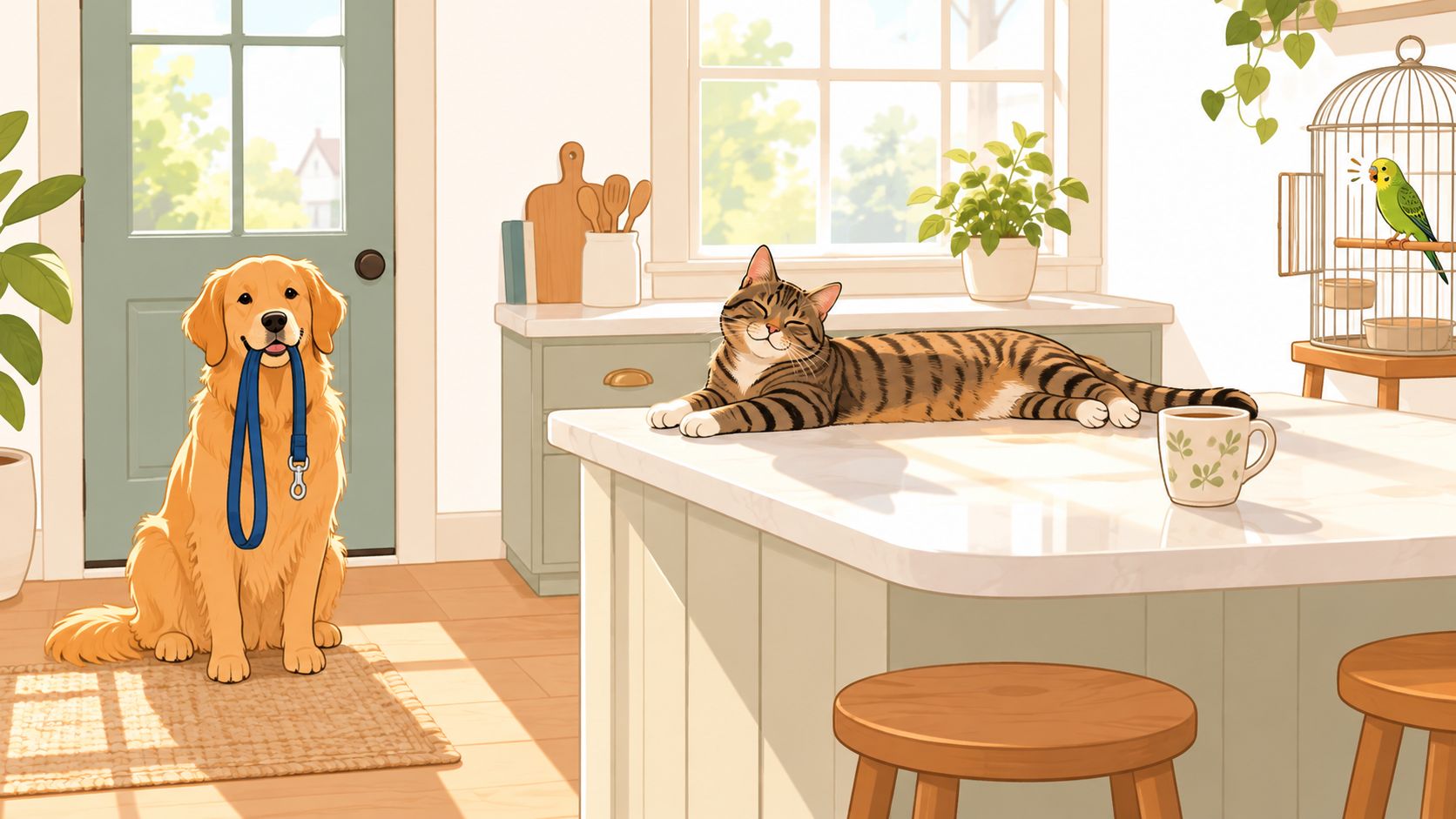
A dog waits beside the door while its owner reaches for the leash. A cat watches from the kitchen counter, following the rhythm of breakfast without appearing to care. From a nearby cage, a parakeet calls when the room grows quiet. These small scenes feel ordinary because pets have become part of the household pattern.
Yet the arrangement is remarkable. Humans invite another species into the home, share space with it, organize schedules around it, and often treat it as a member of the family. Most owners don't pause over this choice each morning. The bond feels natural, even instinctive.
A relationship built into ordinary life
People keep pets at home because animals offer companionship, emotional support, and a sense of family belonging. But those benefits don't float separately from practical life. They appear through repeated contact: a greeting after work, a walk before breakfast, a cat settling beside someone reading, or a bird responding to a familiar voice.
That repetition gives the relationship its strength. A pet isn't only present during special moments. It occupies the background of everyday life, much like a household melody that becomes noticeable when it stops.
The relationship also changes what owners consider a suitable home. A person may choose housing with outdoor access, plan holidays around medication, or arrange supervision during a long workday. Those decisions show that pet keeping is more than ownership in a legal or material sense. It is a shared domestic system.
Central question: Does the home arrangement protect the animal's needs as carefully as it satisfies the owner's emotional needs?
The answer requires more than sentiment. History helps explain why dogs and cats fit so closely into human spaces. Psychology helps explain why the bond can feel socially significant. Research also shows that pet ownership isn't automatically beneficial, either for people or animals. The strongest explanation for why we keep pet animals at home must include all three layers, affection, adaptation, and responsibility.
What Modern Pet Ownership Looks Like in Numbers
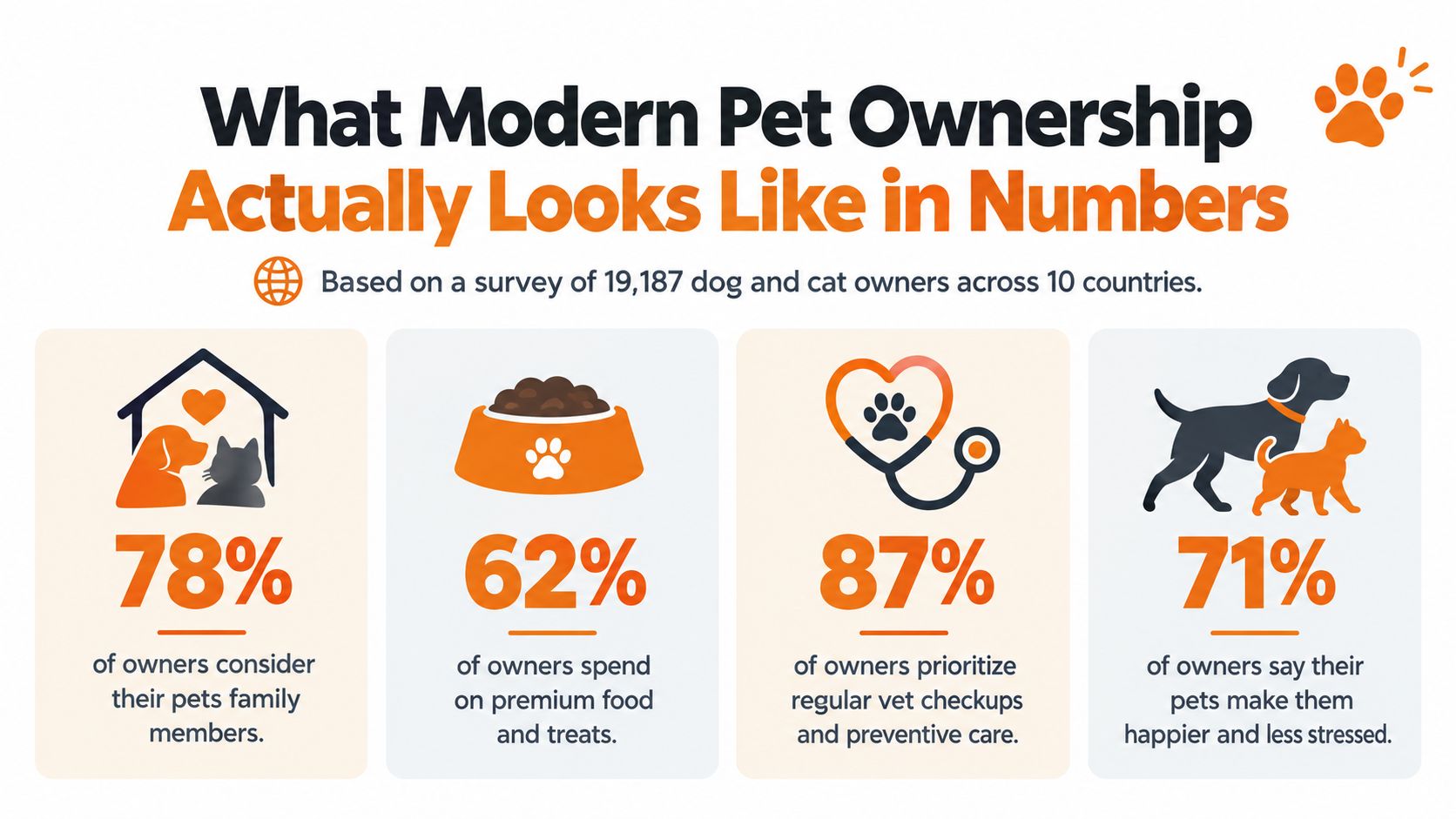
How firmly do pets belong in modern family life? A large international survey offers one answer. Commissioned by the Human Animal Bond Research Institute and Zoetis, it gathered responses from 19,187 dog and cat owners across 10 countries, including the United States, United Kingdom, China, Japan, Brazil, Mexico, Australia, France, Germany, and Spain. The results portray pets as emotionally embedded in households rather than treated as casual possessions. The survey findings provide the evidence for that interpretation.
Four figures that reveal emotional investment
95% of surveyed owners considered their pet part of the family. Families define that role differently, but the result shows how commonly owners understand animals through belonging, attachment, and shared identity, not property alone.
96% agreed that their animal had a positive impact on their life. This is a broad personal judgment, not a clinical measure of mental health. It indicates that owners felt the relationship added value to everyday living.
89% described a close relationship with their pet. Closeness may include affection, trust, routine, physical contact, and familiarity with the animal's behavior. Like a daily conversation, these repeated interactions can make changes in care arrangements feel difficult.
Finally, 92% said there was no reason they would ever be convinced to give the animal up. That response signals strong commitment, while leaving room for practical limits. Illness, relocation, financial strain, or travel can still create situations in which a devoted owner needs assistance.
| What owners reported | Share of surveyed owners | What it suggests |
|---|---|---|
| Pet is part of the family | 95% | Household identity includes the animal |
| Pet positively affects life | 96% | Owners perceive meaningful personal value |
| Close relationship with pet | 89% | The bond is usually emotionally significant |
| No reason to give pet up | 92% | Commitment often remains strong during difficulty |
The figures also raise a welfare question: does care protect the animal's stability as well as the owner's attachment? If a pet functions as a stable social relationship, boarding, rehoming, or prolonged absence can affect more than feeding logistics. Owners may therefore prefer arrangements that preserve familiar surroundings, daily schedules, and trusted human connections.
For people comparing those arrangements, this guide to pet and house sitting prices and care options helps frame cost alongside the kind of care an individual animal requires. In-home care can preserve the ordinary routines that helped turn domestication into companionship, provided the setting meets the pet's needs.
How Dogs and Cats Moved From Wild to Family
Dogs and cats didn't become household companions overnight. Their place in the home emerged through long relationships in which animals and humans gradually adapted to living near one another.
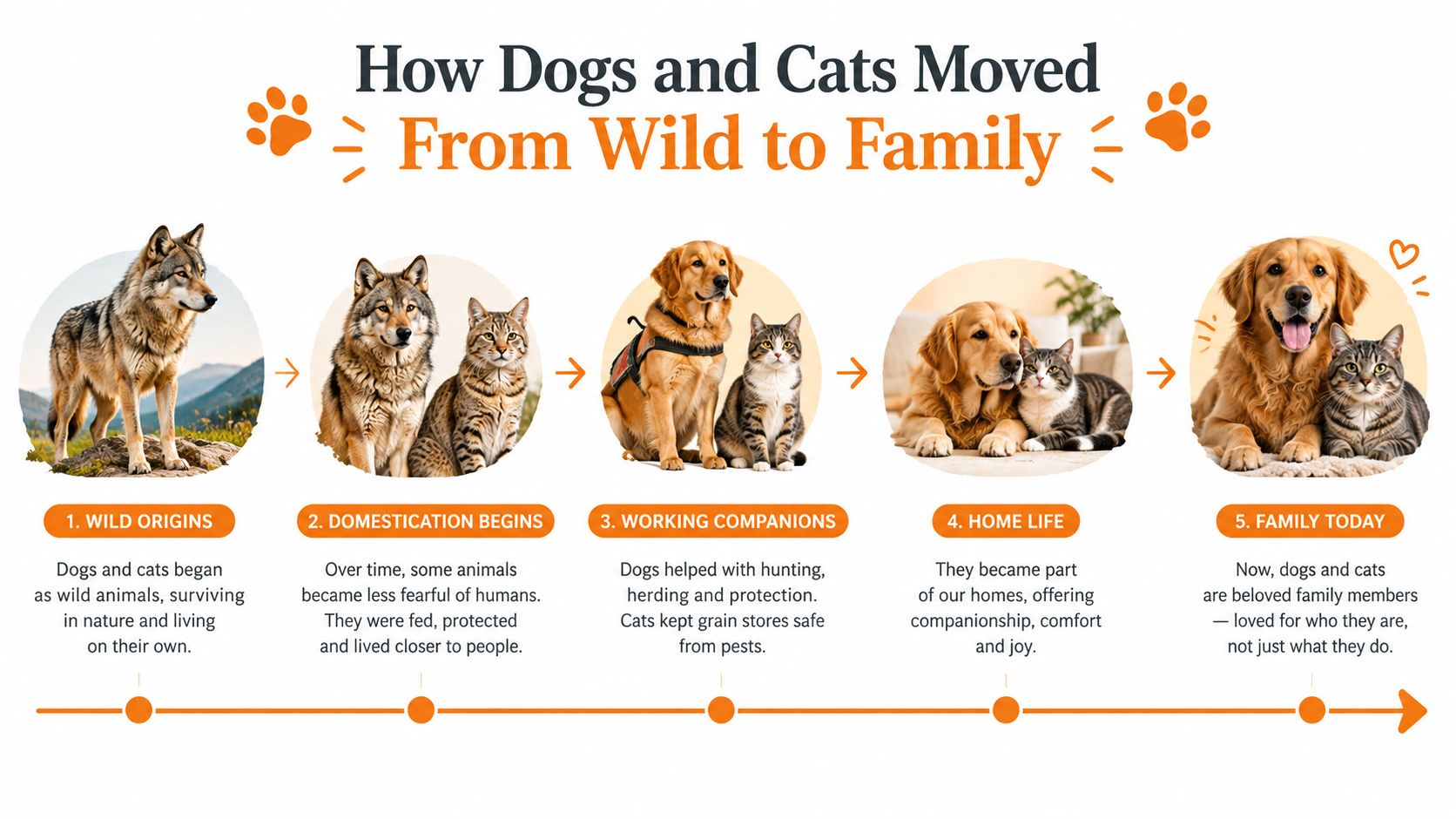
Archaeological and genetic evidence places major dog domestication processes in Europe around 16,000 years ago and Asia around 14,000 years ago. A roughly 14,000-year-old burial in Germany containing a human and a dog or puppy suggests that emotional bonds existed alongside practical roles such as hunting and protection. Research on dog domestication and early human relationships shows that companionship wasn't a modern invention added after working uses disappeared.
Dogs learned the household before the household had a name
Early dogs benefited from proximity to people, while people gained animals capable of helping with tasks and responding to human environments. Over generations, humans favored traits that made some dogs more comfortable around people. The result wasn't a tamed wolf living beside a fire. It was a population increasingly shaped for cooperation, communication, and life near human settlements.
That history still appears in modern behavior. Dogs often monitor human gestures, voices, movement, and routines. A dog that waits near a door may be anticipating a walk, but it may also be participating in a pattern that both household members understand.
Cats followed agriculture into settled life
Cats entered settled human life later, as agriculture created villages, stored grain, and attracted rodents. Evidence dates cat taming in the Near East to roughly 9,500 years ago in Crete and places cat remains at Jericho at about 8,700 years ago. Clear depictions of house cats appear in Egyptian New Kingdom tomb art around 3,600 years ago, according to the same archaeological and genetic research.
Cats benefited from access to prey around human settlements, while people gained animals that could reduce rodent pressure. This arrangement likely required less direct control than dog domestication, but it still rewarded cats that could tolerate human proximity.
Domestication is best understood as a long negotiation. Humans changed animals, and animals changed the way humans lived.
The emotional role came to overlap with the practical one. A dog that once helped with protection could become a walking companion. A cat that lived near grain stores could become a familiar presence on a household chair. The modern pet is the latest chapter in a relationship that began with mutual usefulness and expanded into affection, routine, and family identity.
The Psychology Behind the Companionship
The emotional power of a pet often comes from several small mechanisms working together. A person sees the same animal each day, responds to its needs, receives familiar signals in return, and builds a predictable rhythm around the relationship. That pattern can make a household feel more connected.
A systematic review of 24 observational studies found that adult pet ownership was associated with lower social isolation in the studies examining that outcome. One study of older adults found that pet owners were 36% less likely to report loneliness after adjustment, with an adjusted odds ratio of 0.64 and a 95% confidence interval of 0.41 to 0.98. These findings are reported in the systematic review and related evidence.
Four parts of the bond
Attachment develops through recognition and repeated interaction. A pet knows the sound of a familiar person, while the owner learns the animal's posture, appetite, vocalizations, and preferred forms of contact. That mutual familiarity can create a sense of being known, even though human and animal communication remain different.
Tactile contact adds another layer. Stroking a cat, brushing a dog, or holding a small bird creates physical interaction within the home. Touch doesn't solve every emotional problem, but regular contact can provide a concrete form of comfort when conversation isn't available.
Caregiving routines turn affection into action. Feeding, walking, cleaning, grooming, and medication create obligations, but they also give the day a structure. The owner has a reason to get up, go outside, or pause work. A pet can therefore act as a behavioral anchor, prompting activity through need rather than motivation.
Shared attention strengthens the social feeling. Playing with a dog, watching a cat explore a toy, or responding to a bird's call creates moments in which the owner isn't mentally alone, even if no other person is present. Practical guidance on how to communicate with a cat can help owners interpret those exchanges more accurately.
The evidence needs careful handling. The studies in the review were observational, so they can identify associations but can't prove that pet ownership caused lower isolation or loneliness. People who choose pets may already differ from non-owners in ways that affect their social lives, and the relationship can vary by species, individual temperament, housing, health, and support network.
A pet may offer connection, but it also creates work. The emotional mechanism is strongest when the animal's routines and needs are respected rather than used as a simple treatment for human distress.
When Owning a Pet Does Not Help and Can Hurt
The statement “pets are good for mental health” sounds reassuring, but it compresses a complicated body of research into a slogan. A systematic review of 54 studies found mixed effects: 17 studies reported positive effects, 19 reported mixed effects, 13 found no effect, and 5 found negative effects. Because 76% of the studies were cross-sectional, the evidence has important limits for determining cause and effect. The review explains these findings and limitations.
| Reported outcome | Number of studies | Share of total |
|---|---|---|
| Positive effects | 17 | 17 of 54 |
| Mixed effects | 19 | 19 of 54 |
| No effect | 13 | 13 of 54 |
| Negative effects | 5 | 5 of 54 |
A bond can carry pressure as well as comfort
A pet may support routine for one person and create exhausting demands for another. A dog that needs regular exercise can help an owner leave the house, but the same requirement can become a source of guilt during illness or long workdays. A cat may offer quiet companionship, while behavioral problems, veterinary care, or a difficult household environment create stress.
Species also matter, but species alone doesn't predict the outcome. The individual animal's temperament, age, health, history, and enrichment needs shape the relationship. So do the owner's housing, finances, schedule, emotional capacity, and access to help.
A 2025 meta-analysis found that overall depression risk didn't differ significantly between pet owners and non-owners. It also found a modestly increased association with depression among cat owners, while dog ownership showed no significant association, as reported in the meta-analysis on pet ownership and depression. This doesn't mean cats cause depression, and it doesn't mean dogs prevent it. It shows why broad claims about pets and well-being need context.
The same caution applies to the question of whether a pet belongs in a particular home. An owner may adopt for comfort while underestimating the animal's need for space, stimulation, supervision, training, or specialized care. If you're assessing a dog's ability to cope with absence, guidance on whether dogs can be left alone can help you think beyond the convenience of a work schedule.
A pet can be emotionally important without being the right responsibility for every person at every stage of life.
The humane response isn't to reject the bond. It's to test whether the arrangement works for both sides. Good intentions matter, but they don't replace time, knowledge, veterinary access, or dependable support.
A Welfare-First Framework for Deciding to Keep a Pet
The most useful question isn't just, “Will this pet make me happier?” Ask instead, “Can I provide stable care when life becomes inconvenient?” That shift moves the decision from desire to capacity.
Responsible ownership includes daily exercise where appropriate, supervision, veterinary access, behavioral support, enrichment, and a plan for periods when the owner can't provide care. Those needs continue through illness, work changes, relocation, emergencies, and holidays. A pet's welfare depends on continuity, not only on the enthusiasm present during adoption.
Test your capacity before adoption
- Time: Can your usual schedule support feeding, exercise, cleaning, interaction, training, and rest without relying on ideal conditions?
- Money: Can you plan for routine care and respond to health or behavioral needs without treating every unexpected expense as impossible?
- Household agreement: Do the people sharing the home accept the animal's presence, responsibilities, noise, space requirements, and long-term commitment?
- Backup care: Who can step in during sickness, travel, emergencies, or a sudden change in work?
- Life stability: Would the animal remain welcome after a move, relationship change, new job, or altered housing rules?
- Animal fit: Does the species, age, temperament, and history match the home you can actually provide?
Prospective rescue owners may benefit from practical guidance on advice for new rescue owners, especially when an animal's past behavior and needs aren't fully known at first. A thoughtful match may require patience, training, environmental changes, and professional support.
The welfare question becomes especially important when the owner's benefits conflict with the animal's experience. Keeping a pet at home can comfort a lonely person, but the animal may still need exercise, social contact, medical care, or freedom from prolonged isolation. The relationship serves the animal as well as the owner only when both sets of needs remain visible.
This standard doesn't demand perfect ownership. It demands honest planning and a willingness to adjust. If capacity isn't there, fostering, volunteering, walking a neighbor's dog, or caring for a friend's animal can provide connection without imposing a permanent obligation.
What This Means for How You Care for Your Pet
Why does familiar care matter when you are away? Pets build attachments through repeated contact with people, places, smells, and routines. Home can therefore work like an emotional map: its ordinary sounds and spaces help an animal understand what comes next. Staying there may reduce disruption, though in-home care suits only animals whose safety and social needs can be met.
A temporary caregiver should preserve feeding times, exercise, medication, sleep arrangements, enrichment, and emergency procedures. Meet the caregiver beforehand, explain the pet's signals, share veterinary details, and describe behavior that would require action. Good care follows the animal's established routine rather than forcing it into a generic checklist.
The home itself may need changes. A dog that requires safe outdoor activity could benefit from a secure exercise area, and owners can review practical guidance on custom dog run installation in Austin before altering the yard. Cats, birds, and small animals may need escape prevention, quiet areas, stable temperatures, and enrichment suited to their species.
Global Pet Sitter connects owners with sitters who care for pets in their homes. Owners can use Global Pet Sitter to compare sitter profiles, discuss care details, and arrange companionship around familiar routines. Reviews and advance conversations can also help both sides establish realistic expectations.
The reason people keep pet animals at home should shape the care they provide. The bond grew through closeness and routine. It remains humane only when the animal's comfort, safety, and daily needs receive the same attention as the owner's wish for companionship.
Before traveling, write clear care instructions, compare suitable in-home sitters, and arrange a meet-and-greet. A caregiver who understands the animal's routine can help home remain a secure, recognizable place.
Veuillez vous connecter pour laisser un commentaire
