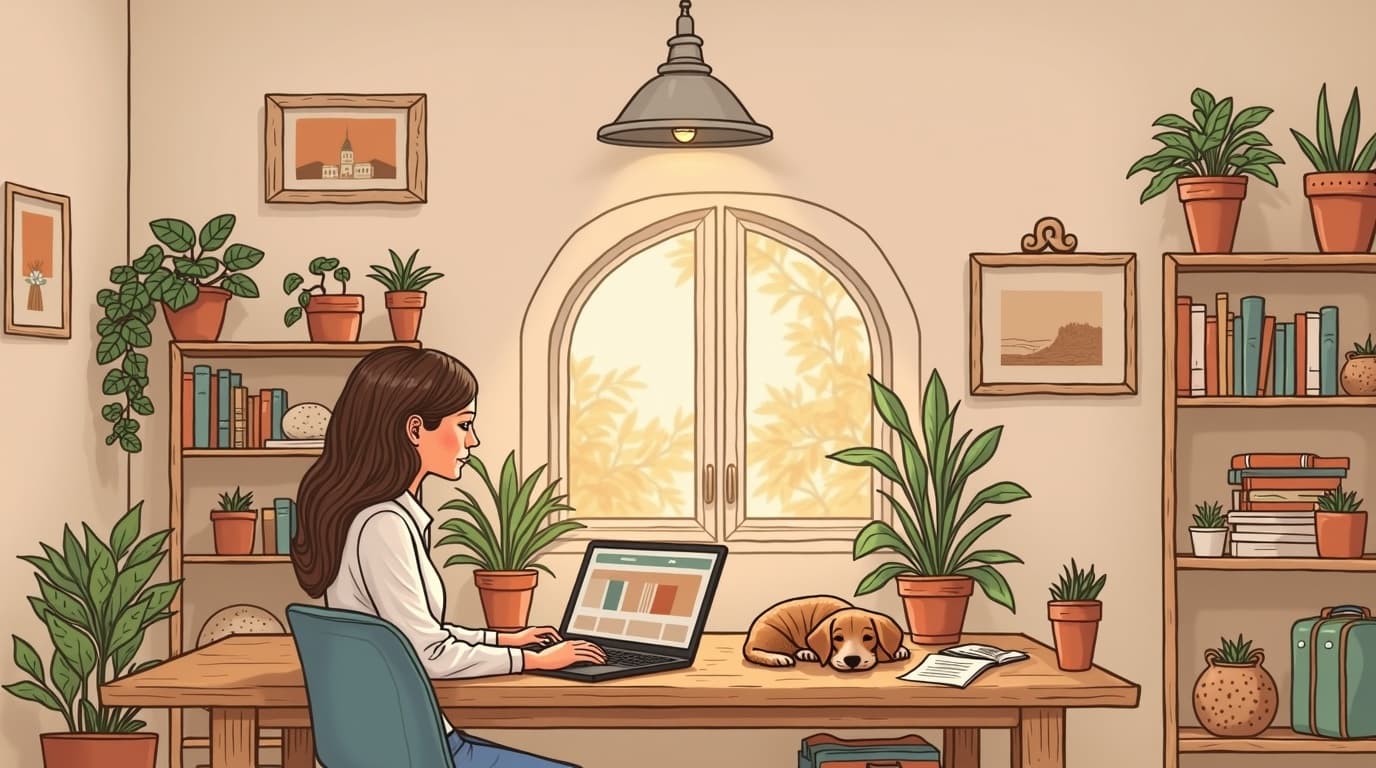
House sitting and remote work go together well. You have a real home instead of a co-living place, pets keep you company, and you don't pay for a place to live. Here's how to do it.
Why House Sitting Is Perfect for Remote Workers
Most digital nomads end up in the same places: Airbnbs that take half their income, co-living spaces with walls like tissue paper, or apartments with minimum stays in places they don't want to be in the long term. House sitting breaks that cycle completely.
You get a fully equipped home, free of charge. No rent, no utilities, no deposits. You just take care of the pets and house while the owners are away. It's perfect for remote workers who only need a quiet space and reliable internet.
The pets are a real bonus too, not just a responsibility. They give your days structure and keep you company while you work.
On Global Pet Sitter you can search by time, place, and pet type. Many pet owners actually prefer sitters who work from home because they're around all day. Your remote schedule becomes an advantage.
Checking WiFi Before Accepting Sits
This is non-negotiable. If you rely on internet for your job, you need to verify the connection before you commit to a sit. A connection that's fine for streaming might not hold up during a video call with screen sharing and cloud syncing at the same time.
What to ask:
- What's the internet speed? (Ask them to run a speed test at speedtest.net and share the results)
- Is it fiber, cable, DSL, or satellite?
- How reliable is it? Any regular outages?
- Is there a data cap?
- What's the mobile signal like as a backup?
Recommended speeds for most remote work:
- 25 Mbps download for video calls and general work
- 10 Mbps upload for comfortable video conferencing (platforms technically require less, but this gives headroom for multitasking)
- Under 50ms ping for real-time communication
Always have a backup plan. Buy a local SIM with lots of data when you arrive. Know where the nearest cafe or coworking space is. Some nomad sitters carry a portable hotspot as insurance.
On Global Pet Sitter, you can add WiFi speed ratings and network details in the welcome guide under connectivity. Check that section before accepting a sit. If it's empty, ask the homeowner to fill it in.
If the internet is unreliable, tell the homeowner upfront. Some will understand, and some will upgrade to attract good sitters. Mention your WiFi needs in your messages so there are no surprises.
Balancing Work Schedule with Pet Care
The biggest adjustment for nomad sitters isn't the new city or the timezone, it's learning to structure your day around another living creature's needs. Dogs don't care about your deadlines.
Plan around the pets first. If the dog needs walks at 7, noon, and 6, those are fixed. Schedule your deep work between those blocks.
A typical nomad sitter day might look like:
- 7:00 - Morning walk and pet feeding
- 7:45 - Breakfast, coffee, settle into work
- 8:00-12:00 - Deep focus work block
- 12:00 - Midday walk and lunch
- 13:00-17:00 - Afternoon work block
- 17:00 - Evening walk, pet playtime
- 18:00 - Dinner and personal time
Cats are easier to work around since they nap during the day and want attention in the morning and evening. Dogs with separation anxiety are trickier. If the listing says the dog can't be left alone, expect a furry coworker in every video call.
Be upfront about your work hours. If you have four hours of calls a day, say so. Homeowners appreciate honesty over finding out mid-sit that you're unavailable.
Chaining Sits for Continuous Travel
The real magic is in linking sits together. Instead of booking one and then scrambling for the next, you chain them - finishing one on Saturday and starting the next on Sunday. You can move from city to city or country to country without ever paying for accommodation.
How to chain effectively:
- Start applying 2-3 months ahead - popular destinations fill up fast
- Leave at least one buffer day between sits for travel and unexpected delays
- Keep your belongings minimal - you'll be moving frequently and lugging three suitcases between sits gets old fast
- Have a backup plan for gaps (hostels, cheap Airbnbs, visiting friends)
Some nomad sitters chain sits for months at a time, building a full travel itinerary out of house sitting gigs.
The challenge is that while you're in the middle of one sit, you need to be applying for the next one. Set aside time each week to browse new listings on Global Pet Sitter, write solid applications, and respond to homeowner messages.
Europe has the most demand in summer and around Christmas. Southeast Asia is busy from November to March. Australia and New Zealand peak during their summer (December to February). Plan your route around where the demand is highest - more listings means more options.
Tax and Legal Considerations
Nobody becomes a digital nomad for the paperwork, but ignoring the legal stuff can lead to a lot of $$ later. The legal and tax situation for nomad house sitters is really complicated, and it's completely different depending on your nationality.
Key things to understand:
- Tax residency: Most countries tax based on where you're a tax resident, which is usually where you spend the most time. If you're moving every few weeks, you might not trigger tax residency anywhere new - but you likely still owe taxes in your home country. Note: the US taxes based on citizenship regardless of where you live, so American nomads must file US taxes even while abroad
- Visa requirements: House sitting is generally not considered "work" in the immigration sense (you're not employed locally), but the remote work you're doing alongside it might require a digital nomad visa in some countries
- Insurance: Standard travel insurance often excludes stays over 30-90 days. Look into long-term travel insurance or annual policies designed for nomads
- Healthcare: Research whether you need coverage in each country or if your home country's system still covers you
Countries with digital nomad visas that work well with house sitting include Portugal, Spain, Croatia, Greece, Estonia, and several Caribbean nations. These visas explicitly allow you to work remotely while living there temporarily.
Get advice from an accountant who specializes in expat or nomad tax. The cost is nothing compared to a big tax bill. And keep records of where you are and when, dates, addresses, receipts. You might need them.
This isn't legal advice. You can have different situations depending on your country, income, and where you live. Do your research.
Dealing with Loneliness on Long Sits
The Instagram version of nomad house sitting is all golden-hour photos with adorable dogs in beautiful homes. The reality includes Tuesday evenings in a suburb where you don't know anyone and the cat is ghosting you.
Loneliness is the most under-discussed part of this lifestyle. It hits hardest when you're in a quiet area with too much free time and no one to share it with. Pets help - dog walks get you out of the house and dog people tend to meet other dog people - but they can't replace human connection.
Strategies that actually work:
- Join local coworking spaces, even just for a day or two per week - the social contact is worth the cost
- Use apps like Meetup or Bumble BFF to find people in the area
- Connect with other sitters on Global Pet Sitter - you'd be surprised how many nomads are in the same city at the same time
- Maintain your existing relationships through regular calls, not just messages
- Get involved in something local - a running group, a language exchange, a volunteer project
Structure helps too. When your days are filled with work, walks, cooking, and exploring, loneliness doesn't get much space.
Know your own limits when choosing sits. If you thrive on social contact, pick urban sits where there's more going on. If long solo stretches drain you, go for shorter sits so you're always meeting new people and seeing new places. The flexibility to choose is one of the best parts of this lifestyle.
Best Destinations for Nomad Sitters
The best destinations combine plenty of available sits, reliable internet, and a good quality of life.
Europe (peak: June-September, December)
- Portugal (Lisbon, Porto, Algarve) - Massive nomad community, great food, affordable, excellent WiFi, digital nomad visa available
- Spain (Barcelona, Valencia, Malaga) - Similar to Portugal with more sit variety, especially along the coast
- United Kingdom (London, countryside) - Highest volume of sits in Europe, but higher cost of living
- France (Paris, Provence, Brittany) - Beautiful sits but verify WiFi in rural areas
- Netherlands (Amsterdam, Utrecht) - Excellent infrastructure, cycling culture, lots of pets
Asia-Pacific (peak: November-March)
- Australia (Melbourne, Sydney, Gold Coast) - Huge sit volume, great lifestyle, but long stays need a visa
- Thailand - Fewer sits on Global Pet Sitter but incredible cost of living between sits
- Bali - Growing number of sits, massive nomad community
Americas
- United States - Enormous sit volume, but varies wildly by location. Best in urban areas with walkable neighborhoods
- Mexico (Mexico City, Oaxaca, Merida) - Growing sit market, affordable, strong nomad scene
- Colombia (Medellin, Bogota) - Emerging destination with improving infrastructure
Speaking the local language makes everything easier, especially in an emergency. Starting in countries where you're comfortable with the language is a smart move. Once you've built confidence and reviews on Global Pet Sitter, branching out to less familiar places feels natural.
Some of the most memorable sits are places you'd never find on a tourist map: a farmhouse in rural Portugal, a canal house in Utrecht, a cottage in the English Lake District. That's the beauty of this lifestyle.