A typical kennel in the UK charges about £20 to £50 per night for one dog, with a national median near £26, which works out at £182 for 7 nights and £364 for 14 nights before any extras. That's the figure to hold in your head when you start comparing dog boarding prices, because the nightly rate is only where the bill begins. Add-on fees, peak dates, charged arrival days and the drive to and from the facility can change your total by more than a small difference in the headline price. We'll show you how to work out the full trip cost per dog, so you can compare a kennel, licensed home boarding and a free in-home house sitter on equal terms and organise care with confidence.
Typical Dog Boarding Cost and Prices in the UK
Two honest quotes for the same fortnight can sit £420 apart. The nightly rate is where the bill starts, and the spread between the low and high ends of the UK market is wide enough to matter to any holiday budget.
The clearest benchmark comes from Compare Dog Boarding's cost guide, which reports a national kennel median of about £26 per dog per night within a typical range of £20 to £50. Multiply before you compare: the low end produces a £280 fortnight for one dog, the high end a £700 one, and the median lands at £364. Those are facility prices. A house sitter who stays in your home exchanges care for the stay itself, with no money changing hands, so any kennel total is really being weighed against a different model altogether.
How the nightly rate builds into a trip total
The nightly figure is a multiplier, and the number of charged days matters as much as the rate itself. Providers count differently: some bill arrival and departure days in full, others use a lower day rate or waive one of them. At the £26 median, fourteen nights come to £364 before extras. If a provider also bills full arrival and departure days on top of a fourteen-night booking, that is another £52 on the same invoice.
| Option | Nightly rate | 14 nights |
|---|---|---|
| Kennel, typical range, one dog | £20-£50 | £280-£700 |
| Kennel, national median | £26 | £364 |
| Kennel, typical low end | £20 | £280 |
| Kennel, typical high end | £50 | £700 |
| London and South East (20-40% above the £26 median) | £31-£36 | £434-£504 |
| Christmas and New Year peak (10-50% above the £26 median) | £29-£39 | £406-£546 |
The regional and festive premiums
Compare Dog Boarding's figures also show where the range stretches. London and the South East typically run 20-40% above the national median, lifting a £26 night to roughly £31 to £36. Over a fortnight, that postcode premium alone adds about £70 to £140 to the base bill.
Christmas and New Year carry the sharpest surcharges, reported at 10% to 50% above standard nightly rates, with the steepest increases generally applying from 23 December to 2 January. On a £26 rate that means £29 to £39 a night. If your dates cross that window, ask which specific nights carry the supplement rather than assuming the whole stay is billed at peak.
Practical rule: Write down three things from every quote, the nightly rate, the number of charged days, and whether arrival and departure days are billed. Without those three, you can't compare providers like for like.
Boarding is one line in a wider household budget, and sourced figures on household spending can help you place pet care alongside other home costs. Whatever the wider picture, the number that counts is the written, date-specific total for your own dog.
What Drives the Dog Boarding Cost Up or Down
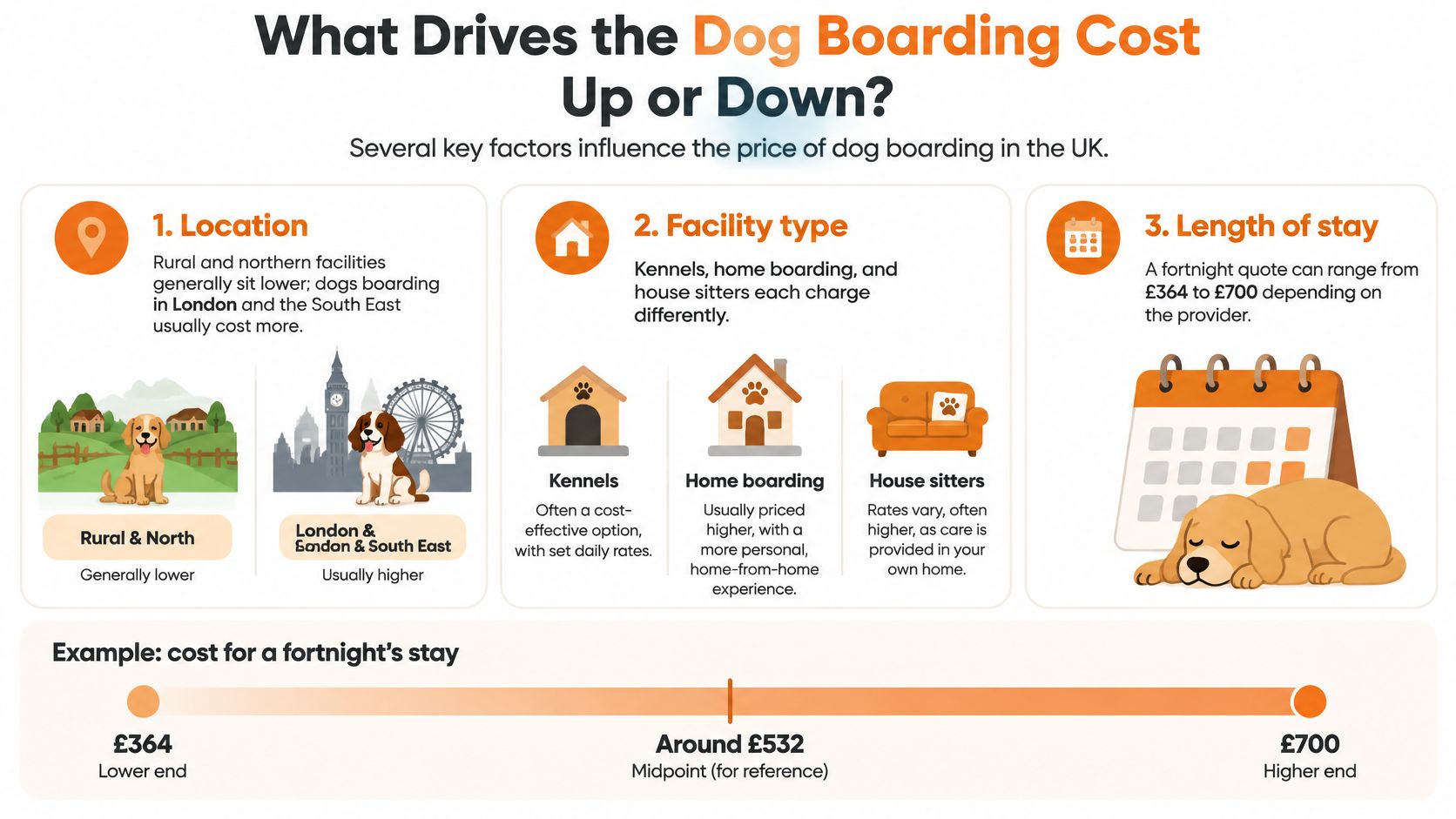
A £364 fortnight and a £700 fortnight can both be honest quotes. The difference usually sits in a handful of drivers, and each one has a clear cause you can check before you book.
Location and facility type
Rural and northern facilities generally sit toward the lower end of the range, while London and the South East charge more because land, property and staffing cost more there. A provider paying higher rent and wages passes part of that cost into the nightly rate. A dearer quote in an expensive postcode usually reflects overheads rather than a higher standard of care.
Facility type works the same way. A purpose-built commercial kennel carries different costs from licensed home boarding, where your dog lives in a host's house alongside a smaller number of dogs. Accommodation, supervision and staffing patterns differ, so nightly rates differ too. For a baseline on the paid-by-the-day alternative, our guide to what dog sitters typically charge sets out the rates to compare against.
Your dog, your dates and how many dogs you have
Size and service level move the price next. A large dog needs more space and food, and one-to-one attention, medication handling or extra exercise all take staff time, so each can lift the rate. Two dogs from the same home who can share a kennel or room often cost less together than apart, because the pair uses one space and one routine. Confirm whether a two-dog quote is a total for the pair or a price per dog, since that single misunderstanding doubles a bill.
Season is the driver owners forget most often.
School holidays and the festive period fill up quickly, and peak pricing follows demand. Booking early protects both your place and your price. Demand stays high partly because dog ownership is widespread: Statlyst's pet ownership data shows how many UK households keep pets, which explains why well-reviewed facilities near popular holiday dates go first.
The cost of pet care has also been climbing. The Office for National Statistics time series for veterinary and other services for pets recorded an annual inflation rate of 7.1% in 2025 for that category, which would turn a £30 nightly service into roughly £32.13 after an equivalent increase. That category covers several pet services rather than boarding alone, but it explains why last year's quote may not hold this year.
One driver never appears on the invoice: getting your dog there and back. Fuel, a pre-booked taxi or time off work for drop-off and collection all add to the trip's real cost per dog. An in-home arrangement removes the journey and the nightly rate together. On Global Pet Sitter, sitters care for pets in the owner's home in exchange for a free stay, no money changes hands for the sit itself, and joining is free with no booking fees.
Add-on Fees and How to Total Your Trip
The nightly rate gets your dog a place to sleep. The lines underneath it decide what you hand over at collection, so read a quote the way you'd read a shopping receipt, one line at a time.
Published UK pricing examples in Loyal and Loved's kennels versus pet sitters guide identify recurring add-ons such as pre-stay veterinary checks of about £30 to £50 and catch-up vaccinations commonly costing £40 to £80 depending on the veterinary practice. Facilities ask for current vaccinations and health documentation because dogs share airspace, runs and staff, and up-to-date records reduce infection risk for every dog on site. If your dog's boosters have lapsed, that cost lands before your holiday even starts, and some vaccinations need time to take effect, so check your record card early.
| Add-on | Typical cost | When it applies |
|---|---|---|
| Pre-stay veterinary check | £30-£50 | Facility requires a health check before arrival |
| Catch-up vaccinations | £40-£80 | Vaccinations are not current, price varies by practice |
| Transport to and from the facility | Quoted per journey, get it in writing | You cannot deliver or collect the dog |
| Medication, late collection, extra walks | Quoted per item, check every line | Quoted separately, check every line |
Seven steps to your true total
Copy this method onto paper or into a notes app and run every quote through it. It takes five minutes and it stops surprises.
- Count the charged nights: Include arrival and departure days if the provider bills them, and write the number down.
- Multiply by the nightly rate: Check the result against the typical range and any regional premium for your area.
- Add any peak surcharge: Apply it only to the dates the provider names, and confirm those dates in writing.
- Add health requirements: Include the pre-stay check and any catch-up vaccinations your vet confirms your dog needs.
- Add transport and care extras: Count both journeys, plus medication administration, late collection or extra-dog fees.
- Check the cancellation terms: Ask whether your deposit is refundable and what happens if your flights change.
- Divide by the number of dogs: This gives you the total trip cost per dog, the fairest basis for comparison.
A worked example at the median
Take a straightforward fortnight at the £26 median. Fourteen nights come to £364. Add a £40 pre-stay check and £60 of catch-up vaccinations and you're at £464 before transport, medication fees or any peak supplement. Nothing about that quote is unreasonable, but it's £100 more than the headline rate suggested, and that's exactly the gap first-time owners don't budget for.
If a line isn't on the quote, ask about it before you pay a deposit. A good provider would rather explain a charge now than argue about it at the gate when you're tired from travelling.
A few practical details protect you here. Ask whether food is included or whether you should supply your dog's usual diet, since a sudden change can upset a sensitive stomach. Confirm drop-off and collection windows, because arriving outside them is the most common reason for an extra day or a late fee. Keep vaccination records, microchip details and your vet's number together in one folder to hand over.
It's also worth a quick call to your insurer before any trip. You must maintain adequate home and contents insurance, and it's sensible to confirm your cover still applies while you're away and, if you choose in-home care, while a sitter is staying in the property. For comparison, we charge no booking fees, ever, so when you weigh a kennel quote against a house sit arranged through us, there's no booking charge to add on our side. Whatever you choose, the cheapest headline rate may not be the cheapest option once mandatory extras and travel are included, so total first and decide second.
Kennel, Home Boarding or a House Sitter Compared
Three options cover most trips, and each suits a different dog. The image below sets them side by side so you can see the trade-offs at a glance.
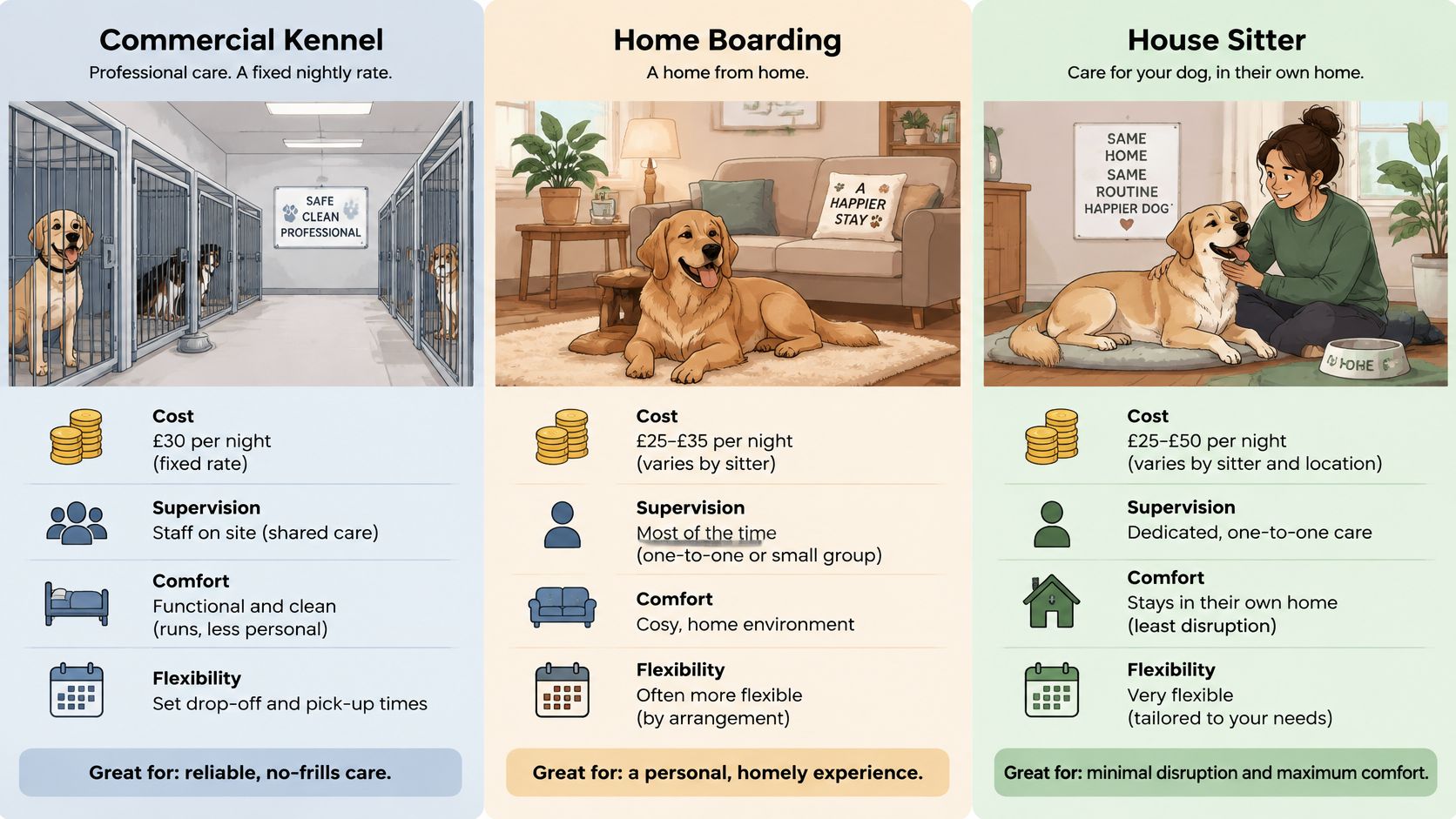
A commercial kennel gives you a fixed nightly rate and a set routine, with your dog in shared accommodation among other dogs. Confident, sociable dogs often settle well, and you know exactly where your dog will be. Licensed home boarding places your dog in a host family's home, usually with fewer dogs and a more domestic rhythm, and it's regulated in England. Nightly fees vary by provider, so ask for a written quote covering your exact dates.
An in-home house sitter works differently. Sitters care for pets at the owner's home in exchange for a free stay, and no money changes hands for the stay itself. Your dog keeps its own bed, bowls, garden and walking route, and your home is lived in while you're away. Our side-by-side guide to pet sitting versus boarding walks through the day-to-day differences if you'd like more detail. If you decide to take your dog with you instead, a guide to genuinely dog welcoming accommodations from maxijournal.com helps you judge what dog friendly really means in practice.
| Option | Typical fee | Where your dog stays | What you still pay |
|---|---|---|---|
| Commercial kennel | £20-£50 per night plus add-ons | Shared kennel accommodation | Nightly fee, add-ons and transport |
| Licensed home boarding | Written nightly quote from the host | Host family home | Nightly fee and any add-ons the host lists |
| House sitter via Global Pet Sitter | No fee for the stay, no money changes hands | Your own home and routine | Vet costs and any agreed household costs |
Honesty about the remaining costs matters. With a house sit, pet owners are responsible for all veterinary treatment costs, and you should provide your sitter with veterinary details and authorisation for emergency care before the sit begins. You also vacate the property for the sit, so the sitter has sole occupancy unless you agree otherwise in advance.
The short video below shows what in-home care looks like in practice, which helps if you've never left your dog with anyone before.
Care intensity deserves as much weight as price. Liverpool City Council's kennel boarding licence page states that licensed kennels need at least one full-time staff member for every 15 dogs, must check dogs during out-of-hours periods, and must provide either two daily exercise periods of at least 20 minutes or two sessions in a secure open area, with a minimum sleeping area of 2.85 square metres per dog. For a senior, anxious, reactive or medicated dog, ask how medication is recorded, how dogs are grouped and what happens overnight, then choose the setting that protects your dog's routine best.
Checking a Provider Is Licensed and Trustworthy
Feeling nervous about handing over your dog, or your house keys, is completely normal. Concrete checks turn that worry into a short list you can work through calmly.
Check the licence first
In England, commercial home boarding for dogs requires a licence from the local authority, and the Government's statutory guidance for home boarding confirms that all home boarding activities carried out as a commercial business must be licensed. Licensing involves more than a payment, because the provider must meet requirements covering the dogs' accommodation, diet, behaviour, companionship or separation, and protection from pain, injury and disease. Ask for the licence number and check it with the council before you pay anything. Our overview of how dog home boarding works explains what a licensed host should be able to show you.
Five questions for any boarding provider
- Medication: Is medication given at set times and recorded, and who administers it?
- Supervision: Is overnight supervision continuous or periodic, and who is on site?
- Grouping: How are dogs grouped for exercise, and can a reactive dog be kept separate?
- Illness: What happens if your dog becomes unwell, and which vet is used?
- Updates: How often will you hear how your dog is settling?
Clear, unhurried answers are a good sign. Vague answers, pressure to pay quickly or a reluctance to show you where dogs sleep are not, and our guide to red flags to watch for lists the warning signs in plain language.
What to check with an in-home sitter
We'll be candid about our own limits. We do not run background checks or vet members unless explicitly stated otherwise, so your own checks matter. Read reviews and references carefully, message with questions, and trust your judgement if something feels off.
Two steps are mandatory and they protect everyone. You must hold a handover with the sitter before leaving, either in person or by video call, and you must provide written care instructions to supplement that handover and remain accessible during the sit for questions or emergencies. Include feeding amounts, walk routes and durations, medication timing, vet details with emergency authorisation, and where cleaning supplies, spare keys and the stopcock live. Putting expectations in writing helps enormously, and our pet sitting contract template gives you a simple structure for dates, duties and house rules.
Before you leave: Walk your sitter through one normal day, morning feed to last garden visit, then ask them to repeat it back. Gaps show up straight away, while there's still time to fix them.
Sitters are independent and under no obligation to accept arrangements involving pets they deem unsuitable, so describe your dog accurately, including quirks and triggers. A truthful listing attracts the right sitter and keeps your dog safe.
Choose Care That Fits Your Dog and Budget
Match the setting to the dog in front of you. A licensed kennel suits a dog that copes well with a fixed routine and busy surroundings, licensed home boarding suits a dog that settles in a family setting, and a house sitter suits a dog that's calmer at home with its own bed, smells and walking route. For a senior, anxious or medicated dog, in-home care usually protects the routine best, because nothing about the day has to change except the person holding the lead.
Keep the price logic beside that decision. The cheapest nightly rate is rarely the cheapest trip once add-ons, peak supplements and transport are included, so compare the total trip cost per dog every time. Joining us is free, with sign-up at no cost, and we charge no booking fees, ever, which keeps the in-home option free for the stay itself.
Your next step is simple. Post your dates and pet details, review sitter profiles and reviews at your own pace, and book a handover before you leave so nothing is left to chance. Find a trusted house sitter for free and let your dog stay home while you enjoy your holiday.
Your dog doesn't need to leave home for you to travel, and you don't need to pay nightly dog boarding prices to know they're cared for. With Global Pet Sitter, you can post your dates for free, choose a sitter who suits your dog's routine, and agree every detail in a proper handover before you go.
Please sign in to leave a comment
