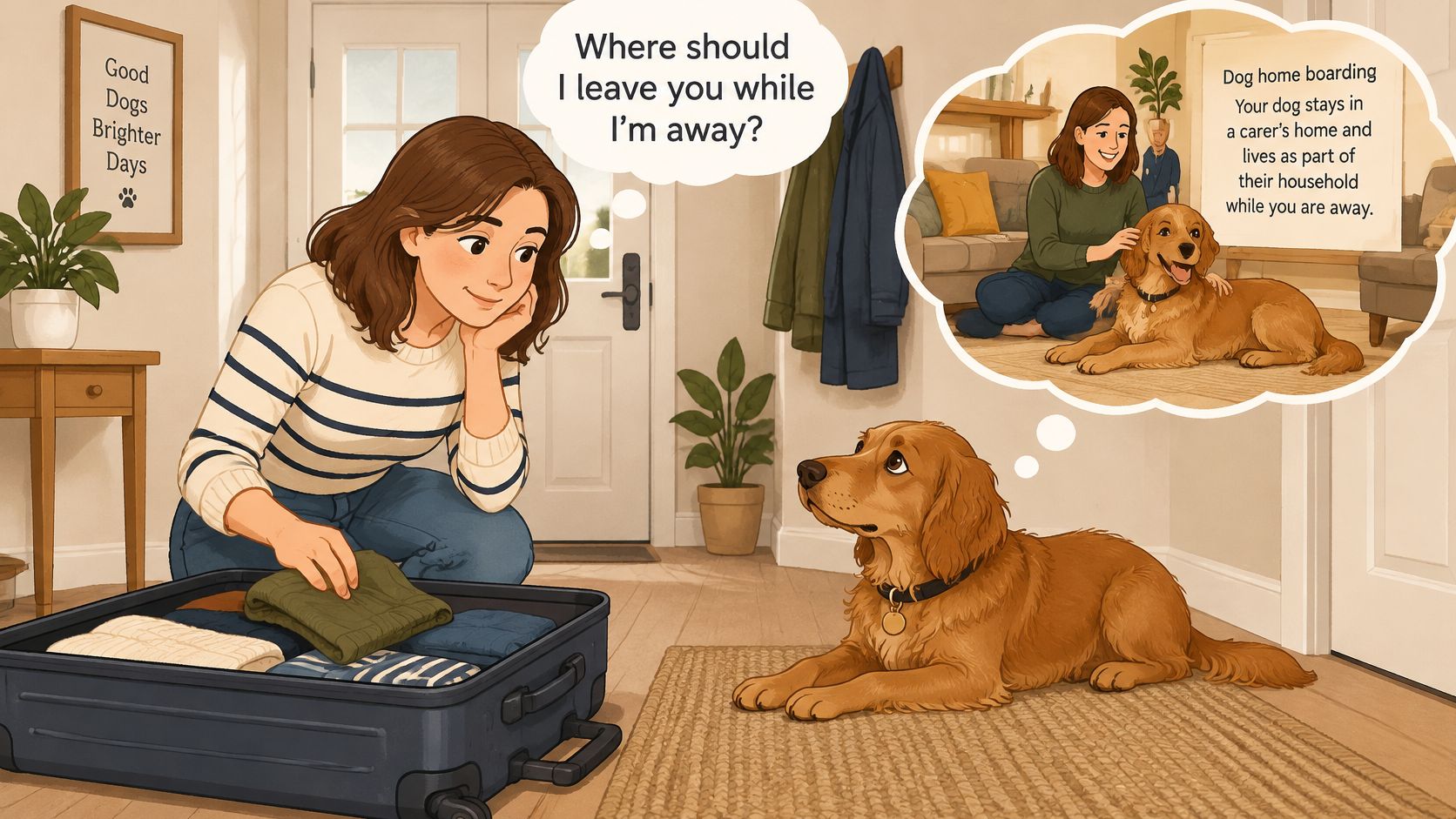
Your suitcase is open, your holiday is getting close, and your dog is watching you pack. If they've never slept anywhere but home, choosing their care can feel harder than organising the trip itself. You might be weighing up a stranger's house against letting someone stay in yours, with understandable worries about both.
At Global Pet Sitter, we encourage you to start with the actual care arrangement, not the name attached to it. Who'll be there, what will your dog's day look like, and what happens if something goes wrong? Those answers matter more than whether an advert promises a homely stay.
What Dog Home Boarding Really Means
Dog home boarding means your dog stays in a boarder's home, usually for a fee. The boarder looks after your dog within their own household, rather than in purpose-built kennel accommodation.
Say your dog normally sleeps beside your bedroom and eats breakfast after a familiar walk. With boarding, you take their food, bed and care instructions to another house. Their temporary carer then fits those needs into a household that may include children, resident pets and other visiting dogs.
In-home house sitting reverses the arrangement. A sitter comes to your home, sleeps there and looks after your dog in familiar surroundings while you're away. Your dog stays put; the person providing care changes.
A home is a setting, not a guarantee
Think about choosing between a friend's spare room and a hotel with a night porter. Both might provide a comfortable night, but you'd ask different questions about privacy, supervision and who takes responsibility in an emergency. Dog care deserves the same attention, without assuming either setting is automatically better.
A comfortable-looking sitting room doesn't tell you whether the garden gate closes securely. Equally, keeping your dog at home doesn't remove the need to check a sitter's identity, experience and ability to follow instructions.
Practical rule: Choose the person and the care plan, not just the photographs of the house.
For UK owners, location also matters. England has a local-authority licensing framework for commercial home boarding; Scotland and Wales operate under their own rules, so check with the council responsible for the home rather than assuming the same requirements apply everywhere.
It's reasonable to feel uneasy about unfamiliar dogs, an unknown household or giving someone access to your property. You don't need to dismiss that feeling. Turn it into concrete questions about daily care, health, supervision and emergency decisions, then judge whether the answers suit your dog's particular needs.
How Home Boarding Compares With House Sitting
Dog home boarding and house sitting compared shows the practical differences to weigh before choosing.
| Factor | Dog home boarding | In-home house sitting |
|---|---|---|
| Where your dog stays | The boarder's home, with their household | Your own home |
| Cost | Nightly fee set by the boarder | Usually no fee in an accommodation exchange; the sitter receives a free stay in return for care |
| Daily routine | Adapted to the boarder's household | Follows your walks, meals and bedtime |
| Stress factors | New home, new people and potentially other animals | Own bed, toys and smells, though a stranger arrives |
| Home security | Your home is empty overnight unless separately occupied | Someone sleeps in your home every night |
| Other dogs | May be shared with the boarder's dogs and other guests | Usually only your pets |
For boarding, request a complete written quote, not just the advertised nightly rate. Ask whether medication, extra walks, holiday dates, late collection or transport attract additional charges. Paid professional house sitting also exists, so distinguish that service from an accommodation-exchange arrangement when comparing costs.
With an exchange, a thank-you is a separate consideration rather than an assumed payment. Our guide to whether you tip pet sitters explains that distinction.
What changes for your dog and your home
A boarder may accommodate your feeding schedule but have different walking times or sleeping arrangements. At home, a sitter can follow your established timetable, provided you explain it clearly and agree what's realistic.
Neither option eliminates adjustment. A sociable dog might enjoy a new household, while another may struggle with unfamiliar smells or shared resting spaces. A dog staying home still needs a comfortable introduction to their sitter.
For your property, overnight occupation can be reassuring, but it isn't a security guarantee. Agree rules about visitors, keys, locked doors and absences, and remember that live-in care doesn't mean someone remains indoors continuously.
Our your place or mine pet-sitting guide offers another way to compare these arrangements. The useful question isn't which sounds nicest, but which changes your dog can comfortably manage.
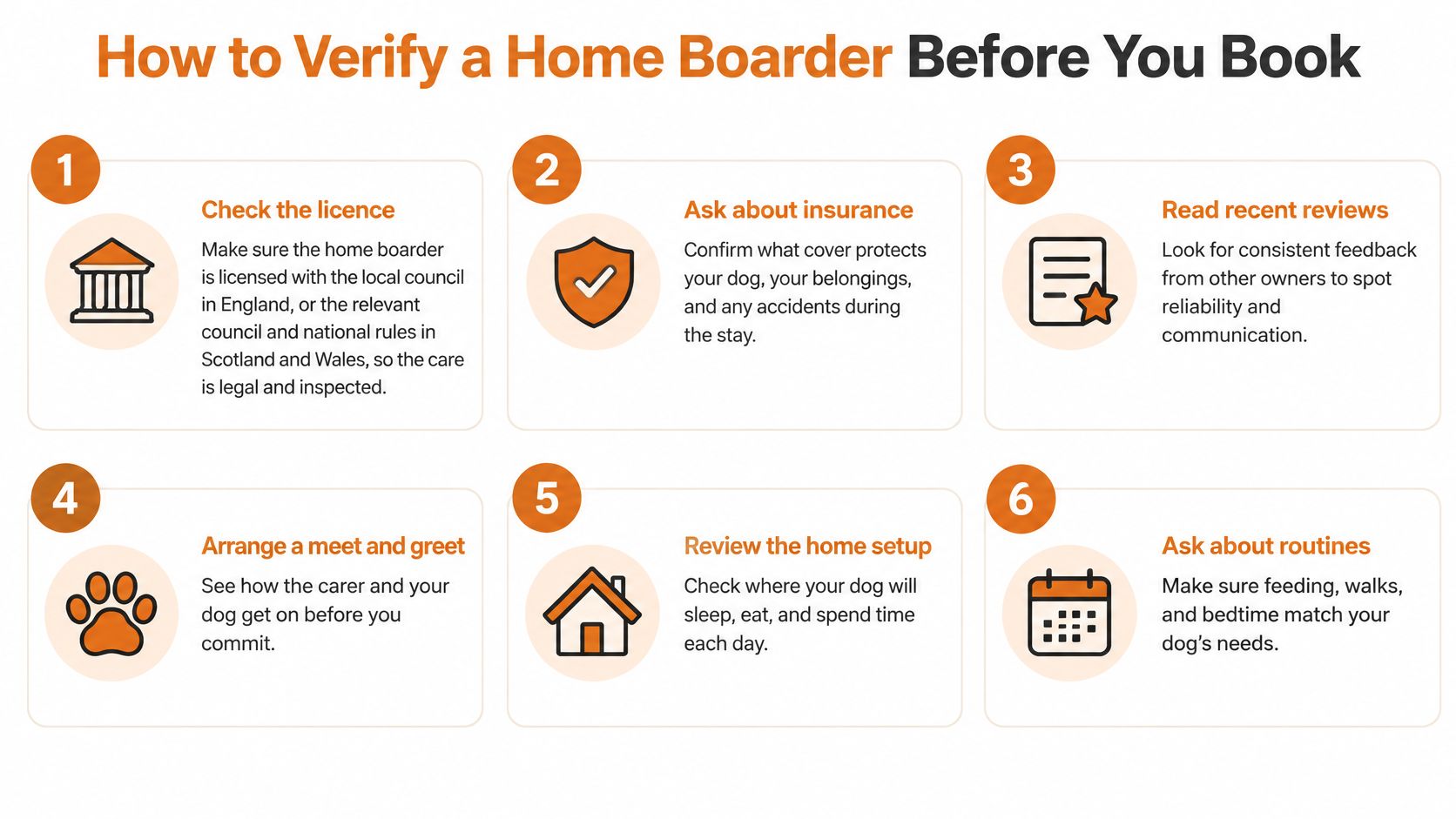
How to Verify a Home Boarder Before You Book
In England, boarding dogs in a residential dwelling as a business requires a local-authority licence under the Animal Welfare (Licensing of Activities Involving Animals) (England) Regulations 2018, as explained in the government's animal-activities licensing assessment. Licensing is your starting checkpoint, not a substitute for checking the proposed stay.
Follow a verification routine
-
Check the licence directly. Find the relevant council register or contact its licensing team, and confirm the licence covers residential dog boarding and the permitted capacity. In Scotland and Wales, ask the relevant council which national and local requirements apply.
-
Match the premises and the person. Check that the licence holder and address match the place where your dog will sleep. If collection is offered, get the destination and transport arrangements in writing rather than accepting an unspecified host.
-
Confirm the household for your dates. Ask which resident and visiting dogs will be present, whether they'll mix, and who will provide care. A licence's maximum capacity doesn't tell you the actual guest list or whether those dogs suit yours.
-
Inspect the setup. Arrange a visit to see gates, fencing, external doors, sleeping areas and feeding spaces, or begin with a live video call if a visit isn't yet possible. Ask to see how dogs can be separated, not merely whether they get along.
-
Settle emergencies and insurance. Confirm the veterinary practice, transport plan, emergency contact and backup carer if the boarder becomes unavailable. Ask what insurance covers, including injury, escape, property damage and exclusions, and establish who authorises and pays for treatment.
-
Put the arrangement in writing. Record costs, routines, supervision, cancellation terms and the handover before drop-off. Read recent reviews and request references, then use our pet-sitter interview questions to explore any gaps.
Don't mistake a badge for verification
The common slip is trusting a website badge without checking the underlying register or asking what the badge means. The Royal Borough of Windsor and Maidenhead's animal-welfare licensing information reinforces the importance of checking the relevant licensing arrangements rather than relying on a domestic setting.
Don't assume a platform or agency has checked someone's background. We don't run background checks or vet members unless explicitly stated otherwise, so verify identity and references yourself; our pet-sitting red flags guide helps you recognise evasive answers.
Written answers and a welcomed visit give you something concrete to assess. They don't guarantee safety, but reluctance to provide either is a reason to pause.
Vaccinations and Hygiene Checks to Request
A dog can appear healthy at drop-off and still be incubating kennel cough or parvovirus. Vaccination paperwork is important for that reason, but it is only one part of the check. The key question is whether the boarder's daily routine reduces the chance of something spreading between your dog and the others in the house. Group size and routine continuity matter here as much as the label on the front door.
Vaccination and hygiene checks for a home boarder should cover your dog's records and the boarder's plan for illness.
| Check | What it protects against | What to ask the boarder |
|---|---|---|
| Canine parvovirus | Severe vomiting and diarrhoea, which can be fatal especially in puppies | Which vaccination records do you require, and how do you confirm a booster is current? |
| Distemper | Respiratory and nervous system illness | What do you do if a dog arrives with an overdue booster? |
| Infectious canine hepatitis (adenovirus) | Liver and eye disease | How do you separate unwell dogs and clean after any illness? |
| Leptospirosis | Bacterial infection that can damage the kidneys and liver | Do you require leptospirosis cover, and how often? |
In England, the statutory home-boarding guidance for local authorities sets out licensing expectations that include checking current veterinary vaccination records, along with written procedures for feeding, cleaning, transport, disease control and health and welfare monitoring. It also addresses accommodation, food, water, bedding, exercise, competent care and emergency protection, including fire precautions. Use the guidance as a checklist of what a licensed home boarder should have in place, then ask the boarder to show you how they apply it day to day.
A vaccination certificate is a fence around the obvious risk. Hygiene is the gate. Ask how bowls, bedding, floors and shared equipment are cleaned, where cleaning products are stored, and how dogs are kept away from treated surfaces until they are dry or safe. Ask whether resident dogs are vaccinated to the same standard and whether the boarder accepts dogs with no vaccination history.
Agree what happens before and during admission
Before arrival, give the boarder your dog's vaccination status, parasite-control history, medication, emergency contacts and normal routine. Ask your vet to resolve any uncertainty about protection or an overdue booster before admission. A boarder should not be asked to make a medical judgement at the door.
Shared spaces give resident and visiting dogs chances for close contact. Ask how the boarder responds to coughing, vomiting, diarrhoea or unusual tiredness. A good answer names the steps: separate the dog, call the vet for advice, clean the area, and tell the owners of any dogs that may have been exposed. Canine cough deserves its own question because vaccination reduces risk without removing it. For general reading on the symptom, these pet pharmacy insights on canine cough are a starting point for questions to raise with your vet.
A useful illness plan names the person who acts, the place an unwell dog can rest separately, and the owner who must be contacted.
Pack a handover folder containing:
- Vaccination evidence: Current records, with any uncertainty already discussed with your vet.
- Medication instructions: Labelled medication, prescribed directions and a way to record each dose.
- Feeding details: Your usual food, portions, meal times and dietary restrictions.
- Veterinary contacts: Your practice details, an emergency contact and treatment authorisation.
Keeping Anxious and Senior Dogs Settled
A UK study of 29 privately owned dogs, summarised by the College of Animal Welfare, compared each dog at home and in boarding kennels, finding higher urinary cortisol and other arousal markers in kennels while cautioning that this didn't necessarily mean negative stress. The comparison involved kennels, not a direct test of home boarding against house sitting.
The useful lesson is to observe your individual dog, rather than assume a particular building makes every dog happier. Write down what's normal before departure so a carer has something meaningful to compare.
Make normal behaviour visible
Record appetite, sleep, toileting, panting, vocalisation, pacing, hiding and reactions to people or dogs. Include medication adherence and explain what a missed meal or restless night means for your dog's existing care plan.
For older or medically complex dogs, describe mobility aids, toileting needs, safe lifting if advised by your vet, and restrictions around stairs or slippery floors. Our senior dog care tips can help you organise those details.
Familiar feeding times, scent items and a predictable sleeping place give the carer a workable routine. At home, explain the usual walking routes; when boarding, agree suitable alternatives rather than expecting an unfamiliar neighbourhood to reproduce every detail.
Watch the whole dog: Being quiet isn't proof of being comfortable. Reduced appetite, lethargy or persistent behavioural changes need veterinary advice, not an automatic explanation of settling in.
Turn the handover into a usable day plan
Our mandatory handover must cover pet care routines, feeding schedules, emergency contacts, veterinary information, house rules and special requirements. Provide written instructions as well, and remain accessible for questions or emergencies.
For a hypothetical ten-year-old dog with arthritis, a daily timetable might look like this. It should reflect that dog's veterinary plan, not serve as general treatment advice.
| Part of the day | Example care plan |
|---|---|
| On waking | Garden toilet break using the step-free exit |
| Breakfast | Usual food and prescribed medication according to the label |
| Morning | Familiar gentle walk within veterinary advice, followed by rest |
| Afternoon | Toilet opportunity and a quiet activity the dog enjoys |
| Evening | Normal meal, prescribed medication if due, and comfortable resting space |
| Bedtime | Final toilet break and access to the usual supportive bed |
Ask for updates about eating, movement and comfort, not just a photograph of your dog asleep.
How Many Dogs Share the Home
A house with sofas isn't necessarily a quiet, low-density setting. Examples in Redbridge's animal-licence register include home boarders approved for four to seven dogs, with some totals including a resident dog.
That doesn't make those arrangements unsuitable. It does mean you shouldn't interpret home boarding as exclusive care unless the provider confirms that explicitly.
How many dogs will be present, and is that group suitable for your dog? Ask about the actual bookings for your dates, including daytime arrivals, rather than accepting a general description of a friendly household.
Ask how the group works
- Care capacity: Who is actively caring for the dogs, and what happens while that person walks another dog or leaves the house?
- Feeding separation: Can your dog eat without another dog approaching their bowl, and where are chews given?
- Medication control: Who administers it, records it and checks that the intended dog swallowed it?
- Introductions: How will the boarder assess compatibility before your holiday begins?
- Overnight arrangements: Who sleeps on the premises, and how are dogs monitored or separated?
- Incompatibility plans: Where will your dog stay if another guest frightens them or repeatedly disturbs their rest?
A provider's ability to separate dogs matters even when introductions go well. Dogs may need privacy around food, sleep, recovery or excitement, and a busy household needs a practical way to provide it.
Compare the care, not just the nightly rate
Budget constraints are real, but a cheaper arrangement isn't automatically crowded and a premium price doesn't establish quality. Compare the full quote with the actual group, available carers, separate resting spaces and contingency plan.
For reactive, anxious or senior dogs, prioritise compatible company, routine continuity and an achievable fallback over a promise that the setting feels like home. A smaller group may help, but one incompatible companion can still make it the wrong match.
Say your dog stiffens and stops eating when another dog approaches. A boarder's reassurance that all their guests are friendly doesn't resolve that concern. Exclusive care or in-home sitting may be more appropriate, with an honest description of your dog's behaviour shared before anyone agrees.
With house sitting, the household usually contains only your own pets. Confirm that no visiting animals will be introduced without your agreement, rather than leaving that expectation unstated.
Choose the Right Setup Before You Book
Which setup suits your dog starts with their needs, not the easiest booking to secure.
| Your dog | Better setup | Why |
|---|---|---|
| Anxious, senior or medicated dog | In-home house sitting | Keeps bed, routine and medication times in familiar surroundings |
| Reacts to other dogs | In-home house sitting | Avoids shared households and mixed groups |
| Copes well with new places and dogs | Dog home boarding | Works only if the licence, premises and group-size checks all pass |
| Routine must stay intact | In-home house sitting | Your walks, meals and bedtime can carry on unchanged |
These are starting recommendations, not guarantees about individual carers. A sitter must be comfortable with your dog's needs and capable of delivering the agreed care; familiarity alone doesn't compensate for a poor match.
For a confident, adaptable dog, verified home boarding can be a reasonable choice. For a dog whose comfort depends on familiar surroundings or avoiding other dogs, we'd favour finding suitable in-home care rather than asking them to tolerate an unsuitable group.
Put expectations on paper
Before committing, use our pet-sitting contract template to organise responsibilities, emergency veterinary authorisation, the handover and any relevant costs. With our accommodation exchange, sitters care for pets in the owner's home in return for a free stay, no money changes hands, and we charge no booking fees, ever.
You remain responsible for veterinary treatment costs and must maintain adequate home and contents insurance. Give your sitter veterinary details and emergency authorisation before leaving, and agree how they'll reach you.
Home comfort deserves practical instructions too. Explain furniture rules and provide washable covers or cleaning supplies; J.G. Carpet Cleaning LLC's sofa fabric care tips for pet owners offer background for preparing shared living spaces.
- Post accurately: Include your dates, pet details, medication needs and relevant behaviour.
- Talk before agreeing: Sitters browse the map and apply, giving you an opportunity to discuss suitability.
- Complete the handover: Meet in person or by video call, provide written instructions and keep the agreement accessible.
If you haven't yet found anyone, don't let urgency decide the care model. Choose the setup your dog needs, then look for someone who can deliver it.
We connect you with house sitters who stay in your home in exchange for caring for your pets, helping your dog keep familiar surroundings while you travel. Visit Global Pet Sitter to post your dates and care details, then discuss the arrangement with suitable applicants. Find a trusted house sitter for free.
Please sign in to leave a comment
