You've found a place you'd love to stay, but the nightly rate makes the trip feel out of reach. Then you see someone offering a home swap and wonder whether it's really possible to stay without paying rent, and what you'd have to give in return.
Home exchange can make accommodation cheaper, but a rent-free stay isn't a free trip. Your dates, your home, your travel budget, and any care responsibilities all shape whether a swap works. The practical question isn't just what you save on lodging. It's whether the full arrangement suits both households.
What Home Exchange Travel Is and How It Started
A family in Lisbon wants two weeks in Chicago. A family in Chicago wants two weeks in Lisbon. They agree to swap front doors, and neither charges the other a cent of rent. Both get a place to stay; both also hand their home to people they have never met.
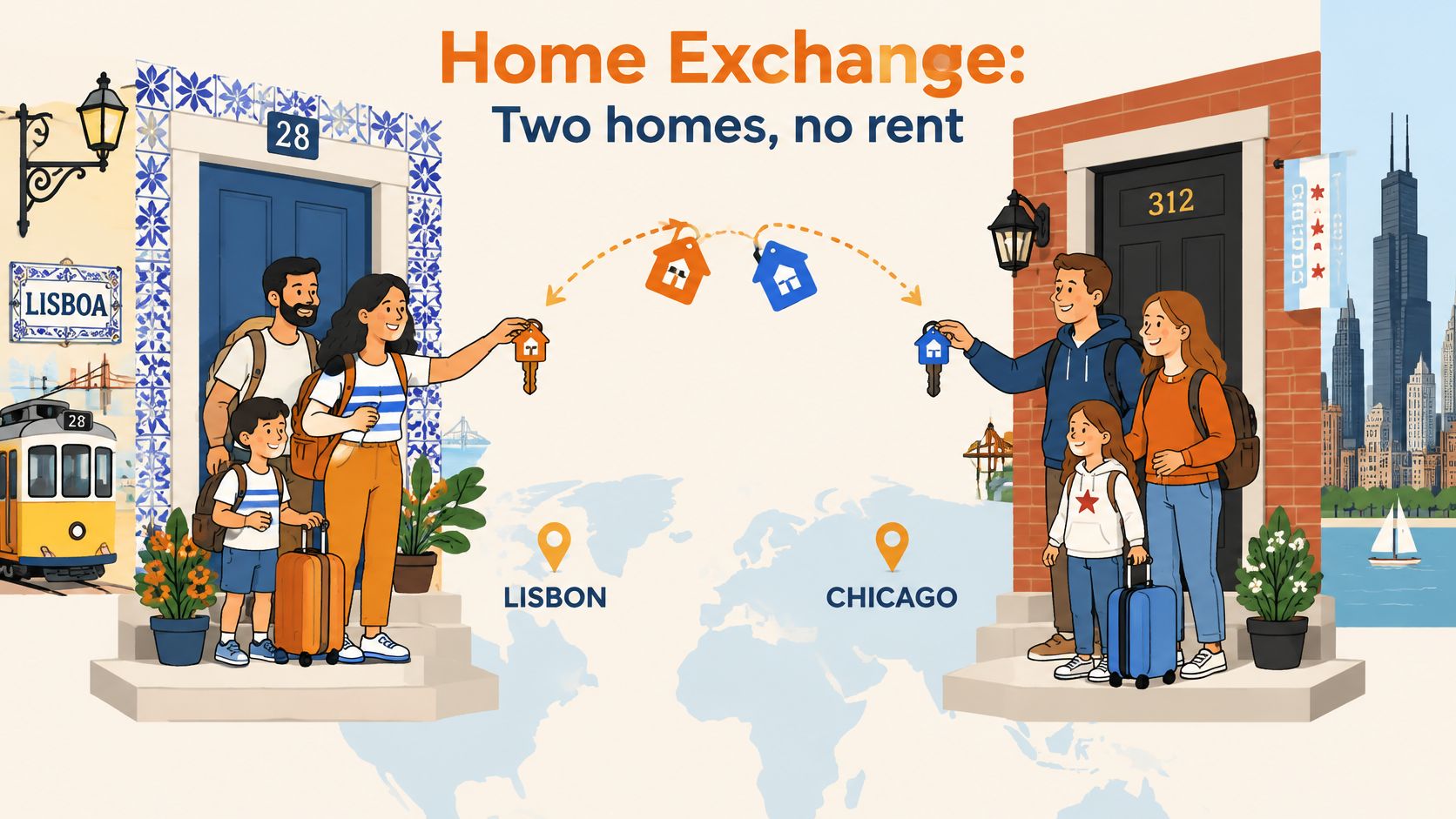
That second part is the piece people underestimate. A swap works like trading houses with a cousin: the stay costs nothing, but you remain responsible for whatever happens on your side of the deal. Three things have to line up: a home someone else genuinely wants, a partner whose dates and needs fit yours, and enough mutual trust to exchange keys. Miss one of them and the arrangement falls apart, which is why flexibility matters more than luck.
The model predates travel apps by generations. In post-war Europe, teachers who could not afford hotel holidays founded Intervac International, while a teacher in New York set up the Vacation Exchange Club, later associated with HomeLink. For decades these clubs matched members through printed catalogs. The internet replaced that slow mailing list with searchable platforms, and the largest of them now count their paying members in the hundreds of thousands, with tens of thousands joining for the first time in a single year.
Home exchange travel means two households agree to use each other's homes, rent-free, on matching or staggered dates, while each side covers its own travel costs and any applicable membership fee. The lodging saving is real, but the swap runs on reciprocity: you only get a home worth staying in by offering one.
Comparing Home Exchange, House Sitting and Short-Term Rentals
| Factor | Home exchange | House sitting | Short-term rental |
|---|---|---|---|
| Nightly lodging cost | No rent paid to the exchange partner | Usually no rent; care is exchanged for accommodation | Paid nightly rate; varies by property and destination |
| What you give in return | Your own home, offered in return | Care for pets, plants, or the home | Money only |
| Typical stay length | Agreed with the exchange partner | Days to several months | Any length, subject to availability |
| Pets in the home | Possible if both sides agree on rules | Common, often central to the sit | May be restricted or involve extra fees |
| Who is at home | Both households stay in each other's homes | Owner is away; sitter occupies the home | Owner is absent; guest occupies the rental |
| Reciprocity needed | Yes, unless the platform offers another exchange arrangement | No, but the owner must accept the sitter | No |
| Upfront commitment | Membership may apply; matching dates takes planning | Membership may apply; you need an accepted application | Booking deposit or full payment may apply |
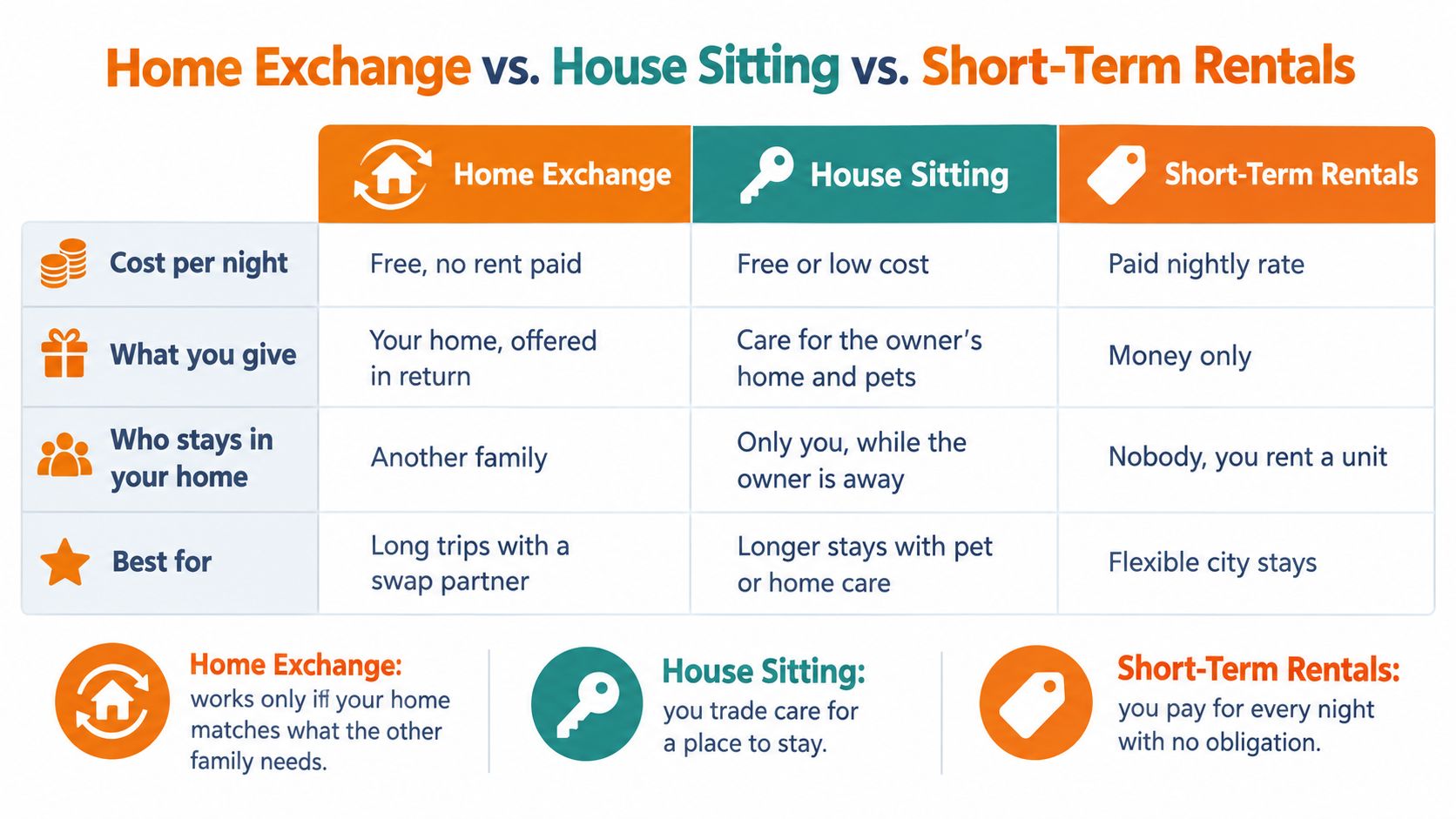
In an exchange, the nightly lodging charge is usually zero, but that doesn't mean anyone will accept your home or dates. A partner needs to want what you're offering, and the arrangements may be simultaneous or happen at different times. You're also responsible for making your home available and agreeing how both households will treat each other's belongings.
With house sitting, you don't offer your own home. Instead, you care for someone else's home, often including pets, in return for a place to stay. You'll need to fit the owner's dates and routines, and the work can affect your ability to explore or work remotely. For a broader overview of how holiday accommodation options compare, consider what each arrangement asks of you, not just its lodging price.
A short-term rental costs money, but it doesn't depend on having a home to exchange or being approved as a sitter. You're paying for a defined booking and can often make plans closer to departure than you can with a reciprocal arrangement. The trade-off is financial: the lodging charge continues for each booked night.
Privacy differs, too. In an exchange, each household uses someone else's private home; in a sit, you're generally the only guest while the owner is away; and in a rental, you occupy a unit under the booking terms. Later in this guide, you can match those differences to the kind of trip you're planning.
The Real Cost of a Swap and Who Can Take Part
A home exchange works like a potluck dinner: nobody pays for the meal, but everyone has to bring a dish. Your dish is a home someone else wants, on dates that suit them too. That framing matters when you look at costs, because "free accommodation" is only one line of the full budget.
| Option | Nightly lodging cost | Lodging total for 14 nights | Extra costs to plan for |
|---|---|---|---|
| Hotel | Varies by destination and property | Get a quote for your dates | Tourist taxes and resort fees |
| Short-term rental | Varies by destination and property | Multiply the quoted rate by 14 nights | Cleaning fee and booking deposit |
| House sitting | Usually no rent in exchange for care | Usually no nightly rent | Membership and travel to the sit |
| Home exchange | No rent paid to your partner | No nightly rent | Membership, travel, insurance, pet and turnover costs |
Hotel and rental rates depend on the property, the season and your dates, so there is no single nightly figure that fits every trip. Get actual quotes for your intended dates before comparing, and treat the home-exchange lodging line as one part of your budget rather than the whole trip cost.
A swap also won't pay for flights or fuel, cleaning or turnover, pet supplies and care, travel insurance, deposits, local taxes, visas, or reliable internet for remote work. If you're hosting pets or taking responsibility for someone else's home, factor in the time and flexibility those duties require as well.
Add up the full trip
Use a simple three-line estimate:
- Lodging: What would the hotel or rental cost for the same dates? What fees remain with your chosen option?
- Travel: Add flights, fuel, public transport, or other transport costs.
- Extras: Include insurance, taxes, cleaning, pet needs, deposits, visas, and internet.
Then compare your total with a hotel or rental quote for those same dates. A home exchange can shrink the lodging bill considerably, but a small lodging bill does not guarantee an affordable trip.
This distinction matters because accommodation is often the expense that stops people from traveling at all. A 2025 Canadian survey reported that accommodation costs were the leading travel barrier, while 28% of respondents said they were willing to use a home-swapping service with no nightly fee (Canadian survey coverage on accommodation costs).
Who can realistically take part
Willingness is not the same as eligibility. To join a swap, you need a home you are allowed to offer, which usually means owning it or holding a lease that permits guests. You also need dates flexible enough to match a partner, since reciprocity is the engine of the whole arrangement: someone must want your home as much as you want theirs.
Pet and care duties narrow the field further. If your swap includes looking after a partner's cats, or handing your own dog to a sitter while you're away, that commitment shapes your daily schedule on the trip. If your home sits outside a popular destination, you can widen your chances with flexible dates, strong reviews, or a longer stay in a quieter town.
The honest question is not just "Can I stay without rent?" It's "Can I cover the remaining costs, and do the obligations work for me?"
Choosing a Platform and Membership Model
Say you pay an annual membership, run your dates, and find three suitable homes in the city you want. That fee bought you three options. Now picture the same search on a larger network returning forty usable listings. The community's total headcount is a weak predictor of success; the supply in your destination, during your window, is what decides whether the fee earns its keep.
A membership fee works like a gym subscription. It buys access to the building, and the value depends on whether the equipment you need is really there when you show up. Platforms sell that access in different ways: some charge a yearly fee for unlimited exchanges, others charge per confirmed swap, and some run on points where hosting earns you credit to spend on your own stays. If a free search or trial period exists, use it before paying. Divide the fee by the trips you realistically expect to take that year, and weigh it against the listings you found.
Before you commit, check the details that decide whether a swap works in practice:
- Run a real search. Enter your exact destination and dates, and look for active, suitable listings rather than advertised membership totals.
- Check pet filters both ways. Confirm whether you can filter for homes with resident pets, homes that accept your pet, or both. Pet obligations are one of the main reasons a promising match falls through.
- Understand verification and reviews. Find out which profile checks the platform performs and how past exchange feedback is displayed.
- Read the cancellation terms. Ask what support or alternatives exist if one household pulls out after you have booked flights.
- Separate sitting from swapping. Some services arrange care in exchange for accommodation rather than two households trading homes. You can compare house-sitting platform features to see which model fits your plans.
Destination supply can differ sharply from country to country. Spain recorded 1.2 million home-exchange nights in 2024, its highest reported total (Spanish home-exchange nights in 2024). A strong national figure signals an active market, though it still tells you nothing about availability in the specific town and weeks you need.
Pick the platform where your destination has partners who fit your dates, your household, and your pets.
How to Arrange a Home Exchange Step by Step
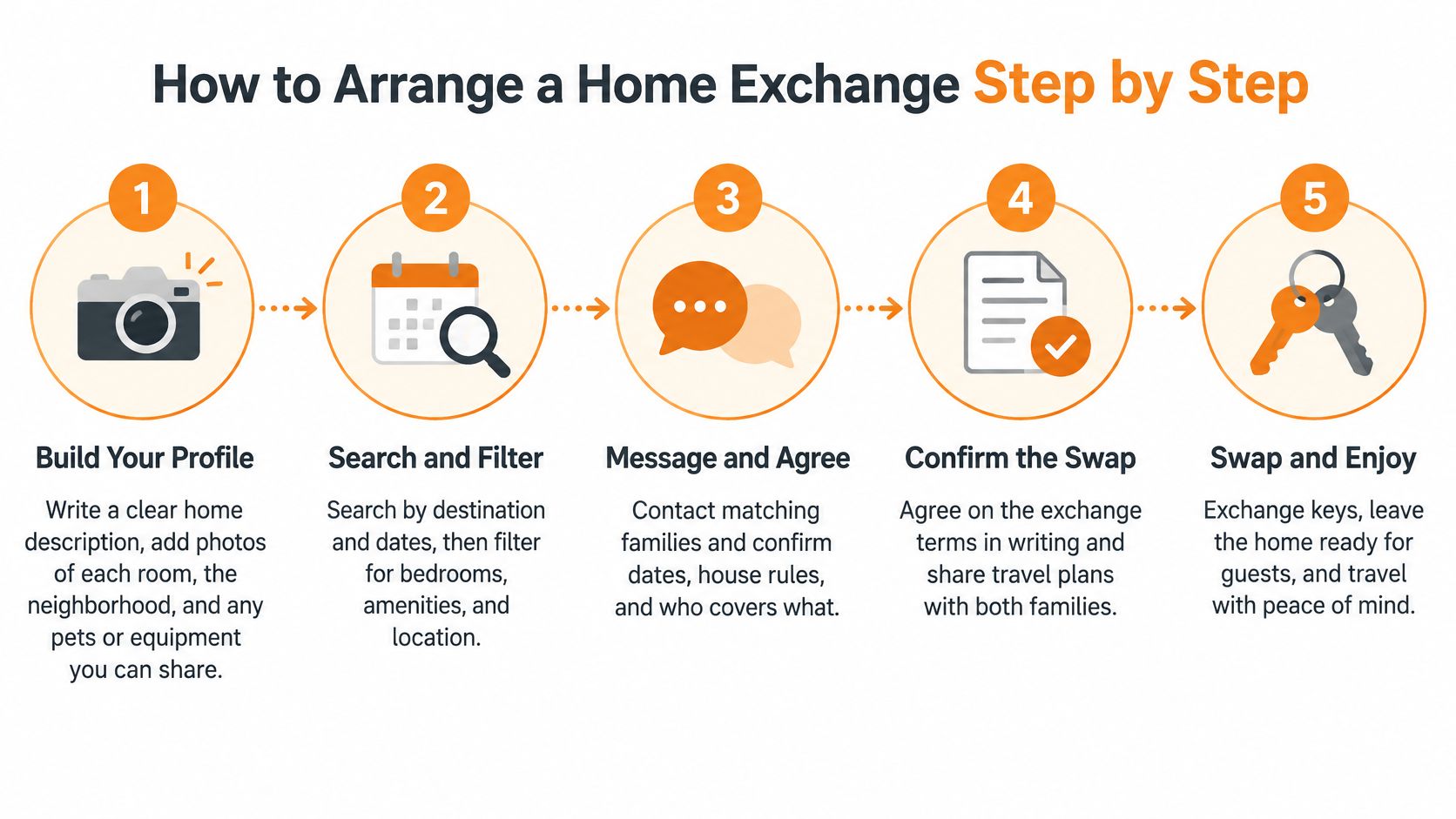
Matched dates are often the hard part. For popular dates and destinations, allow two to four months of lead time so you have room to search, ask questions, and agree on the details. A complete process also gives both households fewer chances to misunderstand what they've agreed to.
-
Build a clear profile. Describe the home accurately and add photos of each room, the neighborhood, and any pets or equipment you can share. Missing details can make a promising home harder to assess, or create surprises after confirmation.
-
Search by destination and dates. Filter for the number of bedrooms you need, pet rules, and transport links. If you can adjust your dates, say so; a little flexibility may help a match fit both calendars.
-
Send a personal message. Name your dates, explain why you chose their city, and describe what you can offer in return. Generic messages don't tell the other household why your proposal is a good fit.
-
Confirm the schedule in writing. Agree on arrival and departure dates, length of stay, and any overlap between trips. Don't assume a partner has understood a tentative message as a confirmed plan.
-
Write down the house rules. Cover utilities, cleaning, car use, emergency contacts, and what happens if something breaks. A short written agreement is easier to refer to than a friendly conversation you both remember differently.
-
Prepare your home before leaving. In the last few days, clear some closet space and a bathroom shelf, stock basics such as coffee and toilet paper, and leave a welcome guide with local shops. Guests need room for their belongings and practical information for settling in.
-
Arrange the handover. Exchange keys or a lockbox code, then walk through the home in person or by video. Confirm emergency contacts and how to reach each other if a lock or appliance causes trouble.
-
Leave the home as agreed. Follow the cleaning expectations, report any issue promptly, and write an honest review while the details are fresh. Clear feedback helps both households and future partners understand what went well.
The video below shows the sort of details to discuss and prepare before a swap.
Vetting Partners and Setting Pet and House Rules
Before confirming, check these basics:
- Profile or identity checks: See whether the platform offers verification and what it covers.
- Reviews: Look at how many there are and how recent they are, while remembering that reviews only show what past members chose to share.
- A video call: Ask to see the home and meet the person you'll be trusting with it.
- References: Request a reference from a previous exchange when the profile leaves unanswered questions.
- Damage responsibility: Agree who to contact and who pays if something is damaged.
Be wary of vague profiles, pressure to move off the platform, reluctance to show the home, or requests for money before you've agreed on dates and terms. These aren't proof of bad intentions, but they are reasons to slow down and ask for clarity.
Replace “pet-friendly” with details
A pet-friendly label doesn't tell you whether an animal can sleep in a bedroom, whether a garden is enclosed, or what to do if a pet gets sick. Research on pet-inclusive accommodation identifies six dimensions travelers evaluate: pet-related activities, facilities and services, room amenities, pet-friendly room features, house rules, and safety measures. Together, those dimensions explained 74.8% of variation in surveyed guests' preferences (research on pet-friendly lodging preferences). The practical lesson is that both households need specific answers, not just a label.
Before confirming, write down the pet's daily routine, feeding and medication schedule, and how separation anxiety appears. Add escape risks, household hazards such as toxic plants or cleaning products, whether outdoor space is secure, the nearest emergency veterinary clinic, and who pays for unexpected treatment. Include clear rules about furniture, bedrooms, walking, and any resident pets.
If the exchange involves significant pet or home-care responsibilities, put those terms in writing as carefully as the dates. A house-sitting agreement template can help you think through what both parties need to settle. If your partner can't answer care and safety questions in writing, don't confirm the exchange.
Pros, Cons and the Problems That Derail Swaps
Two households agree to swap a Paris flat for a Lisbon townhouse in August. On paper, both sides save money. In practice, one family arrives to find the other home still half-full of the owner's belongings, plus a cat nobody mentioned that needs medication twice a day. Swap failures usually look like this: small mismatches stacking up, not deliberate scams.
What you gain beyond the lodging savings covered earlier:
- A home that works like a home: a real kitchen, a washing machine, and separate rooms when children need naps.
- Built-in accountability: your partner sleeps in your bed while you sleep in theirs, so both households have a reason to leave things clean.
- A local starting point: hosts often leave notes on the good bakery, the right bus route, and the reliable plumber.
What you give up:
- Privacy: someone you barely know lives among your belongings. You can lock a cupboard or a room, but you cannot make a home as anonymous as a rental.
- The exit chore: before your own trip even starts, you are stripping beds, clearing the fridge, and emptying wardrobe space for a guest.
- Hotel-style backup: there is no front desk. If a pipe bursts or the heating fails, you solve it by phone with your partner rather than calling reception.
- A safety net if plans collapse: if your partner cancels three weeks out, you are hunting for accommodation in high season, and the savings vanish into a last-minute booking.
That last risk deserves a moment. A platform can help mediate a dispute, but a swap still rests on two private households keeping a promise to each other.
The honest version of the trade-off is this: you exchange the predictability of a paid booking for space, savings, and a reciprocal arrangement you have to manage yourself. Travelers who accept that bargain tend to love swapping. Travelers who want a holiday where nothing is their job rarely do.
Decide Whether a Home Exchange Fits Your Next Trip
Choose the accommodation model that matches your real situation, not an idealized version of a free holiday.
- Choose a home exchange if you have a home another traveler may want, can plan ahead, and feel comfortable letting guests stay in your space.
- Choose house sitting if you're happy to care for pets or a home in return for accommodation, or if you want someone to look after your own pets at home.
- Choose a short-term rental if your dates are fixed, you don't have a home to offer, or you want a booking that doesn't depend on another household's approval.
Before committing, write down the three parts of your trip cost: lodging, travel, and extras. Compare that total with a hotel or rental quote for the same dates. If the home exchange saves money but demands dates you can't meet, or pet care you can't responsibly provide, it may not be the right fit.
Then shortlist potential partners and send a written agreement covering dates, house rules, repairs, pet responsibilities, and emergency contacts. If you own pets but don't have a home to exchange, a house-sitting marketplace can help you look for sitters who'll stay in your home and care for your animals while you travel. That's a different arrangement from a home swap, so be clear about the care expected and how both sides will communicate.
The first useful step doesn't require a booking. Pull up your home profile, or write a care sheet for your pet, and describe it in three honest sentences. A good match starts with clear expectations, not a perfect-looking listing.
Global Pet Sitter connects pet owners with sitters for in-home care and helps sitters find stays with pets and homes to look after. If that kind of reciprocal care suits your travel plans, visit Global Pet Sitter to create a profile or explore available sits.
Please sign in to leave a comment
