You've found a house sitting opportunity in another country that looks almost too good to be true. The dates fit your travel plans, the pets look adorable, and the idea of exchanging care for a place to stay seems like the perfect way to extend your trip. Then the practical questions arrive: Will the owner trust a stranger from abroad? Can your reviews from another platform help? What happens if your visa expires before the next sit begins?
House sitting jobs worldwide can support a long-term travel lifestyle, but only when you treat the arrangement as a professional exchange rather than a free holiday. Strong profiles, careful screening, clear documentation, and reliable communication matter as much as your love of animals.
The New Reality of Global House Sitting
A few years ago, house sitting could feel like an informal favor between neighbors, friends, or friends of friends. Someone needed a person to feed the cat, water plants, collect mail, and make the property look occupied. Today, international house sitting is more structured. Homeowners compare profiles, examine references, ask detailed questions, and often speak with candidates before handing over keys.
That change benefits serious sitters. A homeowner isn't just offering you a spare room. They're trusting you with animals, household systems, personal belongings, and sometimes a property in a location where local help may be difficult to arrange. Your profile therefore functions less like a social introduction and more like a cross-border service résumé.

The commercial scale reflects that shift. The global house-sitting travel market was estimated at USD 2.1 billion in 2024 and is forecast to reach USD 4.05 billion by 2033, implying growth of about 7.2% CAGR from 2025 to 2033, according to market projections for the house-sitting travel sector. North America represented about 38% of the 2024 market, or roughly USD 798 million, which points to a mature concentration of demand alongside wider international expansion.
From casual favor to trusted responsibility
The professional approach starts with a change in mindset. Don't describe yourself only as a traveler looking for accommodation. Describe the care you provide, the routines you can manage, and the way you reduce uncertainty for the owner.
A convincing sitter can explain how they handle medication instructions, anxious pets, garden maintenance, emergency contacts, visitors, cleaning, and updates. They can also say what they can't do. If you work remotely and need dependable internet, ask about the connection before accepting. If you can't drive, don't apply for a rural property whose daily care depends on a vehicle.
Practical rule: The more specific the homeowner's expectations, the more specific your application should be.
Remote work has made longer stays more practical for some travelers, but it hasn't removed the responsibilities of being present. A house sitter can't treat a property as a hotel room while disappearing for several days. Owners increasingly want someone who can combine travel flexibility with dependable routines.
What homeowners are really buying
Homeowners are buying reassurance. They want to know that their dog won't miss a meal, that a leaking tap will be reported, and that the house will be treated respectfully. They also want a person who can communicate calmly when plans change.
That creates an opportunity for experienced sitters. Your value isn't limited to accommodation savings. It comes from making the owner's absence manageable. Each well-run sit can produce references, repeat invitations, and evidence that you can operate responsibly in unfamiliar countries.
The strongest global sitters therefore build a reputation around predictability. They arrive prepared, confirm instructions, send useful updates, document problems, and leave the property in the condition agreed. That standard separates a sustainable travel strategy from a sequence of improvised stays.
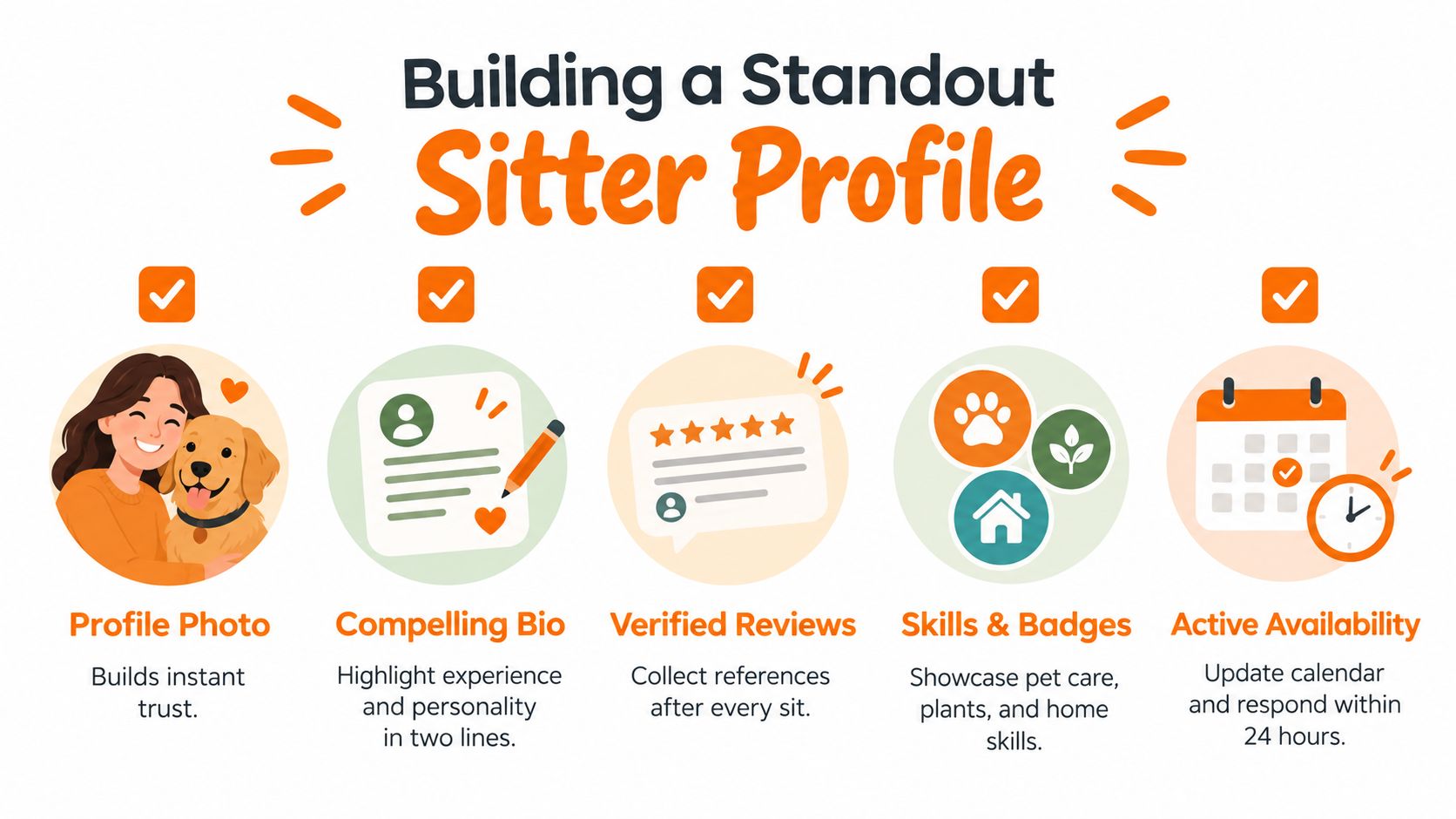
Building a Standout Sitter Profile
Your profile is the first screening stage, so it must answer the homeowner's main concern quickly: Can this person look after my pets and home without constant supervision?
Start with your opening photo. Use a recent, well-lit image where your face is visible, then add photographs that show you interacting naturally with animals. Avoid a gallery made entirely of scenery shots, party photos, or posed travel images. Homeowners aren't choosing a holiday companion. They're assessing your reliability and your relationship with animals.
Write for the specific decision
Your bio should combine personality with evidence. Explain where you live, how you travel, why you enjoy animal care, and what type of home environment suits you. Replace broad claims such as “I love pets” with details about the animals you've cared for, the routines you've followed, or the household tasks you're comfortable handling.
Mention relevant skills without exaggerating:
- Animal care: State whether you've handled dogs, cats, senior animals, nervous pets, medication routines, or multiple animals.
- Property care: Include gardening, pool maintenance, basic troubleshooting, plant care, or experience managing a larger home.
- Work habits: Explain your schedule if you work remotely, including whether you can follow morning and evening routines.
- Travel limits: Say which dates, regions, transport conditions, or pet requirements don't suit you.
- Communication style: Tell owners how often you'll provide updates and how you'll handle an urgent decision.
Clear limitations improve matching. A sitter who says they don't drive can avoid unsuitable rural assignments. A sitter who needs reliable internet can prevent a serious conflict before arrival.
For a more detailed framework on presenting experience and building online trust, use this expert guidance for profile credibility. You can also review practical advice on house and pet sitting jobs before rewriting your own profile.
Import credibility instead of starting from zero
The cold-start problem affects almost every new sitter account. You may have years of experience caring for animals, yet a new profile can make you look untested because the platform has no internal history.
External references can close that gap. Ask former homeowners, landlords, employers, neighbors, or clients to confirm the qualities that matter: punctuality, cleanliness, communication, animal care, and respect for property. If another marketplace allows you to display reviews or doesn't offer a direct transfer tool, keep permission-based screenshots and organize them with the original platform name, reviewer name, date, and context.
Don't edit a review to make it sound stronger. A screenshot should remain clear and credible. Add a short explanation beneath it, such as the type of animal cared for, the length of the assignment, and the duties involved. This turns an isolated compliment into useful evidence.
A large sitter platform study found that sitters with three or more references increased their chances of securing a sit by 20%, making reference depth a measurable conversion lever rather than merely a trust signal, as reported in guidance on house-sitting network safety and references.
A new account isn't the same as an inexperienced sitter. Give homeowners enough evidence to see the difference.
The profile should also include an active availability calendar. Update it whenever a sit is confirmed, respond promptly to suitable invitations, and avoid applying for dates you can't honor. A polished profile attracts attention, but accurate availability prevents wasted conversations and protects your reputation.
Here's a useful profile video to watch before you record or rewrite your own introduction:
Navigating Global Search Strategies
Searching for house sitting jobs worldwide works better when you build a route first and search listings second. Start with the places you genuinely want to visit, then identify the dates when you can stay, the transport you can manage, and the type of property that fits your routine.
Availability is highly international. Sits are reported in more than 130 countries, while one major platform analysis found that the USA and UK together account for more than 10,000 listings and represent the majority of that platform's global availability, according to country-level house-sitting availability analysis. The same analysis identified about 6,330 listings in the USA and 3,786 in the UK, showing how strongly supply can cluster in English-speaking markets even when the wider network spans many continents.
Search corridors, not isolated destinations
A route-based search gives you more options. Instead of searching only for “house sitting in Lisbon,” consider a broader European journey and monitor nearby regions with practical rail, bus, or air connections. The same principle applies in North America, where a sit in one city may work well only if you can reach the next destination without an expensive or complicated transfer.
Use filters for:
- Dates: Search flexible windows when possible, then compare overlapping assignments.
- Pet requirements: Separate cat care, dog walking, medication, and multi-animal homes.
- Location type: Decide whether you can manage rural properties, city apartments, or homes without public transport.
- Duration: Longer sits may reduce relocation stress, while shorter sits can help you test a new region.
- Internet and workspace: Confirm the basics before treating a property as a remote-work base.
Don't assume that a beautiful listing is a good strategic fit. A remote home may look appealing but create problems if the owner expects daily driving, the nearest shop is far away, or the pets can't be left alone for your work schedule.
Apply where your profile has a natural advantage
Market concentration changes the way you should write applications. In an English-speaking market, detailed communication and imported references may help you compete immediately. In another country, language ability, local familiarity, or experience with regional property conditions may matter more.
Read every listing for signals about the owner's real priority. Some owners care most about long walks. Others need a sitter who can administer medication, maintain a garden, or stay home for much of the day. Lead with the experience that matches that priority instead of sending the same generic paragraph everywhere.
A strong application usually does four things:
- Names the pets and dates accurately.
- Connects your experience to the listed routine.
- Raises one or two thoughtful questions.
- Suggests a video call without pressuring the owner.
Set alerts for your preferred regions and check them consistently. Early awareness gives you time to assess transport, visa requirements, and the property's expectations instead of applying impulsively. Speed matters, but relevance beats haste. A fast application that ignores the owner's instructions can damage your credibility more than a later, carefully crafted one can help it.
Vetting Homeowners and Securing the Sit
A listing can be attractive and still be unsuitable. Treat the first conversation as a mutual interview, not a formality. The homeowner is assessing you, but you're also checking whether the property, care routine, and communication style fit your life.
Request a live video call before confirming. Independent house-sitting guidance recommends video conversations, specific applications, and careful confirmation that the listing's photos, dates, and household expectations align. A call also lets you see whether the owner answers directly or avoids practical questions.
Ask questions that expose the daily reality
Begin with the pets. Ask about feeding times, walks, medication, behavior around strangers, separation anxiety, escape risks, veterinary contacts, and emergency decisions. “Is the dog friendly?” isn't enough. You need to know whether the dog can be left alone while you shop, work, or travel locally.
Then move through the property:
- Arrival and departure: Confirm exact handover times, airport or station access, and whether an early arrival is required.
- House systems: Ask about heating, appliances, security, internet, water, and any equipment you're expected to use.
- Responsibilities: Clarify plants, bins, deliveries, pool care, gardening, cleaning, and maintenance calls.
- Absences: Agree on whether you can take day trips or overnight excursions.
- Visitors: Confirm whether guests are allowed, including friends who may only stop by briefly.
- Costs: Establish who handles pet emergencies, transport to a veterinarian, utilities, and unexpected repairs.
Put the agreement in writing. A shared document or platform message should capture dates, duties, contact details, house rules, and emergency instructions. Written expectations protect both sides when memories differ after a long video call.
Notice the red flags
Evasive communication is more concerning than an untidy photograph. Be cautious if the owner won't show the home on video, gives vague answers about pet health, uses photos that don't match the current property, or pressures you to confirm before you understand the assignment. Those signals don't prove bad intent, but they justify slowing down or declining.
The most common operational problems often come from incomplete expectation-setting. Survey guidance found that respondents admitted to eating homeowners' food without asking, inviting guests without permission, and holding parties at the property, which shows why house rules need to be explicit rather than assumed. The same guidance identifies food, guests, and property use as areas where otherwise capable sitters can break trust.
If a rule would matter after arrival, discuss it before booking.
Ask for a local emergency contact and veterinary details. On arrival, photograph existing damage if the owner agrees, check that essential systems work, and send a concise confirmation of the handover notes. During the sit, report problems early. Owners usually handle an honest update far better than a surprise discovered when they return.
Managing Visas, Insurance, and Logistics
International house sitting combines animal care with the administrative rules of travel. A homeowner may welcome you for an extended stay, but that invitation doesn't automatically grant permission to work, remain in the country, or cross a border without additional documentation.
Check the immigration rules for every destination before you accept a sequence of sits. Confirm the permitted stay, whether the arrangement is considered volunteering or work, whether compensation is involved, and whether your nationality changes the answer. Treat official government guidance as the authority, and leave buffer time between assignments so a delayed flight or border issue doesn't put you in breach of the rules.
A large house-sitting statistics dataset reported that 46% of respondents already do international sits, while 54% planned to start sitting internationally, and Europe was the favorite geography for 41.4% of respondents, according to international house-sitting statistics and travel preferences. Those figures show the appeal of cross-border sitting, but interest doesn't remove the need for careful planning.
Build an administrative file
Keep a digital and offline folder containing your passport details, visa records, insurance policy, homeowner agreement, emergency contacts, transport bookings, and copies of relevant pet instructions. A phone can fail, a battery can run out, and rural properties may have unreliable connectivity.
Insurance deserves particular attention. Standard travel cover may not address every activity associated with house and pet care, especially if you handle animals, use a vehicle, or take responsibility for property. Ask an insurer what applies to personal liability, medical treatment, trip interruption, luggage, and accidental damage. Don't assume that the platform, homeowner, or home insurance automatically covers you.
Taxes also require individual advice. A rent-free stay, an exchange of services, remote employment, and paid pet care can have different consequences depending on your residence, citizenship, income source, and time spent in each jurisdiction. Keep records of dates, expenses, payments, and agreements, then speak with a qualified tax professional before building a permanent travel pattern around house sitting.
Practical logistics matter just as much. Confirm how you'll collect keys, whether a local SIM is needed, how you'll reach the property from the airport, and what happens if your arrival is delayed. Save a backup contact outside the home, identify the nearest veterinarian, and keep enough funds for transport or temporary accommodation if a sit changes unexpectedly.
For a more focused preparation guide, review this resource on international house and pet sitting. Good planning doesn't make travel rigid. It gives you the flexibility to handle the problems that arise without putting the pets, homeowner, or your legal status at risk.
Scaling into a Long-Term Travel Lifestyle
Occasional sitting becomes sustainable when you stop treating each assignment as a separate lucky find. Build a sequence around regions, seasons, transport links, visa rules, and the type of care you can consistently deliver. The aim isn't to fill every night with a sit. It's to create a reliable rhythm with enough space for transitions, rest, and unexpected changes.
A long-term sitter's reputation compounds through ordinary actions. You answer messages clearly, arrive when promised, follow the care plan, send useful updates, and leave the home in good condition. Owners remember the sitter who made their departure easy, and repeat invitations often come from relationships rather than public applications.
Choose reputation over constant acquisition
Community-driven platforms can be useful because they place more emphasis on visible feedback, member participation, and direct communication than on purely transactional booking. That model suits sitters who want to preserve experience earned elsewhere, discuss standards openly, and help shape how the marketplace handles trust.
Imported reviews are especially valuable during the transition from casual sitting to regular international work. Keep evidence organized, request a fresh reference after each successful assignment, and ask owners to mention the specific duties they observed. A reference about caring for a senior dog says more than a generic statement that you're “great with pets.”
Your profile should evolve as your route changes. Add experience with new animal types, explain the countries or regions you understand, update availability immediately, and remove services you no longer provide. A trustworthy profile is accurate, not overloaded.
Create a repeatable operating system
Use a simple travel dashboard with:
- A sit pipeline: Track applications, video calls, confirmed dates, and backup options.
- A document register: Record visa dates, passport validity, insurance details, and homeowner agreements.
- A care template: Keep standard questions for feeding, medication, emergencies, visitors, and transport.
- A transition buffer: Leave time between sits for delays, cleaning, and handover.
- A relationship log: Note owner preferences, pet routines, and whether a future invitation is appropriate.
The wider pet-sitting economy is expanding from $3.2 billion in 2025 to $3.53 billion in 2026, with a projection of $5.37 billion by 2030 at an 11.0% CAGR, according to global pet-sitting market data. For sitters, that growth signals opportunity, but it also points toward higher expectations around credentials, communication, specialized care, and technology.
Don't build your lifestyle around accommodation alone. Build it around service quality and community trust. A sitter who contributes feedback, respects platform rules, helps clarify standards, and supports responsible owners has more staying power than someone who merely applies to the most attractive listing.
If remote work is part of your plan, understand the wider responsibilities of being a digital nomad. House sitting can reduce accommodation pressure, but it doesn't replace income planning, legal research, insurance, or a realistic approach to moving between countries.
The practical roadmap is straightforward. Establish a credible profile, import legitimate references, choose a focused route, screen every assignment, document agreements, protect your travel status, and ask for feedback after each sit. Over time, the result is more than a collection of stays. It's a portable professional reputation built on trust between people, pets, and homes.
Global Pet Sitter connects pet owners with trusted sitters worldwide, allowing owners to post care details and dates while sitters build profiles, import existing review evidence, and find suitable house sitting opportunities. Create your profile, explore available matches, and visit Global Pet Sitter to start building a more reliable international travel routine.
Please sign in to leave a comment
