Founded in 1994, Pet Sitters International now serves nearly 4,000 member pet-sitting and dog-walking businesses across the U.S., Canada, and more than 15 other countries. For a Canadian operator, the US$135 annual fee plus the US$5 first-year application fee can be worthwhile, but only when the insurance, professional credibility, and education support match the business's actual needs.
Can PSI membership pay for itself in Canada, or does it just add another fixed cost to a business already managing insurance, transportation, software, taxes, and local compliance? That question deserves more attention than broad claims about professionalism.
Canadian pet care is not one uniform market. A solo sitter in a small community, a side-hustler in a major city, and a growing dog-walking company have different booking volumes, operating risks, and reasons to pursue certification. PSI can be useful, but it isn't automatically the right investment for every operator.
This guide looks at what Pet Sitters International Canada offers, how its Canadian presence developed, and how to judge the return without treating membership as a badge that guarantees clients. It also compares PSI with a more flexible community marketplace and gives pet owners a practical way to vet listed sitters.
Understanding Pet Sitters International in Canada
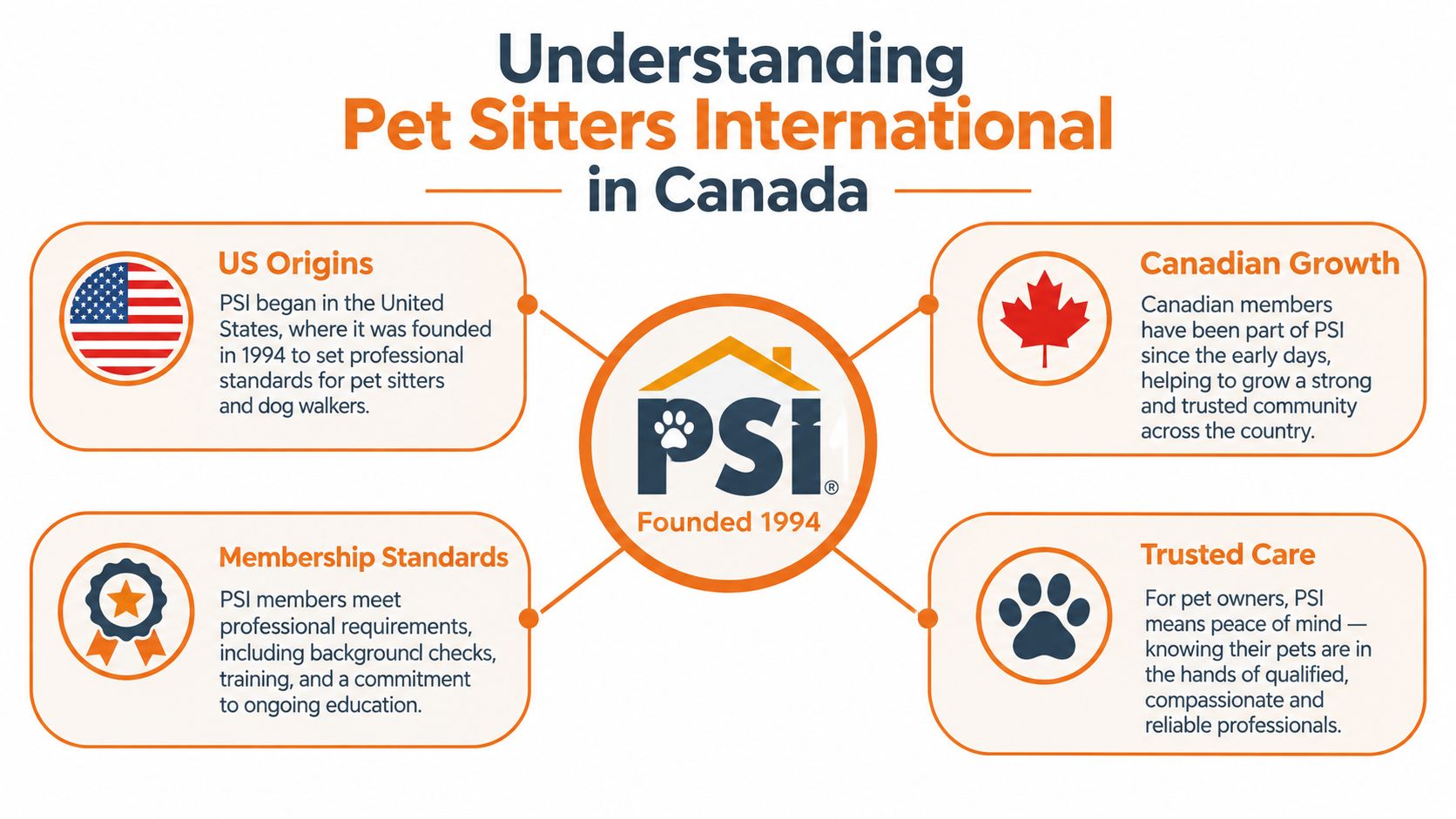
The assumption that Pet Sitters International is only a U.S. organization falls apart as soon as you look at Canadian membership. PSI was founded on March 17, 1994, by Patti J. Moran, and describes itself as the world's leading educational association for professional pet sitters and dog walkers. Its own overview of PSI's history and membership says the organization has served the profession for more than three decades and works with nearly 4,000 member businesses across the U.S., Canada, and more than 15 other countries.
For a Canadian sitter, that distinction matters. PSI isn't a directory where anyone creates a profile. Its model is built around professional education, business resources, certification, and access to pet-sitter insurance and bonding options. That makes it more relevant to operators who want to build a formal service business than to someone occasionally helping a neighbour.
What PSI changes for Canadian professionals
A PSI membership doesn't replace a business licence, contract, insurance review, or local research. It can, however, give a sitter a structured starting point for creating those systems. That includes thinking through client intake, emergency contacts, keys, medication instructions, cancellation terms, and the difference between pet sitting in a client's home and boarding animals at the sitter's property.
The practical value is strongest when the sitter uses the resources. A membership that sits unused won't improve service quality or recover its cost. A membership integrated into onboarding, insurance planning, continuing education, and client communication has a better chance of supporting a professional operating model.
Pet owners should also understand what PSI membership does and doesn't mean. It can signal that a provider takes the trade seriously, but it isn't a substitute for an interview, references, clear policies, and confirmation that the sitter can handle a particular pet. A useful companion resource is this pet sitter guide for evaluating care arrangements, especially for owners comparing independent professionals with online platforms.
The central question is therefore practical, not symbolic: does PSI reduce risk, improve trust, or strengthen operations enough to justify its fixed and optional costs in your market?
The History of PSI's Canadian Presence
PSI's Canadian story developed gradually rather than appearing as a recent expansion. A 2015 Canadian news report identified more than 260 Canadian business owners as active PSI members at that time, evidence that Canadian participation was already established well before the current wave of online pet-care marketplaces. The report is available in CTV News' coverage of online services connecting pet owners with sitters.
That milestone is useful because it puts Canadian membership in context. Canada wasn't merely an occasional market served from the United States. Canadian business owners were participating in the association and using its professional network while the industry was still developing its modern online presence.
A network that expanded beyond its original base
PSI's 25th-anniversary materials in 2019 said the association represented nearly 6,000 member businesses across the U.S., Canada, and more than 15 other countries. That figure describes the organization at a different point in its history than the current membership description, so the two figures shouldn't be treated as a direct like-for-like growth calculation. They do show that PSI has maintained an international footprint rather than remaining a strictly domestic association.
The timeline also explains why Canadian sitters may encounter PSI in several different contexts. Some use it for professional education. Others care most about insurance access, certification, business templates, or being associated with an established industry organization. Those needs overlap, but they aren't identical.
In 2026, founder Patti J. Moran transitioned ownership of PSI to Adam and Rachel Foster. That governance change marked a new chapter after more than three decades under the organization's original founder. For Canadian members, the practical issue isn't the leadership announcement itself. It's whether the next phase continues to provide useful support for businesses operating under Canadian market conditions.
Why the history matters to a buyer
Longevity can help an association build recognition and resources, but age alone doesn't prove current value. A sitter still needs to check whether the available insurance arrangement suits the business, whether the certification fits the services offered, and whether the directory or education resources produce meaningful business benefits.
The history does establish something more modest and more defensible: Canadian participation has been part of PSI's development for many years. That gives the organization credibility as a North American professional network, while leaving the return-on-investment decision to each operator.
How to Become a PSI Member in Canada
Joining PSI is straightforward, but Canadian sitters should treat the application as the beginning of a business review rather than a marketing purchase. Before applying, write down the services you provide, the animals you handle, your service area, and the risks that could arise during visits, walks, key exchanges, or medication routines.
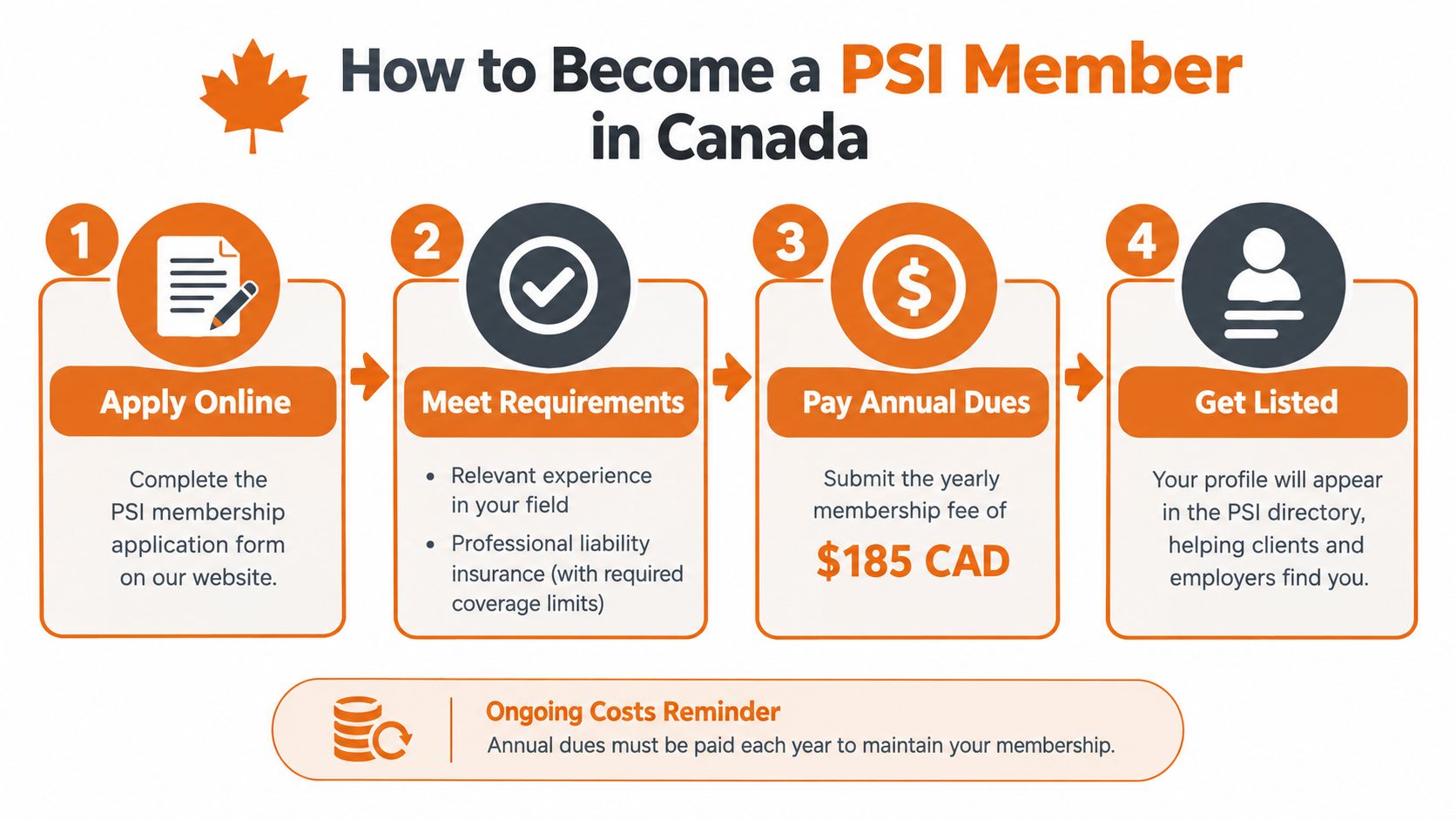
Canadian membership costs US$135 per year, with a US$5 first-year application fee, according to PSI's Canadian membership information. Certification carries an additional fee, so it belongs in a separate part of the budget rather than being assumed to be included in annual dues.
Four practical steps
-
Review the membership offer. Start with the Canadian terms, included resources, directory expectations, renewal conditions, and any optional programs. Don't compare the annual dues with revenue before identifying the complete cost of the package you intend to use.
-
Prepare accurate business information. Use a consistent business name, service description, contact profile, and operating location. If your service includes medication, senior pets, multiple dogs, or complex home access, describe those capabilities clearly. Overstating experience creates more risk than declining a booking.
-
Separate membership from protection. PSI says Canadian members can access group-rate pet-sitter insurance and bonding through Jones DesLauriers. Ask what the policy covers, what exclusions apply, and whether your exact activities are included. Membership isn't the same thing as having a policy in force, and a policy isn't a replacement for a client contract.
-
Decide whether to pursue CPPS certification. The CPPS-Certified Professional Pet Sitter designation can support a professional positioning strategy, but its value depends on whether your clients recognize and care about the credential. Treat the additional fee and study time as an investment that needs a business purpose.
Put the membership to work
Once approved, update your client-facing materials without making claims you can't support. Explain your qualifications, insurance status, service boundaries, emergency process, and terms in plain language. If you're building the business from scratch, a practical pet-sitting business planning guide can help you organize services, pricing, policies, and marketing around the membership instead of treating PSI as the plan itself.
The strongest use of membership is operational. Create a repeatable intake form, use written agreements, document pet routines, maintain emergency contacts, and schedule continuing education. Those habits can improve a business whether or not a prospect has heard of PSI.
Is PSI Membership Worth It for Canadian Pet Sitters
The answer depends on the business model. PSI's reported average gross revenue for Canadian pet sitters was CAD 166,118 in 2025, compared with CAD 100,764 in 2023, according to PSI's Canadian and international membership information. Those figures suggest substantial expansion in the professional segment, but an average isn't a forecast for a new sitter and it doesn't represent profit.
Gross revenue also excludes the costs that determine whether a sitter is earning enough. Travel, fuel, insurance, software, supplies, taxes, subcontractors, unpaid consultations, cancellations, and administrative time can all reduce the amount available to cover membership and certification.
Use the revenue data carefully
| Year | Average CAD revenue | PSI annual fee |
|---|---|---|
| 2023 | CAD 100,764 | US$135 |
| 2025 | CAD 166,118 | US$135 |
The annual fee remains a fixed US$135 in this comparison, while the revenue figures are gross averages and are reported in Canadian dollars. The fee should not be presented as a precise percentage of revenue because the currencies differ and the revenue data doesn't describe each sitter's expenses, booking mix, or profit.
A better calculation is contribution-based:
- Start with net contribution per booking. Use the amount left after direct booking costs, not the advertised price.
- Add every intended PSI cost. Include annual dues, the application fee in the first year, certification if selected, and any insurance or bonding premium.
- Compare like with like. A sitter offering occasional walks shouldn't use the same assumptions as a full-time provider handling overnights and complex care.
- Set a review point. Decide in advance what evidence would justify renewal, such as qualified leads, better insurance terms, completed education, or improved client confidence.
Who gets the clearest return
A full-time operator with established demand may value PSI's insurance access, certification, and business resources more than a sitter testing the market. The membership can also make more sense for someone moving from informal arrangements toward written contracts, formal policies, and a recognizable professional identity.
For a side-hustler, the calculation is less forgiving. If bookings are irregular, a fixed annual fee may take longer to recover, especially after adding certification and insurance. A new sitter should first confirm that the local demand, schedule, and service area can support a professional operating model.
Provincial and municipal requirements create another variable. Rules may differ depending on whether you visit clients' homes, walk dogs, board animals, employ other sitters, or operate from your own property. PSI can support professional preparation, but it can't determine every local obligation. Check the relevant provincial, municipal, and insurance requirements before assuming membership resolves compliance.
Practical rule: Join because a specific PSI benefit solves a current business problem. Don't join solely because a directory listing feels reassuring.
PSI vs Global Pet Sitter Which Platform Suits You
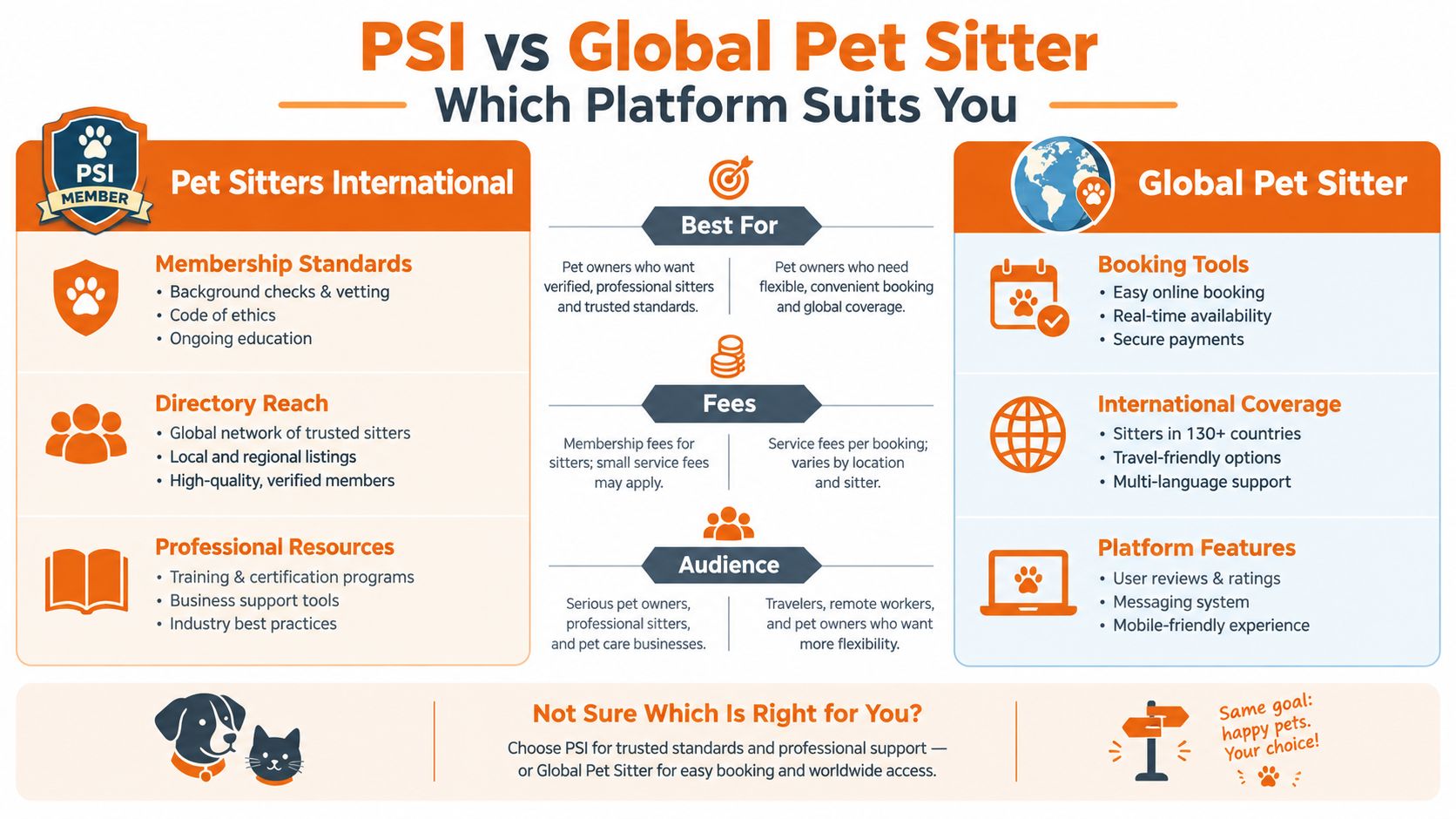
PSI and a community-driven marketplace serve different jobs. PSI is an association-led professional framework. Global Pet Sitter is designed around matching pet owners and sitters, with profiles, messaging, reviews, and sits that can work for local care or travel.
That difference matters because a Canadian professional may need credibility and risk-management resources, while a traveller may care more about finding a compatible host and preserving a reputation built elsewhere. Neither use case makes one platform universally better.
Compare the operating models
| Consideration | Pet Sitters International | Global Pet Sitter |
|---|---|---|
| Primary role | Professional association and education network | Community-driven house and pet-sitting marketplace |
| Best fit | Sitters building a formal service business | Owners and sitters seeking flexible matches |
| Main value | Professional resources, certification pathway, and access to group-rate insurance and bonding | Profiles, messaging, reviewed reputations, and international sit opportunities |
| Reputation signal | Association membership and optional CPPS designation | Reviews and community participation |
| Pricing approach | Fixed membership dues, with additional costs for selected benefits | Transparent marketplace approach, with early-adopter access described by the platform |
| Strongest use case | Risk management and professional development | Local or international matching, including travel-based sits |
PSI is the stronger fit when the business needs a formal framework. It can be particularly relevant to a sitter who wants to explain professional standards to clients, investigate specialized insurance access, or pursue CPPS certification.
Global Pet Sitter may suit an experienced sitter who already has reviews, a digital nomad looking for accommodation through sits, or an owner who wants to compare candidates through a community marketplace. The platform also allows experienced sitters to import five-star reviews from other platforms through screenshots, according to the publisher's description. That can help preserve reputation during a move, although owners should still verify references and discuss care expectations directly.
The choice doesn't have to be ideological. A professional sitter may use an association for education and protection while using a marketplace for discovery. A pet owner may find a candidate through a marketplace and still ask for insurance, references, contracts, and emergency procedures before agreeing to care.
Watch the video below for a visual introduction to the comparison.
Finding and Vetting PSI-Listed Pet Sitters in Canada
A PSI listing is a useful starting point, not a final hiring decision. The profile can help you identify a professional who takes business practices seriously, but you still need to test the match against your pet, home, schedule, and location.

Check the details behind the profile
Start with the basics, then move into operational questions. A polished profile won't tell you how someone handles a dog that refuses medication, a cat that hides, a winter travel delay, or an emergency call from a veterinarian.
- Confirm services: Ask whether the sitter provides drop-ins, walks, overnight care, medication support, or another service your pet needs.
- Ask about insurance: Request confirmation of current pet-sitter liability coverage and ask what the policy includes. Don't assume membership alone proves coverage.
- Verify credentials: If the sitter mentions CPPS certification, ask for the credential details and whether it applies to the person who will care for your pet.
- Request references: Contact recent clients when possible, especially clients with similar animals or care requirements.
- Discuss backup plans: Find out who responds if the sitter becomes ill, their vehicle fails, or severe weather prevents a visit.
- Review the agreement: Confirm rates, cancellations, access to the home, emergency veterinary authorization, updates, and responsibility for supplies.
Interview for judgement, not performance
Ask the sitter to describe how they would respond to a realistic problem. Good answers should address communication, safety, escalation, and documentation rather than relying on confidence alone. A sitter who asks detailed questions about appetite, behaviour, medication, triggers, and household access is showing useful judgement.
Local compliance deserves its own conversation. Requirements may vary across Canada and can depend on the services offered and where the business operates. Ask the sitter what local licences, permits, vaccination expectations, or insurance conditions apply to their work, then verify important points with the relevant authority or insurer.
For home-based care, agree on practical etiquette before the first visit. Define which rooms are accessible, how keys are stored, whether photos are welcome, how often updates arrive, and what happens if the pet refuses food. This guide to trusted pet house sitters reinforces a principle that applies to paid care as well: clear expectations prevent avoidable disputes.
A short meet-and-greet remains valuable. Watch how the sitter approaches the animal, listens to instructions, and handles uncertainty. Trust should come from evidence and communication, not from a membership label alone.
Making the Right Choice for Your Pet-Sitting Needs
The right decision starts with identifying whose problem you're solving. A pet owner needs dependable care and a safe handover. A professional sitter needs a sustainable business model, suitable protection, and a way to earn trust without carrying unnecessary costs.
For sitters, use this decision filter:
- Define the service. Separate occasional help from a business offering recurring visits, walks, overnights, or specialized care.
- Map the exposure. Consider keys, homes, animals, medication, transportation, staff, and the consequences of a mistake.
- Price the complete option. Include membership, application costs, certification, insurance, bonding, local compliance, and the time required to use the resources.
- Choose a measurable reason to join. That reason might be access to a suitable insurance arrangement, structured education, a certification pathway, or stronger professional positioning.
- Review the outcome. Look for practical evidence, such as better client conversations, clearer policies, reduced uncertainty, or business opportunities that wouldn't otherwise be available.
For owners, compare sitters on more than platform presence. Confirm insurance, references, contracts, emergency procedures, availability, and the sitter's ability to meet your pet's routine. A PSI member may be the right choice when formal professional preparation matters most. Another sitter may be better if they offer stronger local experience, a more suitable schedule, or a clearer care plan.
A hybrid approach can work well. A sitter can pursue professional education and appropriate insurance while using a marketplace to reach owners. An owner can search through a directory or community platform, then apply the same careful interview process to every candidate.
PSI makes the most sense when it supports a deliberate business plan. It makes less sense when the fee is paid without enough demand, without checking policy details, or without using the education and systems that create the potential return. Canadian sitters should judge the investment by the problems it solves, not by the prestige attached to the name.
Global Pet Sitter offers a community-driven marketplace where owners can post sits, review sitter profiles, message candidates, and arrange in-home care, while experienced sitters can carry over reputation from other platforms. Visit Global Pet Sitter to explore a flexible way to connect with trusted sitters and pet owners in Canada and beyond.
Please sign in to leave a comment
