You've packed the food, labeled the medication, and checked your flight twice. Then you look at your dog, cat, or both and wonder whether a neighbor can really manage the routine, the keys, the traffic, and an unexpected emergency while you're away. Searching for pet sitting in Los Angeles isn't only about finding someone available. It's about choosing a care arrangement that works with LA's geography, local rules, your pet's temperament, and the things that can go wrong after you leave.
The right plan usually keeps the animal at home, gives the sitter clear instructions, and removes guesswork before the first visit. Here's how to make that plan practical.
Understanding What In-Home Pet Care Means in LA
You're halfway through packing when your cat hides under the bed. Your dog watches every suitcase move across the room. A boarding facility might be perfectly suitable for some animals, but for others, the journey, unfamiliar smells, and changed routine create more stress than the owner expected.
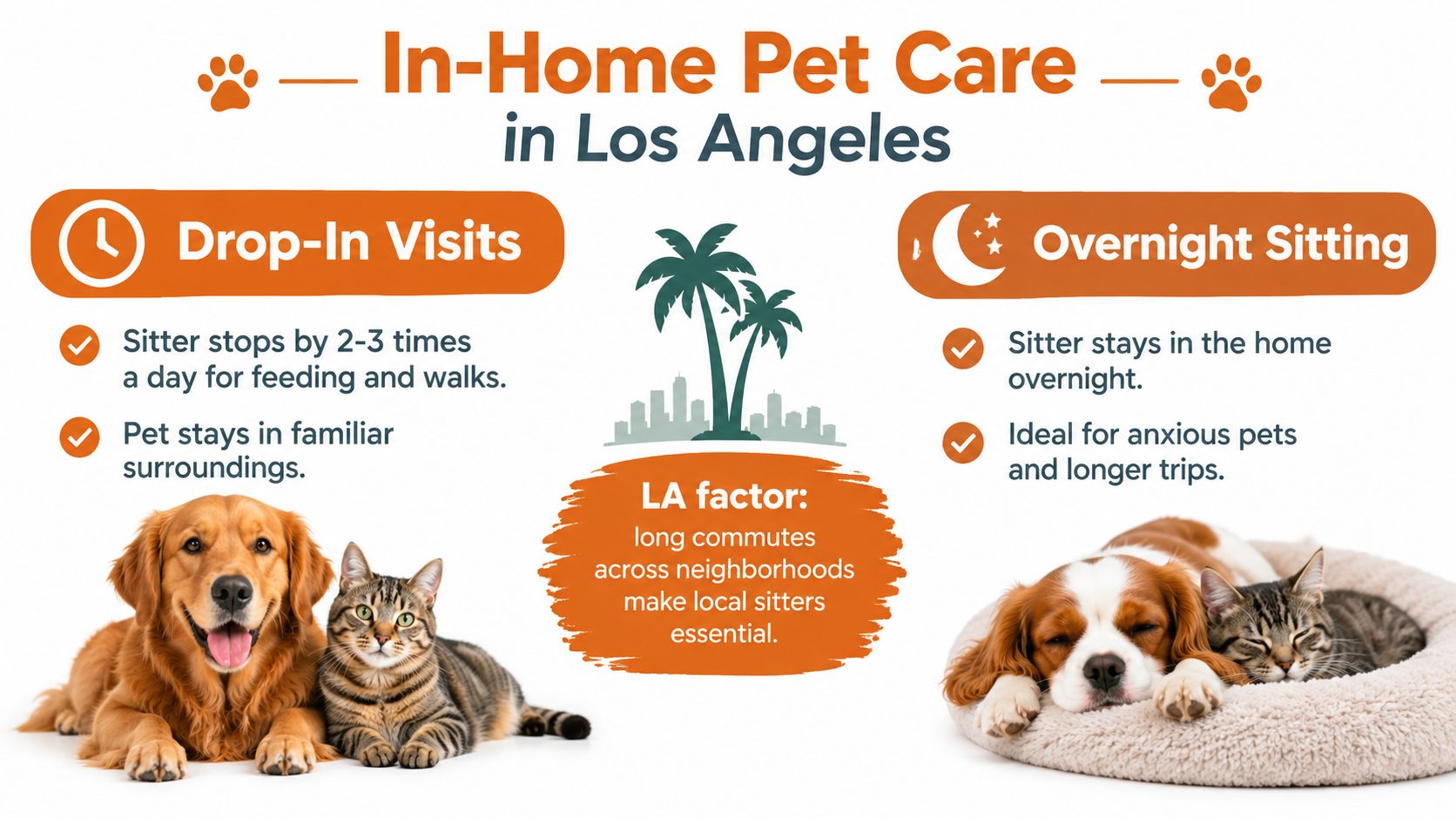
In-home pet care keeps the animal in familiar surroundings while a sitter handles the daily routine. In Los Angeles, that arrangement has an added practical advantage. A sitter who lives near your home can care for your pet without asking you to transport the animal across a sprawling urban area or depend on a long cross-town drive.
Choose the service around the animal
Drop-in visits suit cats, independent dogs, and pets whose normal schedule can continue with check-ins. The sitter may provide food and water, clean litter, administer medication, open a patio door, take a dog outside, and send an update. Ask exactly what each visit includes rather than assuming that “drop-in” means a particular amount of time or activity.
Overnight sitting means the sitter stays in your home. It can make sense for a puppy, a senior pet, a dog that becomes distressed when left alone, or an animal that needs close observation. It also leaves the home occupied, which may simplify care for pets with complicated routines.
Specialized care requires a more detailed conversation. A senior dog may need slow walks and help with stairs. An anxious animal may need a quiet introduction, familiar food, and a sitter who won't force interaction. A pet taking medication needs someone who can demonstrate the process before the booking begins, not someone who merely says they're comfortable with it.
Practical rule: Match the sitter to the hardest part of the routine, not the easiest part. Feeding a healthy adult cat is simple. Feeding that cat while managing medication, hiding behavior, and a locked apartment building is the real assignment.
Test the arrangement before travel
During the meet-and-greet, show the sitter where food, cleaning supplies, carriers, leashes, and medication are kept. Walk through the door, gate, elevator, parking, and alarm process. In an LA apartment or condo, access instructions can matter as much as pet instructions, so write down every code, key location, and building restriction.
A good sitter should ask questions about appetite, bathroom habits, escape behavior, interactions with other animals, and what counts as unusual behavior. You should also ask how they'll communicate, what happens if they're delayed, and who can step in if they become unavailable.
Keep the service local where possible. A sitter who understands your neighborhood can plan around the home's access arrangements and avoid turning every visit into an uncertain journey. The familiar home then becomes an asset rather than a complication.
Why LA Pet Owners Prefer Home-Based Sitting
Los Angeles has a substantial pet-care customer base because companion animals are widespread across the county. A Los Angeles County Department of Public Health report estimated approximately 1 million owned dogs and 1.5 million owned cats in the county in 2009. The report also estimated 1.5 million to 4 million feral or stray cats, and found that 39% of surveyed households, approximately 1.24 million households, reported having a pet.
A later Los Angeles County document described ownership as roughly one in four people owning a dog or cat, reinforcing the scale of the possible customer base for in-home care. These figures are historical, so they shouldn't be treated as a current census. They still help explain why local, recurring services such as walks, feeding, medication support, overnight supervision, and holiday care are established needs rather than unusual requests.
The local market in context
| Metric | Statistic | Source |
|---|---|---|
| Owned dogs in Los Angeles County in 2009 | Approximately 1 million | Los Angeles County Department of Public Health report |
| Owned cats in Los Angeles County in 2009 | Approximately 1.5 million | Same report |
| Pet-owning surveyed households | 39%, approximately 1.24 million households | Same report |
| Feral or stray cats in the county | Approximately 1.5 million to 4 million | Same report |
| U.S. pet-industry spending in 2024 | $158 billion | American Pet Products Association industry data |
| U.S. households owning at least one pet in the latest APPA survey data | 95 million | Same APPA data |
| U.S. pet-sitting and boarding spending in 2021 | Approximately $9.5 billion | Industry estimate reported in the provided market data |
| Registered pet-sitter home visits in 2021 | More than 12 million | Industry estimate reported in the provided market data |
The national figures show that pet sitting belongs to a wider consumer-services economy. The APPA's “Other Services” category includes boarding, grooming, insurance, training, pet sitting, pet walking, and services outside veterinary care. That matters because owners aren't choosing between “professional care” and “no market.” They're choosing among several ways to support an established household responsibility.
Why the home matters
A large animal population doesn't automatically make home visits the right answer for every pet. It does make neighborhood-based care practical. Owners can avoid moving an animal through traffic, and sitters can build a route around nearby homes rather than treating Los Angeles as one easy-to-cross service area.
The county's shelter history also gives the issue a safety dimension. In 2011, approximately 84% of cats and 75% of dogs entering Los Angeles shelters were reported as not spayed or neutered, while nearly 84% of shelter cats and 60% of shelter dogs were classified as strays, according to the same county report. Those figures don't describe every household or current shelter condition, but they underline why reliable, responsible care and identification procedures matter.
For an owner, the decision is straightforward. If a pet eats, sleeps, and settles best at home, a sitter can preserve the environment that already works. The challenge is making the arrangement specific enough to handle the city, the animal, and an unexpected change.
Navigating LA Regulations and the Leash Rule
The most important dog-walking rule is simple. On public property or common areas, dogs must be restrained by a substantial leash no longer than six feet and controlled by a capable person. Dogs may not run at large, and county guidance also prohibits animal defecation on public property or property other than the owner's. Review the Los Angeles County animal regulations before setting a walking routine, especially if the home sits near a city boundary.
That rule affects the sitter's intake process, not just the walk itself. A professional should know the dog's strength, weight, reactivity, escape history, equipment preferences, and the handler's own limitations.
Build a compliant walking routine
Before the first outing, agree on the following:
- Equipment: Confirm the collar or harness fits securely, and identify the leash the sitter must use. A backup slip lead can help during an escape-risk situation.
- Control: Use one-dog-at-a-time walks when a dog shows leash aggression, poor recall, or unpredictable reactions to people and animals.
- Identification: Record the pet's identification and microchip details, and make sure the sitter knows where the information is stored.
- Route selection: Choose routes that reduce exposure to crowded corridors and avoid places where the dog's behavior is difficult to control.
- Waste management: The sitter should carry bags and remove waste promptly.
- Handoff: The leash should be attached before the door opens, the collar or harness should be checked, and the return should be confirmed.
The last step deserves more attention than it usually gets. Many preventable incidents happen during transitions, when a door opens, a leash is loose, or a sitter assumes the pet is safely inside. A short written checklist turns a vague expectation into a repeatable procedure.
For a broader overview of how owners and sitters can structure services in the United States, see this guide to pet sitting regulations and arrangements in the USA. Local rules still control the work in Los Angeles, so treat general guidance as context rather than a substitute for checking the relevant authority.
Know whether the service is sitting or boarding
Owners often use “pet sitting” to describe two different arrangements. In a home visit, the sitter goes to the client's property. In boarding, the animal stays at the sitter's home. The regulatory consequences can differ.
Available municipal guidance indicates that visiting a client's home generally doesn't require a kennel license. Keeping four or more dogs at a residence can meet Los Angeles's kennel definition and may trigger local permitting requirements. A business operating in the City of Los Angeles may also need a Business Tax Registration Certificate, with a possible small-business exemption below $100,000 in gross receipts, according to the available regulatory summary at Los Angeles pet-sitting permit guidance.
That doesn't mean every sitter without a kennel license is operating illegally. The relevant questions are where the animals stay, how many animals are kept there, which municipality governs the address, and whether the sitter operates as a business. Verify current requirements with Los Angeles Animal Services and the applicable city or county authority before presenting one rule as universal.
Vetting Your Sitter and Preparing for Emergencies
A sitter's profile can tell you what services they offer. It can't, by itself, show how they'll respond when a pet refuses medication, a gate won't open, or an evacuation order changes the plan. The strongest preparation connects vetting, written instructions, and emergency authority into one system.
Start with the person. Confirm identity, review references relevant to the service you need, and ask direct questions about previous experience with your animal's needs. A sitter who has cared for calm adult dogs may not be prepared for a reactive dog, a cat that hides, or a pet requiring a precise medication routine.
Turn trust into documented instructions
Use the meet-and-greet as a practical test rather than a friendly introduction only. Ask the sitter to demonstrate how they'll give medication, secure the leash, enter the home, and handle the carrier. Watch how your pet responds, but also watch whether the sitter notices details without being prompted.
Your written care sheet should include:
- Daily routine: Feeding amounts and times, water instructions, walks, play, sleep preferences, and normal bathroom habits.
- Medical information: Primary veterinarian, backup clinic, medication schedule, vaccination status, allergies, and microchip number.
- Access information: Keys, alarm instructions, building entry, carrier location, leash and harness locations, and a backup way to enter.
- Behavior notes: Triggers, hiding places, escape history, interactions with animals, and signs that indicate distress.
- Communication: Update frequency, preferred contact method, and who receives information if you're unreachable.
A sitter may also need to notice outdoor-care problems. If your pet spends time in brush, parks, or other areas where parasites are possible, give clear instructions for checking the coat and explain what to do if you spot and treat tick infestations. The sitter shouldn't improvise treatment without permission, but they should know how to report a finding quickly.
Write the emergency authorization before departure
Los Angeles emergency planning identifies approximately 713,491 pet-owning households and states that owners remain responsible for basic care and sheltering during major emergencies, according to the city's Mass Care Small Animal Appendix.pdf). That makes emergency readiness a core part of the booking specification.
Your authorization should state when the sitter may seek treatment and what expenses or decisions they may approve. Define triggers such as an evacuation order, prolonged utility loss, unsafe indoor temperature, wildfire smoke, or a pet's inability to eat, drink, urinate, or breathe normally.
Keep the plan operational:
- Name a primary and backup contact. Include a veterinarian, a backup clinic, an alternate caregiver, and someone who can access the home.
- Create a 24-hour contact tree. The sitter should know who to call first, second, and third if you don't respond.
- Extend supplies. Leave two days of food and medication beyond the planned end date.
- Record transport details. Identify the carrier or crate, the preferred transport method, and where the equipment is stored.
- Log decisions. Ask the sitter to record the time of an incident, calls made, instructions received, and actions taken.
For a printable way to organize the owner's instructions, use a pet sitter information sheet. It won't replace a conversation with your veterinarian, but it can keep the details visible when a substitute caregiver or emergency responder needs them quickly.
How a Marketplace Helps Find Trusted Care
Once the care requirements are written down, a marketplace becomes more useful than a simple list of available names. You can compare location, service type, experience, reviews, and communication style against the actual needs of your pet.
A community-driven platform can support this process by letting owners post house- and pet-sitting opportunities, describe the animals and dates, and message potential sitters. For LA owners, the useful detail is location. A sitter who can reach the home reliably is a more practical candidate than someone who looks suitable but has no workable plan for the address.
Compare the details, not just the profile
A generic marketplace may emphasize speed and a large choice of providers. That can help when a walk is needed quickly, but it can also make the owner do more interpretation. The profile may describe dog walking while the booking requires overnight care, medication, building access, and emergency decision-making.
A transparent matching process should help you ask:
- Does the sitter provide drop-ins, overnight care, or both?
- Have they handled the animal's specific behavior or medical routine?
- Can they attend a meet-and-greet before the booking?
- Do they understand the home's access requirements?
- Can they identify a backup if they become unavailable?
- Are reviews relevant to the service you're booking?
Experienced sitters moving from other services may also need a way to preserve their reputation. The platform described in the publisher information allows sitters to import 5-star reviews from other platforms through screenshots, while owners can review profiles and connect around a specific sit.
A useful profile is not the one with the most promises. It's the one that gives you enough detail to test whether the person fits your pet's real routine.
The service's stated three-step flow is to create a profile, find a match, and connect and care. Owners can find a sitter by location and service, then continue the conversation before deciding whether the arrangement is suitable. That keeps the platform in its proper role. It can help organize discovery and communication, but the owner still needs to verify instructions, access, emergency authority, and local compliance.
Here's a short visual overview of the matching experience.
For Los Angeles, the best use of a platform is to narrow the search to plausible local candidates, then apply the practical checklist from the earlier sections. A verified profile can support trust, but it shouldn't replace a meet-and-greet or written emergency plan.
Conclusion - Enjoying Peace of Mind While You Travel
Good pet sitting in Los Angeles starts before the sitter arrives. Decide whether your animal needs drop-ins or overnight company, and choose care that protects the pet's familiar routine. Then check the details that make LA different, including neighborhood access, the six-foot leash rule, public-property waste requirements, and the legal distinction between a home visit and boarding.
Your emergency plan matters just as much as your booking. Give the sitter written veterinary contacts, medication instructions, transport information, backup access, and clear permission for treatment. That preparation helps a capable sitter act promptly instead of waiting for a reply while a situation worsens.
The result isn't only convenience. Your pet stays in a known environment, your sitter has instructions that can be followed, and you can travel without leaving important decisions to memory or assumption. A little structure turns pet care from a last-minute favor into a dependable part of the trip.
Global Pet Sitter lets owners post house- and pet-sitting opportunities, describe their pets and dates, and connect with sitters for in-home care. Create your listing, compare suitable candidates, and visit Global Pet Sitter to start planning care that fits your Los Angeles home and your pet's routine.
Please sign in to leave a comment
