A cattery is a premises that houses other people's cats, usually while their owners are away, and in England running one commercially requires a council licence. It's a purpose-designed boarding option, but is a new environment always the best choice for your cat while you're away?
If you're planning a holiday and feel unsure about either boarding your cat or letting someone stay in your home, that's understandable. The right choice depends less on which option sounds easiest and more on your cat's health, temperament and need for familiar routines.
What a Cattery Is and How the UK Regulates It
Think of a cattery as a hotel for cats, with an important difference: its accommodation and care arrangements are subject to animal-welfare rules. If you're comparing one with a neighbour popping in, the distinction is that commercial boarding is a regulated service, not informal help.
In England, the government's cat and dog boarding licensing guidance explains that commercial cat boarding has been governed by the Animal Welfare (Licensing of Activities Involving Animals) (England) Regulations 2018 since 1 October 2018. A licence is required when an operator provides or arranges cat accommodation commercially, including when they earn a fee or commission or operate with a view to profit. The local council inspects the premises before granting a licence, which can last 1, 2 or 3 years, depending on the council's assessment.
That licence isn't just paperwork. Licensed operators must provide suitable accommodation, food and water, protection from pain, injury and disease, emergency arrangements, trained staff and records that can be inspected. Running a cattery in England without the required licence can result in an unlimited fine or up to 6 months in prison.
The licensing arrangements differ in Wales and Scotland:
| Nation | Licence | Renewal | Inspection and records |
|---|---|---|---|
| England | Licence from the local council for boarding cats | Lasts 1, 2 or 3 years | Council inspects premises before granting the licence |
| Wales | Animal boarding establishment licence from the local council | Renewed every year | Register open to inspection by a vet or council-approved officer |
| Scotland | Animal boarding establishment licence from the local council | Renewed every year | Register open to inspection by a vet or council-approved officer |
In Wales and Scotland, the animal boarding establishment licence guidance says the register records the animals boarded, their arrival and departure dates, and each owner's name and address. A veterinary practice holding a cat after treatment is generally outside the boarding regime when accommodation is only incidental to veterinary services.
How Cattery Boarding Works Day to Day
A cattery gives each cat a defined space rather than a shared room. Under the cat boarding statutory guidance for local authorities, a cat unit has an enclosed sleeping area and an enclosed exercise run, joined by direct, permanent access.
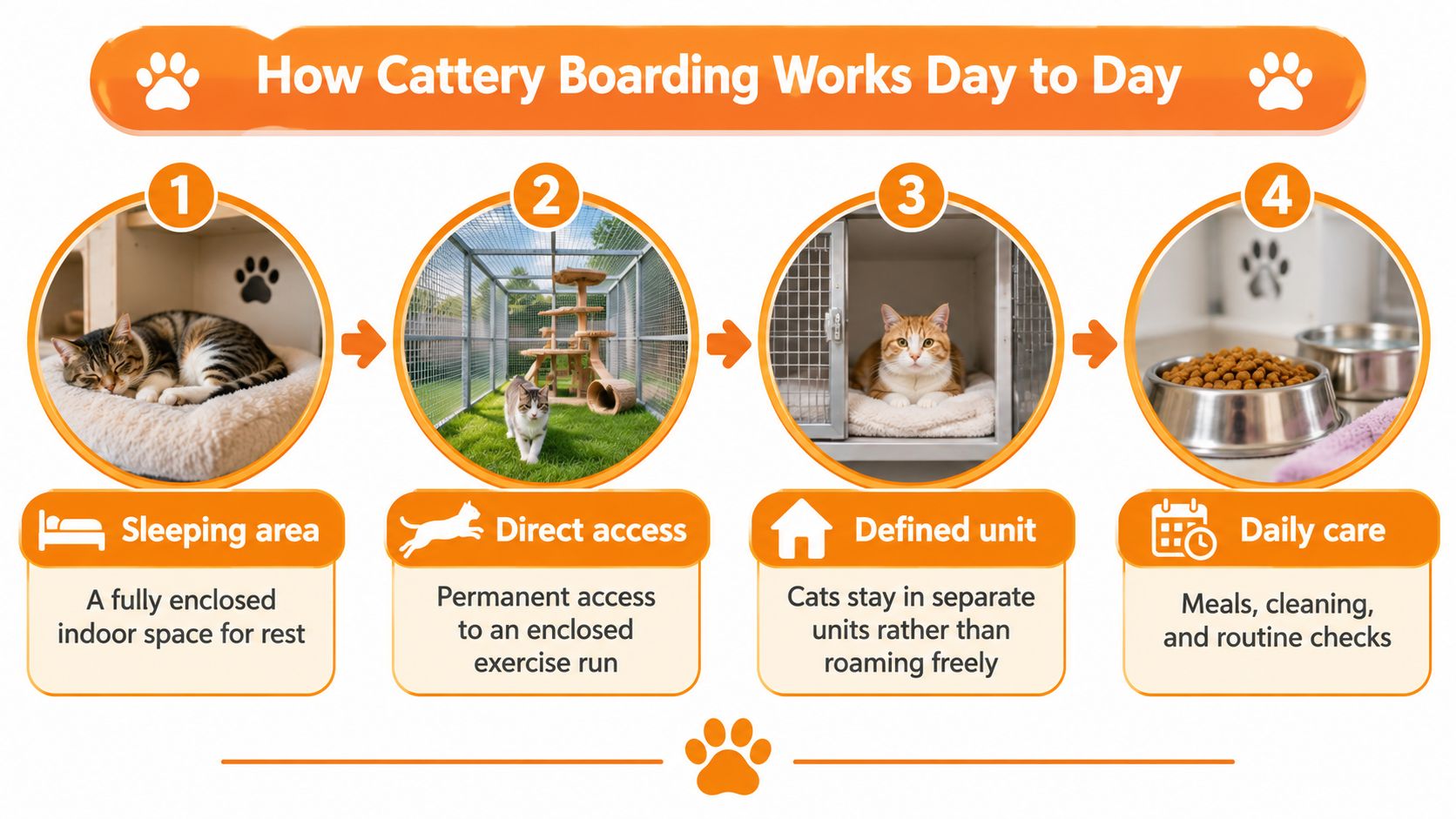
Space affects how freely a cat can move, rest and choose where to spend time. An example specification in Barking and Dagenham Council's cat boarding guidance gives these minimum areas:
| Cats housed | Sleeping area | Exercise area |
|---|---|---|
| One cat | 0.85 square metres | 1.7 square metres |
| Up to three cats from the same household | 1.2 square metres | 3 square metres |
These are example dimensions, so ask about the unit your cat would use. More room alone cannot guarantee a good stay, but cramped quarters can limit movement and choice.
The daily checks behind the routine
Staff check cats, serve meals and clean the units as part of the daily routine. Ask how the cattery organises checks, including overnight, and how staff respond if a cat seems unwell. Regular attention helps staff notice changes in a cat's condition or in the cleanliness of its space.
Temperature control also matters. Ask how sleeping areas are kept comfortable in both warm and cold weather, and whether the cattery can adjust conditions for your cat's needs.
A typical day has a steady rhythm: cats are checked and fed, their units are cleaned, and staff monitor how they are doing. Each cat can move between its sleeping area and exercise run, then settle in for a quieter period after the evening check. The set-up provides a structured routine, while care at home may better preserve familiar surroundings for a cat unsettled by a change of environment.
How to Check a Cattery Before You Book
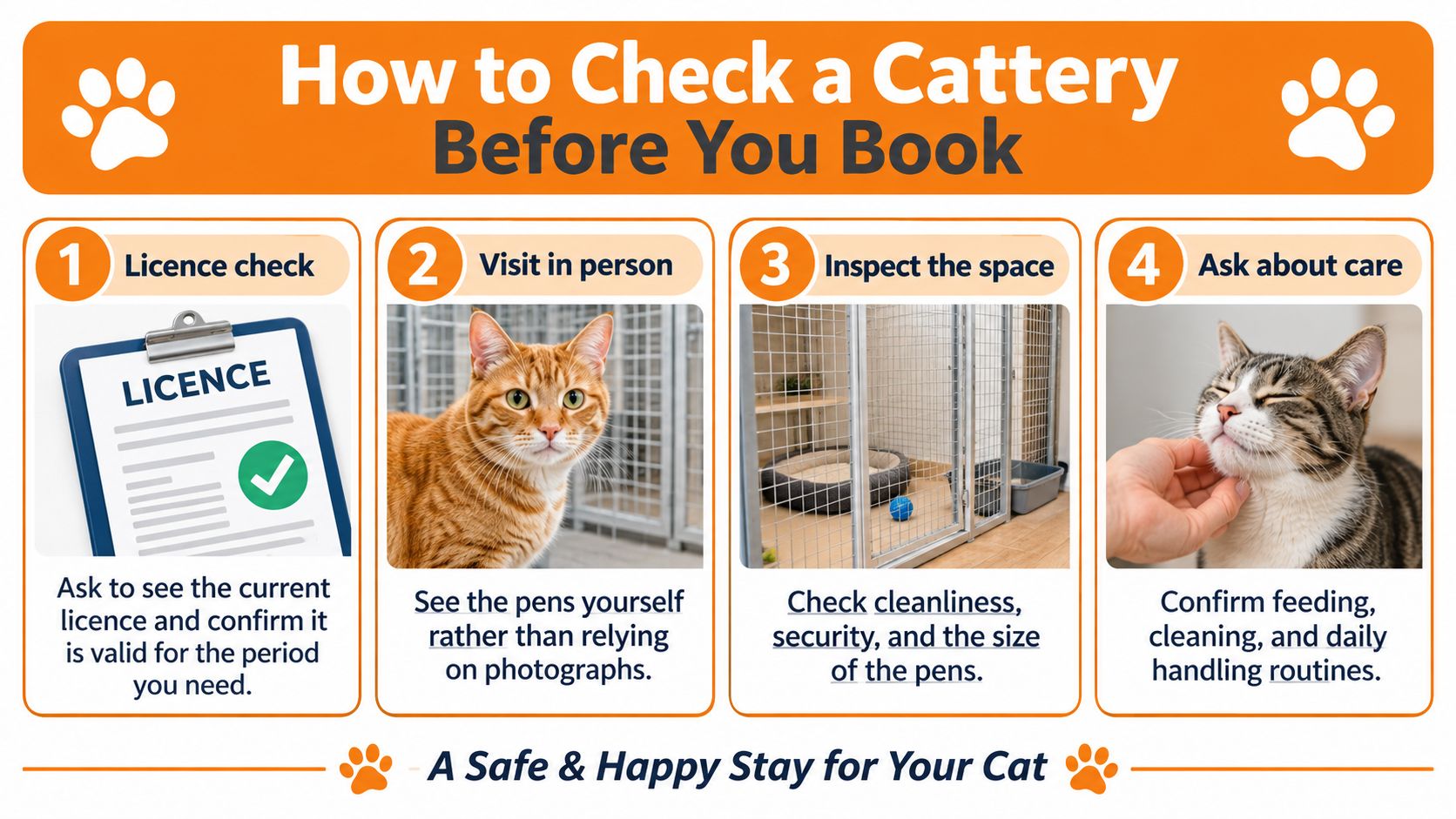
Visit before you commit if you can. Cats Protection's guidance on holiday care for cats recommends inspecting a cattery rather than relying only on its website or photographs. These checks help you judge whether the set-up feels safe and suitable for your cat.
-
Ask to see the current licence. Check that it's valid for the dates you need. A clear answer includes the licence details and an explanation of any relevant conditions.
-
Visit in person. Photos can't show you how the pens smell, sound or feel when you're there. A good visit lets you see where cats sleep, eat and exercise, and gives you time to ask questions without being hurried.
-
Check separation and escape prevention. Ask whether cats are housed separately, with no direct contact between pens, and look for double doors or a safety corridor. These features help limit contact and reduce the chance of a cat slipping out during entry or exit.
-
Look closely at the unit. Check that it's heated or insulated, easy to clean and arranged so cats can't see one another if that might unsettle them. Clean food and water bowls are a simple, visible sign of attention to daily care.
-
Ask about medication and routine. Tell staff what your cat takes and when, then ask them to explain how they'll administer it and record each dose. A reassuring answer is specific about who gives the medication and how they'll handle a missed dose or concern.
-
Find out how checks and emergencies work. Ask what happens outside normal opening hours and who staff contact if your cat becomes unwell. In Wales and Scotland, you can also ask to see the register of animals, arrival and departure dates, and owner details.
Clean pens and well-maintained surroundings support hygiene. If you're also planning exterior cleaning at home before your trip, Eco Clean Solutions' power washing services in Kildare offer a separate example of a practical cleaning service to consider.
How the Two Compare
A cattery moves your cat to a boarding facility. An in-home house sitter brings care to your home, so the main trade-off is a purpose-run environment versus keeping your cat in familiar surroundings.
| Factor | Cattery | In-home house sitter |
|---|---|---|
| Cost | Set fee, often per cat and per night, plus extras such as medication | Free stay for the sitter in exchange for care, with you covering food and vet bills |
| Cat stress | Unfamiliar room, noise and smells, sometimes sight of other cats | Stays in its own bed, litter tray and territory |
| Daily routine | Fixed staff schedule shared with other cats | Feeding times, play and habits can follow your rules closely |
| Vet access | Often arranged with a local vet, with medication given by staff | Sitter contacts your chosen vet, so you give written authority in advance |
| Home security | Your home is left empty while your cat is in the facility | A sitter stays in your home, under a written agreement you approve |
Cost: A cattery's fees are a direct boarding expense and may rise if your cat needs extra care, such as medication. With Global Pet Sitter, sitters care for pets at the owner's home in exchange for a free stay, and no money changes hands; you still cover your cat's food and veterinary bills. The sit needs to suit both the sitter and your household, rather than being treated as a paid service.
Stress and routine: The cattery may suit a confident cat who adapts readily to new places and the presence of other animals nearby. A house sitter is often a better fit for a cat who is unsettled by unfamiliar smells or relies on familiar feeding and play patterns. The home option wins on continuity, while a cattery may offer a more structured setting.
Vet access and home security: Neither option automatically guarantees faster veterinary care. A cattery may have staff support and arrangements with a local vet, while a sitter can contact the vet you choose if you give written authority and clear instructions. Your home is occupied during a sit, but you'll need to agree who stays there and what they can do. Read more about choosing between your place and the sitter's before deciding which arrangement fits your cat and home.
Home Security and Trust With a House Sitter
Letting someone stay in your home is a significant decision. It's sensible to ask direct questions, check the details and be clear about what you expect before you hand over keys.
Start with a conversation about privacy and occupancy. During a sit, you must vacate the property, and the sitter has sole occupancy unless you agree otherwise in advance. Tell the sitter where any security cameras or recording devices are, and agree in writing how they'll be used.
Write the handover down: Give the sitter written care instructions covering feeding, medication, litter, your chosen vet and emergency contacts. Stay accessible during the sit so they can reach you with questions or if something unexpected happens.
Before agreeing, read the sitter's profile, references and reviews, then arrange a video call. We don't run background checks or vet members unless we explicitly state otherwise, so don't assume a platform has done that work for you. Our guide to finding a cat sitter near you can help you think through what to discuss.
Agree that no pet will leave the property overnight without your approval, and make sure the sitter can decline an arrangement if they consider a pet unsuitable. Put the responsibilities, dates and practical details in writing with our pet sitting contract template, and review our guide to spotting pet sitting red flags.
If you're reviewing home monitoring as part of your preparation, Networking2000's guide to upgrading from battery cameras at home may help you consider your equipment. Whatever you use, disclose the location of cameras and recording devices and agree their use before the sit begins.
Choosing the Right Option for Your Cat
Would your cat feel more settled in a licensed cattery with defined housing standards, or at home with a sitter? The right choice depends on your cat's temperament, health and response to change.
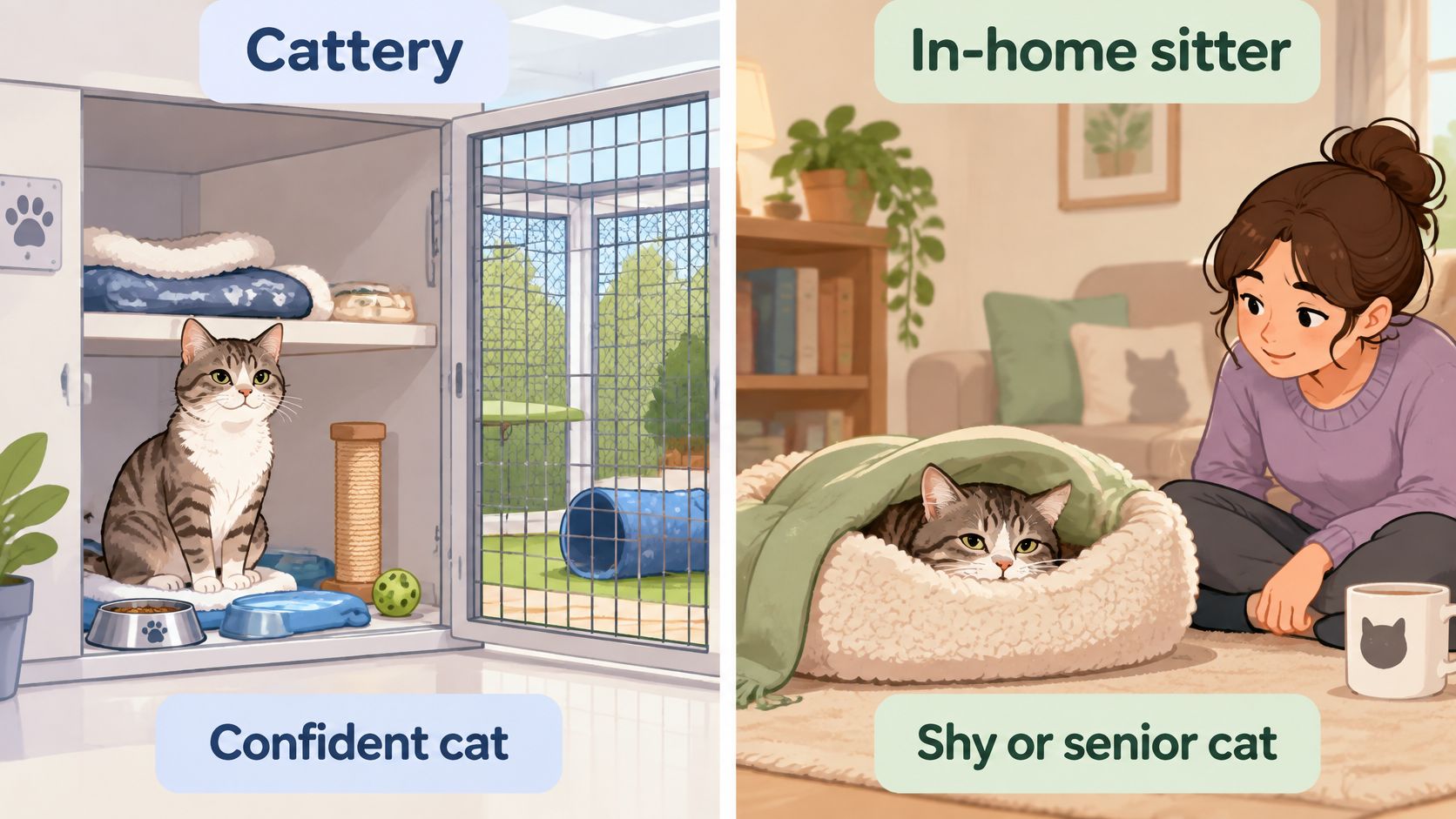
A confident cat who copes well with new places may settle into a cattery's structured environment. A shy, senior or routine-dependent cat may be more comfortable staying in familiar surroundings. If your cat needs medication, compare the practical arrangements: a sitter can follow the usual routine at home if they are comfortable giving it, while a cattery's ability to administer medication should be confirmed before booking.
A licensed cattery offers a defined boarding environment, staff and isolation arrangements. Some facilities have veterinary links, but a change of setting can still be difficult for a cat. Home care avoids that move, though it relies on the sitter following your instructions and knowing whom to contact in an emergency.
Many UK cat owners worry about access to veterinary care. Ask how far the nearest vet is, who would transport your cat and how quickly they could be seen in an emergency. These questions help you understand the plan before you need it.
If your cat becomes distressed when you travel, planning for separation can help you decide which care arrangement may suit them. Read our guide to managing pet separation anxiety when you travel for ideas to discuss with a carer.
Make the decision around your cat
Before booking, weigh your cat's needs against what each arrangement can provide:
- Your cat's needs: Consider health, temperament, medication, tolerance of travel and how much routine matters to them.
- The care arrangement: For a cattery, confirm its licence and ask about the accommodation and care routine. For a sitter, check references and agree written instructions and emergency arrangements.
Choose a cattery if its structured setting and care arrangements suit your cat. Choose home care if familiar territory and routine matter more, and you can find a sitter you trust.
With Global Pet Sitter, sitters care for pets in the owner's home in exchange for a free stay, with no money changing hands. We charge no booking fees. Our guide to whether you tip pet sitters explains how to think about thanking a sitter.
We help pet owners connect with house sitters who stay in the home and care for pets while their owners travel. If that arrangement suits your cat, find a house sitter.
Please sign in to leave a comment
