Cattery prices in the UK typically range from £15 to £30 per cat per night, which comes to roughly £105 to £210 for a seven-night stay before extras. Your final bill will depend on your dates, how the cattery counts the stay and what your cat needs.
The biggest budgeting mistake is treating the advertised rate as the complete holiday-care cost. We recommend comparing a written boarding quote with the practicalities of care in your own home, then choosing the arrangement that suits both your cat and your comfort level.
UK Cattery Prices by Area at a Glance
UK cattery rates are generally quoted per cat per day or night, and the spread is wide. Check the charging unit before multiplying: a seven-night holiday doesn't necessarily mean seven chargeable days.
The advertised rates in the PetMe cattery comparison range from £13.50 per day in West Yorkshire to £30 in Edinburgh, with the highest sampled rate more than twice the lowest. The table converts those published rates into seven-night planning equivalents, before extras, rather than guaranteed booking quotes.
UK cattery rates per cat per night
| Area | Rate per cat per night | Seven-night total before extras |
|---|---|---|
| West Yorkshire | £13.50 | £94.50 |
| Staffordshire | £14.26 | £99.82 |
| Bristol | £15 to £17.75 depending on peak season | £105 to £124.25 |
| Dorset | £18 | £126 |
| Hertfordshire | £19 | £133 |
| Cardiff | £20 | £140 |
| Midlothian | £22 | £154 |
| Edinburgh | £30 | £210 |
| Typical UK estimate (Agria Pet Insurance) | £15 to £30 | £105 to £210 |
The planning row uses the Agria Pet Insurance estimate reproduced in the Carla Lane Animals in Need boarding guidance: £15 to £30 per cat per night, or approximately £105 to £210 for seven nights.
Use local quotes rather than a national average
These are advertised examples, not regional averages. They don't establish that every cattery in Edinburgh is dearer than every cattery in West Yorkshire, or that the cheapest advertised unit will meet your cat's needs.
A slightly more expensive cattery near your home might also be more practical than a cheaper one requiring an awkward collection journey. Look at opening hours, the journey with your cat and whether your return flight leaves enough time to collect before closing.
Food, VAT, heating, bedding, insurance and transport aren't automatically included. Ask each cattery to mark what its tariff covers rather than assuming that similar-looking accommodation comes with the same package.
Budgeting rule: Compare the amount you'll actually pay for your dates, not the smallest number on the tariff page.
Start your shortlist with your area, travel dates and your cat's care requirements. Then approach two or three nearby catteries with the same questions, so you're comparing accommodation and care on equal terms.
How Much Does a Cattery Cost for Your Trip
A cattery charging £16 per night for one cat and £14 for a second cat sharing would cost £210 for two cats over seven nights, before VAT. That figure, the complete booking total, is the number worth comparing. A nightly rate on its own tells you very little, because collection day charges, sharing arrangements and separately priced care all change the invoice.
Build the total before paying a deposit
- Confirm the chargeable stay. Give the cattery your proposed arrival and collection times, not just your holiday dates. Ask whether it charges by night or calendar day, whether collection day is included and what happens if your return is delayed.
- Add each cat correctly. Ask for the shared-unit price rather than doubling the single-cat rate. Confirm that the quoted amount is the household total, not the price for each cat.
- Add separately quoted services. Request a breakdown for heating, medication, special feeding and peak-date supplements where applicable. A reassuring conversation isn't a substitute for an itemised quote.
- Compare the final amounts. Put the cheapest and dearest suitable options beside each other. Identify what the extra money buys before deciding whether the difference is worthwhile.
A worked example shows why this matters. At £16 for the first cat and £14 for a sharing cat, seven nights come to £112 for one cat or £210 for a pair, and VAT can push both figures higher. Two catteries with identical nightly rates can still produce different totals once collection-day charges and supplements are applied.
Sharing reduces the price per cat, but it doesn't make the additional cats free. It also only works if they can comfortably eat, rest and use the accommodation together.
Cats that tolerate each other at home may still need separate feeding or places to retreat. Tell the cattery about food guarding, different diets or tension between your cats before accepting a shared-unit quote, and ask what it costs to split them if problems arise.
Check the booking extras in order
Work through these points before committing:
- VAT. Ask whether the final consumer price includes it. Don't compare a VAT-exclusive tariff with an inclusive quote as though they're equivalent.
- Food. Establish which food is supplied and whether you can bring your cat's usual diet. Label portions and feeding instructions clearly, especially if your cats eat different foods.
- Bedding and litter. Check what's provided and whether familiar bedding is welcome. Ask about your usual litter if your cat is particular about texture or scent.
- Collection and drop-off. Confirm opening hours, transport charges and the procedure for delayed collection.
- Deposits and cancellation. Find out whether the deposit comes off the balance, when payment is due and what happens if your plans change. A deposit isn't necessarily an additional cost, but its refund conditions matter.
- Vaccination and health records. Request the admission requirements before booking. Leave time to resolve missing paperwork with your vet rather than discovering a problem at handover.
Medication deserves its own conversation. Explain the method, timing and your cat's behaviour when receiving it, then ask whether the cattery can deliver that exact routine and whether there's a separate charge.
A useful quote names your cats, your dates, the chargeable stay, the accommodation, the inclusions and the final payable amount.
Ask for that quote in writing and dated. Keep it with the booking conditions and your care instructions so you can check any later changes.
Seven nights in a cattery is also worth weighing against care in your own home, where your cat keeps its territory and routine. Our guide to pet and house sitting prices breaks down what those arrangements cost. Whichever route you choose, compare the written total alongside the care behind it: who is present, for how long, and what happens if your cat needs a vet.
What Pushes Cattery Prices Up or Down
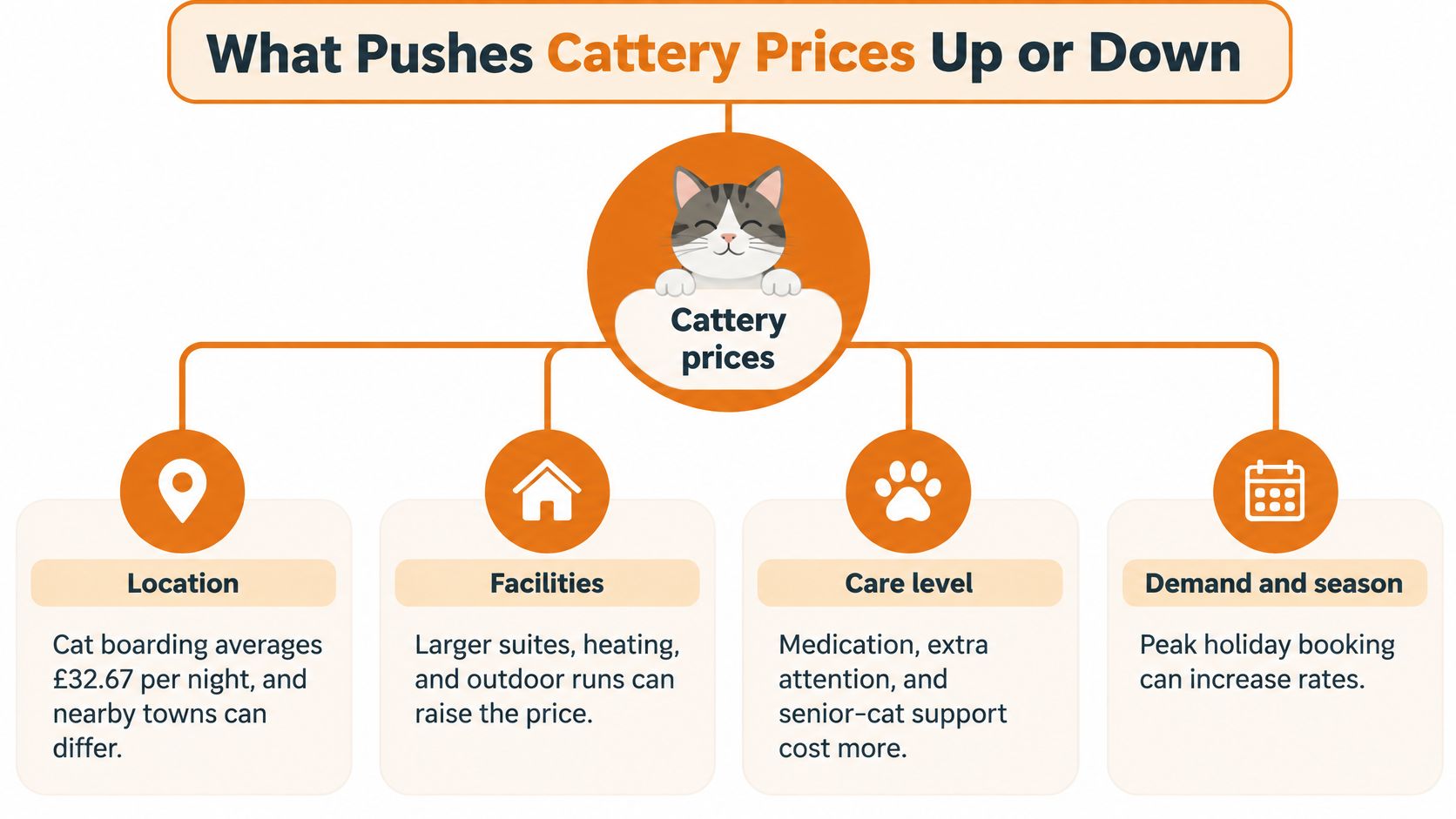
Neighbouring catteries can charge differently without either being unreasonable. Their premises, staffing arrangements and included services may be quite different, so ask what sits behind the price.
For context, Napo's boarding comparison gives a London cat-boarding average of £32.67 per night, equivalent to £228.69 for seven nights, compared with £24 to £30 per night, or £168 to £210 for seven nights, across several large-city benchmarks. Those are city-level comparisons, not a quote for your particular cat.
Separate useful care from attractive extras
- Location. Premises costs and local demand affect pricing. A convenient site can also save you an uncomfortable journey with a travel-anxious cat.
- Season. School holidays, bank holidays and Christmas can bring peak pricing. Ask about your actual dates, not the standard off-peak tariff.
- Accommodation. Larger units, heated spaces, outdoor runs, shelves and hiding places can change the price. Check what your cat can use rather than judging from a photograph of the largest suite.
- Cat count. Compatible cats sharing accommodation can cost less per cat. Separate units may be the better choice where diets or relationships make sharing difficult.
- Licensing and staffing. Suitable housing, hygiene, records and trained staff require resources. Ask who carries out care and what happens when the usual staff member is absent.
- Length of stay. A cattery may offer a lower nightly rate for a longer booking. Confirm how it applies the tariff and whether any dates remain subject to supplements.
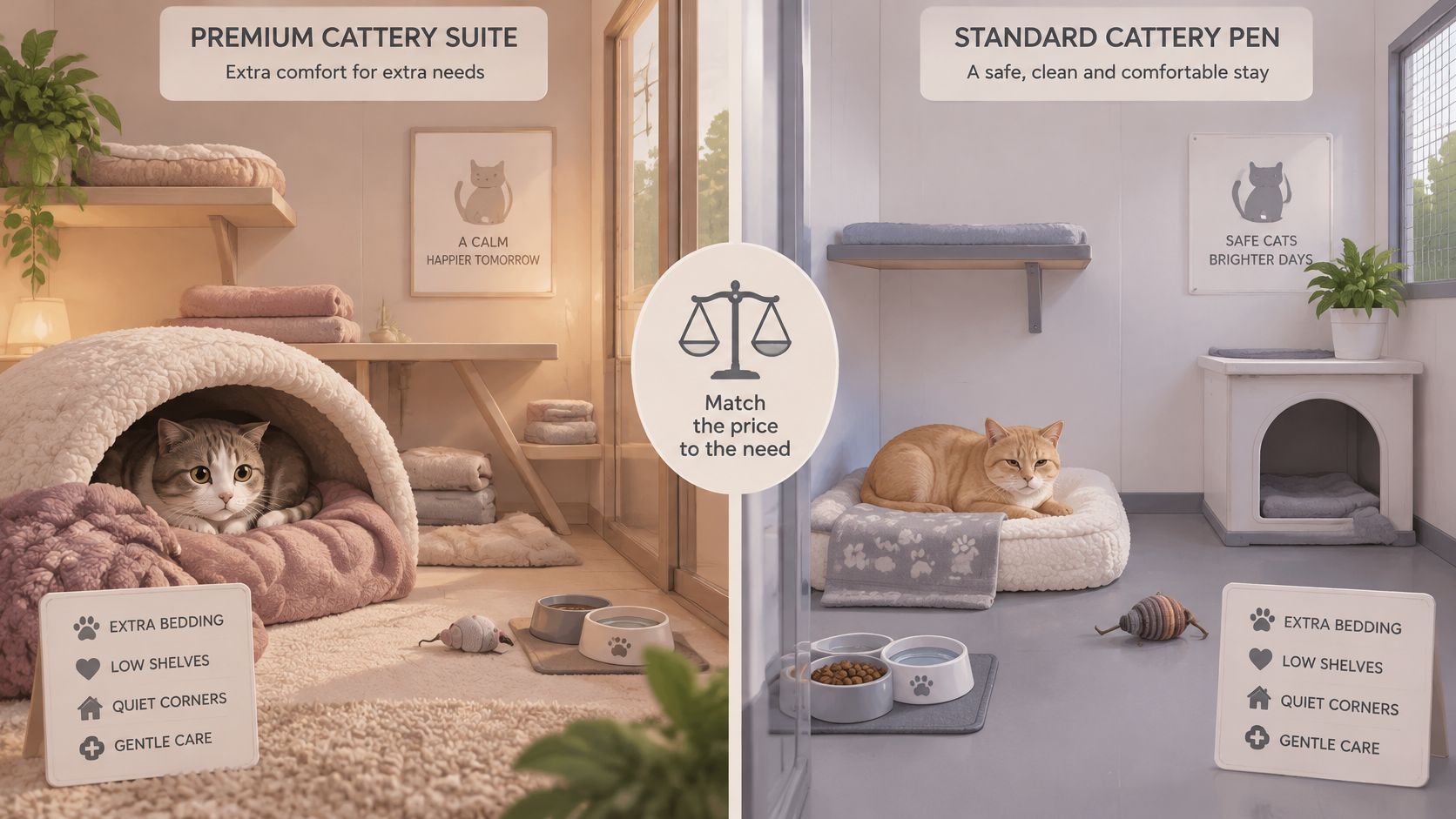
A luxury label doesn't tell you whether someone will notice that your cat hasn't eaten. Equally, a basic-looking unit isn't automatically poor accommodation.
Pay for features your cat will benefit from. A quiet position and careful observation may matter more to an anxious cat than extra floor space, while an active cat may make good use of climbing shelves and play opportunities. The best-value quote is the one that meets those needs with clear, dependable care.
Stay Length, Peak Dates and Surcharges Explained
A seven-night stay at one rate can cost more than the headline suggests once holiday supplements or extra-cat charges apply. Meeting House Kennels' published tariff uses lower nightly rates for longer stays, with separate charges for additional cats and certain holiday dates.
| Stay length | Rate per cat per night | Example total |
|---|---|---|
| Fewer than 7 nights, example 6 nights | £16 | £96 |
| 7 to 14 nights, example 7 nights | £14 | £98 |
| 15 to 21 nights, example 15 nights | £12 | £180 |
| More than 21 nights, example 22 nights | £12 | £264 |
| Bank holiday, Christmas or New Year | Confirm applicable rate with the cattery | Confirm before booking |
| Second cat | £14 per night | £98 for 7 nights |
| Third cat | £12 per night | £84 for 7 nights |
The seven-night totals for the three quoted rates are £112, £98 and £84. The first applies to stays shorter than seven nights, so it is not available for a seven-night booking. For example, fourteen nights at £14 per night totals £196, before any additional-cat charges.
Check the nights and the total
Ask the cattery to show which dates attract any holiday supplement. A booking that crosses a bank holiday or festive period may not be charged at the same rate for every night.
Confirm how the longer-stay rate is applied, too. Check whether the lower rate covers the full booking or only nights after a threshold, and ask for the calculation in writing.
Compare the full quote before changing your travel dates to reach a cheaper band. A longer stay can have a lower nightly rate yet still cost more overall.
Popular dates can limit your choice of accommodation. Check the care arrangements and the total price before paying a deposit, so you can decide whether the booking suits your cat.
What Higher Prices Buy for Anxious or Senior Cats
If your cat needs tablets, close observation or a particularly quiet environment, it's reasonable to look beyond the cheapest quote. A premium is worthwhile only when it buys care you can verify.
The Dorset Council commercial cattery licensing framework describes requirements covering accommodation, hygiene, health and diet records, enrichment and trained staff. It also explains that higher star ratings involve meeting required standards plus at least 50% of optional higher standards, with higher ratings allowing longer licence periods.
Ask for the licence rating and latest inspection outcome. Treat these as evidence to discuss alongside your cat's needs, not as a promise that a particular environment will suit every animal.
Turn reassurance into specific answers
- Medication. Who gives it, what relevant training do they have and how are doses recorded? Ask what happens if your cat refuses.
- Overnight observation. When are cats checked, who is on site and how is a concern escalated?
- Veterinary emergencies. Which practice is used, how is transport arranged and when will staff contact you?
- Shared accommodation. Can your cats be separated promptly if sharing doesn't work?
- Changes in behaviour. How are reduced appetite, hiding, missed toileting or signs of distress recorded and acted on?
- Care records. Will staff follow your written diet and health instructions, and can they explain their handover process?
A senior cat taking daily tablets may justify a higher rate if trained staff administer and log each dose reliably. A confident young cat that eats readily may be comfortable in simpler accommodation with good hygiene, enrichment and attentive staff.
Keep existing dietary instructions precise. If you're considering a product such as Joyfull's prebiotics for cats, discuss its suitability with your vet before the trip rather than introducing a new supplement at boarding handover.
The goal isn't to buy every available extra. It's to make sure the person caring for your cat recognises what's normal and knows what to do when that changes.
For help assessing evasive promises or missing detail, use our guide to pet-care red flags. Clear answers matter more than polished descriptions of luxury accommodation.
How to Check a House Sitter Before They Stay
Letting someone stay in your home is a big step, particularly the first time. You don't need to rush that decision or ignore an uneasy feeling because your departure date is approaching.
We help owners and sitters connect, but we don't run background checks or vet members unless explicitly stated otherwise. Our guide to vetting a house sitter supports the checks you should make yourself.
Make trust checkable
- Check identity and history. Ask to see photo ID and compare it with the sitter's profile. Read reviews for specific comments about reliability, pet care and cleanliness, rather than relying on a friendly photograph.
- Arrange a video call. Discuss your cat's routine, medication and behaviour. If you also have a dog, ask how they'd handle your dog's walks, recall limitations and interactions with other animals.
- Contact references. Ask for at least two previous-owner references and speak to them directly. Ask whether the sitter followed instructions, communicated concerns and left the home as agreed.
- Put the arrangement in writing. Record care duties, medication, emergency contacts, veterinary authorisation and responsibility for treatment costs. Our pet sitting contract template provides a starting point for those discussions.
- Plan the handover. Arrange a meeting with your pets where possible and demonstrate locks, feeding and medication. We require a handover before departure, either in person or by video call.
- Agree updates and escalation. Request a daily photo or message and define which changes require an immediate call. Include a backup contact if you can't be reached.
Protect your home as well as your pets
Confirm who may enter your home, how keys will be handled and which rooms are private. Secure sensitive documents and valuables, and maintain adequate home and contents insurance, as our terms require.
Refusing a video call, avoiding written terms or requesting payment outside the agreed process are reasons to pause. Don't hand over keys while important questions remain unanswered.
The sitter shouldn't have to improvise beyond the agreed plan. Set emergency authority beforehand, including contacting you before veterinary expenses where possible, so urgent treatment isn't delayed while routine decisions remain yours.
Decide Between a Cattery and In-Home Care
The right choice combines total cost, your pet's routine and confidence in the person responsible. A cattery offers purpose-built boarding away from home; an in-home arrangement keeps your pets in familiar surroundings but requires you to be comfortable giving someone access to your property.
For paid pet sitting, Cats Protection's estimate cited by Perfect Pet Insurance is approximately £150 to £300 for one week, depending on location. That's a national consumer estimate for pet sitting, not a cattery rate, a guarantee of live-in coverage or our price.
Full cost of a cattery compared with in-home care
| Option | Typical seven-night cost | What is included | What you still pay |
|---|---|---|---|
| Cattery, one cat | £105 to £210 planning range | Accommodation for the stay | VAT, food, heating and peak supplements if excluded; veterinary fees |
| Cattery, two cats sharing | About £210 at the Meeting House rates, excluding VAT | Shared unit where cats are compatible | VAT, applicable peak supplements and veterinary fees |
| In-home pet sitting, Cats Protection estimate | £150 to £300 for one week | Agreed care in your home; confirm visits or overnight coverage | Veterinary treatment and anything excluded from the quote |
| Global Pet Sitter, in-home care | No care payment between owner and sitter; annual subscription access, current subscription price not stated here | Pets stay in their own home and routine in exchange for a free stay | Veterinary treatment costs and normal pet supplies |
Boarding figures are the planning ranges and worked calculations established earlier, not fresh quotes. For our exchange arrangement, no money changes hands between owner and sitter, and we charge no booking fees, ever. Joining is free; access uses an annual subscription, so a future target membership price shouldn't be treated as a current charge.
Choose by fit, not price alone
- Total the complete boarding quote. Include every chargeable date and any care extras.
- Write down each pet's needs. Include medication, feeding, anxieties, companionship and how long they can comfortably be left.
- Choose the workable arrangement. Assess the care environment, then complete the identity, reference and handover checks before committing.
Our guide to care in your home versus someone else's can help you assess that practical fit. In-home care preserves access to familiar food, beds and routines, but it doesn't remove the need for a capable, well-prepared carer.
You remain responsible for all veterinary treatment costs. Keep an emergency plan and a backup care option, whichever arrangement you choose.
At Global Pet Sitter, we connect you with sitters who care for your pets in your home in exchange for a free stay, offering an alternative to nightly cattery charges. Compare your cat's needs with potential sitters, complete your trust checks and Find a trusted house sitter for free.
Please sign in to leave a comment
