You found a listing last night that offers a spare room if you help in the garden. The kitchen looks lived-in, and the host wrote back within an hour. Before you say yes, the useful question isn't how cheap the stay looks. It's whether the hours, the duties, and your right to leave are clear enough to trust.
Work exchange travel is that trade made explicit. You give a fixed block of practical help. The host gives you a bed, and often meals, instead of a lodging bill. Farms, hostel shifts, skill projects, and house or pet sits all use the same bargain, with very different risks attached. The photos won't tell you if the work is legal, fair, or safe. A short written agreement will.
What Work Exchange Travel Is and Which Model Fits
Work exchange travel means trading a fixed number of hours of practical help for a place to stay, and often meals, instead of paying for lodging. Think of it as paying the hotel bill with your hands rather than your card.
The template most hosts still copy started small. In 1971, Sue Coppard, a London secretary, organized a weekend visit for urban volunteers at a farm in England. The group was first named "Working Weekends on Organic Farms," then became World Wide Opportunities on Organic Farms, known as WWOOF. National Geographic notes that typical WWOOF arrangements involve approximately 4 to 6 hours of work daily in return for food and accommodation. Matching relied on country networks long before any app existed.
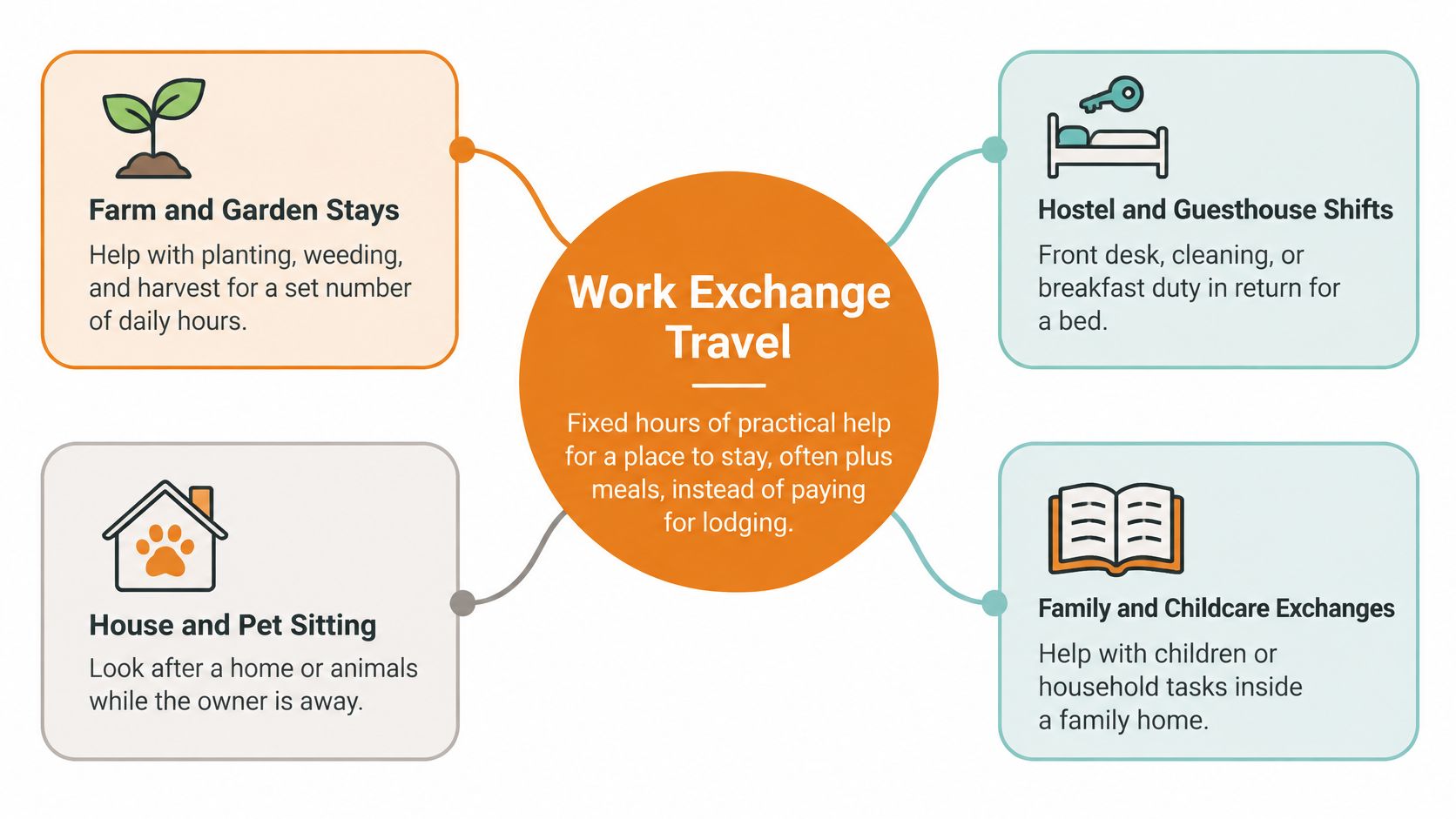
Four models side by side
| Model | What you trade | Typical commitment | Cost to join |
|---|---|---|---|
| WWOOF (organic farms) | 4 to 6 hours of farm work a day for food and lodging | Often one to two weeks at one farm, flexible | Country membership fee; host listings differ by country |
| Workaway (mixed hosts) | Around 4 to 5 hours a day for food and lodging, set by each host | From a few days to several months | Annual paid membership to contact hosts |
| Direct skill swap | A specific skill such as teaching, design, or repairs, for lodging or meals | Agreed per project before arrival | Usually free when arranged directly |
| House or pet sitting | Looking after a home and pets for free accommodation | Days to months, with dates set by the owner | A platform fee or a free sign-up; read the amount before you join |
Which model matches what you can offer
Manual outdoor work points to farm networks. A professional skill, such as teaching a language or repairing a website for your keep, points to a direct skill swap with the scope fixed before you travel. A love of animals plus a wish for a town or city base points to house or pet sitting, which sits closer to home exchange travel than to a harvest crew.
Practical rule: Match the model to the hours you can honestly give, not to the prettiest photo.
If you can spare five mornings and you don't mind dirt under your nails, start on a farm. If your value is a skill, don't bury it in open-ended chores. If you want a kitchen and a quiet evening, look after a home.
Who Work Exchange Travel Suits and Who Should Skip It
This bargain rewards people who can bend a week. People with fewer fixed commitments show up most often. A WWOOF press kit cites 2010 data finding that nearly three-quarters of WWOOF participants were between 19 and 28 years old. Age isn't the test, though. Flexibility is.
| Traveler profile | Best-fit model | Main risk | Verdict |
|---|---|---|---|
| Budget traveler on a two to four week trip | WWOOF or Workaway farm stays | Physical work is tiring and stays are short | Good fit if cutting costs is the priority |
| Digital nomad with paid remote work | House or pet sitting with a fixed routine | Work hours clash with host duties; visa limits | Fit only with set hours and a clear visa position |
| Early-career traveler | Workaway in hospitality, farms, or family projects | Hard to tell reliable hosts apart | Strong fit with careful vetting |
| Skilled professional such as a designer or teacher | Direct skill swap | Unpaid scope creep | Good fit with a written scope |
| Slow traveler who loves animals | Pet sitting | Animal welfare liability | Good fit with a full handover |
| Traveler who needs fixed income or strict hours | Avoid long placements | Little flexibility | Poor fit |
The risk behind each profile
A short farm stay saves lodging, but your body pays in weeding, lifting, and early starts. A remote worker can keep client hours only if the host's duties end on time. Test the connection first with a SwiftNet Wifi remote work speed guide, because a beautiful valley with a dead line still costs you a workday. Designers and teachers often get "one more small thing" after the agreed project. Say no in writing, or the free room becomes unpaid overtime.
Savings shrink once you add membership fees, buses, and days you can't bill a client. House sitting is the exception many slow travelers want. Sitters can save on accommodation while house sitting and see new countries, with a home base instead of a bunk in a barn.
When to skip it
- You need a paycheck during the stay. Room and board doesn't replace wages.
- Your job has strict daily hours. Host tasks will collide with them.
- You're healing from an injury. Physical placements aren't a rest cure.
- You want little contact with strangers. You'll share a kitchen, and often a routine, with people you just met.
Score yourself against that list. Three or more skip signals means you should take a shorter stay, or pick another model entirely.
What a Typical Exchange Week Looks Like
Say you arrive on a Sunday evening. Monday morning is the work block, often finished before lunch, and the afternoon is yours. Some hosts cook with you. Others point at the pantry and leave you to it. By Wednesday you know whether the listing matched the week. By Friday you should have had a real day off.
| Expectation | Typical range | Red flag |
|---|---|---|
| Working hours per day | 4 to 6 hours | More than 8 hours or no set schedule |
| Working days per week | 5 days, with 2 days off | Seven days with no rest period |
| Lodging | Private room, shared room, or camp space | Lodging conditions not described in advance |
| Meals | Two to three meals, often shared with the host | Meals not mentioned in the agreement |
| Length of stay | One week to three months | No end date or open-ended extensions |
| Task scope | Tasks matched to your skills and written down | Open-ended "whatever needs doing" |
| Cash | Usually none; some hosts offer pocket money or transport help | Host expects you to pay for the work |
Write the deal before you unpack
Before arrival, agree the tasks, the hours, who supervises, the sleeping arrangements, how either side cancels, and what you aren't allowed to decide. That last point matters. You're a guest helper, not the stand-in manager.
The gap between the promise and the week usually shows up as a small task that grows. Two hours of weeding becomes a full day with no break, because "the weather's good." On a pet or house sit, the day is quieter and also stickier. Feeding, medication, walks, and sleeping in the home can fill evenings the listing called free.
Pack for both halves of the day. Work clothes for the morning, and a compact remote kit if you still have calls. A what to pack for remote work list keeps that second bag from eating your whole suitcase.
Put the agreed hours in the message thread and ask the host to confirm them. A host who dodges a number is telling you the workload is open-ended.
Visa and Work Rules Before You Accept a Placement
Crossing a border isn't the same as permission to work. Visa-free entry lets you arrive. It doesn't, by itself, let you produce value for a host. The WTM Global Travel Report 2025 notes that global travelers could access more than 110 destinations without a visa in 2025, compared with 58 in 2006. That mobility figure says nothing about permission to work.
"Free accommodation" can still look like a labor relationship when duties are scheduled, essential to a business, or controlled by the host. A café that needs you on the espresso machine every morning isn't offering a cultural visit. It's filling a shift.
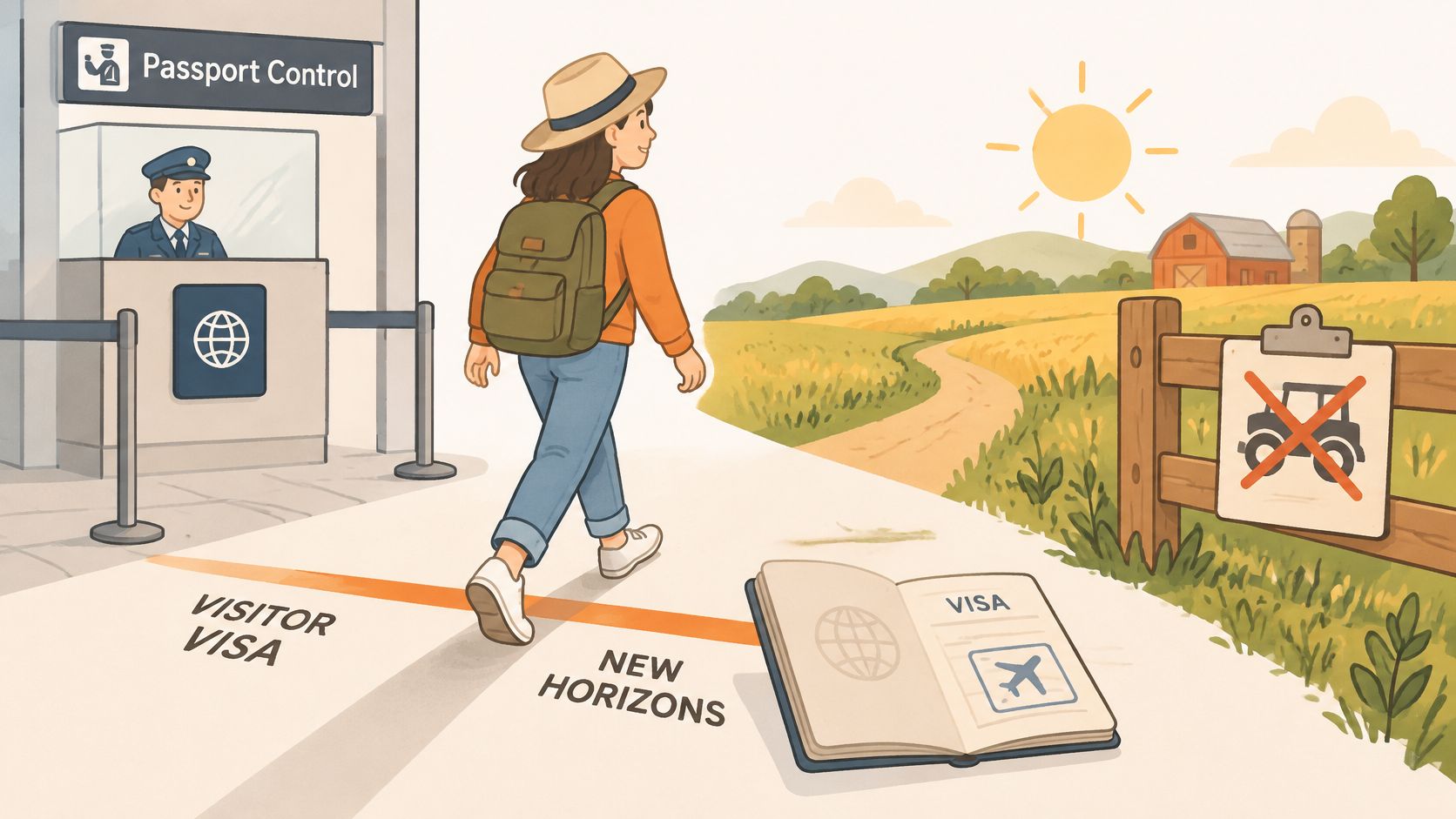
A three-color rating you can apply tonight
- Green: Occasional personal help in a private household, with no business gain. Think watering plants for a neighbor, not running their shop.
- Amber: Regular tasks inside a host business, such as a farm shop, hostel desk, or café.
- Red: Duties that resemble a paid job, childcare, animal handling you aren't trained for, or any regulated service.
| Situation | Usual reading | What to verify |
|---|---|---|
| Occasional household help, no business gain | Usually treated as informal exchange, rules differ by country | Entry conditions and whether the host runs a business |
| Scheduled, essential work in a host business | Can count as unpaid employment | Work permit need and minimum wage rules |
| Remote paid work while staying on an exchange | Separate from the exchange; may need work rights on your visa | Whether your visa allows paid work and tax registration |
| Pet or house sitting with round-the-clock duties | Care duties can create liability and labor questions | Insurance, emergency authority, and local rules for animal care |
What to confirm before you accept
- Tasks and hours: Exact duties, daily cap, and days off.
- Who the host is: A private household, or a business that sells rooms, food, or tours.
- What replaces a wage: Bed and meals only, or something that looks like pay.
- Local thresholds: Minimum wage, permits, and whether unpaid help is even allowed.
- Insurance and tax: Who covers injury, and whether you must register.
- Your exit: You can leave early without being stranded.
Round-the-clock pet care looks informal and still carries liability, which is why international house and pet sitting needs the same visa check as a hostel shift. Any amber or red placement that lasts more than a few weeks, or involves money, should get advice from that country's immigration or labor authority before you accept.
How to Vet a Host Before You Commit
A sunny kitchen photo tells you the host has daylight. It says nothing about fair hours, safe work, or who answers when something goes wrong. Vetting a placement works like checking a used car: the paint matters less than the service history, and the service history here is evidence you can verify. That evidence matters because some placements fail in ways no refund fixes. Short-term voluntourism can place untrained travelers in roles that need professional skill, disrupt local systems, and create child-safety risks, especially in orphanage placements, as a critical examination of voluntourism lays out.
The central question is whether your help is extra, safe, and welcome rather than a substitute for a local wage. Run the seven checks below in order, and score each answer green, amber, or red as you go. One red ends the conversation. Two ambers mean you slow down and get written answers before committing.
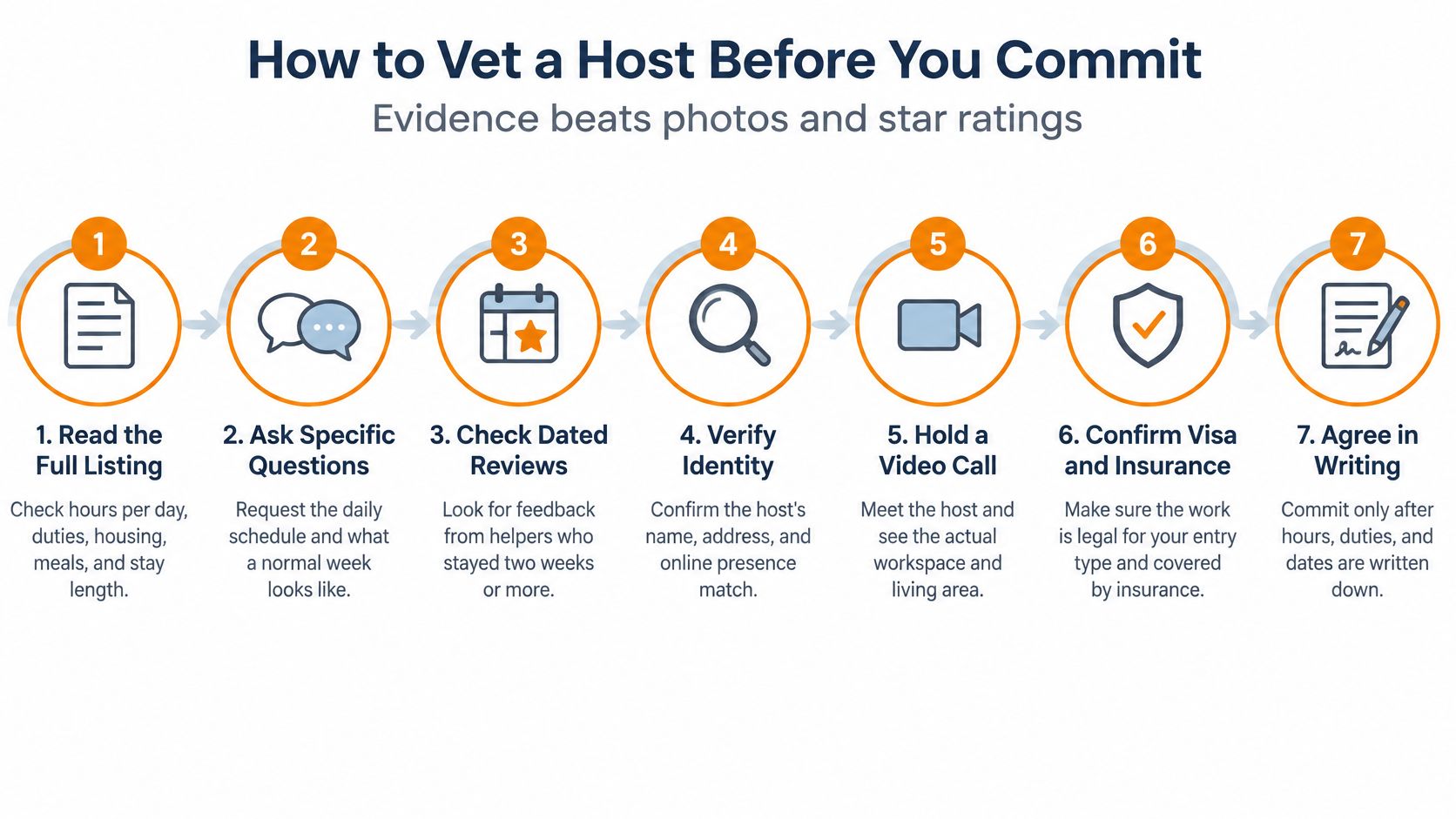
Seven checks, in order
- Read the full listing. It should name the work, the hours, the bed, and whether the host runs a business. If you cannot tell who owns the place or who profits, stop.
- Read reviews for what got done. Prefer notes that describe finished tasks, from people who stayed long enough to see a normal week.
- Ask for two past helpers you can message. Ask them what the hours looked like on an ordinary Tuesday. "The host was lovely" is a feeling. "We finished at two and had afternoons free" is evidence.
- Get the agreement in writing. Tasks, hours, who supervises you, and how either side cancels.
- Ask about safeguarding when people or animals are involved. Background checks, training, and who you call if something feels wrong. Walk away from orphanage-style roles you are not qualified for.
- Exchange emergency contacts and confirm insurance before day one. On Global Pet Sitter sits, members exchange emergency contact information before each sit starts.
- Finish a real handover for any pet sit. Pet owners must hold a mandatory handover with the sitter before leaving, in person or by video call. It must cover pet care routines, feeding schedules, emergency contacts, veterinary information, house rules, and any special requirements.
Start with established listing networks: WWOOF country directories, Workaway profiles, and house-sitting platforms that publish the full work scope. Profiles of trusted pet house sitters show what documented experience looks like. Treat them as a first filter, and apply the seven checks to every host behind them.
Red flags that should end the chat
- Vague ownership. You cannot tell who runs the place or who profits from your hours.
- Pressure to arrive before terms are written. Urgency is a warning. A legitimate host can wait for a message thread to catch up.
- Payment beyond a normal membership. A platform fee is fine. Paying the host for the chance to work means you are buying a job.
- No references. A host who has welcomed helpers before can name two people willing to describe the week.
Trust is a stack of checks you can show someone else. If a host resists being checked, that resistance is your answer.
Three Exchanges Compared in Real Situations
These three stays are composites, not real people. Each one turns on a single missing sentence.
A two-week organic farm. The listing said about four hours. Most days landed closer to six, because harvest didn't stop at noon. The host wasn't cruel. The number had never been confirmed. What worked was the food and a clear end date. What failed was the daily cap. Writing "four hours, then I'm done" into the thread before arrival would have kept the afternoons free.
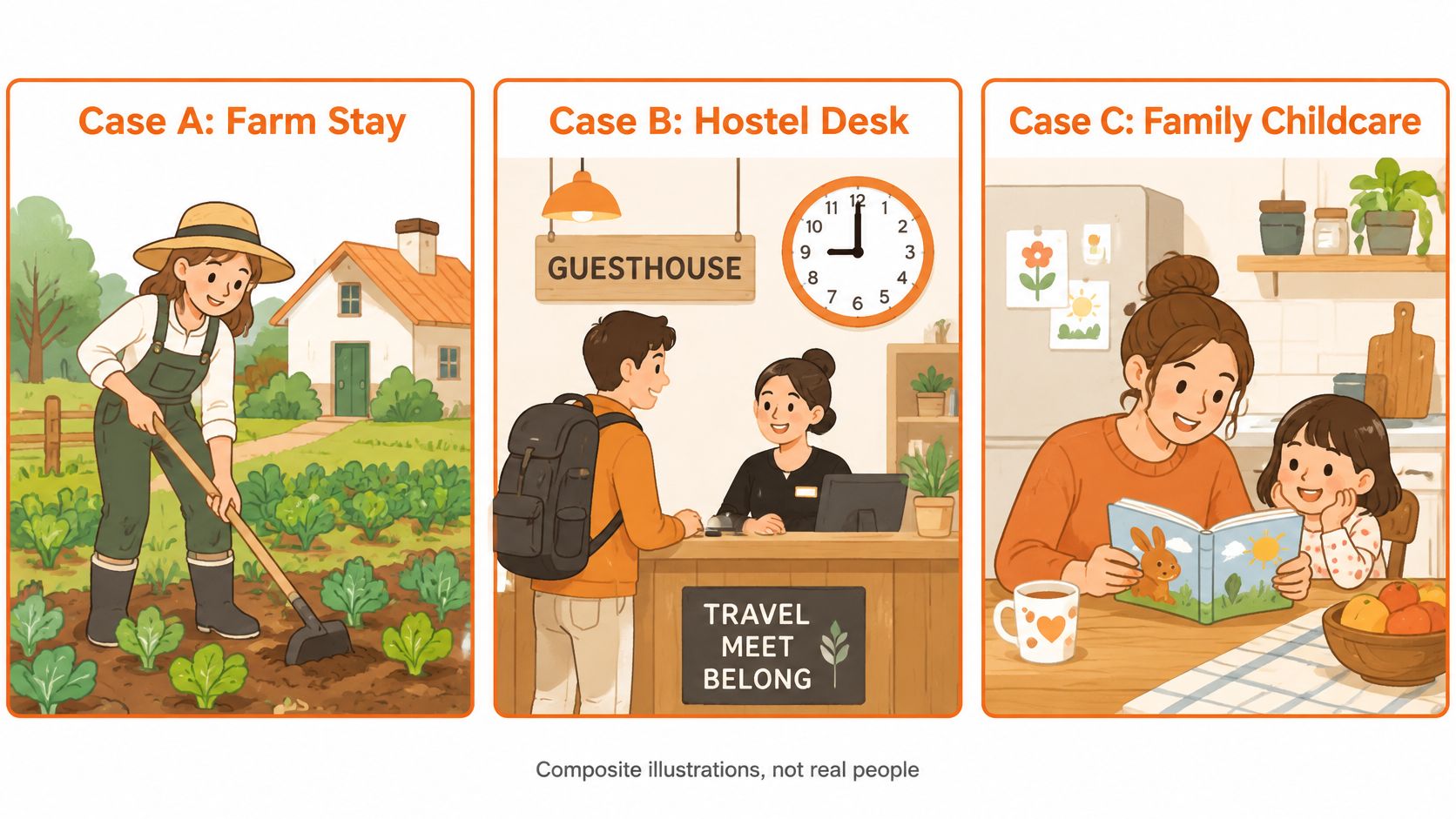
A six-week house sit for a remote designer. Mornings stayed with paying clients. Dog walks sat in a fixed afternoon slot the owner had already accepted. The stay only became workable after a visa check on the remote work, separate from the sit itself. Skipping that check is the change that would have sunk an otherwise calm six weeks.
Ten days with a cat and two dogs. The sitter did a video handover, kept the vet's number, and had emergency authorization in writing. A late-night call was stressful and still simple, because the plan named who could approve treatment. Without that page, the same night becomes guesswork with someone else's animal.
Most of these problems came from unstated expectations, not bad intent. The fix, every time, was a written agreement both sides could point to.
Book a First Exchange Safely
Pick one model first, using the profile that actually fits your week, and match it to hours you can give without borrowing from sleep or paid work. Then shortlist three hosts, not one. Run the same checks on each: full listing, specific reviews, two references, and written terms. Confirm the visa position for that country and length of stay, including any remote work, before you accept. Book a nearby night and a way home in case the placement ends early. Hope isn't a backup plan.
Copy this checklist
- Model chosen, matched to hours you can give.
- Three hosts shortlisted, not a single favorite.
- References checked with two past helpers.
- Hours and tasks in writing, confirmed in the thread.
- Visa status confirmed for the stay and any paid remote work.
- Emergency contacts exchanged.
- Insurance confirmed.
- Backup plan ready, with a night nearby and a way out.
Any missing item is a reason to walk away.
If pet or house sitting is the model you chose, Global Pet Sitter is one place to look. Joining is free. Sitters care for pets at the owner's home in exchange for a free stay, and no money changes hands. We only provide peer-to-peer online mediation, so members find and connect with each other. The checks above still apply, and you should confirm every term directly with the owner before the stay begins.
Global Pet Sitter connects pet owners with sitters who look after animals at home in exchange for a free stay, which is work exchange travel with a duty of care attached. You can browse sits, message, and agree the handover before anyone leaves. When you're ready to line up a first sit with the checks in this guide, visit Global Pet Sitter.
Please sign in to leave a comment
